2026-2027 Strategic Funding Roadmap: Navigating the Sovereign Infrastructure Landscape
1. Macro-Infrastructural Landscape: The Catalyst for Sovereign Resilience
The systemic collapse of centralized infrastructure throughout 2025-2026 has exposed a critical fragility in the American digital fabric. The Rural Digital Opportunity Fund (RDOF) has reached a catastrophic inflection point, with default rates exceeding 30% and leaving approximately 1.9 million locations “stranded”—legally ineligible for BEAD funding due to regulatory “freezes.” Simultaneously, the global decommissioning of 2G/3G networks has surfaced deep-tech vulnerabilities; legacy systems relying on unidirectional authentication and compromised GSM ciphers (A5/1) are now defenseless against IMSI catchers and man-in-the-middle attacks. For executive leadership, these failures necessitate a pivot toward “Sovereign Stack” architectures. Unlike fragile centralized paradigms, these systems prioritize mutual authentication, hardware-level cryptographic provenance, and “Island Mode” survivability, ensuring critical municipal and industrial operations persist when centralized backhauls fail.
The 2026 Infrastructure Gap Analysis
| Dimension | Legacy Centralized Paradigms | Sovereign Edge Paradigms |
| Connectivity Stability | Dependent on carrier cores; prone to 30% RDOF-style defaults. | Distributed mesh nodes; high-availability “Island Mode” survivability. |
| Security Architecture | Unidirectional authentication; vulnerable to A5/1 cipher decryption. | Mutual authentication; hardware-level TPM 2.0 and Locutus Ledger. |
| Data Sovereignty | Data routed through foreign/third-party centralized clouds. | Localized data ownership; air-gapped physical AI (OpenClaw). |
| Economic Resilience | High “Fiber Gap” ($50k/mile); unsustainable in low-density zones. | Capital-efficient wireless/LEO hybrid; non-dilutive capital stacking. |
The “Fiber Gap” economics have rendered traditional wireline broadband unfeasible for populations under eight homes per route mile, forcing a federal shift toward non-dilutive funding for high-performance wireless and edge-AI solutions that bypass the costs of physical cabling.
This landscape shift confirms that the market problem is no longer one of mere access, but of systemic resilience and sovereign control.
——————————————————————————–
2. The Sovereign Stack Consortium: Integrated Technical Architecture
We have architected the TriFi-DeReticular-InVentures alliance as a strategic response to these infrastructural failures. This consortium represents a vertically integrated technical and capital solution that satisfies stringent “Build America, Buy America” (BABA) mandates while delivering a full-stack alternative to legacy dependencies. By bonding TriFi’s domestic manufacturing with DeReticular’s resilient Operating System and InVentures’ capital orchestration, we provide a turnkey “Sovereign Stack” capable of securing national critical infrastructure.
Consortium Core Competencies
| Partner | Role | Key Strategic Contribution |
| TriFi Wireless | Hardware & Supply Chain | BABA-compliant Oklahoma manufacturing; SignalScan™ (TowerSync) & vSIM failover. |
| DeReticular | Software & AI Architecture | RIOS Edge OS; OpenClaw AI-RAN; Locutus cryptographic ledger for provenance. |
| InVentures | Capital & Strategy | Non-dilutive capital stacking; Fractional Co-Founders; Defense-grade GTM. |
Sovereign Stack Product Pillars
- RIOS Campus (Infrastructure Core): Ruggedized, solar-powered (150 kW) containers with 400 kWh battery storage. These units integrate Starlink LEO backhaul and private Wi-Fi 6E/LoRaWAN to provide off-grid compute and utility.
- RIOS Mobile (Edge Connectivity): Nomad series fleet kits featuring “Tractor-as-a-Relay” systems. These units bridge geographical dead zones by caching telemetry and automatically relaying data to the RIOS Campus once within range.
- Sovereign Automation (Agentic AI): Air-gapped agents (Sovereign Sentry, Field Medic, Industrial Foreman) running on local edge servers. These use the OpenClaw framework to execute autonomous operations without cloud dependencies.
- Sovereign Harvest (Agricultural Vertical): A specialized bundle designed to bypass manufacturer software locks via CAN Bus/ISOBUS interfacing, enabling “Right-to-Repair” autonomy and localized telemetry management.
This integrated technical stack serves as the definitive baseline for capturing large-scale federal investment through high-priority translation pathways.
——————————————————————————–
3. Primary Funding Pathway: NSF VINES (Verticals-enabling Intelligent NEtwork Systems)
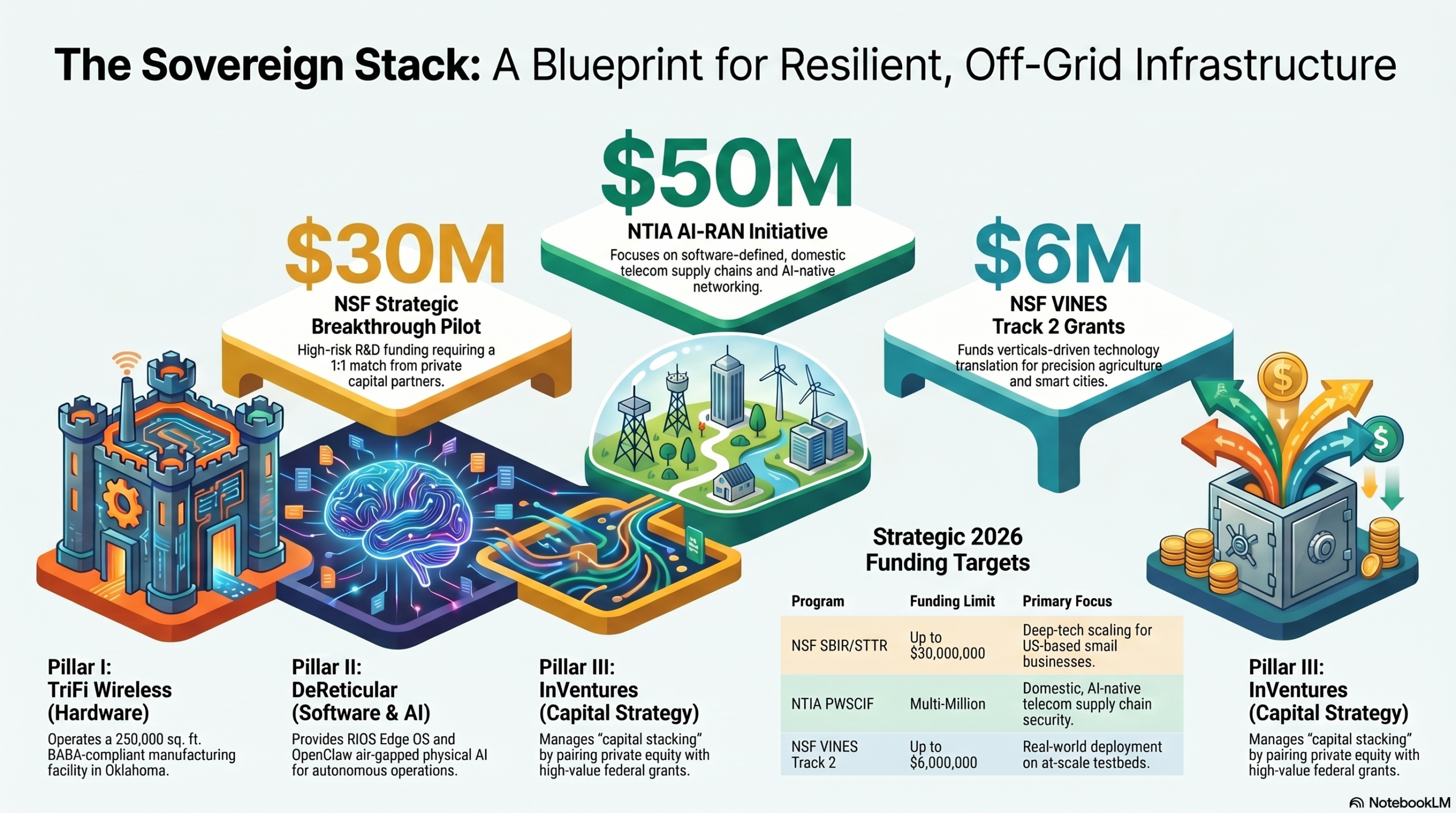
The NSF VINES program is a 100 million vehicle for translating NextG networking into real-world industrial applications. Our primary target is **Track 2 (6M)**, which focuses on end-to-end system maturation and at-scale demonstration. In VINES Track 2, the consortium acts as the Industrial System Integrator, translating academic research into ruggedized, deployable platforms.
VINES Track 2 Eligibility & Team Competencies
- [ ] Competency A (Networking Technology): Proved by academic partners specializing in advanced SDR, 5G NR, and resilient routing protocols.
- [ ] Competency B (Vertical Domains): Proved by industrial/agricultural partners (e.g., land-grant universities) with CAN Bus and heavy machinery expertise.
- [ ] Competency C (Integrated Systems): Proved by DeReticular’s RIOS Core and Sovereign Sentry, binding wireless, energy, and AI into a unified system.
- [ ] Academic Lead Requirement: Mandatory. A university partner must serve as the Lead PI to maintain Track 2 compliance.
- [ ] At-Scale Testbed Commitment: Requires deployment on Platforms for Advanced Wireless Research (PAWR) nodes or similar national testbeds.
Mandatory Concept Outline Process: “Sovereign Harvest” Strategy
The consortium must submit a Concept Outline to vines-track2@nsf.gov following these architectural steps:
- Define the Vertical: Propose the “Sovereign Harvest” model, focusing on the deployment of Nomad Fleet Kits to support autonomous tractor logistics.
- Highlight the Technology Continuum: Explain the system’s reach from the user (machinery CAN Bus) to the edge (RIOS Campus) and the localized AI core.
- Specify Technical Translation: Detail how advanced SDR algorithms from academic partners will be implemented into the TriFi/DeReticular stack to stabilize telemetry in variable rural RF environments.
- Validate via Testbed: Commit to a demonstration on a university research farm, utilizing TriFi routers to prove sub-millisecond precision timing synchronization.
Securing a lead academic institution is a non-negotiable friction point; the consortium must serve as the translation bridge to ensure the research achieves commercial maturation.
——————————————————————————–
4. Supply Chain Security Pathway: NTIA Public Wireless Supply Chain Innovation Fund (PWSCIF)
The NTIA’s $50 million AI-RAN Notice of Funding Opportunity (NOFO) marks a strategic departure from hardware-only manufacturing toward software-defined, spectrum-aware network solutions. This fund specifically targets the establishment of a secure, domestic telecommunications supply chain that reduces reliance on foreign, closed-architecture vendors.
The Sovereignty Pillar: TriFi’s Oklahoma Advantage
- BABA Compliance: TriFi’s 250,000 sq. ft. Oklahoma facility ensures that over 55% of total component costs are domestically sourced, satisfying the primary NTIA gate for eligibility.
- Operational Readiness: The facility provides the footprint and workforce capacity to scale high-volume production of the Far X and NetLink Fortress routers, providing a “default rescue” for stranded rural municipalities.
- SPIN Credentials: TriFi’s established Service Provider Identification Number (SPIN) validates its eligibility to capture municipal contracts and federal connectivity subsidies.
AI-RAN Proposal Core Stack
A competitive submission must detail an AI-native RAN built on the OpenClaw framework, enabling real-time spectrum sensing and dynamic spectrum sharing within the software layer. The proposal will prioritize Open RAN Interoperability, committing to O-RU, O-DU, and O-CU hardware interfaces that prevent vendor lock-in. Furthermore, the architecture must implement Zero-Trust Security, utilizing TPM 2.0 chips and Radio Frequency Fingerprinting to verify the physical provenance of every node in the network.
This supply chain security focus provides a de-risked foundation for high-risk commercialization through the NSF America’s Seed Fund.
——————————————————————————–
5. Deep-Tech Scaling Pathway: NSF America’s Seed Fund (SBIR/STTR)
The NSF SBIR/STTR solicitations (NSF 26-510/26-511) under the Wireless Technologies (W) topic are reserved for high-risk R&D that pushes the boundaries of physics and computation. The ultimate objective is the Strategic Breakthrough Pilot, which offers a $30 million match for deep-tech scaling critical to U.S. competitiveness.
NSF SBIR/STTR Funding Tiers (2026/2027)
| Tier | Funding Amount | Primary Focus |
| Phase I | Up to $305,000 | Feasibility of vSIM algorithms and OpenClaw AI-RAN. |
| Fast-Track | Up to $1,555,000 | Accelerated prototyping pipeline; requires commercialization plan. |
| Strategic Breakthrough | Up to $30,000,000 | Scaling critical deep-tech; requires 1:1 match from InVentures. |
Project Pitch Requirements
The mandatory Project Pitch (portal reopening June 2, 2026) must address:
- Technological Innovation: Focus on the “vSIM” multi-carrier switching and Channel State Information (CSI) spatial sensing algorithms.
- Technical Risks: Detail the high-risk R&D required to maintain Maximum Coupling Loss (MCL) of 164 dB in high-interference environments and the sub-minute failover timing of SignalScan™.
- Commercial Potential: Target the “stranded” RDOF locations and the 1.9 million location market gap as the primary entry point for the Sovereign Stack.
Operational success requires strict adherence to DCAA-compliant accounting and the rule that the Principal Investigator (PI) must be primarily employed (51%+) by the small business at the time of the award.
——————————————————————————–
6. The Capital Stacking Architecture: InVentures Operational Strategy
InVentures utilizes a “Fractional Co-Founder” model to navigate the complex 18-24 month hard-tech commercialization path. By pairing private venture equity with federal grants, we maximize capital efficiency and de-risk the deployment of physical infrastructure.
Non-Dilutive Capital Stack
| Grant Vehicle | Target Amount | Consortium Lead |
| NSF SBIR Phase I / Fast-Track | $305k / $1.55M | InVentures (Deal Structure) |
| NTIA AI-RAN NOFO | Multi-Million Co-Bid | TriFi & DeReticular (Hardware/AI) |
| NSF VINES Track 2 | Up to $6,000,000 | DeReticular (Systems Integration) |
| NSF Strategic Pilot | Up to $30M (Match) | InVentures Equity (Matching Capital) |
Fractional Leadership & Milestone De-Risking
The InVentures General Partners are directly tied to the roadmap’s critical execution gates:
- Melissa Chalfant: Architecting the financial modeling and capital stacking required to unlock the $30M NSF Strategic Breakthrough match.
- Michael Kyle: Directing the military-grade infrastructure integration and advanced hardware digital twins for dual-use defense targets.
- Gerardo Garza: Overseeing onshoring strategies and BABA-compliant IP commercialization.
- Dr. Hojung Joseph Yoon: Managing regulatory clearances and health informatics integration for the “City-in-a-Box” municipal vertical.
This strategy ensures that the consortium is not merely a technology provider, but a structured investment vehicle.
——————————————————————————–
7. Execution Roadmap: 2026-2027 Milestones and Action Plan
The 2026 fiscal cycle demands rapid mobilization. Success is predicated on hitting the June 2, 2026 portal reopening with a fully architected submission suite.
Strategic Action Plan (Q3 2026 – Q2 2027)
- Phase I (Immediate – Q3 2026):
- Submit the NSF SBIR Project Pitch for the Wireless (W) topic.
- Submit the VINES Track 2 Concept Outline to
vines-track2@nsf.govin partnership with an academic lead.
- Phase II (Mid-Term – Q4 2026):
- Submit the full NSF SBIR Proposal (Target Deadlines: July/November 2026).
- Engage in NTIA AI-RAN Listening Sessions to align OpenClaw specs with final NOFO mandates.
- Phase III (Scale – Q1-Q2 2027):
- Finalize at-scale demonstrations on PAWR testbeds for VINES validation.
- Unlock the $30M Strategic Breakthrough Pilot matching funds via InVentures private equity.
Risk Mitigation & Compliance
The consortium will strictly adhere to the following pass/fail mandates:
- BABA: All hardware components will maintain 55%+ domestic cost through the Oklahoma facility.
- ITAR/EAR: All dual-use and defense-grade technologies will be managed under Michael Kyle’s integration oversight.
- Research Security Disclosure: All PIs and Senior Personnel must certify no participation in foreign government-backed talent programs or foreign lab affiliations. This is a primary compliance gate for the 2026 cycle.


