
The Death of the Line: Why the Future of Power is Local, Autonomous, and Already Here
1. The Fragility of the “Centralized” Dream
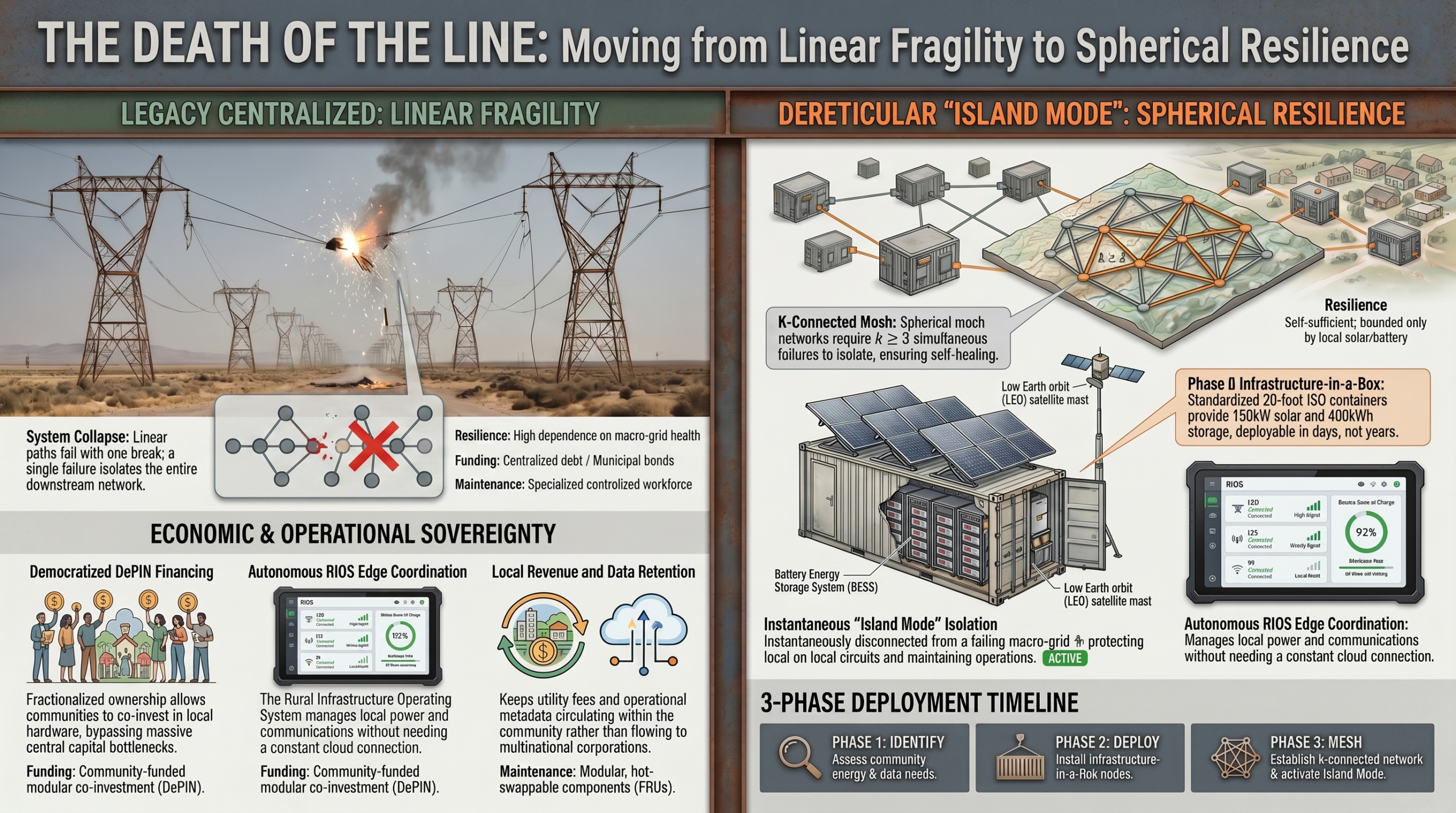
Modern public infrastructure is defined by a historical design choice: linear concentration. For over a century, civil engineering and regional planning have relied on high-capacity, centralized corridors—high-voltage transmission lines and long-haul fiber-optic backbones—to deliver services from central nodes to distributed endpoints. While economically efficient under stable conditions, this “Linear Fragility” exposes modern society to unprecedented systemic risk.
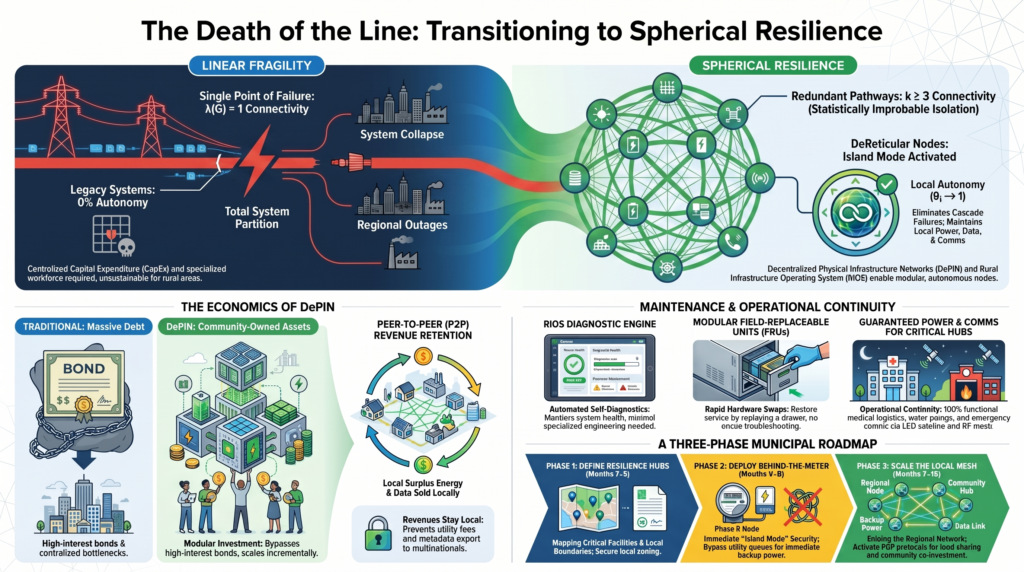
The vulnerability is structural, born of a design paradigm that prioritizes linear centralization over distributed resilience. In a linear configuration, a single physical or digital severance cascades downstream, resulting in total system collapse. Mathematically, the probability of a systemic partition event (P_{\text{partition}}) in traditional utility networks is P_{\text{partition}} = 1 – (1 – p)^{|E|}. As the geographical scale (|E|) grows, the probability of partition approaches 1. The economic consequences are no longer speculative; prolonged outages cost municipal economies millions of dollars per day. To solve this, DeReticular has pioneered “Spherical Resilience,” an architecture that is no longer speculative but deployable today.
podcast
2. The Most Surprising Realization: We Already Have the Parts
One of the most important misconceptions surrounding sovereign autonomous infrastructure is the assumption that it requires futuristic technologies or massive hyperscale investment. In reality, the foundational components are mature and widely available.
The innovation is not in the invention of new hardware, but in the integration and orchestration of existing technologies:
- Open-Source Software: Linux systems (Kubuntu), Kubernetes, Docker, and decentralized tools like Freenet.
- Commodity Hardware: Mini PCs, ARM systems, and low-power edge accelerators.
- Edge AI: Quantized 7B–14B parameter models and compressed vision systems capable of running local reasoning agents without cloud dependency.
As the source context notes: “One of the most important misconceptions… is the assumption that they require futuristic technologies or massive hyperscale investment.”
video
3. From Linear Fragility to “Spherical Resilience”
The transition to Spherical Resilience is a fundamental shift in network topology. Traditional infrastructure follows a linear or tree configuration where the edge connectivity (k) equals 1. Any single failure partitions the graph.
DeReticular’s architecture utilizes Graph Theory to create a k-connected mesh where k \ge 3. In this spherically resilient network, the isolation of any single node requires the simultaneous failure of at least k independent pathways. The probability of isolation is reduced to P_{\text{isolation}} = \prod_{j=1}^{k} p_j. This redundancy is a strategic choice for survival in politically fragmented or disaster-prone zones where central reliability is a liability rather than an asset.
4. The Magic of “Island Mode”
The defining feature of this architecture is “Island Mode.” In legacy networks, the local autonomy factor (\theta) is near zero; nodes cannot function without real-time synchronization from the macro-grid.
In the DeReticular model, when upstream connectivity drops below quality-of-service thresholds, the node sets its autonomy factor to 1 (\theta \to 1). Using solid-state transfer switches, the node physically and digitally isolates its local systems. By generating its own reference voltage and data synchronization signals, the failure is “bounded” to the origin. As \theta approaches 1, the probability of cascading system failure (P_{\text{cascade}}) drops to zero, allowing the local community to remain operational while the surrounding grid goes dark.
5. Layer 1: The Physical Seed (Infrastructure-in-a-Box)
The physical foundation of this resilience is the DeReticular Phase 0 unit. Housed in a ruggedized, ISO 20-foot High-Cube shipping container, these units represent a “utility-in-a-box” that can be commissioned in days.
Phase 0 Specifications:
- Weight & Foundation: 25,000 lbs (11,300 kg) loaded weight; requires level concrete pads or screw-pile foundations.
- Power: 150 kW bifacial solar array with a mechanical scissor-jack mounting system.
- Storage: 400 kWh Lithium Iron Phosphate (LiFePO4) battery system (6,000+ cycle life).
- Auxiliary: 30 kW hydrogen-ready thermal generator for extended low-solar periods.
The BTM Strategy: To bypass the multi-year utility interconnection study queues that paralyze most projects, DeReticular utilizes a Behind-the-Meter (BTM) deployment strategy. Phase 0 nodes are installed directly at facility service points to offset local loads without exporting power, providing immediate “Island Mode” security while strictly complying with existing safety regulations.
6. Layer 2: RIOS—The Brain That Doesn’t Need the Internet
The orchestration layer is the Rural Infrastructure Operating System (RIOS), an edge-native microkernel designed for air-gapped operations.
RIOS acts as the hardware-agnostic bridge, integrating legacy municipal assets through standard industrial protocols including Modbus, CAN bus, and DNP3. Its core engines include:
- Signal Fusion Engine: Dynamically routes data across LEO satellite, LTE, and RF mesh on a millisecond-by-millisecond basis.
- Autonomous Machine Coordination (AMC): Implements machine-learning models to balance generation against critical loads, such as prioritizing water treatment over non-essential circuits.
- Localized Consensus: Uses RAFT/PBFT protocols to ensure administrative actions and machine identity remain functional without a global internet connection, preserving “Data Sovereignty.”
7. Layer 3: DeReticular Mesh—Community-Owned Networking
When multiple Phase 0 nodes are deployed, they self-organize into a peer-to-peer network utilizing dynamic routing protocols (optimized Babel or OLSRv2). This creates a regional mesh where every node serves as an autonomous relay. If a single node’s satellite link is obstructed, it automatically reroutes telemetry through the mesh to a neighboring node, ensuring 100% functionality for intranodal services like local telephony and emergency dispatch.
8. DePIN: The Economic Catalyst for Independence
The barrier to resilience has historically been the massive Capital Expenditure (CapEx) required for centralized projects. The Decentralized Physical Infrastructure Network (DePIN) model facilitates a “CapEx-to-OpEx substitution.”
Through Microgrid-as-a-Service (MaaS), local cooperatives or public-private partnerships can fractionalize the ownership of hardware assets. Instead of waiting for municipal bonds, communities co-invest in modular nodes. This keeps utility revenue and operational metadata circulating within the local economy. While localized units have a higher initial unit cost than massive utility-scale plants, they mitigate the “Monopolistic Regulatory Obstacles” and “Supply Chain Volatility” that threaten centralized models.
9. The “Leapfrog” Dynamic: The Edge of the Developing Region
Rural and developing regions are strategically advantaged because they lack the “entrenched legacy systems” of the West. Just as these regions skipped landlines for mobile phones, they are now positioned to skip the centralized macro-grid phase entirely. By moving straight to sovereign autonomous infrastructure, they avoid the rigid institutional dependencies of the grid and adopt a model that is chemistry-agnostic and self-healing from day one.
10. Conclusion: A New Blueprint for Sovereignty
The paradigm of infrastructure is shifting from “Scale” to “Distribution.” The vulnerabilities of our current systems are structural, but the tools to decouple from them are ready for deployment. Through DeReticular’s Phase 0 hardware, RIOS edge orchestration, and DePIN economics, municipalities can transform from fragile endpoints into resilient islands.
The barriers that remain are no longer technical—they are matters of governance, identity, and the courage to build independently. If your community could decouple from the grid tomorrow, would you choose the perceived safety of the line, or the proven resilience of the island?


