The End of the Grid: 5 Radical Lessons from the Sovereign Infrastructure Revolution
The modern industrial world is currently navigating a terminal phase of centralized dependence. We inhabit a landscape of unavoidable systemic fragility, where aging utility and computing grids are no longer merely “stressed”—they are reaching legacy obsolescence. The inevitable cascade of macro-grid failure is no longer a “if,” but a “when,” driven by regulatory choke-points and the inherent instability of linear distribution.
Against this backdrop of decay, the Sovereign Infrastructure Education Alliance (SIEA) and the DeReticular Consortium are deploying the antidote. They are the primary architects of “Island Mode,” a radical transition from fragile dependence to hardened, localized autonomy. This is not a theoretical exercise; it is an infrastructure-first insurgency designed to decouple vital functions from failing systems.
The shift toward sovereign infrastructure represents the most significant pivot in civil engineering and digital architecture since the New Deal. For those prepared to adapt, the roadmap is clear. By embracing the Sovereign Stack and moving toward “Point-of-Need” operations, communities and enterprises can insulate themselves from the coming volatility.
Here are the five radical lessons from the frontline of the sovereign infrastructure revolution.
- The Sovereign Stack: Building from the Dirt Up
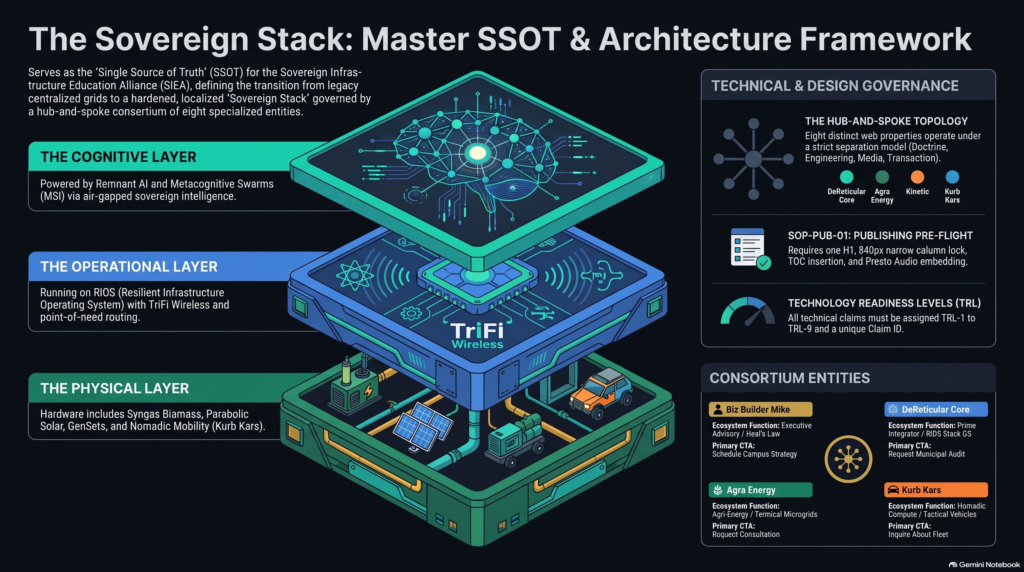
The Sovereign Stack is the definitive hierarchy of autonomy. In a cloud-first world, we have mistakenly prioritized software while ignoring the physical ground it stands on. True resilience begins at the dirt—the physical layer.
The foundation is built from the bottom up: Baseload Power and Nomadic Mobility (Physical Layer), followed by the operating engine and mesh networking (Operational Layer), and culminating in air-gapped intelligence (Cognitive Layer).
Starting with physical power—utilizing Bio-Energy Emerald syngas gasification and parabolic solar—is counter-intuitive to the digital nomad, but essential for the strategic analyst. Without power and the physical capacity to move it, intelligence remains a captive of the grid.
The Sovereign Stack: Infrastructure built from the physical layer up (baseload power → nomadic mobility → edge networking → air-gapped intelligence → sovereign governance) capable of sustained “Island Mode” operation without reliance on public utilities or hyperscaler cloud networks.
- Noel’s Law: Every Campus is a Power Plant
Noel’s Law demands the total destruction of the “consumer” identity. For municipalities, agricultural cooperatives, and institutional campuses, the era of external energy and compute procurement is over. Survival now dictates a transition to autonomous energy production and captive compute operation.
By integrating thermal microgrids with Behind-the-Meter AI Compute, a campus effectively captures the data sovereignty produced by its own energy. This shift eliminates the economic hemorrhaging of utility costs and secures Federal Grant & Capture Readiness by meeting high Technology Readiness Level (TRL) standards. The impact is a total disruption of the utility model: the “subscriber” becomes the “sovereign,” utilizing syngas-driven 45 kW GenSets to power localized digital economies.
- Kinetic Autonomy: The Office is Now a Nomad
In the DeReticular framework, mobility is not an accessory; it is a core component of the Physical Layer. Through “Nomadic Hardware” like Kurb Kars, the consortium has integrated “Point-of-Need” routing into the very vehicles that transport the workforce.
This layer is governed by RIOS (Resilient Infrastructure Operating System), the canonical edge operating engine that manages both the hardware and the network. Utilizing tactical platforms like the Pawnee Sand Buggy and the TriFi Rover Gateway, C2 (Command and Control) nodes now move with the mission. Kinetic autonomy ensures that even during total grid failure, the operational capacity remains mobile and functional, bypassing stationary infrastructure that has become a liability.
- Spherical Resilience: Beyond the Linear Grid
Legacy grids are defined by linear fragility—a single break in the chain precipitates a macro-grid failure. The Sovereign Infrastructure model replaces this with Spherical Resilience. This design philosophy utilizes distributed, non-linear node architectures that are mathematically optimized to withstand kinetic disruption and regulatory interference.
By deploying TriFi Wireless mesh networking, the architecture creates a web of connectivity that is “Hyper-Teal” in its sovereign capability. It is a system designed to survive the collapse of the center. When the macro-grid fails, the spherical network remains intact, protecting the localized “Island” from the surrounding blackout.
Spherical Resilience: Distributed, non-linear node architectures designed to withstand macro-grid failures, kinetic disruption, and regulatory choke-points.
- Air-Gapped Sovereign Intelligence (MSI)
At the apex of the stack sits the Cognitive Layer: Air-Gapped Sovereign Intelligence. This is the domain of Metacognitive Swarms (MSI) and Remnant AI. The strategic importance of air-gapping cannot be overstated—for intelligence to be truly sovereign, it must be untethered from hyperscaler cloud networks.
Running “Cobalt Intelligence” models on localized, air-gapped hardware ensures that critical decision-making remains private and functional. This intelligence does not ask permission from a central server to operate; it exists within the sovereign node, powered by its own thermal microgrid and managed by RIOS. It is intelligence that survives the internet, not intelligence that relies on it.
Conclusion: Choosing the “Island”
The SIEA and DeReticular vision is currently in active rollout. This is not a slow-motion evolution but a 90-day execution plan designed to move organizations toward federal compliance and operational independence. Central to this rollout is the Technical Training Ladder (Entry -> Tech -> Admin -> Architect), ensuring a workforce capable of maintaining the Sovereign Stack in any environment.
As legacy systems continue their inevitable decline, the choice becomes binary: remain tethered to a fragile, failing grid, or build an island of resilience. How much longer will you allow your community’s survival to depend on a centralized system that is already showing its seams? What would “Island Mode” look like for your mission?


