
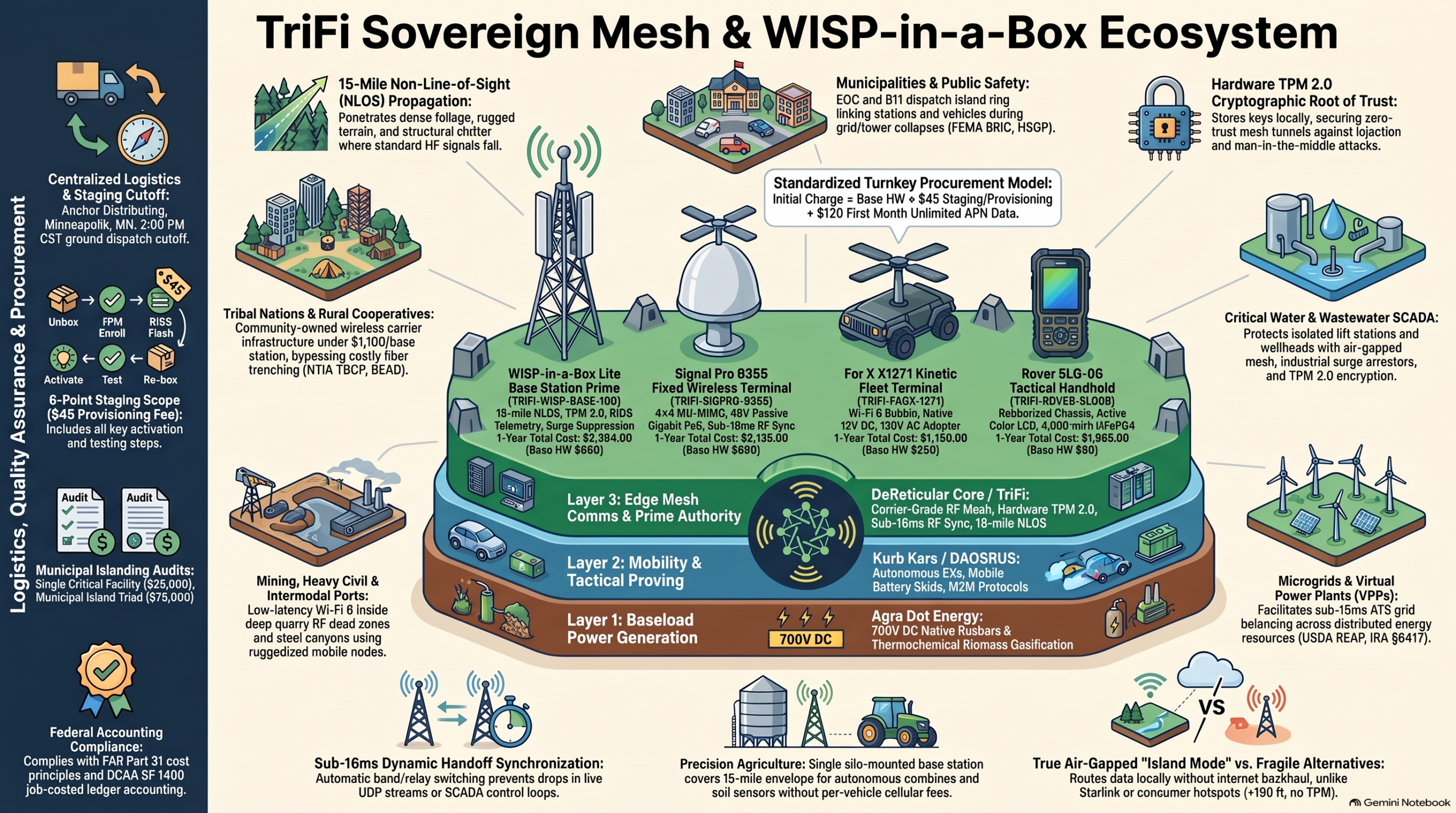
Curing the 1,000-Mile Failure Model: How WISP-in-a-Box and Decentralized Mesh Networks Are Disrupting Fragile Telecom
- Introduction: The Fragility of Modern Connectivity
Modern telecommunications infrastructure is built on a dangerous illusion of stability. We have been conditioned to accept that our digital lifelines—from emergency services and SCADA telemetry to local governance—must route through thousands of miles of centralized fiber backbones, remote cloud hyper-scalers, and vulnerable cell towers. When a hurricane hits, a cyberattack paralyzes an internet exchange, or a regional electric grid collapses, these fragile public networks are the very first systems to go dark.
This systemic flaw is what industry engineers call the “1,000-Mile Failure Model.” It defines a catastrophic paradox: local, mission-critical infrastructure collapses not because equipment on-site is broken, but because a remote disruption thousands of miles away severs central authentication, DNS routing, or cloud coordination. When remote servers go dark, pristine local facilities are instantly rendered useless.
Traditional telecom incumbents respond to this vulnerability with multi-year delays, multi-million-dollar fiber-trenching projects, and endless carrier leases that leave operators as passive, helpless consumers.
A fundamental shift is underway. Engineered by DeReticular—operating as Layer 3 (Edge Mesh Comms & Prime System Authority) within the Sovereign Infrastructure Consortium (SIC)—turnkey “WISP-in-a-Box” (Wireless Internet Service Provider in a Box) technology and autonomous “Island Mode” networking are turning this paradigm on its head. By empowering municipalities, utilities, and enterprises to deploy air-gapped, carrier-grade mesh networks in hours rather than years, this architecture transforms fragile operations into self-sustaining network islands.
Here are the top five counter-intuitive takeaways driving this decentralized telecom revolution.
- Takeaway 1: Centralized Cloud & Cell Towers Are Remarkably Fragile (Enter “Island Mode”)
Major telecommunications carriers sell enterprise connectivity under the banner of high availability, yet their physical architecture relies on a brittle, linear chain: commercial cell towers with short-lived battery backups, exposed terrestrial fiber lines, and centralized cloud platforms. If any single link in this distant chain snaps, local operations grind to a halt.
DeReticular breaks this passive dependency through native “Island Mode” operation. When central cloud controllers, domain name systems, or commercial towers fail, local facilities—such as municipal EOCs, water SCADA networks, microgrids, or emergency command posts—automatically decouple from external backhauls. Utilizing Layer 3 Edge Mesh Comms, the network executes dynamic, peer-to-peer routing with sub-16-millisecond channel failover. Local traffic continues flowing without dropping UDP data streams, losing sensor telemetry, or interrupting voice calls, completely independent of cloud authentication.
True operational survivability, however, requires more than just isolated radios—it demands an integrated, multi-layer defense. During a total grid collapse, DeReticular’s Layer 3 Edge Mesh Comms seamlessly interlocks with Layer 1 (Agra Dot Energy off-grid power, utilizing 700V DC native busbars and biomass gasification to bypass public power queues) and Layer 4 (DeReticular Energy air-gapped SCADA and edge AI computing). The result is a fully integrated operational island where power, communications, and intelligence stay online simultaneously when external utilities collapse.
This architectural reality is governed by a fundamental axiom of infrastructure survivability:
“The survivability of any operational node is inversely proportional to the length and central coordination of its critical supply chains and communication backhauls.” — Noel’s Law of Structural Vulnerability
Shifting your stance from a passive subscriber dependent on commercial telecom leases to an autonomous “island node” operator is the ultimate operational insurance policy. When local network autonomy is guaranteed, regional grid blackouts cease to be existential threats.
- Takeaway 2: 15-Mile Non-Line-of-Sight (NLOS) Beats Sky-Dependent Satellite
When primary terrestrial links fail, enterprise IT departments routinely turn to Low Earth Orbit (LEO) satellite systems like Starlink as an off-grid backup. While satellite provides valuable point-to-point data, it possesses severe structural limitations: it requires an unobstructed view of the sky, suffers from severe rain and snow attenuation, and collapses completely if local cloud gateways go offline or tree lines, smoke, and structural clutter block the terminal dish.
By contrast, sub-6 GHz carrier-grade RF propagation utilized in WISP-in-a-Box mesh systems is built specifically to punch through physical terrain obstacles. Operating with massive link budgets, sub-6 GHz signals penetrate dense timber lines, crop canopies, heavy rain, wildfire smoke, and even the steep corrugated steel “container canyons” of intermodal shipping ports.
Feature / Metric Consumer Hotspots Satellite (Starlink) WISP-in-a-Box Mesh
Private Island Mode None None Native / Standard
Coverage Radius <150 ft Terminal Only Up to 15 Miles
Hardware Crypto (TPM 2.0) Rare No (Cloud) Integrated
Foliage / NLOS Penetration Poor Zero (Needs Sky) Carrier-Grade
Multi-Terminal Handoff Slow N/A <16 ms
Beyond raw physical superiority, WISP-in-a-Box delivers a massive economic disruption to operational expenditure (OpEx). Consider a large agricultural enterprise, mining operation, or kinetic utility fleet: paying for dozens of individual cellular SIM cards across tractors, haul trucks, and field sensors creates an exorbitant, recurring financial drain.
A single silo- or mast-mounted WISP-in-a-Box base station radiates a continuous 15-mile Non-Line-of-Sight coverage umbrella over thousands of acres. By consolidating all localized equipment, mobile field terminals, and IoT sensors through a single master APN node, operators can eliminate dozens of commercial cellular SIM subscriptions while establishing complete local network control.
- Takeaway 3: Hardware-Rooted Zero-Trust Is Entering Telecom (TPM 2.0)
For over a decade, enterprise cybersecurity has focused almost exclusively on software-defined zero-trust frameworks. However, software overlays cannot defend an edge network if the physical radio hardware itself can be compromised over the air. Exposed cellular modems and remote telemetry units are prime targets for state-sponsored spoofing, man-in-the-middle (MITM) interception, and malicious over-the-air firmware injection.
To eliminate these vectors at the physical layer, every Layer 3 TriFi and DeReticular device integrates a dedicated hardware TPM 2.0 (Trusted Platform Module) cryptoprocessor directly onto the silicon board.
This hardware root of trust shifts security enforcement down into the physical radio edge:
- Cryptographic Boot Integrity: Ensures the device will only boot if the operating system and RIOS telemetry agent pass cryptographic signature verification against the Sovereign Authority root key.
- Hardware-Authenticated Mesh Tunnels: Automatically authenticates zero-trust peer-to-peer mesh tunnels between physical nodes, completely bypassing remote cloud certificate authorities.
- OT Infrastructure Defense: Provides ironclad protection for mission-critical Operational Technology (OT)—such as municipal water/wastewater SCADA lift stations, gas pipeline valves, and microgrid Automatic Transfer Switches (ATS)—blocking unauthorized remote manipulation or over-the-air exploits.
By embedding cryptoprocessors directly into edge hardware, zero-trust transitions from a fragile software promise into an unalterable physical reality.
- Takeaway 4: A Transparent, Scalable Hardware Ecosystem (From Pocket Hotspots to Base Stations)
Deploying private carrier-grade infrastructure used to mean dealing with opaque vendor quotes, hidden license fees, and complex integration contracts. The TriFi Sovereign Mesh hardware catalog completely dismantles this legacy model with a transparent, predictable pricing structure across four modular hardware profiles.
Every device in the ecosystem adheres to an exact upfront acquisition formula:
Initial Acquisition Cost = Base Hardware + $45.00 (Staging/Provisioning) + $120.00 (Month 1 Data)
Because the upfront turnkey price covers the hardware, mandatory factory provisioning, and the first month of uncapped multi-carrier cellular APN service, only 11 recurring monthly payments of 120.00 remain in Year 1. This makes 1-Year Total Cost of Ownership (TCO$) calculations straightforward and completely transparent.
TriFi Sovereign Mesh Hardware Comparison Matrix
Device Name Model / SKU Primary Role & Form Factor Base Hardware Turnkey Upfront Cost Ongoing Data Plan 1-Year Total Cost (HW + 12 Mo.)
TriFi Rover SLG-06 / TRIFI-ROVER-SLG06 Tactical Handheld Hotspot / Rugged LiFePO4 Display Terminal $80.00 $245.00 $120.00 / mo $1,565.00
TriFi Far X X1271 / TRIFI-FARX-1271 Kinetic Fleet / Rural 4-Antenna Router (12V DC Native) $250.00 $415.00 $120.00 / mo $1,735.00
TriFi Signal Pro 8355 / TRIFI-SIGPRO-8355 Fixed CPE / IP67 Dome Gateway (4×4 MU-MIMO, PoE) $650.00 $815.00 $120.00 / mo $2,135.00
WISP-in-a-Box Lite Base-100 / TRIFI-WISP-BASE-100 Carrier Base Station Prime / 15-Mile NLOS Anchor $899.00 $1,064.00 $120.00 / mo $2,384.00
Form Factors & Practical Field Applications
- TriFi Rover (SLG-06): Designed for tactical first responders, mobile inspectors, and field crews. It features a drop-tested rubberized chassis, a thermally stable 4,000 mAh LiFePO4 battery (built to withstand extreme temperatures up to 140°F), USB-C PD pass-through, and a full-color active LCD displaying live signal health, data usage, and a dynamic QR code for instant zero-touch Wi-Fi pairing.
- TriFi Far X (X1271): Engineered specifically for kinetic vehicle fleets, utility maintenance trucks, and mobile command centers. Formatted as an upright matte-gray terminal with four high-gain 9dBi directional vertical paddle antennas, it features native 12V DC vehicle power integration and creates a localized, high-throughput Wi-Fi 6 bubble around moving assets.
- TriFi Signal Pro (8355): Built for fixed outdoor installation on building eaves, communications masts, water towers, and remote SCADA substations. Encased in an IP67 weather-sealed cast aluminum and UV-stabilized composite dome, it houses a 4×4 MU-MIMO directional array and operates via 48V Passive Gigabit Power-over-Ethernet (PoE) for seamless single-cable field deployment.
- WISP-in-a-Box Lite (Base-100): The district anchor node designed for high-elevation tower, silo, and rooftop mounting. Features industrial-grade gas-discharge lightning surge suppression to ensure continuous operations during severe electrical storms.
Staging, Quality Assurance & Logistics
To guarantee plug-and-play reliability in field conditions, every piece of hardware undergoes rigorous quality control at Anchor Distributing in Minneapolis, MN (operating under a strict 2:00 PM CST same-day ground dispatch cutoff). The mandatory $45.00 staging fee covers a detailed 6-step bench process: unboxing physical inspection, cryptographic enrollment of the TPM 2.0 cryptoprocessor with the Sovereign Root Key, pre-flashing of the proprietary RIOS telemetry agent, cellular IMEI activation and ICCID SIM marrying, and RF loopback bench testing to verify sub-16ms failover synchronization.
- Takeaway 5: Sovereign Infrastructure Can Be Funded 100% via Federal Grants
One of the biggest misconceptions surrounding private telecommunications infrastructure is that it requires prohibitive, out-of-pocket capital expenditures. In reality, through public-private capital stacking strategies managed under DeReticular’s Layer 5 Governance framework (Biz Builder Mike / SIEA Academy), tax-exempt entities, municipalities, and commercial enterprises can fund 100% of their sovereign network deployments using non-dilutive federal grants.
Key federal funding mechanisms directly compatible with this hardware architecture include:
- FEMA BRIC (Building Resilient Infrastructure and Communities): Reimburses hazard mitigation, emergency communications hardening, and Emergency Operations Center (EOC) islanding rings.
- USDA REAP & ReConnect: Provides direct grants for rural broadband expansion, agricultural microgrid communications, and off-grid operational telemetry.
- IRA §6417 (Direct Pay): Offers direct cash reimbursements to tax-exempt entities (municipalities, Tribal nations, co-ops) deploying clean microgrids and sovereign infrastructure.
- NTIA TBCP & BEAD: Allocates non-dilutive capital for Tribal broadband projects (Tribal Broadband Connectivity Program) and unserved rural infrastructure districts.
To unlock these grants, DeReticular executes formal forensic engineering assessments structured specifically to meet stringent federal procurement guidelines:
- Single Critical Facility Audit ($25,000): A targeted engineering assessment for standalone infrastructure assets, such as a water lift station, standalone fire station, or isolated health clinic.
- Municipal Island Triad Audit ($75,000): A comprehensive regional audit covering the three essential pillars of municipal governance: City Hall Administration, Water/Wastewater SCADA, and 911 Emergency Dispatch.
Crucially, all engineering audits, Statements of Work (SOWs), and staging invoices adhere strictly to FAR Part 31 (Federal Acquisition Regulation: Cost Principles) and DCAA SF 1408 job-costed ledger criteria. This rigorous compliance framework ensures that municipal entities receive non-dilutive funding while fully protecting them against federal grant clawbacks during post-deployment audits.
- Conclusion: Becoming a Sovereign Network Operator
For decades, the legacy telecom model forced organizations into passive submission—paying perpetual lease fees for fragile networks that break precisely when they are needed most. WISP-in-a-Box technology and Layer 3 Sovereign Mesh architecture reverse this dynamic entirely.
By combining autonomous “Island Mode” routing, sub-16ms dynamic RF failover, 15-mile Non-Line-of-Sight propagation, chip-level TPM 2.0 hardware security, and 100% federal grant offset strategies, organizations no longer have to settle for telecom vulnerability. They can take complete ownership of their digital destiny as sovereign network operators.
When the regional power grid goes dark and remote cloud servers disconnect, will your organization remain standing as a self-sustaining, operational island—or will it collapse under the 1,000-Mile Failure Model?


