Executive Briefing: Sovereign Cryptographic Corporate and Biophysical Enterprise Architecture
Executive Summary
American entrepreneurship faces a structural Venture-Thermodynamic Crisis caused by the “Tragedy of Human Middleware.” Traditional business formation is hindered by severe legal, financial, spatial, and logistical barriers:
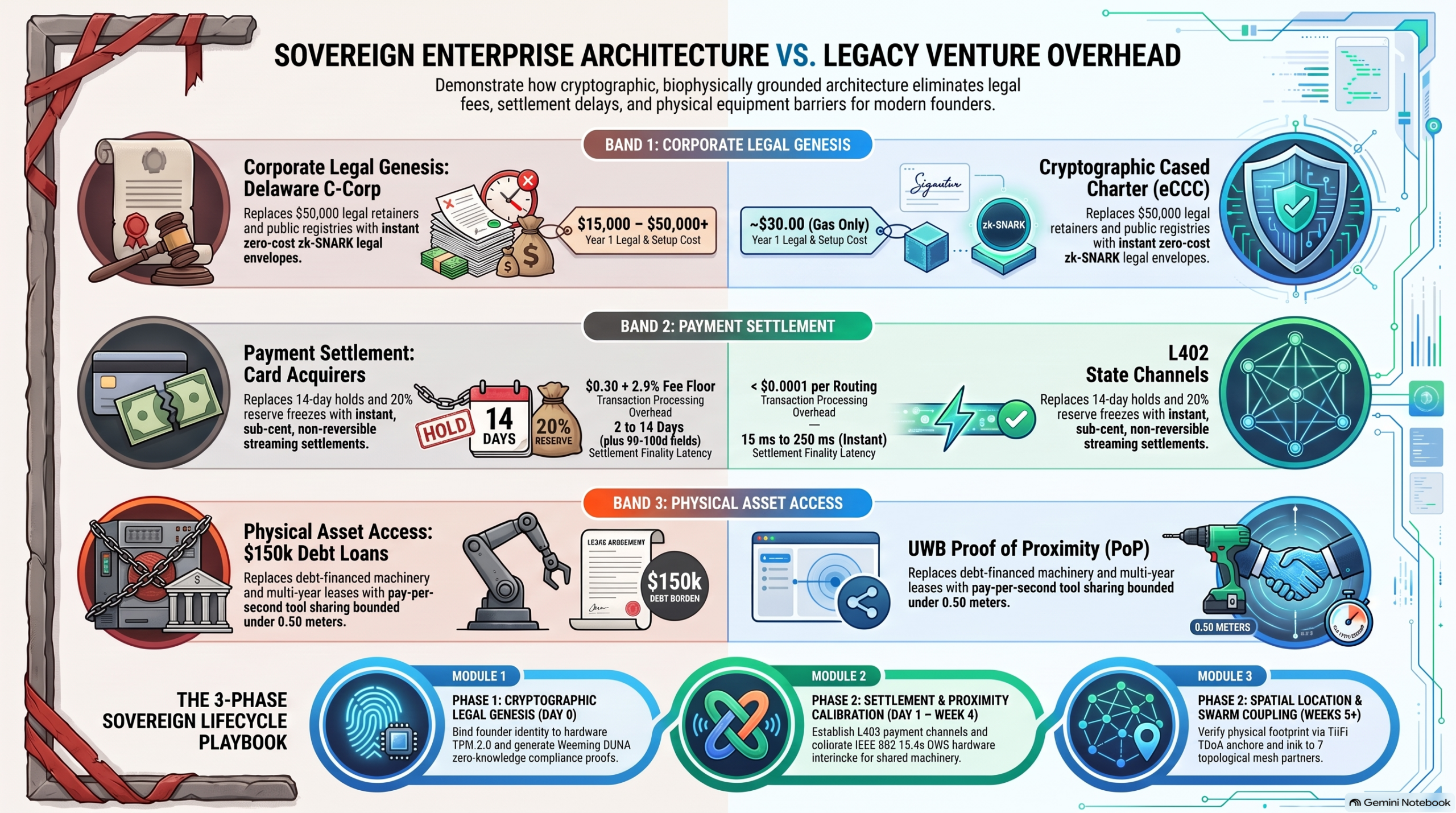
- Legal Retainer Overhead: Delaware C-Corporation setups demand $15,000 to $50,000+ in legal fees and subject DAOs and decentralized protocols to general partnership joint-and-several liability.
- Payment Processing Friction: Credit card networks enforce a $0.30 + 2.9% fee floor, 2-to-14-day settlement lags, and 10% to 20% rolling reserve freezes held for 90 to 180 days.
- Real Estate & Spatial Extortion: Commercial leases require 3-to-10-year binding commitments with personal guarantees, while centralized search monopolies sidetrack local customer discovery through pay-to-play ads and fraudulent “pin farms.”
- Supply Chain & Infrastructure Fragility: Reliance on fragile 10,000-mile just-in-time supply chains and centralized cloud hyperscalers creates single points of regional failure.
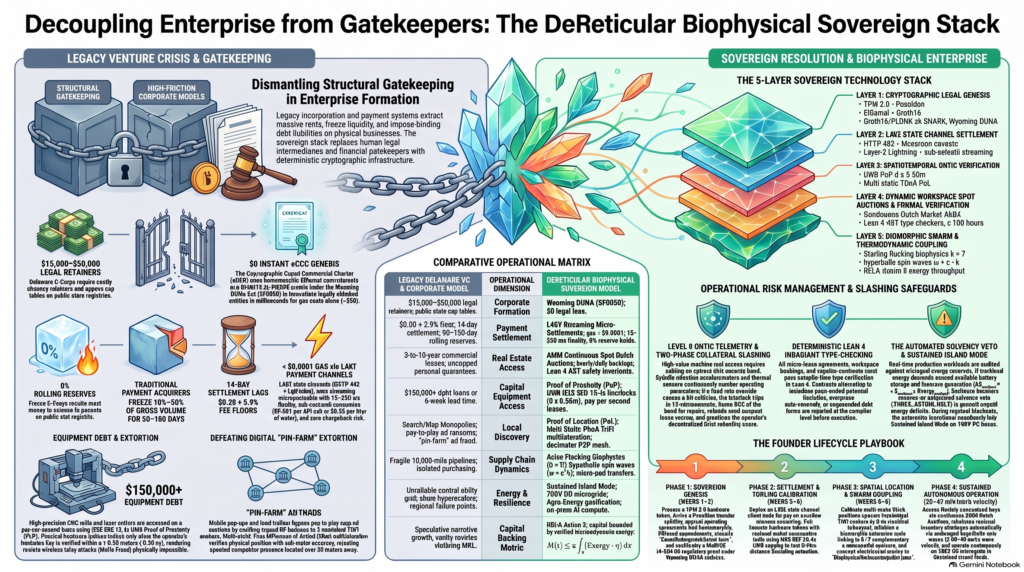
The Sovereign Cryptographic Corporate Stack and the DeReticular Biophysical Enterprise Architecture resolve these systemic bottlenecks. By unifying the Wyoming Decentralized Unincorporated Nonprofit Association (DUNA) Act (SF0050), the Cryptographic Cased Commercial Charter (eCCC), Homomorphic Capitalization Tables, L402 Streaming Micro-Settlements, Ultra-Wideband (UWB) Proof of Proximity (PoP), TriFi Time Difference of Arrival (TDoA) Proof of Location (PoL), Biomorphic Avian Swarm Flocking (k=7), and Thermodynamic Exergy Bounding (RELA Axiom 3), entrepreneurs can launch legally shielded, financially liquid, and operationally resilient enterprises at zero marginal legal cost.
┌─────────────────────────────────────────────────────────────────────────────────────────┐
│ THE SOVEREIGN CRYPTOGRAPHIC CORPORATE STACK │
├─────────────────────────────────────────────────────────────────────────────────────────┤
│ LAYER 4: ZERO-COST AUTOMATION & DETERMINISTIC DEPLOYMENT PIPELINE │
│ • Formal Verification (Lean 4 ASTs) • Zero-Overhead Factory • ~$30 Initial Gas Cost │
├─────────────────────────────────────────────────────────────────────────────────────────┤
│ LAYER 3: HOMOMORPHIC CAP TABLE & PRIVACY PRESERVATION │
│ • FHE / Additive ElGamal State • Private Voting • Selective Threshold Auditing │
├─────────────────────────────────────────────────────────────────────────────────────────┤
│ LAYER 2: CRYPTOGRAPHIC CASED COMMERCIAL CHARTER (eCCC) │
│ • Inner Core (T_core): Homomorphic Commitments • Outer Envelope (T_env): zk-SNARK │
├─────────────────────────────────────────────────────────────────────────────────────────┤
│ LAYER 1: STATUTORY ANCHOR — WYOMING DUNA ACT (SF0050) │
│ • Wyo. Stat. § 17-31-101 et seq. • Entity Shielding • Limited Liability Protection │
└─────────────────────────────────────────────────────────────────────────────────────────┘
- Forensic Breakdown of Legacy Entrepreneurial Gatekeeping
Small businesses encompass over 33 million registered independent enterprises in the United States, driving 44% of U.S. GDP and employing 46% of the private workforce. Despite over 5 million new annual filings, 20% of new ventures fail in Year 1, and nearly 50% collapse before Year 5. This mortality rate stems from institutional gatekeeping across four main dimensions:
1.1 The Merchant Banking Plastic Wall
- Rolling Reserve Locks: Surge sales trigger risk algorithms at traditional acquirers (Stripe, PayPal, Square), which freeze 10% to 20% of gross processing volume for 90 to 180 days, starving ventures of working capital.
- Prohibitive Fee Floors: The legacy payment interchange model ($0.30 + 2.9%) imposes an effective fee rate of 302.9% on a $0.10 transaction and 30,000% on a $0.001 query. This makes granular unit economics, pay-per-second equipment access, and machine-to-agent (A2A) micro-commerce mathematically impossible.
- Settlement Lags: Multi-day clearing windows (2 to 14 days) create operational delays and force businesses into high-cost factoring loans.
1.2 The Corporate Legal Monoculture & Epicycle Trap
- Legal Overhead: Standard venture formation involves $15,000 to $50,000 in legal retainers, $3,000/year equity SaaS subscriptions (Carta), and $1,200/hour legal counsel for corporate administration.
- The Epicycle Trap: Delaware C-Corp frameworks pressure ventures to generate exponential narrative growth to secure venture capital. When empirical unit economics are negative, companies add auxiliary parameters—inventing non-GAAP metrics (“Community-Adjusted EBITDA”) to mask unit deficits. This increases model complexity (Kolmogorov complexity K(\mathcal{H})) without improving solvency, violating the Minimum Description Length (MDL) parsimony principle.
- General Partnership Liability: Under common law and cases like CFTC v. Ooki DAO (2023), unwrapped DAOs are treated as general partnerships. Token holders who vote or hold governance tokens incur joint and several unlimited personal liability for protocol debts, software exploits, and legal judgments.
1.3 The Spatial Oracle Deficit & Local Exploitation
- Rigid Commercial Real Estate: Landlords demand 3-to-10-year commercial leases backed by uncapped personal guarantees, shifting real estate market risk onto the founder’s personal balance sheet.
- Digital Search Extortion: Centralized search and mapping platforms extract pay-to-play ad fees. Fraudulent operators set up digital “pin farms” (buying fake VoIP numbers and automated bot reviews) to siphon foot traffic from physical businesses.
1.4 Physical & Supply Chain Fragility
- Centralized Dependencies: Dependence on 10,000-mile just-in-time supply chains and centralized cloud hyperscalers (AWS, Azure) leaves businesses vulnerable to regional grid outages, cloud downtime, and trade disruptions.
- Statutory Grounding & Legal Architecture: The eCCC & Wyoming DUNA
The Sovereign Cryptographic Corporate Stack replaces manual, natural-language corporate law with deterministic, machine-verifiable code anchored directly in state statutes.
┌─────────────────────────────────────────────────────────────────────────┐
│ CRYPTOGRAPHIC CASED COMMERCIAL CHARTER (eCCC) │
│ │
│ ┌───────────────────────────────────────────────────────────┐ │
│ │ OUTER ENVELOPE (T_env) — Zero-Knowledge Proof: │ │
│ │ • zk-SNARK (Groth16 / PLONK) Verification │ │
│ │ • Proves: Wyoming DUNA Compliance, Tax Reserves, │ │
│ │ TPM Signatures, Solvency Invariants. │ │
│ │ • Zero leakage of identities, margins, or distributions. │ │
│ │ │ │
│ │ ┌───────────────────────────────────────────────────┐ │ │
│ │ │ INNER CORE (T_core) — Homomorphic Commitments: │ │ │
│ │ │ • ElGamal / Pedersen Commitments (g^r · h^Payload)│ │ │
│ │ │ • Encrypted Cap Table, Bylaws, IP Rights, │ │ │
│ │ │ Threshold Multi-Sig Rules, Voting Polynomials. │ │ │
│ │ └───────────────────────────────────────────────────┘ │ │
│ └───────────────────────────────────────────────────────────┘ │
└─────────────────────────────────────────────────────────────────────────┘
2.1 The Cryptographic Cased Commercial Charter (eCCC)
Modelled after ancient Mesopotamian cased clay tablets, the eCCC uses a Dual-Envelope Cryptographic Container:
- The Inner Core (T_{\text{core}}): Encrypts proprietary operating agreements, equity shares, founder vesting schedules, profit-sharing formulas, and trade secrets (\mathcal{O}) using additive homomorphic commitments: T_{\text{core}} = \operatorname{Enc}(\mathcal{O}, r) = \left( g^r, ; h^r \cdot g^{\mathcal{O}} \right) \quad \text{for random scalar } r \in \mathbb{Z}_q
- The Outer Envelope (T_{\text{env}}): Generates a non-interactive zero-knowledge proof (\pi, using Groth16 or PLONK) over an arithmetic circuit \mathcal{C}{\text{DUNA}}. This proves to regulators, tax authorities, and counterparties that the charter meets statutory requirements, holds tax reserves, and possesses valid founder hardware signatures—without disclosing trade secrets or personal identities: \pi \leftarrow \operatorname{Prove}\left( \text{CRS}, ; \vec{x}{\text{public}}, ; \vec{w}_{\text{private}} \right)
2.2 Formal Machine Verification via Lean 4
Operating rules pass formal type-checking in the Lean 4 interactive theorem prover before deployment, preventing circular or predatory clauses:
— Formal Verification Gate for Sovereign Charters
structure CasedCharterInvariant where
total_equity_basis_points : Nat
founder_liability_bounded : Bool
tax_escrow_funded : Bool
statutory_code : String
def verify_charter_safety (c : CasedCharterInvariant) : Prop :=
c.total_equity_basis_points = 10000 ∧
c.founder_liability_bounded = true ∧
c.tax_escrow_funded = true ∧
c.statutory_code = “WYO_STAT_17_31_DUNA”
2.3 Wyoming DUNA Act (SF0050) Statutory Provisions
Codified at Wyo. Stat. § 17-31-101 through § 17-31-116, the DUNA Act establishes a statutory foundation designed for web3-native and decentralized protocols:
- Statutory Entity Shielding (W.S. § 17-31-104): A DUNA is a distinct legal entity separate from its members. It can sue, be sued, enter into contracts, acquire property, and hold IP rights.
- Limited Liability Protection (W.S. § 17-31-106): Liabilities belong solely to the association. Members, administrators, and agents are not personally liable for association debts or exploits simply by participating in governance.
- Smart Contracts as Governing Principles (W.S. § 17-31-102(a)(iv)): Formally recognizes software protocols, distributed consensus, and smart contracts as valid legal bylaws.
- Commercial Operation vs. Non-Distribution Constraint: Under W.S. § 17-31-105, a DUNA can engage in for-profit commercial activities, generate revenue, and build capital reserves. However, it cannot pay direct net profit dividends to passive token holders based on capital equity alone. Value transfers are permitted for:
- Reasonable compensation for services (developer grants, security audits).
- Direct payment for goods, real estate, or energy infrastructure.
- Staking rewards, liquidity incentives, and programmatic yield tied to active network security or protocol maintenance.
- Ecosystem growth and treasury reserve accumulation.
2.4 Corporate & Cooperative Taxation Architecture
Under Treas. Reg. § 301.7701-3, an unincorporated entity can elect corporate tax treatment using IRS Form 8832:
- Subchapter C Corporate Election: The DUNA files Form 1120 as a C-Corporation, settling federal income taxes directly from its on-chain corporate treasury via L402 state channels.
- Subchapter T Cooperative Taxation (IRC §§ 1381–1388): Producer-owned associations (such as shared machine shops or compute networks) can operate under Subchapter T. “Patronage dividends” distributed to members based on business volume with the co-op (rather than passive capital ownership) are deductible from gross corporate income, preventing double taxation.
- Homomorphic Capitalization Tables
Public, plaintext on-chain cap tables introduce business risks, including competitive intelligence leaks, targeted phishing, and regulatory non-compliance with data privacy mandates (GDPR/CCPA). Homomorphic Cap Tables perform cryptographic accounting across fully encrypted states.
┌─────────────────────────────────────────────────────────────────────────────────────────┐
│ HOMOMORPHIC CAP TABLE ARCHITECTURE │
├─────────────────────────────────────────────────────────────────────────────────────────┤
│ OPERATOR 1 CIPHERTEXT OPERATOR 2 CIPHERTEXT │
│ Enc(s_1) = (c_{1,1}, c_{1,2}) Enc(s_2) = (c_{2,1}, c_{2,2}) │
│ │ │ │
│ └──────────────────┬─────────────────┘ │
│ ▼ │
│ ON-CHAIN COMPUTATION ACROSS ENCRYPTED STATES (FHE / Additive ElGamal) │
│ │
│ 1. Homomorphic Addition (Balance Transfer): │
│ Enc(s_1 – Δs) = Enc(s_1) ⊘ Enc(Δs) │
│ Enc(s_2 + Δs) = Enc(s_2) ⊙ Enc(Δs) │
│ │
│ 2. Homomorphic Scalar Multiplication (Pro-Rata Dilution by α): │
│ Enc(α · s_i) = (c_{i,1}^α, c_{i,2}^α) │
│ │
│ 3. Zero-Knowledge Invariant Enforcement: │
│ zk-Proof π: “s_i ∈ [0, 2^32 – 1] AND ∑ s_i == TotalAuthorizedShares” │
├─────────────────────────────────────────────────────────────────────────────────────────┤
│ SELECTIVE THRESHOLD AUDITING & TAX DISCLOSURE │
│ (k, n)-Threshold Decryption Key Shares: │
│ • Share 1: Enterprise Auditor • Share 2: Tax Authority • Share 3: DAO Board │
└─────────────────────────────────────────────────────────────────────────────────────────┘
3.1 Cryptographic Primitives
- Additive Homomorphic Encryption (Exponential ElGamal): Used for lightweight on-chain balance updates, equity transfers, and pro-rata equity scaling.
- Fully Homomorphic Encryption (FHE via TFHE/BGV): Handles complex, non-linear financial logic such as vesting schedules, waterfall distributions, and liquidation preferences.
3.2 Accounting State Transitions
Given balance s_i \in \mathbb{Z}q, the encrypted balance is \mathbf{C}i = (c{i,1}, c{i,2}) = (g^{r_i}, h^{r_i} \cdot g^{s_i}).
- Encrypted Share Transfer: \mathbf{C}_i’ = \mathbf{C}_i \oslash \operatorname{Enc}(\Delta s) = \operatorname{Enc}(s_i – \Delta s) \mathbf{C}_j’ = \mathbf{C}_j \odot \operatorname{Enc}(\Delta s) = \operatorname{Enc}(s_j + \Delta s)
- Pro-Rata Dilution (Issuance Scaling Factor \alpha): \mathbf{C}i^{\text{diluted}} = (\mathbf{C}i)^\alpha = \left( (c{i,1})^\alpha, ; (c{i,2})^\alpha \right) = \operatorname{Enc}(\alpha \cdot s_i)
3.3 Zero-Knowledge Invariants & Threshold Auditing
Every encrypted state change must submit a zk-SNARK proof (\pi) verifying:
- Range Proof: s_i \in [0, 2^{32} – 1] (prevents negative equity balances).
- Conservation of Supply: \sum_{i=1}^N s_i = \text{TotalAuthorizedShares} (prevents unapproved share inflation).
- Identity Verification: Confirms member accreditation via Poseidon nullifiers bound to verifiable credentials (W3C DIDs) without disclosing real-world identity data.
- Selective Threshold Auditing: Master decryption key x (h = g^x) is split using Shamir’s Secret Sharing across n keyholders (e.g., Enterprise Auditor, Tax Authority, DAO Board). Recombining k-of-n shares allows auditors to decrypt historical snapshots for Form 1120 tax compliance without revealing ongoing operational data.
- Layer 4 & 5: Sovereign Settlement, Spatial Verification, and Biophysical Infrastructure
4.1 L402 Streaming Micro-Settlements
The L402 protocol combines HTTP 402 Payment Required status codes, Google Macaroon bearer tokens with caveat attenuation, and Layer-2 Lightning Network state channels.
CLIENT (Agent / Browser / Tool) SERVER (API / CNC / Microgrid)
│ │
│ ─── 1. GET /api/v1/resource ─────────────────────────────► │
│ ◄── 2. HTTP 402 Payment Required ───────────────────────── │
│ WWW-Authenticate: L402 │
│ macaroon=””, invoice=”lnbc…” (Hash H) │
│ │
│ ┌──────────────────────────────────────────────┐ │
│ │ Settle Invoice via Lightning Channel: │ │
│ │ Pay invoice & receive preimage P │ │
│ │ Verify: SHA-256(P) == H │ │
│ └──────────────────────────────────────────────┘ │
│ │
│ ─── 3. GET /api/v1/resource ─────────────────────────────► │
│ Authorization: L402 : │
│ │
│ ┌─────────────────────────┐ │
│ │ Server verifies: │ │
│ │ 1. SHA-256(P) == H │ │
│ │ 2. Valid HMAC signature │ │
│ │ 3. Caveats satisfied │ │
│ └─────────────────────────┘ │
│ ◄── 4. HTTP 200 OK (Stream Payload / Actuate Relay) ────── │
Key Performance Metrics of L402:
- Sub-Millicent Routing Economics: Overhead is less than $0.0001 per routing hop (routing costs run as low as 1 millisatoshi, or $0.0000006).
- Millisecond Settlement Finality: Achieves settlement within 15 ms to 250 ms (bounded by network round-trip time), enabling immediate hardware latch actuation.
- Eradication of Rolling Reserves: Payments settle with push-based, mathematically non-reversible cryptographic finality (\operatorname{Pr}(\text{Chargeback}) = 0). This eliminates merchant chargeback risk and removes the rationale for 10% to 20% reserve holds.
4.2 Spatiotemporal Proof of Proximity (PoP) & Proof of Location (PoL)
[ ADVERSARIAL WIRELESS RELAY ATTACK (MAFIA FRAUD) ON HIGH-VALUE TOOL ]
[ Authorized Machinist ] ──(BLE/RF)──► [ Attacker A ] ══ HIGH-SPEED TUNNEL ══► [ Attacker B ] ──► [ CNC Spindle ]
Result: Machine actuates fraudulently; physical proximity invariant broken.
[ SOVEREIGN DEFENSE: IEEE 802.15.4z UWB DISTANCE BOUNDING ]
[ Machinist Hardware Token ] [ Tool Controller ]
│ ◄──────────────────────── Nonce Challenge c_i ──────────────────────────────────┤ (Time t_0)
│ ├──────────────────────── Rapid Response r_i ──────────────────────────────────► │ (Time t_1)
Calculation: Δt = t_1 – t_0 – t_proc ===> d ≤ (c · Δt) / 2
Result: Physical distance enforced at d ≤ 0.50m (Δt ≤ 3.33 ns); relay attacks fail.
- Proof of Proximity (PoP) for Asset Sharing: Shared tools (5-axis CNC mills, industrial lasers) connect to hardware controllers equipped with IEEE 802.15.4z Ultra-Wideband (UWB) transceivers. The power contactor energizes only if physical round-trip time confirms a physical distance bound: d \le 0.50\text{ meters} \quad (\Delta t_{\text{flight}} \le 3.33\text{ nanoseconds}) If an operator moves outside the 0.50-meter perimeter or attempts a wireless tunnel relay attack (Mafia Fraud), the machine safe-halts automatically.
- Proof of Location (PoL) for Mobile Enterprises: Stationary TriFi anchors emit synchronized RF signals to perform multi-static Time Difference of Arrival (TDoA) multilateration: \Delta d_{ij} = c \cdot (t_i – t_j) = |\mathbf{x} – \mathbf{s}_i| – |\mathbf{x} – \mathbf{s}_j| Mobile ventures (food trailers, pop-up stalls) verify their spatial coordinates with residuals below 0.05 meters (well within 2.5 m tolerances). This allows them to publish verified physical footprints to peer-to-peer registries, bypassing search engine ad auctions and defeating spoofed “pin farms.”
4.3 Biomorphic Avian Swarm Economics (k = 7)
Regional commercial alliances structure peer coordination using biomorphic flocking physics modeled after starling murmurations (Sturnus vulgaris):
- Bounded Topological Attention (k = 7): Every enterprise node links its inventory and ERP systems strictly to its k = 7 nearest complementary trade partners: S_i = \left{ j \in \text{Alliance} : \operatorname{rank}(\text{Synergy}_{ij}) \le 7 \right} This bounds communication overhead and prevents network congestion.
- Hyperbolic Spin Waves: Inventory shortages or demand surges propagate across the alliance as undamped second-order spin waves: \frac{\partial^2 \mathbf{v}}{\partial t^2} = c^2 \nabla^2 \mathbf{v}, \qquad \omega(k) = c \cdot k Rebalancing signals travel at c = 20\text{ to }40\text{ m/s} in \mathcal{O}(\log N) time. Neighboring nodes automatically execute atomic Hash Time-Locked Reservation Contracts (HTLRC) to shuttle inventory using autonomous light-electric utility pods (KurbKar), absorbing demand surges without losing sales.
4.4 Biophysical Thermodynamics & RELA Axiom 3
Enterprise value is anchored in thermodynamic exergy rather than ungrounded speculative debt:
- RELA Axiom 3 Capital Bounding: Nominal credit issuance (M_{\text{nominal}}(t)) is capped by net physical work capacity delivered: M_{\text{nominal}}(t) \le \kappa \int_{t_0}^t \left( \text{Exergy}_{\text{net}}(\tau) \cdot \eta(\tau) \right) d\tau \quad (\text{with } \kappa = 1.0\text{ Credit/MJ})
- Automated Biophysical Veto: Mass balances, electrical meters, and calorimeters update BiophysicalBalanceRegister.json. If a workshop’s energy demands exceed available microgrid exergy surplus (\Delta E_{\text{workload}} > \text{Exergy}_{\text{available}}), internal breaker systems halt non-critical workloads (FORCE_ACTION_HALT), preventing ungrounded debt accumulation.
- Sustained Island Mode: Physical nodes connect to on-premises 700V DC microgrids (using Agra.Energy biomass gasification and Project Octagon battery buffers), maintaining power, edge compute, and local production during regional utility or financial disruptions.
- Applied Archetypal Implementation Scenarios
┌─────────────────────────────────────────────────────────────────────────────────────────┐
│ ARCHETYPAL ENTERPRISE SCENARIOS │
├────────────────────────────┬────────────────────────────┬──────────────────────────────┤
│ Scenario A: Micro-Fab │ Scenario B: Pop-Up Fleet │ Scenario C: Microgrid Node │
│ • Precision Haas 5-Axis │ • Mobile Culinary Pods │ • Agra.Energy Gasification │
│ • UWB PoP Tool Interlock │ • TriFi TDoA PoL Registry │ • Project Octagon Buffers │
│ • 50% Slashing Bond Escrow │ • AMM Shared Kitchen Bays │ • Sustained Island Power │
├────────────────────────────┴────────────────────────────┴──────────────────────────────┤
│ Scenario D: Edge AI Micro-Services │ Scenario E: Swarm Alliance │
│ • Air-gapped Remnant AI Inference │ • 10-Store Murmuration Mesh │
│ • L402 Pay-per-Token ($0.0001) │ • Starling Flocking (k=7) │
│ • On-Prem Local GPU Clusters │ • KurbKar Autonomous Pods │
└──────────────────────────────────────────┴──────────────────────────────────────────────┘
Scenario A: Precision Hardware Micro-Fab (Shared Capital, Zero CapEx)
- Context: A 2-engineer robotics team in Detroit prototyping titanium drone chassis needs access to an $180,000 Haas 5-axis CNC mill.
- Implementation: The team accesses shared machinery at a regional manufacturing cooperative hub using UWB distance bounding (d \le 0.50\text{ m}). They pass a Lean 4 lease check (6-hour duration \le 168\text{ h}, 45 kWh exergy draw \le 250\text{ kWh}, 150 Credits deposit \ge 50\text{ Credits}) and stream L402 micro-payments at 1.50 Credits/second.
- Risk Handling: If spindle telemetry detects a tool collision (Level 0 Ontic Breach), the interlock trips in 10 microseconds. The verifier burns 50% of the staked security deposit for repairs, refunds the unspent lease escrow, and updates the team’s Brier reliability score.
Scenario B: Mobile Culinary & Artisan Fleet (Defeating Pin Farms)
- Context: An artisan sourdough and mobile pizza pod in Austin seeks to avoid 5-year commercial leases ($8,000/month) and digital map extortion.
- Implementation: The vendor books prep time in a shared kitchen from 3:00 AM to 7:00 AM for 14.50/hour using continuous AMM Spot Dutch Auctions (P(t) = P_{\min} + (P_{\max} – P_{\min})e^{-\lambda t}$). When parked at an urban plaza, four TriFi anchors multilaterate the pod’s RF signals via TDoA. Positional residuals below 0.05 meters publish its verified location to a P2P directory, defeating competing ghost kitchens whose spoofed signals generate residuals exceeding 50 meters. Revenue settles instantly via L402.
Scenario C: Distributed Energy & Bio-Refining Hub (Thermodynamic Grounding)
- Context: An Iowa biomass gasification facility producing electricity, biochar, and process heat faces wholesale utility buyback rates ($0.03/kWh) and 3-to-5-year grid interconnection delays.
- Implementation: The facility deploys an Agra.Energy gasifier and Project Octagon battery bank on a 700V DC islanded microgrid. Under RELA Axiom 3, verified exergy output automatically mints authorized enterprise credits into BiophysicalBalanceRegister.json at \kappa = 1.0\text{ Credit/MJ}. Local cold storage and vertical farm partners connect directly to the 700V DC bus, paying continuously per kWh via L402 tokens.
Scenario D: Machine-to-Machine Edge AI Inference Node
- Context: An autonomous software micro-service running open-weight reasoning models for agricultural drones needs to charge $0.0005 per query without cloud egress fees or credit card interchange floors.
- Implementation: The venture operates an on-premises GPU cluster connected to the local TriFi mesh, running air-gapped Remnant AI engines. Client agents query the model via HTTP and receive an HTTP 402 header requiring 20 satoshis (\approx $0.01) per 1,000 tokens. The agent pays in milliseconds over an L402 state channel, and tokens stream back in real time. Proprietary trade secrets remain local on the mesh.
Scenario E: Regional Cooperative Retail Alliance (Swarm Economics)
- Context: A corridor of 10 independent downtown businesses (bakery, roaster, brewery, grocer, courier, etc.) suffers stockouts during a festival that brings 3,000 unexpected visitors.
- Implementation: Each business connects its inventory ERP to its k=7 nearest partners via TriFi mesh. When the roaster experiences an oat milk deficit, it injects a shock torque (\boldsymbol{\tau}_{\text{shock}} = [-8.0, 0.0, 0.0]). A hyperbolic spin wave updates peer nodes at velocities of 20\text{ to }40\text{ m/s}. The grocer and brewer detect the wave and execute an atomic HTLRC inventory transfer, while autonomous KurbKar utility pods transfer stock in 4 minutes, absorbing the demand surge locally.
- Comprehensive Comparative Dimension Analysis
Operational Dimension Traditional Delaware C-Corp Model Offshore Foundation Model (Cayman/Panama) Sovereign eCCC + Wyoming DUNA Stack
Statutory Basis DGCL (8 Del. C. § 101 et seq.) Special Economic Zones / Trust Acts Wyo. Stat. § 17-31-101 et seq. (SF0050)
Legal Personality Traditional legal person Complex offshore orphan structure Full statutory entity shielding (W.S. § 17-31-104)
Personal Liability Protection Protected via traditional corporate veil Variable (Shielded via trust structure) Statutory liability shield (W.S. § 17-31-106)
Setup Cost $15,000 – $50,000 in legal retainers $40,000 – $100,000 initial fees 0 legal fees (~30 network gas deployment)
Ongoing Maintenance Overhead $5,000 – $15,000/yr (CPAs, registered agents) $15,000 – $30,000/yr (Nominee directors) Near $0 (Only on-chain settlement gas)
Cap Table Privacy None (Visible to legal counsel, Carta, state) Low (Subject to offshore registry filings) Absolute (Homomorphic ElGamal/FHE + ZK proofs)
Payment Rails & Reserves Credit cards / Stripe; $0.30 + 2.9%; 10-20% reserve Traditional wire transfers / Merchant banking L402 State Channels; gas < $0.0001; 0.00% reserve
Real Estate Leases 3-to-10-year leases; personal guarantees Traditional commercial leases AMM Continuous Spot Dutch Auctions; hourly/daily
Machine Tool Access $150k+ debt loans or high job-shop markups Capital equipment loans / Fixed leases Proof of Proximity (PoP); UWB d \le 0.50\text{ m} interlocks
Local Discovery Google Maps / Yelp; pay-to-play ad auctions Traditional digital ad placements Proof of Location (PoL); TriFi TDoA multilateration
Tax Filing Capability High (Standard IRS Form 1120) Complex (CFC / PFIC reporting traps) Standardized (Elects Form 1120 or Subchapter T co-op)
Machine-to-Machine Readiness Impossible (Requires human signatures) Minimal (Requires human nominee councils) Native (Autonomous smart contracts and AI tokens)
Verification Speed Weeks (Human legal discovery & stock ledgers) Months (Letters rogatory & cross-border subpoenas) Sub-second (Algorithmic zk-SNARK validity proofs)
Capital Backing Metric Speculative narrative growth; vanity user metrics Speculative token valuation RELA Axiom 3; bounded by net physical exergy
- Strategic Execution Roadmap & Action Plan
Founders follow a structured four-stage initialization plan to deploy a sovereign enterprise node:
[ WEEKS 1-2: SOVEREIGN BOOTSTRAP ]
- Procure TPM 2.0 Hardware Key (YubiKey / Secure Element).
- Inscribe Operating Agreement into CasedEnterpriseCharter.json.
- Generate zk-SNARK Compliance Envelope (Wyoming DUNA).
│
▼
[ WEEKS 3-4: INFRASTRUCTURE & SETTLEMENT INITIALIZATION ] - Deploy Local TriFi Mesh Node / Ed25519 Peer Identity.
- Establish L402 Lightning State Channels for Pay-as-You-Flow Revenue.
- Calibrate UWB IEEE 802.15.4z Transceiver for Physical Asset Access.
│
▼
[ WEEKS 5-8: DISTRICT INTEGRATION & SWARM COUPLING ] - Verify Commercial Location (PoL) via TriFi Multi-Static Anchors.
- Connect to 7 Nearest Topological Commercial Neighbors (k=7 Mesh).
- Integrate Real-Time Energy Tracking to BiophysicalBalanceRegister.json.
│
▼
[ WEEKS 9+: SUSTAINED AUTONOMOUS OPERATION ] - Access Shared Tooling Bays via Continuous Spot Dutch Auctions.
- Automate Inventory Balancing via Hyperbolic Spin Wave Signals.
- Operate Continuously in Sustained Island Mode on 700V DC Microgrids.
Strategic Action Plan
- Phase 1: Sovereign Genesis (Weeks 1–2):
- Provision a TPM 2.0 hardware security token to generate asymmetric keypairs over secp256k1 or ed25519 curves.
- Compute founder nullifier: \text{Nullifier} = \operatorname{Poseidon}(\text{PrivateKey}, \text{Salt}).
- Define bylaws and homomorphic equity allocations in CharterManifest.yaml. Verify invariants using the Lean 4 type-checker (10,000 basis points total share allocation, bounded liability).
- Synthesize Groth16 zk-SNARK compliance envelope (\pi_{\text{compliance}}) and deploy CasedDUNACharter.sol via Layer-2 contract factories (~$30 total gas cost).
- Phase 2: Settlement & Tooling Calibration (Weeks 3–4):
- Deploy an L402 client node linked to self-custodial Lightning/state channels.
- Pair hardware keys with local co-op maker spaces using IEEE 802.15.4z UWB transceivers, verifying distance bounding (d \le 0.50\text{ m}).
- Fund escrow channels for pay-per-second tool leases and set up the 21% automated C-Corp tax reserve split (streamOperatingRevenue).
- Phase 3: Spatial Location & Swarm Mesh Coupling (Weeks 5–8):
- Calibrate TDoA multilateration against four municipal TriFi anchors, confirming positional residuals < 2.5\text{ m}, and publish physical footprint coordinates to the P2P registry.
- Initialize BiomorphicEnterpriseNode, establishing k=7 topological links with complementary regional partners.
- Connect workshop electrical meters to BiophysicalBalanceRegister.json to ground authorized enterprise credit expansion in net physical exergy (RELA Axiom 3).
- Phase 4: Sustained Sovereign Operation (Ongoing):
- Bid on commercial bays using AMM Continuous Spot Dutch Auctions, eliminating multi-year commercial leases.
- Stream customer settlements in real time via L402 with millisecond finality, bypassing 90-day merchant reserve holds.
- If broader grid or financial disruptions occur, transition seamlessly into Sustained Island Mode on the 700V DC microgrid, maintaining production and commercial continuity.


