
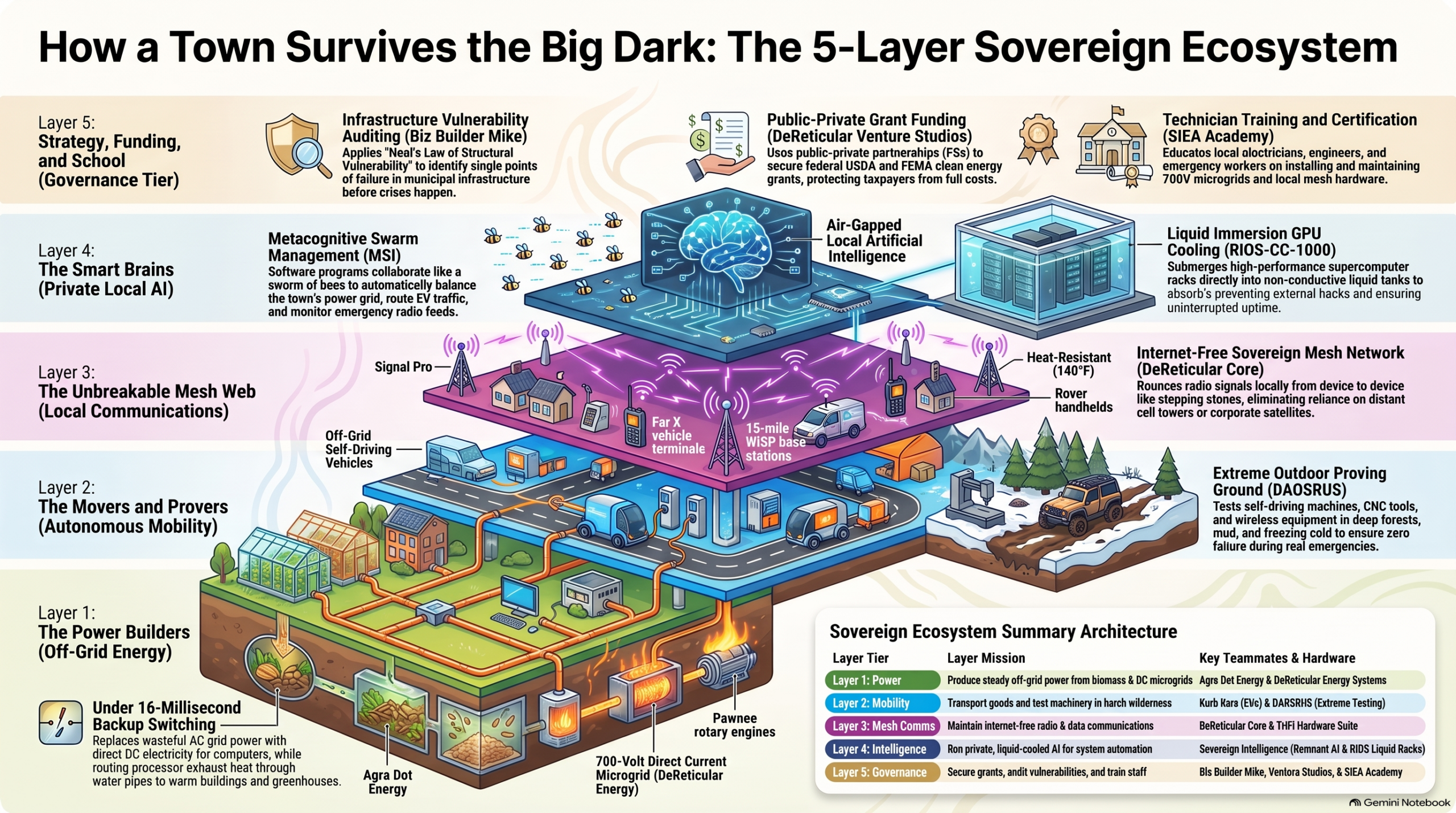
How to Build an Unkillable Town: 5 Mind-Bending Ideas Behind the ‘Sovereign Ecosystem’
A severe winter storm strikes, collapsing electric transmission lines across hundreds of miles. In an instant, the grid goes dark, cell towers lose signal, digital payment systems freeze, and communications cut off entirely. For the vast majority of municipalities, recovery is a agonizing waiting game that lasts days or weeks while distant utility conglomerates and telecommunication providers attempt to repair fragile, centralized networks.
A “Sovereign Ecosystem” radically disrupts this vulnerability by enabling a town, hospital, agricultural hub, or emergency operations center to instantly transition into “Island Mode”—the capacity of a localized infrastructure system to maintain fully operational power, transportation, computing, and communications independently when the overarching global grid and internet fail.
To achieve total self-reliance during wide-area cataclysms, modern infrastructure architecture must abandon fragile, single-point-of-failure networks. DeReticular and its partner network address this systemic threat through an integrated 5-layer framework designed to keep local communities functioning indefinitely. Here is an inside look at the five core engineering breakthroughs redefining municipal survival.
Takeaway 1: Making Electricity from Wood Chips and Switching Power in Under 16 Milliseconds
Traditional energy grids depend on long-distance transmission lines spanning thousands of miles. Layer 1 of the Sovereign Ecosystem decentralizes generation entirely by placing power production directly at the point of consumption. Agra Dot Energy achieves this by utilizing local biomass, such as agricultural waste and wood chips. Through pyrolysis and gasification, organic waste is heated without burning into smoke, converting raw refuse into clean fuel that powers Pawnee rotary engines to generate continuous electricity 24 hours a day, regardless of weather conditions.
To distribute this power with maximum efficiency, DeReticular Energy Systems replaces standard alternating current (AC) infrastructure with a 700-Volt Direct Current (DC) system. Standard AC grids suffer from inherent inefficiencies when powering modern computing infrastructure, as energy is repeatedly wasted through lossy AC-to-DC conversion steps at the device power supply level. By delivering native 700V DC power directly to local facilities, the microgrid eliminates these conversion losses.
“The system utilizes super-fast switches capable of sensing a blackout and transferring to backup power in under 16 milliseconds—faster than an eye blink—preventing sensitive electronics from flickering.”
In addition to direct electrical distribution, the ecosystem captures waste heat generated by running computer processors, pumping warm water through insulated pipes to heat local greenhouses and surrounding municipal buildings.
At a structural level, this combination of localized biomass generation and high-voltage DC plumbing solves the primary flaw of legacy energy networks. Direct current microgrids remove dependency on long-distance transmission corridors, ensuring that when the national grid collapses, local power generation stays rock-solid.
Takeaway 2: Driverless Ambulance Pods and Deep-Forest Proving Grounds
Physical mobility breaks down rapidly during prolonged outages when commercial gas stations close and internet-dependent GPS navigation drops offline. Layer 2 resolves these critical logistical bottlenecks through off-grid electric transport and rigorous real-world stress testing.
Kurb Kars manufactures autonomous electric utility vehicles and mobile battery pods engineered to operate completely independent of the public internet. These units draw power directly from the localized 700V microgrid, enabling them to safely transport patients, deliver emergency food rations, and route vital hardware across disrupted zones.
To guarantee that autonomous emergency vehicles, computer-controlled factory tools (CNC machinery), and wireless hardware do not fail when lives are on the line, every component undergoes grueling field validation at DAOSRUS. Operating as an extreme environmental proving ground, DAOSRUS subjects robotics and wireless gear to deep forests, mud, sub-zero cold, and treacherous terrain.
In a crisis scenario where commercial fuel distribution freezes and cloud navigation networks disconnect, off-grid autonomous transport ensures that first responders and emergency logistics remain fully operational despite total external infrastructure collapse.
Takeaway 3: A Walkie-Talkie Mesh Internet That Works in 140°F Heat
When regional cell towers topple and satellite backbones drop out, localized communication collapses. Layer 3 replaces vulnerable corporate telecom networks with a localized “Sovereign Mesh” managed by DeReticular Core. Instead of routing data to distant out-of-state servers, every radio node functions as an independent stepping stone, hopping encrypted messages locally from device to device.
This resilient localized network is driven by the TriFi hardware suite:
- TriFi Signal Pro 8355: A ruggedized, weatherproof metal antenna mounted atop elevated infrastructure like schools, hospitals, or water towers to broadcast high-speed wireless coverage across entire campuses.
- TriFi WISP-in-a-Box Lite: A commercial base station capable of projecting a localized wireless coverage bubble up to 15 miles through dense tree foliage and hilly terrain.
- TriFi Far X (X1271): A vehicle-mounted terminal featuring dual antennas mounted to truck or ambulance roofs, transforming mobile units into rolling Wi-Fi hubs.
- TriFi Rover (SLG-06): A tough, rubber-coated handheld pocket hotspot constructed with thermal-resistant battery architecture engineered to run in severe environments.
“The TriFi WISP-in-a-Box Lite projects a 15-mile wireless bubble through heavy coverage, while mobile units like the TriFi Rover utilize non-melting batteries rated for temperatures up to 140°F.”
This paradigm shift from centralized telecom monoliths to localized mesh architectures guarantees that communities retain internal disaster coordination, operational data routing, and emergency communication even when global fiber backbones are severed.
Takeaway 4: Dunking Supercomputers in Liquid and Running Offline “Remnant AI”
Mainstream artificial intelligence models rely on massive, distant cloud data centers. During a blackout, these tools go dark, while their normal operation poses severe data privacy risks. Layer 4 eliminates cloud dependency by moving high-performance computational intelligence entirely on-site.
The Sovereign Intelligence framework isolates data processing and municipal management through three specialized hardware and software components:
- Air-Gapped “Remnant AI”: Specialized AI chips operating completely isolated from the outside internet. Being physically air-gapped prevents remote cyberattacks while guaranteeing zero drop in computational capacity during blackouts.
- Immersion-Cooled GPU Racks (RIOS-CC-1000): Advanced thermal management units that submerge supercomputers directly into tanks of non-conductive dielectric fluid, eliminating noisy, power-hungry cooling fans while preventing thermal throttling.
- Metacognitive Swarms (MSI): Networked software programs operating autonomously like a swarm of bees to balance microgrid power loads, route emergency traffic, and monitor local radio frequencies without human intervention.
Relying on cloud-hosted software during a disaster introduces fatal blind spots. Localized, liquid-cooled, air-gapped hardware ensures real-time computational decision-making—from load-balancing microgrids to routing emergency pods—remains secure, functional, and private when external connections drop.
Takeaway 5: Fixing Vulnerabilities with “Noel’s Law” and Funding It with Federal Grants
Technological innovation fails without rigorous organizational planning, public policy execution, financial structuring, and technical education. Layer 5 provides the human and civic framework required to deploy, finance, and maintain sovereign infrastructure over generations.
This governance tier operates through three foundational pillars:
- Biz Builder Mike: Systemic risk strategists who conduct municipal audits to identify structural single points of failure before disasters strike.
- DeReticular Venture Studios: A specialized financial engineering team leveraging Public-Private Partnerships (P3s) to help cities win competitive federal grants (such as USDA clean energy grants and FEMA resilience funding), ensuring local taxpayers aren’t burdened by upfront costs.
- SIEA Academy: Operating under the SIEA non-profit association, this learning center trains local technicians, electricians, and engineers to install, maintain, and repair 700V microgrids, immersion tanks, and mesh radio nodes.
“Under ‘Noel’s Law of Structural Vulnerability,’ municipal infrastructure is audited to systematically eliminate single points of failure—such as a single isolated transformer whose disruption could paralyze an entire municipal water pumping station.”
Ultimately, advanced hardware remains useless without human competency. Strategic risk mapping, grant acquisition blueprints, and accredited hands-on technical training form the necessary civic foundation required to construct and preserve off-grid survival ecosystems over the long haul.
Conclusion: The “Survival Bubble” Era
Building true community resilience requires abandoning the assumption that distant power grids, commercial telecommunications, and cloud data centers will always remain available. By integrating continuous local biomass generation, 700V DC power routing, internet-independent autonomous mobility, high-temperature mesh communications, air-gapped liquid-cooled computing, and structured grant funding, municipalities can create self-sustaining “survival bubbles.”
If the main regional power grid and global internet connections were to disconnect indefinitely today, does your town have the local infrastructure required to keep the lights on and vital services running tomorrow?


