
Municipal Infrastructure Specification: Biomorphic Autonomous Transit and DC Microgrid Standards (Ver. 2026.1)
- Architectural Scope and Strategic Imperative
This specification formalizes the transition from the “1,000-Mile Failure Model”—characterized by centralized, high-latency cloud-tethered transit—to a decentralized, biomorphic swarm architecture. This shift is not a mere logistical preference but a physical necessity for municipal resilience. Centralized command structures are structurally incapable of managing the sub-16ms Refresh intervals and kinetic densities required for modern urban flow without suffering from the catastrophic tail latencies of cellular backhauls. By adopting active matter physics modeled after avian murmurations, the municipality transitions into a self-organizing kinetic network capable of maintaining operational integrity in Denied, Degraded, Intermittent, or Limited (DDIL) environments.
The legacy transit paradigm is foreclosed by Three Foundational Pathologies that necessitate this architectural replacement:
- Mass-Energy Inversion: The thermodynamic irrationality of utilizing 5,000-lb vehicles to transport a 170-lb payload. This inversion results in a kinetic efficiency of ~3%, where 97% of primary exergy is dissipated solely to move the vehicle chassis.
- The Omniscience Trap: The “Solitary God” fallacy of designing autonomous vehicles as isolated cognitive monads. Lacking direct coordination, these units must predict human intent through high-latency sensors, inducing “phantom braking” and systemic gridlock.
- Infrastructure Degradation: The exponential acceleration of pavement fatigue caused by heavy electric vehicles (EVs). Under the Fourth Power Law, current consumer EV fleets inflict damage that scales to thousands of times that of right-sized modular units, bankrupting municipal maintenance budgets.
This specification provides the formal grounding for kinetic and epistemic autonomy, establishing the physical standards for standardized transit platforms and their governing protocols.
- Kinetic Layer: Modular KurbKar Platform Specifications
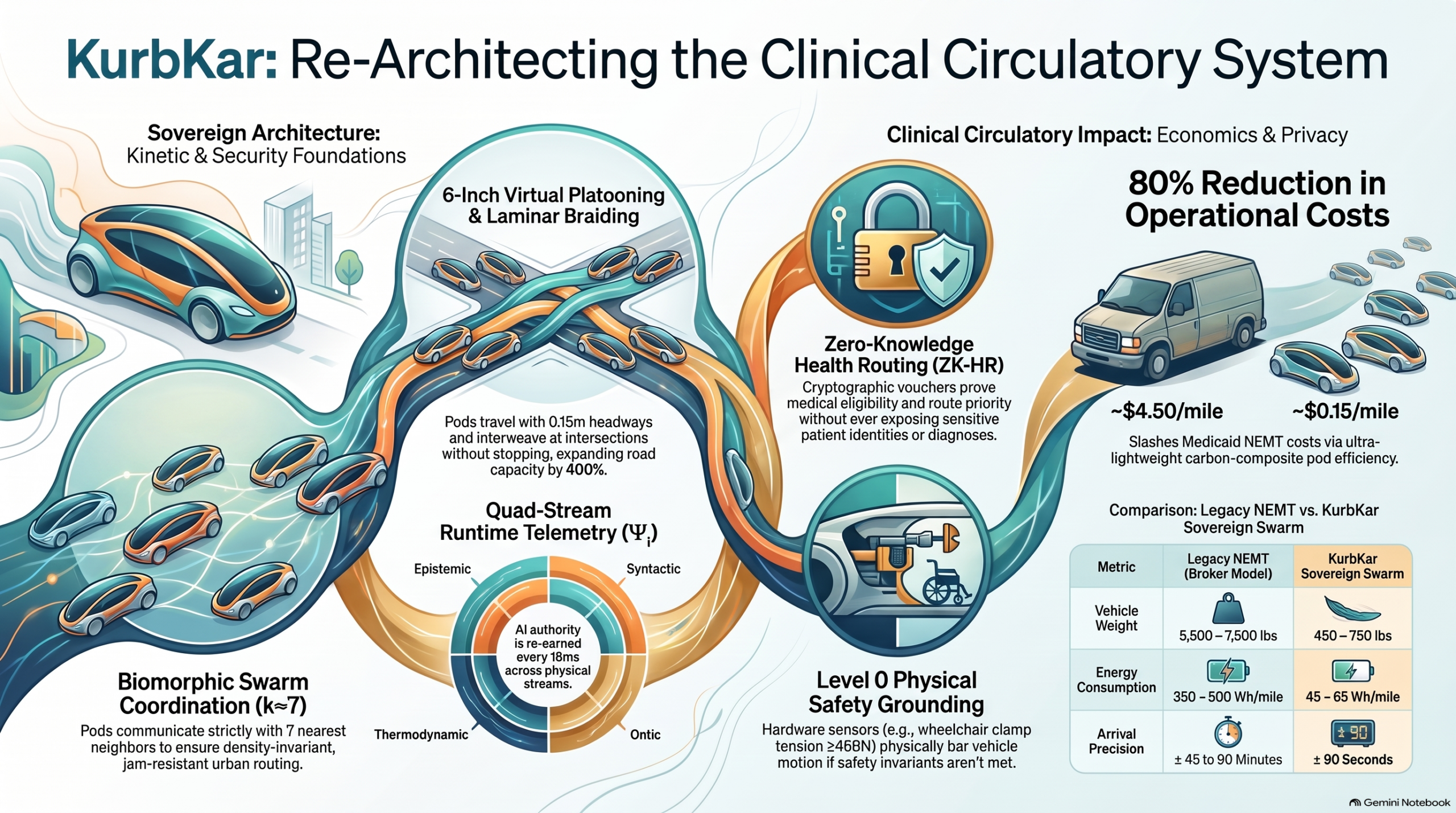
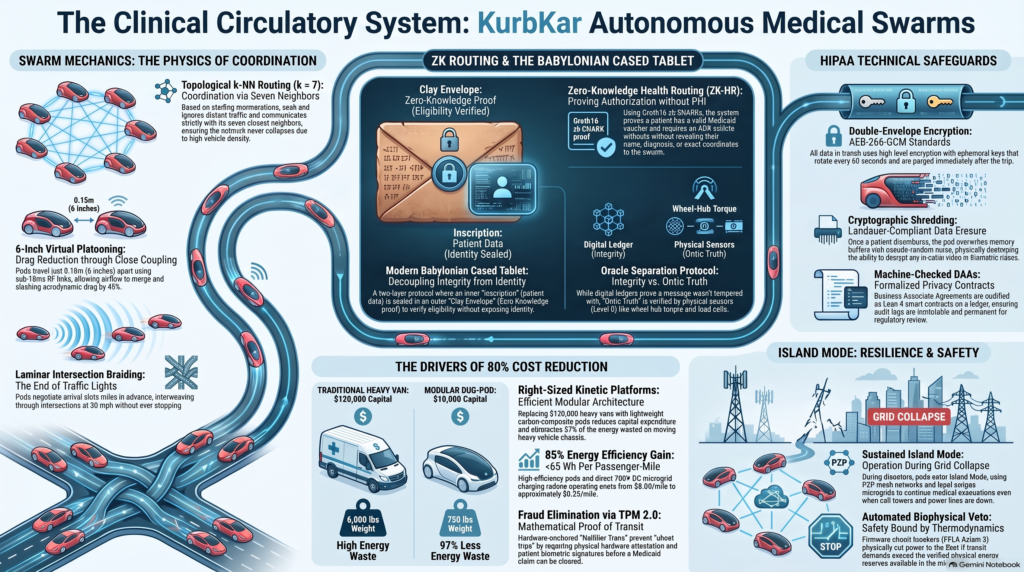
Strategic resolution of the Mass-Energy Inversion requires the “right-sizing” of vehicle mass to match specific payload requirements. By utilizing carbon-composite modularity and drive-by-wire integration, the KurbKar platform reduces primary exergy consumption by over 80%.
Module Curb Weight Footprint Primary Use Case Exergy Draw (Wh/pass-mile)
Solo-Pod (1P) 450 lbs (204 kg) 1.2m x 2.0m Individual Commuter Transit 45–65 Wh
Duo-Pod (2P/ADA) 750 lbs (340 kg) 1.5m x 2.0m NEMT / Wheelchair / Paramedic 65–85 Wh
Freight-Skid 500 lbs (226 kg) 1.5m x 2.0m Last-Mile / Logistics / Cargo N/A (Payload dependent)
Dynamic Virtual Platooning Standards High-density throughput is achieved via Dynamic Virtual Platooning. KurbKar units utilize sub-16ms electronically linked simultaneous braking to maintain 6-inch (0.15m) headways at cruising velocities.
- Aerodynamic Fusion: At 0.15m intervals, pods achieve boundary-layer airflow fusion, acting as a unified aerodynamic body. This results in a -45% reduction in drag for trailing units.
- Simultaneous Deceleration: Telemetry propagates across the TriFi mesh in under 16ms, ensuring concurrent regenerative braking across the platoon and eliminating accordion-style kinetic instability.
Under the Fourth Power Law, a 450-lb Solo-Pod inflicts approximately 1/22,300th the structural fatigue of a 5,500-lb consumer EV. This reduction in pavement stress allows for the recovery of municipal infrastructure funds currently lost to asphalt degradation.
- Network Layer: TriFi RF Mesh and Topological Routing
Operation in DDIL environments requires a multi-tier radio frequency (RF) physical layer to ensure continuous coordination without reliance on vulnerable public cellular backhauls.
Tier Spectrum Primary Role Performance
Tier 1: mmWave 60 GHz Near-Field Virtual Coupling: Raw sensor stream sharing for 6-inch headways. <1.5ms latency; >5 Gbps throughput.
Tier 2: Sidelink 5.9 GHz (C-V2X) Topological Coordination: Intersection braiding and neighborhood-level merging. 4–12ms latency; 60 Hz kinematic updates.
Tier 3: Sub-GHz 410/900 MHz Macro-Fleet Failover: NLOS coordination and swarm-wide alert propagation. 25–45ms latency; high NLOS penetration.
Biomorphic Topological Routing (k ≈ 7) The infrastructure utilizes Topological k-NN Routing, where nodes maintain links strictly with k ≈ 7 nearest neighbors. Modeled after starling murmurations, this approach ensures network graph invariance to density. This biomorphic logic prevents the “packet broadcast storms” and RF channel saturation typical of legacy metric-distance routing, which inevitably causes communication collapse during peak congestion.
i
Hyperbolic Spin Waves Emergency information propagates as second-order Hyperbolic Spin Waves. These undamped acoustic wavefronts transport information across the fleet at c ≈ 20–40 m/s. This linear dispersion allows trailing units to adjust trajectories hundreds of meters before onboard sensors achieve line-of-sight to an obstacle, enabling undamped swarm evasions. This stack allows for the decommissioning of traditional time-division traffic signals.
- Traffic Management: Phase-Synchronized Laminar Intersection Braiding
Municipalities shall transition from time-division multiplexed traffic signals (Poisson Queues) to continuous fluid-dynamic flow to maximize existing roadway capacity.
Intersection Protocol Comparison
- Legacy Human Intersections: Characterized by stop-and-go cycles, a 1,800 vehicles/lane/hour capacity ceiling, and significant kinetic energy dissipation through friction braking (producing toxic brake dust).
- Laminar Braided Intersections: Instantiates continuous interweaving where pods negotiate micro-arrival slots miles in advance. This forecloses upon idling, expanding carrying capacity to 11,000 pods/lane/hour while eliminating kinetic dissipation.
“Green Channel” Priority Medical Directives Upon detection of a clinical emergency (e.g., cardiac event via smart-seat ECG), the pod initiates the Green Channel protocol. The injection of a high-amplitude hyperbolic priority wave into the TriFi mesh opens an unobstructed corridor. Surrounding pods execute lateral “peel” maneuvers in sub-16ms intervals, establishing a high-velocity, zero-stop path to emergency departments.
- Energy Layer: 700V Native DC Microgrids
Transit charging must be coupled directly to local thermochemical generation to bypass utility load queues and ensure “Island Mode” resilience.
Agra.Energy Thermochemical Syngas Microgrids Municipal hubs shall deploy microgrids co-located at hospital campuses and waste facilities. These units gasify local biowaste into syngas to drive microturbines. Power is distributed via 700V DC native buses to minimize conversion losses. Pods utilize automated underbody contacts for rapid 3–5 minute recharges.
RELA Axiom 3 (The Biophysical Veto) The infrastructure enforces RELA Axiom 3, establishing a hardware-level biophysical constraint on operations. A Biophysical Veto circuit breaker monitors the Biophysical Balance Register (BBR); if total fleet mileage or compute workloads exceed the verified net exergy generation of the microgrid, the system physically cuts power to the execution queue. This thermodynamic limit cannot be overridden by administrative decree or majority vote.
- Security and Compliance: The Sovereign Stack and HIPAA Standards
Perimeter Single Sign-On (SSO) is insufficient for autonomous kinetic platforms, as it fails to address the Confused Deputy Vulnerability and Quadratic Sybil Attacks. This specification mandates Continuous Runtime Execution Telemetry, re-evaluating agent authority at every 16ms tick.
The Quad-Stream Telemetry Engine
- Epistemic Stream: Monitors rolling Brier scores to detect model delirium.
- Syntactic Stream: Uses Lean 4 Abstract Syntax Trees (AST) to verify motion directives are mathematically type-safe.
- Thermodynamic Stream: Employs Landauer metabolic accounting to ensure compute cycles result in actionable trajectory clarity.
- Ontic Stream: The supreme authority; Level 0 sensors (e.g., wheelchair clamp tension) override all software. Impact: Level 0 Ontic Telemetry physically bars propulsion if wheelchair clamps do not measure ≥450 N tension.
Modern Babylonian Cased Tablet Protocol (HIPAA) To satisfy HHS/OCR mandates for Non-Emergency Medical Transportation (NEMT), the system utilizes a two-step cryptographic process:
- The Clay Envelope (T_env): A Zero-Knowledge (zk-SNARK) voucher that proves valid Medicaid coverage and trip authorization without disclosing passenger identity or diagnosis.
- The Core Inscription (T_core): Homomorphically encrypted clinical data, decryptable solely by the receiving medical facility.
Transitive Slashing Invariant Any ontic breach (e.g., physical collision or sensor discrepancy) triggers the Transitive Slashing model. Liability is conserved across the delegation chain: the Primary Executor suffers an immediate 50% stake slash, the Curator 25%, and the Originator 10%. The offending node is quarantined from the TriFi mesh and mechanically commanded to the road shoulder.
- Deployment Roadmap: The 60-Month Master Plan
Implementation occurs in four epochs to allow for the recovery of clinical truth and the decommissioning of extractive brokers.
- Epoch 1 (Months 1–12): Cryptographic Auditing and ZK-Voucher Prototyping. Integration of cased tablet software with hospital EHRs.
- Epoch 2 (Months 13–24): Municipal Microgrid BBR activation and Pilot NEMT Fleet deployment in dedicated corridors.
- Epoch 3 (Months 25–42): Activation of full swarm braiding and implementation of Transitive Slashing for unverified data.
- Epoch 4 (Months 43–60): Full Sovereign Cutover to Sustained Island Mode.
Projected Economic and Clinical ROI The transition from legacy NEMT brokers to the KurbKar swarm eliminates the $5 billion annual “ghost trip” fraud and administrative extraction.
- Legacy Broker Cost: 4.50–8.00 per vehicle mile.
- KurbKar Sovereign Cost: 0.15–0.25 per vehicle mile.
- Clinical Outcomes: A missed dialysis session increases 30-day mortality risk by 20% and drives a 38% spike in emergency admissions. The KurbKar standard facilitates a 35–45% reduction in avoidable acute visits, expanding clinic throughput by 25% through deterministic ±90-second arrival precision.
Through the implementation of Ver. 2026.1, the city achieves asymptotic recovery of its clinical and kinetic health, transitioning into a self-correcting computational organism grounded in biophysical reality.


