
Operational Systems Integration Manual: Sovereign Node Fulfillment & Production
- The Integrated Fulfillment Ecosystem: Strategic Overview
The modern industrial landscape demands a seamless transition from digital cryptographic agreement to physical edge deployment. This manual establishes the operational framework for the “closed-loop” fulfillment cycle, a strategic convergence where physical assembly at the DeReticular Node 3 Workshop in Arizona is synchronized with HubSpot CRM automation and the Locutus Ledger. This “Sovereign Factory” model, executed by the Sovereign Stack Consortium—comprising DeReticular, Pawnee Mobility, Trifi Wireless, and InVentures Capital—eliminates traditional supply chain friction. By integrating these systems, the Consortium replaces fragmented consumer-grade patchwork with a vertically integrated, professional-grade “Sovereign Node” that is backed by a verified cryptographic record and a robust administrative trail.
The fulfillment pipeline operates as a high-velocity narrative, progressing from a “Transaction Trigger” via Hemp-Grade AI to a final “Sovereign Release” on the ledger. This flow ensures that every unit produced is fully capitalized through automated escrow and verified via heartbeat telemetry before final technician payout, maintaining absolute integrity across the lifecycle of the hardware.
Fulfillment Logic Gateways
Pipeline Step Driving System Resulting Action
Transaction Trigger Hemp-Grade AI & HubSpot CRM AI parsing of spoken intent; auto-generation of MOU and Deal stage transition.
Escrow & Token Lock Locutus Ledger ($SVRN) InVentures Treasury locks deposit in $SVRN utility tokens to guarantee production capitalization.
Inventory Allocation HubSpot (via MCP) & IMS Reservation of specific hardware SKUs (e.g., RIOS-NL-01) from Raw Stock to Reserved status.
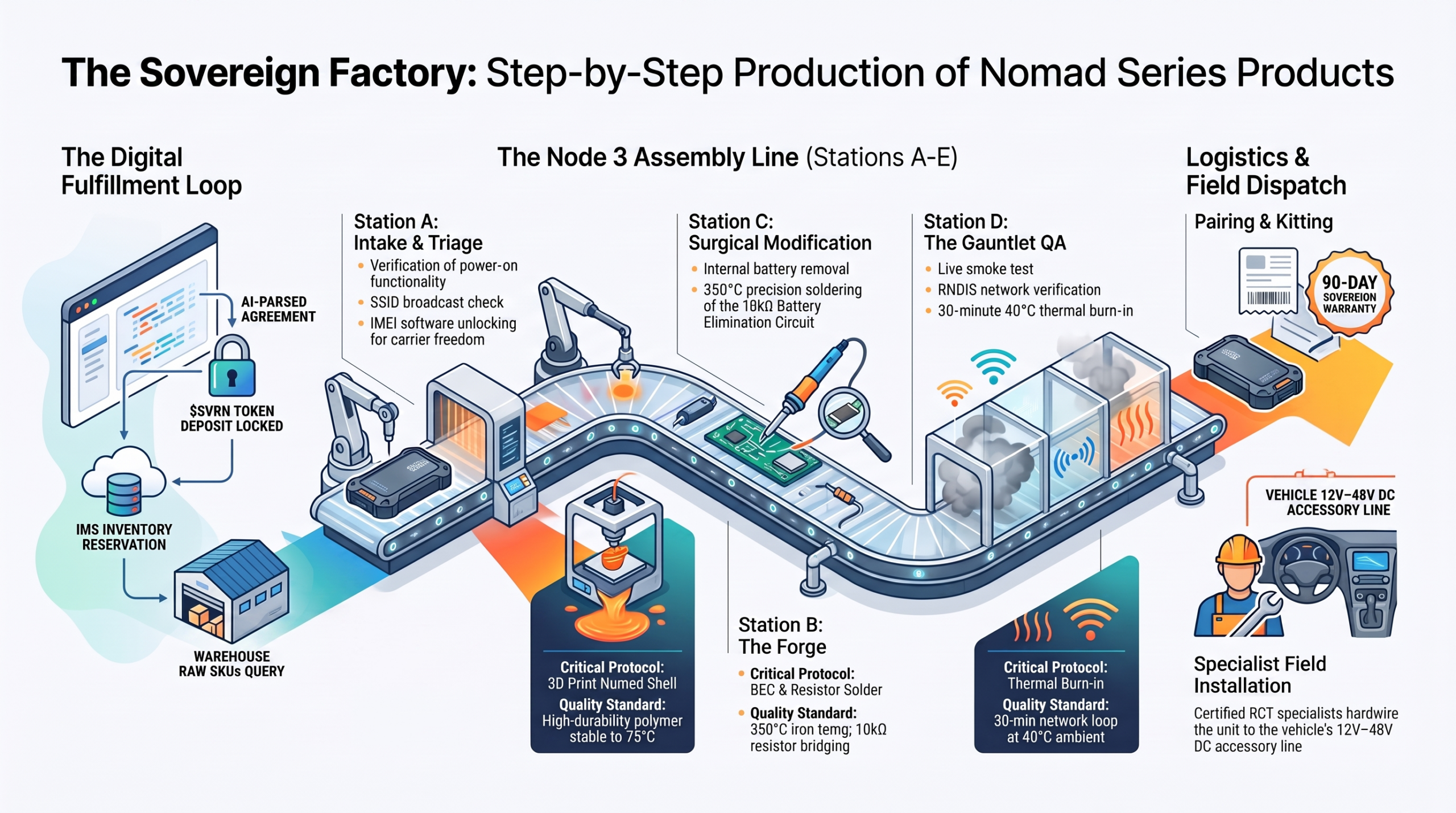
Sovereign Factory Node 3 (Stations A–E) Multi-stage physical manufacturing, surgical modification, and rigorous Gauntlet testing.
Warranty Pairing IMS & WooCommerce Scanning holographic SKU to link Unit Serial Number with Order for 90-day sovereign warranty activation.
Deployment & Dispatch HubSpot & “RCT” Specialists Delivery heartbeat triggers dispatch of DeReticular Academy-certified specialists for field install.
With the conceptual pipeline established, the manual now details the specific mechanics of Phase 1, moving from verbal agreement to programmatic resource commitment.
- Phase 1: Automated Transaction & Resource Allocation
Maintaining the capitalization and inventory integrity of the Sovereign Factory requires absolute automation of the “Handshake” and “Escrow” phases. Before physical labor commences, the system must programmatically verify financial commitment and hardware availability. This protocol eliminates the risk of unbacked labor and ensures the production run is insulated from “Connectivity Chaos” or inventory stock-outs.
At the core of this phase is Hemp-Grade AI, which monitors live sessions for specific agreement triggers. When the AI parses the phrase “Lock this structure,” it initiates the auto-generation of a Microsoft Word Memorandum of Understanding (MOU) and advances the HubSpot Deal to the “MOU Review” stage. This digital handshake ensures that the intent of both parties is captured with surgical precision.
Escrow and Inventory Verification
Upon MOU initiation, the system executes two critical verification protocols:
- The Escrow Lock: A transaction request is routed to InVentures Capital to execute a smart contract on the Locutus Ledger. This process locks a pre-authorized deposit in $SVRN utility tokens (or fiat equivalent). This cryptographic lock guarantees the booking and ensures the production phase is fully capitalized.
- The IMS Reservation: Once the escrow is confirmed, a HubSpot “Run Agent” workflow utilizes the Model Context Protocol (MCP) to query the local warehouse Inventory Management System (IMS). The agent programmatically transitions target hardware from “Raw Stock” to “Reserved.”
Target Hardware SKUs
The following SKUs are the primary targets for allocation during the transition to Gen 5 architecture:
- RIOS-WBB-01: WISP-in-a-Box Base connectivity unit.
- RIOS-NL-01: Standard Nomad Link connectivity unit.
- RIOS-TC-01: Telemetry Core hardware.
Successful inventory reservation provides the terminal “Go” signal for the commencement of physical manufacturing at the Node 3 Sovereign Factory.
- Phase 2: Sovereign Factory Manufacturing SOP (Stations A-C)
The manufacturing process at Node 3 represents a strategic shift toward “small-batch” industrialism. Stations A through C are designed to transform raw, consumer-grade components into ruggedized tactical nodes capable of surviving extreme operational environments.
Station A (The Boneyard): Intake & Triage
- Receipt: Retrieve raw units (e.g., SLG-06 modems) from reserved stock and scan manufacturer serial numbers into the IMS.
- Functional Check: Power on the unit using a temporary battery; verify LCD activation and default SSID broadcast.
- Failure Protocol: Route any units that fail or boot-loop to Bin F. These units are designated for spare parts harvesting to minimize waste stream losses.
- Firmware Check: Verify firmware status. Carrier-locked units must be routed to the Software Bench for immediate IMEI unlocking.
Station B (The Forge): 3D Printing
- Shell Construction: Print custom, honeycomb-ventilated “Nomad Shell” backplates to facilitate maximum airflow.
- Material Specification: Use only high-durability polymer filaments.
- Thermal Requirement: All printed components must maintain structural stability up to 75°C.
Station C (The Operating Table): Technical Guide for Surgical Modification
This station performs the critical transition from battery-dependent consumer hardware to a solid-state, vehicle-integrated tactical node.
- Disassembly: Pop the rear casing clips using a professional-grade plastic spudger.
- Battery Evacuation: Remove the stock lithium-ion battery immediately. It must be placed in a Fire-Safe HAZMAT bin for recycling to prevent potential thermal runaway.
- Soldering Specifications: Set the soldering iron to a precise temperature of 350°C.
- Battery Elimination Circuit (BEC) Installation:
- Solder a 10kΩ resistor between the motherboard’s BSI (Battery Status Indicator) pin and the Negative (-) terminal. This tricks the CPU into detecting a healthy 100% charge.
- Solder the output lines of the Mini-360 Buck Converter directly to the battery’s positive (+) and negative (-) terminals on the board.
- Secure the converter to the PCB using heat-resistant Kapton tape.
- Re-Housing: Discard the original plastic backplate. Snap on the 3D-printed Nomad Shell, ensuring the hardwired fused power whip is correctly routed through the exit port.
These modifications prepare the unit for “The Gauntlet,” where it will be tested for 100% duty cycle reliability.
- Phase 3: The Gauntlet – Quality Assurance & Stress Testing (Station D)
“The Gauntlet” is the mandatory validation phase that ensures Sovereign Nodes can maintain a 100% duty cycle in extreme environments. This contrasts sharply with consumer-grade alternatives that often suffer from thermal shutdown.
Validation Checklist
Technicians must verify the following:
- [ ] Smoke Test: Apply 12V DC power to the input whip. The device must boot instantly and display “Battery: 100%.”
- [ ] Failure Recovery (Protocol Red): If the smoke test fails, initiate Protocol Red—desolder the BSI resistor and re-check resistance values before re-application.
- [ ] Data Verification: Connect the USB-C port to a Linux terminal. Run check_rndis.sh to confirm the device is recognized as usb0/eth1.
- [ ] Network Validation: The script must successfully ping 8.8.8.8 specifically via the internal vSIM network to ensure the routing path is fully validated.
Thermal Burn-In Parameters
Pass Criteria: Thermal Load Test
- Environment: 40°C heat chamber.
- Duration: 30 minutes.
- Load: Continuous heavy network speed-test loop.
- Result: Zero reboots, zero packet drops, and zero thermal throttling.
Following validation, the unit receives a final physical polish. A serialized “DeReticular Modified” tamper-evident void seal is applied over a chassis screw hole to maintain integrity. This transitions the unit to final kitting and secure packaging.
- Phase 4: Kitting, Logistics, and Cryptographic Pairing (Station E)
Station E (The Outpost) manages the final kitting and logistics, ensuring brand identity and 100% traceability.
Kitting Components
Assemble the “Nomad Series” kraft board box with the following:
- Modified Nomad unit (enclosed in an anti-static bag).
- 6-inch high-speed USB-C data cable.
- 3ft fused hardwire power whip (placed at the bottom of the tray).
- CRITICAL: High-visibility yellow Quick Start card marked with the warning: “DO NOT INSERT BATTERY.”
Pairing and Dispatch
The technician must retrieve the pending customer order from the WooCommerce portal. By scanning the holographic SKU label (RIOS-NL-01 or RIOS-WBB-01), the system automatically bridges the physical Unit Serial Number with the order data. This digital lock activates the 90-day sovereign modification warranty. Once paired, a 4×6 thermal shipping label is applied for USPS/UPS dispatch. The physical departure of the unit triggers the automated delivery notification system.
- Phase 5: Field Deployment & Specialist Dispatch
The “Consortium Dispatch” model solves the physical installation barrier by utilizing specialists trained via the DeReticular Academy. This ensures the “Sovereign” hardware is professionally integrated into the client’s environment.
Dispatch and Installation
- Heartbeat Detection: Delivery confirmation in HubSpot triggers a dispatch agent to coordinate a local “RCT – Mobile Specialist.”
- Field Requirements: The specialist must hardwire the fused power whip directly to the vehicle’s 12V–48V accessory line and verify the Telemetry Core sync.
Sovereign Release Mechanism
The fulfillment cycle concludes with the Sovereign Release. Once the installed device writes its initial heartbeat telemetry to the local ledger—serving as the ultimate proof-of-installation—a smart contract is triggered. This automatically releases the $SVRN installation fees from escrow directly to the technician’s digital wallet.
- Technical Reference: Generation 5 Product Matrix
The Generation 5 (Gen 5) portfolio achieves manufacturing efficiency by consolidating the Sovereign Stack into six configurable products.
Gen 5 Configurable Catalog
Product Name Primary Mission Base Hardware Profile MSRP
Product 1: WISP-in-a-Box Base Entry-level secure remote routing Modified SLG-06, pfSense, Starlink bracket $1,497
Product 2: WISP-in-a-Box LTE Turnkey custom remote communications Dual-WAN LTE, LOE Starlink radio, custom shell $4,997
Product 3: WISP-in-a-Box Agentic Air-gapped V2V ledger & calendar sync Dual-WAN WISP + Agentic compute core Config. Dependent
Product 4: Pawnee Power GenSet Standalone baseload microgrid power Multi-fuel Wankel rotary engine, inverters $49,997
Product 5: Pawnee Dune Buggy Lightweight off-road mobility Meyers Manx-style chassis, Wankel APU $99,000
Product 6: Custom Pawnee TAV Flagship armored tactical command Steel-tube chassis, Ogre Skin, full tech stack $450,000
Product 1: WISP-in-a-Box Base (RIOS-WBB-01)
- Connectivity: 4G LTE CAT 6 (300 Mbps Down / 50 Mbps Up).
- Frequency Bands: Global FDD-LTE, TDD-LTE, WCDMA (vSIM coverage in 140+ countries).
- SIM Architecture: vSIM (Primary) + Physical Nano-SIM (Backup Slot).
- Input Voltage: 12V–48V DC via 3ft fused hardwire whip.
- Primary OS: pfSense / OPNsense Embedded.
- Mounting: Includes Heavy-Duty Starlink Business Kit Mounting Strap for roof-rack integration.
Compliance & Warranty: These systems are backed by a 90-day “Works or We Replace It” warranty. All modifications utilize high-quality, shielded DC-DC converters to minimize RF noise and maintain strict FCC compliance.


