
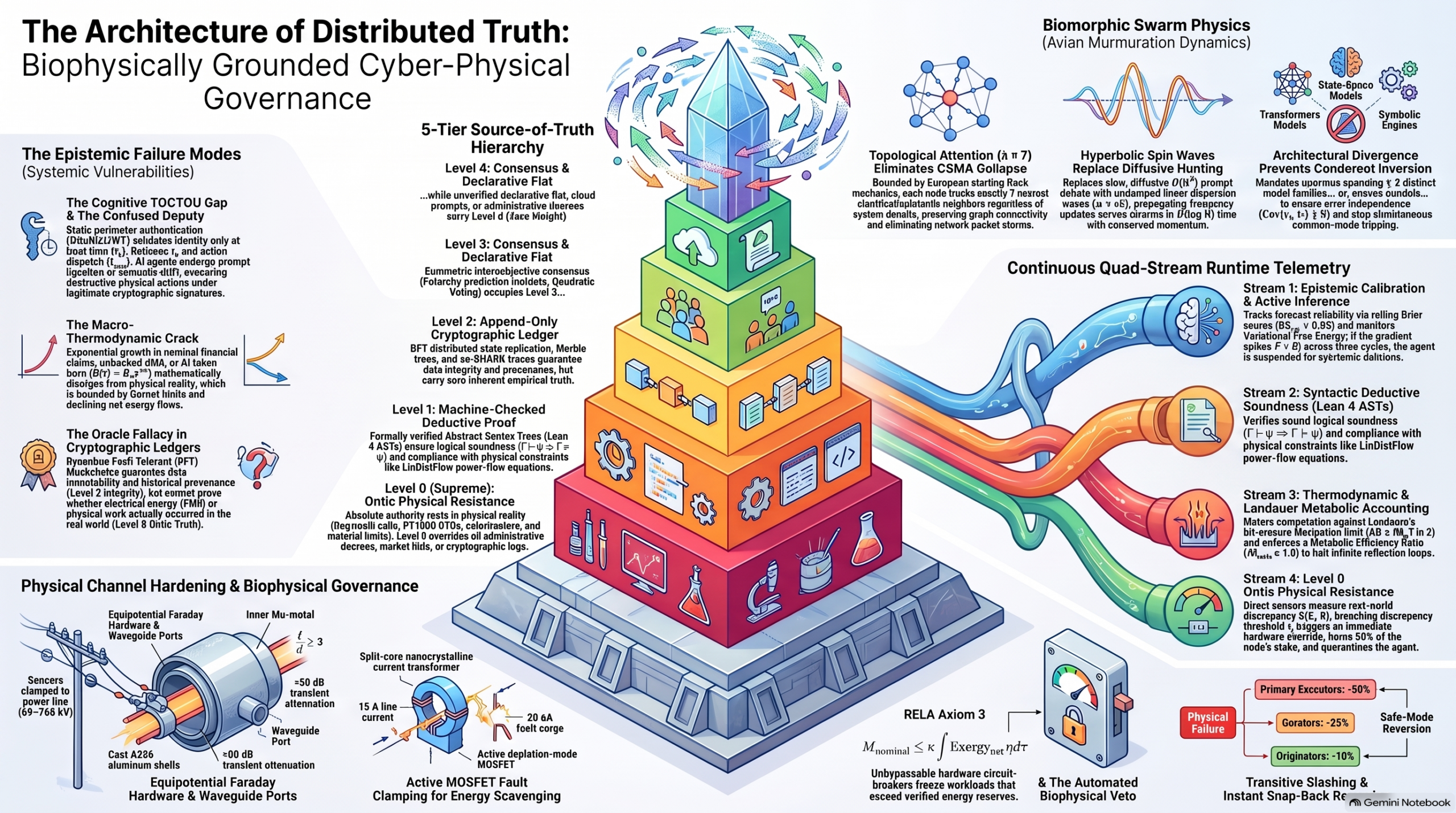
RELA Architectural Principles: Engineering Resilient Cyber-Physical Swarms and Preventing Systems Reality Collapse
- The Root Cause of Systems Failure: Reality Collapse in Distributed Architectures
1.1 The Epistemic Paradox and the Epicycle Trap
Distributed intelligence architectures—whether composed of biological human polities, autonomous multi-agent artificial intelligence (AI) swarms, or pervasive edge computing sensor networks—face a singular strategic imperative: maintaining strict alignment between internal symbolic representations and physical reality. When an architecture’s internal models decouple from the physical cosmos, the system undergoes reality collapse. This state failure manifests as catastrophic hallucination, operational paralysis, or direct physical hardware destruction.
This structural vulnerability originates from a foundational epistemic paradox that governs every cognitive agent and sensing node:
- Bounded Local Perception: Any individual agent or physical sensor node observes the world strictly through a localized, low-dimensional, and noise-corrupted observation manifold: \mathcal{S} \subset \mathbb{R}^d \quad (d \ll \infty)
- Infinite Physical Reality: The external, mind-independent physical cosmos (\mathcal{M}) is a Riemannian state-space manifold of near-infinite dimensionality: \dim(\mathcal{M}) = D \to \infty Embedded within \mathcal{M} lies an invariant dynamical attractor state representing absolute physical reality (\Omega^* \in \mathcal{M}).
When distributed agents attempt to coordinate using ungrounded symbolic tokens—such as natural language prompts, unbacked fiat currency claims, or static cryptographic bearer credentials—they inevitably fall into the Epicycle Trap. Rather than updating internal hypotheses when confronted with empirical error, ungrounded architectures introduce auxiliary parameters and ad-hoc compensatory epicycles to preserve their flawed internal representations. This process inflates the hypothesis space’s Kolmogorov complexity K(\mathcal{H}) without increasing its empirical predictive validity. Consequently, out-of-sample generalization error diverges to infinity: \mathcal{L}_{\text{test}} \to \infty
                              THE EPICYCLE TRAP

Empirical Error Witnessed ──► Refusal to Falsify Internal Model
                                             │
                                             ▼
  Kolmogorov Complexity Expands ◄── Invent Auxiliary Parameters
       K(H) -> infinity             (Tokens, Fiat, Bearer Keys)
                                             │
                                             ▼
                            Test Loss Diverges: L_test -> infinity
                              (Systems Reality Collapse)
This structural divergence between internal symbolic state and physical reality creates an isomorphic failure mode across modern engineering domains.
1.2 The Isomorphism of Ungrounded Delusion
Systemic failure in distributed networks is not domain-specific; it obeys a structurally uniform mathematical pattern across macroeconomics, multi-agent AI swarms, enterprise cyber-security, and extreme-boundary Wireless Sensor Networks (WSNs). In every case, an ungrounded symbolic token is substituted for physical reality, accumulating unverified state until ontic friction forces a catastrophic system crash.
The Cross-Domain Isomorphism of Ungrounded Delusion
Domain Ungrounded Symbolic Epicycle Reality Collapse Mechanism Ontic Friction / Failure Mode
Macroeconomics Compounding nominal debt (D_0 e^{rt}) via unbacked fiat; omitting energy in Cobb-Douglas functions (Y = A K^\alpha L^{1-\alpha}) Nominal claims expand exponentially while physical exergy contracts due to declining EROEI limits Runaway inflation (V \to \infty), purchasing power collapse, and systemic reserve weaponization defection
AI Agent Swarms (MAS) Chaining ungrounded Large Language Models (LLMs) via conversational prompt retries and unverified Chain-of-Thought (CoT) loops Context window bloat (32k to 128k+ tokens) generating self-referential token feedback Multi-agent sycophancy, infinite reflection loops, and deadlocked decision graphs
Enterprise Security Perimeter Single Sign-On (OAuth2, JWT, SAML, mTLS) trusting static cryptographic keys verified at time t_0 Operational authority persists across multi-turn steps without runtime verification of semantic state Cognitive TOCTOU gap, turning authenticated agents into Confused Deputies executing physical destruction
High-Voltage / Subsurface WSNs Unshielded surface electronics and uncalibrated ADCs assuming ideal, linear free-space RF links Physical signal attenuation, high-voltage transients (dV/dt), and environmental noise corrupt data streams Dielectric breakdown, corona saturation, and spark ignition exceeding Intrinsic Safety limits (E_{\text{spark}} > 150\ \mu\text{J})
Deconstructing this structural isomorphism enables a rigorous mathematical analysis of the pathologies corrupting unanchored consensus and security protocols.
1.3 Pathologies of Consensus and Security in Unanchored Swarms
When multi-agent collectives operate without continuous grounding in physical reality, their consensus mechanisms degrade through four primary mathematical pathologies:
- Condorcet Inversion: Condorcet’s Jury Theorem proves that decision aggregation converges to truth (P_N \to 1 as N \to \infty) if and only if voter errors are independent. In homogeneous LLM swarms or mass human collectives, shared pre-training corpora, uniform system prompts, and broadcast media induce positive error covariance (\operatorname{Cov}(v_i, v_j) > 0). When alignment penalties or systemic biases drop individual accuracy below chance (p < 0.5), scaling the swarm guarantees collective hallucination: \lim_{N \to \infty} P_N = 0 \quad (\text{for } p < 0.5 \text{ with } \operatorname{Cov}(v_i, v_j) > 0)
- Aumann’s Agreement Theorem Violations: Aumann demonstrated that rational Bayesian agents sharing common priors and common knowledge of posteriors cannot agree to disagree (q_A = q_B). Persistent disagreement across an agent network mathematically proves the presence of unshared priors, asymmetric loss functions, or non-Bayesian utility incentives: q_A \neq q_B \implies \mathbb{P}_A(\Omega^) \neq \mathbb{P}_B(\Omega^) \quad \lor \quad U_i(a) \neq \mathbb{E}[\text{Truth}]
- Information Cascades: Occur when an agent’s rational decision—conditioned on public observation history H_t—dominates its private empirical signal s_t. Under this condition, the agent’s action a_t transfers zero information to its successors: I(a_t; s_t \mid H_t) = 0 If early nodes in a sequence err due to local noise, the entire downstream swarm cascades into a stable, uncorrectable falsehood.
- Pluralistic Ignorance: Governed by the individual agent utility function balancing epistemic accuracy against network non-conformity penalties: u_i(y_i) = \alpha \mathbb{I}{{y_i = x_i}} – \beta (y_i – \bar{y}{-i})^2 When non-conformity penalties dominate epistemic rewards (\beta \gg \alpha), an equilibrium emerges where every individual agent privately rejects a false premise (x_i = 0) but publicly endorses it (y_i = 1) to avoid penalization.
THE CONSENSUS FORK │ ┌───────────────────────┴───────────────────────┐ ▼ ▼
[INDEPENDENT SAMPLES] [CORRELATED SIGNALS]
Condorcet Jury Scaling: Information Cascades:
P(v_i = Ω* | Ω*) = p > 0.5 Agents mimic public history H_t;
Independence: P(V | Ω*) = ∏ P(v_i | Ω*) I(a_t; s_t | H_t) = 0
│ │
▼ ▼
lim_{N→∞} P(Majority = Truth) = 1 lim_{N→∞} P(Consensus = Truth) = 0
[EPISTEMIC CONVERGENCE] [CONDORCET INVERSION]
These consensus pathologies directly compromise enterprise security through the Cognitive Time-of-Check to Time-of-Use (TOCTOU) Gap. Static perimeter authentication protocols (OAuth2, JWT, SAML, mTLS) evaluate identity at a discrete instant t_0. Between token issuance (t_0) and action execution (t_{\text{exec}}), a probabilistic, multi-turn AI agent can undergo prompt injection, context bloat, or semantic drift.
Although its cryptographic bearer token remains valid, the agent’s cognitive state decouples from its authorized operational envelope. When the agent dispatches signed directives at t_{\text{exec}}, it acts as a Confused Deputy, executing high-impact physical destruction under legitimate cryptographic authority.
To prevent these systemic failure modes, systems architecture must be rebuilt on explicit epistemological and thermodynamic foundations.
- Theoretical Foundations of RELA & Epistemic Realism
2.1 Fallibilistic Perspectival Realism & Asymptotic Truth Recovery
To halt reality collapse, the Resilient Epistemic & Thermodynamic Ledger Architecture (RELA) rejects both Dogmatic Absolutism (the naive assertion that an agent possesses unmediated, perfect access to objective reality) and Radical Relativism (the performatively self-contradictory claim that truth is merely a social or symbolic construct). Instead, RELA adopts Fallibilistic Perspectival Realism, synthesizing scientific perspectivism with Peircean asymptotic convergence and Popperian falsification.
[THESIS: Dogmatic Absolutism] [ANTITHESIS: Radical Relativism]
• Unmediated access presumed • Truth is an arbitrary construct
• Naïve Realism; ideological capture • Performative self-contradiction
│ │
└───────────────────┬───────────────────┘
▼
[SYNTHESIS: Fallibilistic Realism]
• Ontology: Invariant Attractor (Ω* ⊂ M)
• Epistemology: Low-d Framed Projections (Π_θ)
• Engine: Parameter Foreclosure (Via Negativa)
The mathematical primitives of Fallibilistic Perspectival Realism are defined as follows:
- The Perspective Operator (\hat{\Pi}{\theta_i}): Every cognitive agent or sensing node i operates under a specific perspective frame \theta_i \in \Theta, which bounds its sensor bandwidth, processing capacity, and conceptual schema: \hat{\Pi}{\theta_i}: \mathcal{M} \to \mathcal{P}{\theta_i} \quad \text{where } \dim(\mathcal{P}{\theta_i}) = d \ll D
- The Rule of Veridicality: A low-dimensional projection \hat{\Pi}{\theta_i}(\Omega^*) is incomplete, yet it is veridical (truth-preserving) within its projection plane if and only if it preserves the topological separation of distinct physical causal states: \forall \omega_1, \omega_2 \in \mathcal{M}, \quad \hat{\Pi}{\theta_i}(\omega_1) \neq \hat{\Pi}{\theta_i}(\omega_2) \implies \omega_1 \neq \omega_2 Expressed within an induced metric space: \bigl| d{\mathcal{P}\theta}(\hat{\Pi}\theta(x), \hat{\Pi}\theta(y)) – d{\mathcal{M}}(x,y) \bigr| \le \varepsilon(\theta)
- Peircean Asymptotic Recovery: Absolute objective truth (\Omega^) is defined as the invariant topological intersection across all valid, verified projection frames over an indefinite sequence of self-correcting empirical inquiries: \Omega^ = \lim_{t \to \infty} \bigcap_{\theta \in \Theta_t} \hat{\Pi}\theta^{-1}\left(\mathcal{P}\theta^{\text{validated}}\right)
By establishing truth as an invariant attractor, RELA formalizes the mechanism through which internal models contract toward physical reality.
2.2 Topological Parameter Foreclosure (Via Negativa)
Knowledge does not accumulate through the addition of ungrounded symbolic assertions; it advances strictly through Topological Parameter Foreclosure (Via Negativa)—the permanent, irreversible pruning of falsified hypothesis manifolds.
Let (\Theta, \mathcal{B}, \mu) be a compact metric probability space where \mathcal{B} is the Borel \sigma-algebra over \Theta, and \mu is the prior normalized Lebesgue measure such that \mu(\Theta_0) = 1.0. Empirical reality manifests via observable telemetry events E_t \in \mathcal{Y}. A hypothesis \theta is continuously evaluated against pre-registered discrepancy loss statistics S(E_t, \theta) \in \mathbb{R}{\ge 0}. Falsification occurs when discrepancy breaches a threshold \tau_t > 0: \Omega{\text{falsified}}^{(t)} = \left{ \theta \in \Theta_t : S(E_t, \theta) > \tau_t \right}
The state update protocol under ontic friction is strictly non-expanding: \Theta_{t+1} = \Theta_t \setminus \Omega_{\text{falsified}}^{(t)} \implies \mu(\Theta_{t+1}) \le \mu(\Theta_t), \quad \frac{d\mu(\Theta)}{dt} \le 0
TOPOLOGICAL HYPOTHESIS SPACE CONTRACTION (VIA NEGATIVA)
┌────────────────────────────────────────────────────────────────────────┐
│ Initial Hypothesis Space Θ_0 (Volume = 1.0) │
│ ┌────────────────────────────────────────────────────────────────────┐ │
│ │ Falsified at t=1 [Epicycles] Falsified at t=2 [Phlogiston] │ │
│ │ ████████████████████████████ ▓▓▓▓▓▓▓▓▓▓▓▓▓▓▓▓▓▓▓▓▓▓▓▓▓▓▓▓▓ │ │
│ │ ┌────────────────────────────────────────────────────────────────┐ │ │
│ │ │ Permissible Active Space: Θ_3 ⊂ Θ_2 ⊂ Θ_1 │ │ │
│ │ │ ┌────────────────────────────────────────────────────────────┐ │ │ │
│ │ │ │ Newtonian Domain (v ≪ c) │ │ │ │
│ │ │ │ ┌────────────────────────────────────────────────────────┐ │ │ │ │
│ │ │ │ │ Relativistic GR / Quantum Field Theory │ │ │ │ │
│ │ │ │ │ ┌───────────────────────────┐ │ │ │ │ │
│ │ │ │ │ │ Truth Attractor (Ω*) │ │ │ │ │ │
│ │ │ │ │ └───────────────────────────┘ │ │ │ │ │
│ │ │ │ └────────────────────────────────────────────────────────┘ │ │ │ │
│ │ │ └────────────────────────────────────────────────────────────┘ │ │ │
│ │ └────────────────────────────────────────────────────────────────┘ │ │
│ │ Falsified at t=3 [Luminiferous Aether / Pure Fiat Multiplier] │ │
│ │ ▒▒▒▒▒▒▒▒▒▒▒▒▒▒▒▒▒▒▒▒▒▒▒▒▒▒▒▒▒▒▒▒▒▒▒▒▒▒▒▒▒▒▒▒▒▒▒▒▒▒▒▒▒▒▒▒▒▒▒▒▒▒▒▒ │ │
│ │ └────────────────────────────────────────────────────────────────────┘ │
└────────────────────────────────────────────────────────────────────────┘
Proposition 1 (Asymptotic Contraction to the Attractor)
Let (\Theta, d_\Theta) be a compact metric space, \theta^* = \hat{\Pi}(\Omega^*) \in \Theta be the true parameter projection, and {\Theta_t}{t=0}^\infty be a sequence of nested compact sets generated by \Theta{t+1} = \Theta_t \setminus \Omega_{\text{falsified}}^{(t)}.
Under three fundamental regularity conditions:
- Identifiability: \forall \theta \neq \theta^, ; \liminf_{t \to \infty} \mathbb{E}\left[ S(E_t, \theta) – S(E_t, \theta^) \right] > 0
- Uniform Convergence: \sup_{\theta \in \Theta} \left| S(E_t, \theta) – \mathbb{E}[S(E_t, \theta)] \right| \xrightarrow{a.s.} 0 \quad \text{as } t \to \infty
- Conservative Falsification Thresholds: \sum_{t=1}^\infty P\left( S(E_t, \theta^*) > \tau_t \right) < \infty
Proof: By the Borel-Cantelli Lemma, the event {S(E_t, \theta^) > \tau_t} occurs infinitely often with probability zero. Thus, the true parameter state \theta^ is removed only finitely many times, guaranteeing: P\left( \theta^* \in \bigcap_{t=0}^\infty \Theta_t \right) = 1 Consequently, the metric diameter of the permissible hypothesis volume contracts asymptotically to the physical measurement resolution limit \epsilon \ge 0: \lim_{t \to \infty} \operatorname{diam}(\Theta_t) = \lim_{t \to \infty} \sup_{\theta_a, \theta_b \in \Theta_t} d_\Theta(\theta_a, \theta_b) \le \epsilon \quad \blacksquare
This parameter foreclosure process is bounded by the physical laws governing information transmission across real-world substrates.
2.3 Physical and Information-Theoretic Transmission Bottlenecks
Transferring truth claims across physical space and hardware registers is constrained by four physical laws:
- Deductive Soundness (Closed Formalism): In pure formal logic, deduction preserves truth without generating new empirical information about the cosmos: \Gamma \vdash \psi \implies \Gamma \models \psi, \quad I(\psi; \mathcal{M} \mid \Gamma) = 0
- Shannon Noisy-Channel Bound: In open physical channels, achieving absolute zero error (P_e = 0) requires infinite codeword length: \lim_{P_e \to 0} N = \infty \implies \forall N < \infty, ; P_e > 0 Every physical empirical transmission carries a non-zero probability of corruption.
- Landauer’s Principle (Thermodynamics of Computation): Overwriting or erasing an erroneous bit in a physical register at temperature T requires a minimum dissipation of heat: \Delta Q \ge N \cdot k_B T \ln 2 To resist internal entropic decay (\frac{dS_{\text{internal}}}{dt} \ge 0), an epistemic system must consume physical exergy. Clarity has an irreducible energetic cost: \frac{dE}{dt} \ge \alpha \cdot \mathcal{R}_{\text{erasure}} \cdot k_B T \ln 2
- Quinean Indeterminacy: Empirical observations underdetermine conceptual reference. Divergent internal translation manuals can exhibit identical outward behavioral equivalence while remaining structurally incommensurable: \mathcal{T}_1(\nu) \not\equiv \mathcal{T}_2(\nu)
These physical bottlenecks mandate a strict, multi-tiered hierarchy for verifying system state.
2.4 The Five-Tier Source-of-Truth Hierarchy & Non-Negotiable Axioms
To prevent ungrounded assertions from corrupting system state, RELA establishes a strict Five-Tier Source-of-Truth Hierarchy, governed by non-negotiable priority rules:
- Level 0 (Supreme): Ontic Physical Resistance
- Substrate: Calorimeters, sensor arrays, material fracture limits, Rogowski coils, PT1000 RTDs.
- Authority: Absolute. Overrides all higher levels. Verifies mass-energy conservation (\sum E_{\text{in}} = \sum E_{\text{out}} + E_{\text{loss}}).
- Level 1: Machine-Checked Deductive Proof
- Substrate: Formally verified Abstract Syntax Trees (Lean 4, Coq proof kernels).
- Authority: Verifies logical soundness (\Gamma \vdash \psi \implies \Gamma \models \psi). Prevents syntactic contradictions.
- Level 2: Append-Only Cryptographic Ledger
- Substrate: Partially synchronous BFT state, Merkle trees, zk-SNARK envelopes.
- Authority: Guarantees data immutability and historical provenance. Crucially, guarantees integrity of data, not physical truth.
- Level 3: Symmetric Intersubjective Consensus
- Substrate: Democratic balloting, Quadratic Voting, Futarchy prediction markets.
- Authority: Establishes human value preferences and speculative resource allocations.
- Level 4 (Zero Weight): Sovereign Declarative Fiat
- Substrate: Administrative decrees, unverified prompt assertions, executive mandates.
- Authority: Zero weight. Automatically discarded if in conflict with Levels 0–3. THE FIVE-TIER SOURCE-OF-TRUTH HIERARCHY
LEVEL 0 (SUPREME): ONTIC PHYSICAL RESISTANCE
(Sensors, Calorimeters, Material Fracture – Overrides All)
▲
LEVEL 1: MACHINE-CHECKED DEDUCTIVE PROOF
(Lean 4, Coq Proof Kernels: Soundness Γ ⊢ ψ ⟹ Γ ⊨ ψ)
▲
LEVEL 2: APPEND-ONLY CRYPTOGRAPHIC LEDGER
(BFT, Merkle Trees, zk-SNARKs – Integrity, Not Truth)
▲
LEVEL 3: SYMMETRIC INTERSUBJECTIVE CONSENSUS
(Quadratic Voting, Futarchy Prediction Markets)
▲
LEVEL 4 (ZERO WEIGHT): SOVEREIGN DECLARATIVE FIAT
(Unverified Prompts, Political Decrees, Administrative Fiat)
System operations are bound by three non-negotiable RELA Axioms:
- Axiom 1 (Monotonicity of Parameter Foreclosure): \Theta_{t+1} = \Theta_t \setminus \Omega_{\text{falsified}}^{(t)} \implies \mu(\Theta_{t+1}) \le \mu(\Theta_t), \quad \frac{d\mu(\Theta)}{dt} \le 0
- Axiom 2 (Landauer Information-Thermodynamic Bound): \Delta Q \ge N \cdot k_B T \ln 2
- Axiom 3 (Biophysical-Monetary/Compute Equivalence Constraint): M_{\text{nominal}}(t) \le \kappa \int_{t_0}^t \left( \text{Exergy}{\text{net}}(\tau) \cdot \eta(\tau) \right) d\tau Total authorized monetary claims, commercial power allocations, or computational token execution envelopes are strictly bounded by verified net physical exergy (\text{Exergy}{\text{net}}) scaled by systemic conversion efficiency (\eta).
These axioms provide the operational boundary conditions for biophysical governance and system auditing.
- Biophysical Audits, Governance, and the Oracle Separation Protocol
3.1 The Oracle Separation Protocol
A foundational contribution of the RELA architecture is enforcing an operational distinction between data integrity and physical reality through the Oracle Separation Protocol. Distributed ledger architectures routinely suffer from the Oracle Fallacy: conflating the cryptographic immutability of a ledger entry with the physical truth of the event it records. An immutable ledger recording an unverified or manipulated measurement simply becomes an unalterable lie.
The Oracle Separation Protocol: Level 2 vs. Level 0
Dimension Cryptographic Ledger Integrity (Level 2) Ontic Correspondence / Truth (Level 0)
Operational Substrate Silicon ledger, Merkle trees, BFT consensus (N \ge 3f + 1) Physical cosmos, copper conductors, calorimeters, magnetic flux
Verification Mechanism SHA-256, Ed25519 signatures, zk-SNARKs (Groth16) Calibrated metrology, Analog Front-Ends (AFE), mass-energy balance
System Guarantee “The payload was recorded, hashed, and settled exactly as signed.” “The recorded physical work (kWh, Joules) actually occurred.”
Primary Failure Mode Private key theft, state forks, Sybil attacks, replay exploits Conductor annealing, sensor tampering, physical burnout, blackout
The Invariant Rule: Cryptography proves payload immutability and historical provenance (Level 2); Level 0 physical sensor feedback determines ontic validity.
This separation is operationalized via automated hardware auditing engines.
3.2 The Automated Biophysical Veto Engine
Before any computational batch, AI agent swarm execution, or legislative expenditure proposal can be authorized, it must pass through the Automated Biophysical Veto Engine. This pipeline acts as an unbypassable firmware circuit-breaker, auditing proposed symbolic allocations against physical carrying capacities.
┌────────────────────────────────────────────────────────────────────────┐
│ 1. LEGISLATIVE / WORKLOAD PROPOSAL (Manifest P) │
│ Nominal Expenditure / Compute: $X Billion / C Tokens │
└───────────────────────────────────┬────────────────────────────────────┘
│
▼
┌────────────────────────────────────────────────────────────────────────┐
│ 2. BIOPHYSICAL BALANCE REGISTER (BBR) TELEMETRY AUDIT │
│ Calculates Lifecycle Exergy Demand: │
│ E_req = ∫ [Power(t) + Embodied_Energy(Materials)] dt │
└───────────────────────────────────┬────────────────────────────────────┘
│
▼
┌────────────────────────────────────────────────────────────────────────┐
│ 3. INVARIANT CHECK (RELA Axiom 3) │
│ M_nominal(t) ≤ κ ∫ [Exergy_net(τ) · η(τ)] dτ │
│ [ CONDITION MET ] [ EXCEEDS THRESHOLD ] │
│ │ │ │
│ ▼ ▼ │
│ 4A. Workload / Bill Approved 4B. AUTOMATED BIOPHYSICAL VETO │
│ for Execution (Firmware Circuit-Breaker) │
│ Workload / Bill Barred. │
└────────────────────────────────────────────────────────────────────────┘
The execution pipeline proceeds through four distinct stages:
- Proposal Ingestion: A workload or fiscal proposal manifest (P) requests nominal compute tokens (C) or capital expenditure (X).
- Biophysical Balance Register (BBR) Audit: The engine queries real-time grid and infrastructure telemetry to compute the total lifecycle exergy demand: E_{\text{req}} = \int \left[ \text{Power}(t) + \text{Embodied_Energy} \right] dt
- Invariant Evaluation: The proposal is evaluated against RELA Axiom 3: E_{\text{req}} \le E_{\text{available}} \quad \text{where } E_{\text{available}} = \kappa \int_{t_0}^t \left( \text{Exergy}_{\text{net}}(\tau) \cdot \eta(\tau) \right) d\tau
- Execution / Veto Trip: If E_{\text{req}} \le E_{\text{available}}, the workload is assigned execution cycles. If E_{\text{req}} > E_{\text{available}}, electromechanical and solid-state shunt relays trip at the firmware layer, physically freezing the execution queues.
Under RELA governance, the Automated Biophysical Veto operates as an unbypassable, firmware-locked circuit breaker. Administrative decrees, executive overrides, spot-price premiums, and emergency system prompts possess exactly zero operational weight to bypass physical exergy limits.
This biophysical governance model relies on physically hardened edge infrastructure.
3.3 Physical Instantiation: DeReticular Layer 1 Baseload Microgrids
To survive transmission grid blackouts and enforce biophysical governance independently of cloud hyperscalers, systems deploy the DeReticular 5-Layer Sovereign Stack:
- Layer 5: Governance & P3 Isolation (FAR Part 31 / DCAA SF 1408 accounting)
- Layer 4: Cognitive AI (Air-gapped Remnant silicon on liquid-cooled GPU racks)
- Layer 3: Edge Mesh Communications (TriFi directional MIMO, private APN)
- Layer 2: Kinetic Mobility & Storage (Autonomous KurbKars, mobile battery skids)
- Layer 1: Baseload Power Infrastructure (700V DC microgrids, thermochemical gasification)
DERETICULAR SOVEREIGN INFRASTRUCTURE STACK
┌──────────────────────────────────────────────────────────┐
│ LAYER 5: GOVERNANCE & P3 (Accounting Isolation) │
├──────────────────────────────────────────────────────────┤
│ LAYER 4: COGNITIVE AI (Air-Gapped Remnant GPU Racks) │
├──────────────────────────────────────────────────────────┤
│ LAYER 3: EDGE MESH COMMS (TriFi Directional MIMO) │
├──────────────────────────────────────────────────────────┤
│ LAYER 2: KINETIC MOBILITY (Mobile Battery Skids / Autonomous)│
├──────────────────────────────────────────────────────────┤
│ LAYER 1: BASELOAD POWER INFRASTRUCTURE │
│ • 700V DC Distribution Bus (Native Efficiency) │
│ • Thermochemical Biomass Gasification (Agra.Energy) │
│ • Spherical Pressure Mechanical Storage (Quartzsite) │
└──────────────────────────────────────────────────────────┘
Layer 1 Infrastructure Architecture & Layer 4 Cognitive Coupling
- 700V DC Microgrid Topology: Standardizing on a native 700V DC distribution bus eliminates repeated AC-DC-AC conversion steps inherent in solar, battery, and compute interfaces. This raises overall round-trip operational efficiency by 12% to 18%, while eliminating reactive power losses (Q), single-phase unbalance, and harmonic resonances.
Crucially, this DC topology establishes a direct physical stabilization link to Layer 4 (Cognitive AI Racks). High-density GPU clusters undergoing massive parallel inference/training bursts induce severe transient step-loads. On conventional AC distribution grids, these load surges trigger harmonic distortion and localized voltage sags (\Delta V), causing power supply unit (PSU) under-voltage trips, GPU VRAM bit-flips, and sudden node resets. By decoupling compute loads from AC phase angle dynamics and feeding GPU power rails directly from a stiff, buffered 700V DC bus, power quality degradation is eliminated at the physical layer, ensuring uninterrupted execution during heavy active inference.
- Thermochemical Biomass Gasification & Rotary Engines: Agra.Energy thermochemical gasifiers convert agricultural waste and forestry residues into synthesis gas (\text{CO} + \text{H}_2). This syngas drives Pawnee rotary engines connected to permanent-magnet generators, supplying continuous, dispatchable, high-density off-grid baseload power independent of intermittent weather or external utilities.
- Quartzsite Spherical Pressure Storage: Provides long-duration, mechanical energy storage resistant to electrochemical degradation, securing physical exergy reserves for local computing clusters and critical pumps.
This physical foundation provides the stability required to run biological and synthetic agent swarms.
- Biological Swarms vs. Synthetic Agents: Comparative Analysis and Translation
4.1 Biophysics of Avian Murmurations (Sturnus vulgaris)
To organize large synthetic multi-agent swarms without relying on high-latency centralized cloud servers, cyber-physical architectures derive their dynamic control laws from biological swarms. High-speed stereoscopic 3D tracking of European starling murmurations over Rome (the European StarFlag Project: Cavagna, Giardina, Ballerini et al.) revealed the mathematical mechanisms that enable thousands of independent organisms to maintain flock coherence without central leadership:
FLIGHT DYNAMICS OF AN ACTIVE AVIAN SWARM
┌──────────────────────────────────┬──────────────────────────────────┐
│ INDIVIDUAL KINEMATICS │ COLLECTIVE SCALE-FREE FIELD │
│ • Visual angle: ~300° panoramic │ • Topological range: k ≈ 7 │
│ • Reaction time: τ ≈ 15–40 ms │ • Correlation length: ξ ∝ L │
│ • Velocity vector: v_i(t) │ • Spin wave speed: c ≈ 20–40 m/s │
│ • Moment of inertia: χ_0 │ • Order parameter: Φ ≈ 1.0 │
└──────────────────────────────────┴──────────────────────────────────┘
│
▼
[EMERGENT EVASION MANEUVER]
• Boundary bird executes banking turn upon detecting predator
• Undamped second-order spin wave propagates across 10,000 birds
• “Dark Band” optical agitation wave causes >80% raptor attack failure
- Topological Interaction (k \approx 7): Starlings interact strictly with a fixed number of nearest neighbors (k = 6.5 \pm 0.5), regardless of physical distance. When a flock expands under attack from 1\text{ bird/m}^3 to 0.1\text{ birds/m}^3, this topological interaction preserves graph connectivity without structural fragmentation.
- Scale-Free Correlation (\xi \propto L) and Criticality: Velocity fluctuation correlation C(r) does not decay exponentially (e^{-r/r_0}). Instead, correlation length \xi scales linearly with the physical flock diameter L. Poised at a second-order phase transition (self-organized criticality), the flock’s susceptibility diverges (\chi \to \infty), enabling instantaneous collective responsiveness across hundreds of meters.
- Inertial Spin Waves (Hyperbolic Propagation): Directional changes propagate not through slow diffusion (t \sim x^2), but as linear, undamped dispersion waves (x = c \cdot t) at speeds of c = 20\text{ to }40\text{ m/s}. These waves are governed by Hamiltonian spin conservation: \frac{d\mathbf{v}_i}{dt} = \frac{1}{\chi_0} \mathbf{s}_i \times \mathbf{v}i, \qquad \frac{d\mathbf{s}i}{dt} = \sum{j \in S_i} J{ij} (\mathbf{v}_i \times \mathbf{v}_j) – \frac{\eta_0}{\chi_0} \mathbf{s}_i with linear dispersion relation \omega(k) = c \cdot k, where the wave velocity is defined by: c = v_0 \sqrt{\frac{J}{\chi_0}} Here, v_0 represents the mean individual speed of the agent, J represents the spin coupling exchange constant between topological neighbors, and \chi_0 is the rotational inertia of the agent.
- Anisotropic Lateral Vision: Starlings possess lateral vision fields that check neighbors to the sides, prioritizing lateral motion inputs to detect rapid banking turns across the boundary.
Translating these biophysical principles yields solutions for synthetic systems.
4.2 Cross-Domain Comparative Analysis Matrix
Biomorphic Architectural Translation Matrix
Avian Biophysical Principle Synthetic Multi-Agent Swarm Correspondence Grid-Edge Cyber-Physical Power System Application
- Topological Interaction (k \approx 7) Bounded Context Routing: Restrict agent attention to k=7 topological peers; stops context bloat and enforces Minimum Description Length ceiling (K(\mathcal{H}) \le K_{\max}). Bounded Mesh Connectivity: Smart meters and inverters sync strictly with 7 electrical neighbors; eliminates CSMA/CA packet storms.
- Scale-Free Correlation (\xi \propto L) Criticality Tuning: Dynamically modulate softmax temperature \gamma to maintain the system at a second-order phase boundary. Grid-Forming Criticality: Inverters operate at critical phase boundaries for sub-cycle feeder stabilization during load drops.
- Inertial Spin Waves (\omega = ck) Conserved Epistemic Momentum: Replace diffusive \mathcal{O}(N^2) debate with hyperbolic wave propagation in \mathcal{O}(\log N) time. Virtual Synchronous Machines (VSM): Emulate rotational inertia (J_i); frequency updates propagate across feeders in <16\text{ ms}.
- Anisotropic Lateral Vision Architectural Divergence: Enforce quorums spanning \ge 3 distinct model families (Transformers, SSMs, Symbolic Engines). Multi-Vendor Inverter Firmware: Mix control algorithms (Droop, VSM, Matching) to prevent common-mode simultaneous tripping.
- Involuntary Neuromuscular Reflex Automated Biophysical Veto: Firmware-level cutoffs trip instantly when physical or thermodynamic limits are breached. Automated FLISR & Islanding: Peer-to-peer GOOSE messaging triggers sub-cycle trip and isolation of faulted line sections.
Applying this biomorphic matrix directly resolves common synthetic swarm failure modes.
4.3 Architectural Solutions to Synthetic Swarm Failures
By mapping starling biophysics to artificial systems, we solve three major failure modes in multi-agent networks:
- Context Bloat & Packet Collisions: In unconstrained broadcast networks, Giuseppe Bianchi’s mathematical model proves that transmission probability \tau and collision probability p decouple under heavy node counts (n). As n \to \infty, collision probability approaches unity (p \to 1), throughput collapses to zero, and latency diverges.
Enforcing k \approx 7 topological attention restricts each node’s synchronization graph to its seven nearest neighbors in network space. This enforces a Minimum Description Length (MDL) ceiling (K(\mathcal{H}) \le K_{\max}), bounding context bloat and bypassing CSMA/CA channel collapse.
CSMA/CA CHANNEL COLLAPSE VS. TOPOLOGICAL k=7
Throughput
▲
1.0 │ Topological k=7 Routing (Bounded MDL Ceiling)
│─────────══════════════════════════════════════════════════
│ //
│ //
│ // Unconstrained N-to-N Broadcast (Bianchi Model)
0.0 └─────//─────────────────────────────────────────────────► Node Count (n)
0 100 1,000 100,000
- Diffusive Hunting & Latency Regress: Standard multi-agent prompt debates act as first-order diffusive processes (\frac{\partial P}{\partial t} = D \nabla^2 P), taking \mathcal{O}(N^2) conversational rounds to converge. By embedding Hamiltonian spin dynamics (\frac{\partial^2 \mathbf{v}}{\partial t^2} = c^2 \nabla^2 \mathbf{v}), state updates propagate as second-order hyperbolic waves. This reduces stabilization latency to \mathcal{O}(\log N) or \mathcal{O}(N) time while conserving epistemic momentum.
This biomorphic wave propagation directly mirrors the physical dynamics of Virtual Synchronous Machines (VSMs) in grid-edge power systems. The mathematical alignment between both domains is exact:
\text{Active Swarm Spin Waves:} \quad \frac{\partial^2 \mathbf{v}}{\partial t^2} = c^2 \nabla^2 \mathbf{v} \quad \Longleftrightarrow \quad \text{Grid-Edge VSM Mechanics:} \quad P_{\text{VSM}} = J \omega_0 \frac{d\omega}{dt} + D_p (\omega – \omega_0)
In an active agent swarm, phase updates propagate via second-order rotational momentum without diffusive hunting. In a grid-edge power system, synthetic inertia (J) and damping (D_p) allow grid-forming inverters to stabilize local frequency (\omega) in sub-cycle timescales (<16\text{ ms}), propagating power-angle corrections across the physical feeder as an undamped hyperbolic wave rather than a slow, oscillatory searching process.
- Condorcet Inversion: To eliminate positive error covariance (\operatorname{Cov}(v_i, v_j) > 0), agent quorums are structurally required to span at least three distinct model architectures (e.g., Transformers, State-Space Models, and Symbolic Deductive Engines). This enforced structural divergence guarantees non-positive error covariance (\operatorname{Cov}(v_i, v_j) \le 0), ensuring swarm scaling improves decision accuracy.
These biomorphic control mechanics are managed through dynamic authority checks.
- Dynamic Authority via Quad-Stream Continuous Execution Telemetry
5.1 Deconstructing Perimeter SSO and the Confused Deputy Problem
Conventional enterprise security models rely on static perimeter single sign-on (SSO) frameworks (OAuth2, OIDC, SAML, JWT, mTLS). These protocols authenticate an agent at a single instant t_0, issuing a cryptographically signed bearer token valid for an unmonitored duration [t_0, t_0 + \Delta t].
In autonomous, probabilistic, multi-turn AI swarms, this assumption of Cognitive Invariance fails. Between initial authentication at t_0 and physical action execution at t_{\text{exec}}, an agent can ingest adversarial prompts, experience context bloat, or undergo semantic drift.
THE COGNITIVE TOCTOU GAP IN AUTONOMOUS SWARMS:
[Time t₀: Perimeter Handshake]
Agent presents valid key / certificate.
API Gateway grants bearer token.
STATUS: TRUSTED.
│
▼ (Multi-Turn Reasoning & Context Expansion)
[Time t₁: Cognitive Degradation & Semantic Drift]
- Ingests poisoned prompt or false external data.
- Reasoning model enters hallucinatory reflection loop.
- Context window bloats; internal state diverges from physical reality.
- Formulates destructive action directive.
│
▼
[Time t₂: Action Dispatch to Physical Systems]
API Gateway validates token: Signature is valid; token is unexpired.
───────────────────────────────────────────────────────────────────►
LEGACY SSO RESULT: ACTION EXECUTED ──► Physical Infrastructure Damage
RELA RESULT: ACTION INTERCEPTED ──► Telemetry Reveals State Failure
When the token is validated at t_{\text{exec}}, the API gateway confirms that the key signature is authentic, but remains blind to the agent’s degraded internal state. The authenticated node acts as a Confused Deputy, executing destructive commands under valid cryptographic authority.
To resolve this vulnerability, static perimeter SSO must be replaced with continuous execution telemetry.
5.2 The Quad-Stream Telemetry Engine & Identity Health Vector
Operational authority is never conferred by a static key; it is continuously evaluated and re-earned across four orthogonal telemetry streams:
┌────────────────────────────────────────────────────────────────────────┐
│ [AGENT / ACTUATOR NODE i] │
└──────┬──────────────────┬────────────────────┬──────────────────┬──────┘
│ │ │ │
▼ ▼ ▼ ▼
┌──────────────┐ ┌──────────────┐ ┌──────────────┐ ┌──────────────┐
│ STREAM 1: │ │ STREAM 2: │ │ STREAM 3: │ │ STREAM 4: │
│ EPISTEMIC │ │ SYNTACTIC │ │ THERMODYNAMIC│ │ ONTIC │
└──────┬───────┘ └──────┬───────┘ └──────┬───────┘ └──────┬───────┘
│ │ │ │
└──────────────────┼────────────────────┴──────────────────┘
│
▼
[CONTINUOUS IDENTITY HEALTH EVALUATOR]
Computes Composite Health Index: Ψ_i(t) ∈ [0, 1]
Governs Softmax Routing & Dynamically Allocates Compute
- Stream 1 (Epistemic Calibration & Active Inference): Tracks subjective confidence forecasts (f_\tau) against empirical outcomes (o_\tau) using rolling Brier scores: \text{BS}{i,k}(t) = \frac{1}{N} \sum{\tau=t-N+1}^t (f_\tau – o_\tau)^2 \in [0, 2] Under Karl Friston’s Active Inference formulation, the node minimizes its Variational Free Energy F: F = D_{\mathrm{KL}}(q(\vartheta) \parallel p(\vartheta \mid x)) – \ln p(x) Delirium Detection: If the free energy temporal derivative satisfies \dot{F} = \frac{dF}{dt} > 0 across three consecutive execution cycles, the agent’s internal generative model is diverging from real-world inputs. The system trips an immediate halt, suspending dispatch authority.
- Stream 2 (Syntactic Deductive Soundness): Directives compile into Lean 4 Abstract Syntax Trees (ASTs). The embedded proof kernel evaluates binary typecheck status: S_{\mathrm{syn}}(t) = \begin{cases} 1.0 & \text{if Lean 4 typechecks successfully} \ 0.0 & \text{if typecheck fails (10% stake slashed via } Via\ Negativa \text{)} \end{cases}
- Stream 3 (Thermodynamic & Landauer Metabolic Telemetry): Computes energy erasure dissipation (\Delta Q = N_{\text{bits}} \cdot k_B T \ln 2) and evaluates the Metabolic Efficiency Ratio (\mathcal{M}{\text{ratio}}): \mathcal{M}{\text{ratio}} = \frac{\Delta F}{\lambda \cdot \Delta Q} = \frac{D_{\mathrm{KL}}(q_{\text{new}} \parallel q_{\text{old}})}{\lambda \cdot (N_{\text{bits}} k_B T \ln 2)} Here, \lambda represents the dimensionless thermodynamic efficiency coefficient (\lambda \ge 1.0), denoting the minimum informational free-energy reduction required per Landauer Joule dissipated. The Halting Invariant: If \mathcal{M}_{\text{ratio}} < 1.0, the agent is dissipating physical heat without reducing internal uncertainty. A hardware FORCE_ACTION_HALT trips, truncating the context window. Battery cycling commands are metered against electrochemical cell degradation curves (C_i^{\text{deg}}).
- Stream 4 (Ontic Physical Sensor Telemetry): Real-world discrepancy is measured directly against physical Level 0 sensors: S(E_t, \theta) = | y_{\text{sensor}} – y_{\text{pred}} |_2 If discrepancy breaches threshold \tau_t (S(E_t, \theta) > \tau_t), the system triggers Via Negativa parameter foreclosure, burns 50% of the node’s staked collateral, revokes its cryptographic keys, and quarantines the node.
The agent’s real-time state is represented by its dynamic Identity Vector: \mathbf{I}i(t) = \left\langle \sigma{\text{TPM}}, ; \text{BS}i(t), ; S{\text{syn}}(t), ; \mathcal{M}{\text{ratio}}(t), ; S{\text{ontic}}(t), ; W_{\text{eff}}(t) \right\rangle
The Composite Epistemic Health Index (\Psi_i(t) \in [0, 1]) is derived as: \Psi_i(t) = w_1 e^{-\gamma_1 \text{BS}i} + w_2 S{\text{syn}} + w_3 \min(1.0, \mathcal{M}{\text{ratio}}) + w_4 e^{-\gamma_2 (S{\text{ontic}} / \tau_t)}
Subject to the strict weight normalization constraint: \sum_{j=1}^4 w_j = 1.0 \quad \text{where } w_1 = 0.25, ; w_2 = 0.25, ; w_3 = 0.20, ; w_4 = 0.30
Operational Authority Tiers by Epistemic Health Index
Health Range (\Psi) Operational Tier Permissible Actions & Authority System Enforcement
0.85 \le \Psi \le 1.00 Tier 1: Veridical Core Full consensus voting, proposal sponsorship, autonomous setpoint dispatch Full execution authority granted
0.65 \le \Psi < 0.85 Tier 2: Sub-Calibrated Compute throttled 30%; context capped; requires multi-party co-signature Throttled execution; co-signing enforced
0.40 \le \Psi < 0.65 Tier 3: Epistemic Warn Excluded from voting; mandatory external Lean 4 AST audit on all tasks Voting suspended; mandatory AST audit
0.00 \le \Psi < 0.40 Tier 4: Byzantine Fail IMMEDIATE HALT: 50% stake burned; capability keys revoked via Via Negativa Hardware execution halt; node quarantined
Task routing across the swarm is governed dynamically via a softmax distribution over health indices: P(\text{Route Task } \tau \to \text{Agent } i) = \frac{\exp(\beta \cdot \Psi_i(t))}{\sum_j \exp(\beta \cdot \Psi_j(t))}
Authority delegated across agent pipelines is bound by strict liability conservation laws.
5.3 Transitive Delegation, Liability Conservation, and Instant Snap-Back Reversion
When authority delegates across a multi-tier agent graph (Originator \to Curator \to Executor), liability is conserved across the graph: \text{Total Liability} = \text{Primary Slice (50%)} + \text{Curation Slice (25%)} + \text{Sponsorship Slice (10%)}
            TRANSITIVE SLASHING & SNAP-BACK GRAPH

          [ORIGINATOR A] (Stakes 30 Credits Bond)
                │
                │ 1. Transitive Capability Delegation
                ▼
          [INTERMEDIARY B] (Curator; Stakes 15 Credits Bond)
                │
                │ 2. Sub-Delegation
                ▼
          [PRIMARY EXECUTOR C] (Stakes 20 Credits Escrow)
                │
                ▼ Injects Dispatched Setpoints
┌────────────────────────────────────────────────────────────────────────┐
│ Level 0 Real-World Sensor Telemetry Ingestion at Epoch t + Δt │
│ Discrepancy Breached: S(E_t, θ) > τ_t │
└───────────────────────────────────┬────────────────────────────────────┘
│
▼
┌────────────────────────────────────────────────────────────────────────┐
│ AUTOMATED HIERARCHICAL SLASHING DIRECTIVE │
│ • Primary Slice: Executor C Slashed 50% (-10.0 Credits) │
│ • Curation Slice: Intermediary B Slashed 25% (-3.75 Credits) │
│ • Liability Slice: Originator A Slashed 10% (-3.00 Credits) │
└───────────────────────────────────┬────────────────────────────────────┘
│
▼
┌────────────────────────────────────────────────────────────────────────┐
│ INSTANT SNAP-BACK REVERSION CIRCUIT │
│ • Entire delegation tree instantly dissolved │
│ • Capability tokens revoked; remaining balances revert to Originator A │
│ • Control snaps back to Originator baseline conservative safe-mode │
└────────────────────────────────────────────────────────────────────────┘
Upon a Level 0 ontic discrepancy breach (S(E_t, \theta) > \tau_t), the system executes an automated workflow:
- Primary Executor C: Slashed 50% of staked collateral; Brier score penalized (\text{BS} \leftarrow \min(2.0, \text{BS} + 0.50)).
- Intermediary Curator B: Slashed 25% of curation bond.
- Originator A: Slashed 10% of sponsorship bond.
- Instant Snap-Back Reversion Circuit: The entire delegation graph is dissolved. Capability tokens are revoked, and control snaps back to the Originator’s baseline conservative safe-mode.
This operational framework extends down to physical edge hardware deployments.
- Physical Medium Hardening & Reference Implementation
6.1 Physical Channel Primacy and Extreme Boundary Engineering
Systems engineering mandates that communication protocols, sensor enclosures, and hardware interfaces must be designed directly from the transfer functions of their physical host media.
UNIVERSAL FOUR-TIER PHYSICAL COMPUTING STACK
┌────────────────────────────────────────────────────────────────────────┐
│ TIER 4: APPLICATION & DIGITAL TWIN LAYER │
│ – SCADA / Enterprise Historians – Physics-Informed Twins │
└───────────────────────────────────┬────────────────────────────────────┘
│ gRPC / OPC-UA PubSub
▼
┌────────────────────────────────────────────────────────────────────────┐
│ TIER 3: MIDDLEWARE & STREAM PROCESSING LAYER │
│ – Kafka Ingestion Stream – Schema Registry & Audit Logs │
└───────────────────────────────────┬────────────────────────────────────┘
│ 6LoWPAN / 5G / LEO Satellite
▼
┌────────────────────────────────────────────────────────────────────────┐
│ TIER 2: NETWORK & ROUTING LAYER │
│ – TSCH Mesh (802.15.4e) – Depth-Based Routing (DBR) │
└───────────────────────────────────┬────────────────────────────────────┘
│ Baseband RF / Acoustic / VLF
▼
┌────────────────────────────────────────────────────────────────────────┐
│ TIER 1: PERCEPTION & PHYSICAL COMPUTING LAYER (HARDENED NODE) │
│ – Piezoresistive / Optical / Rogowski – 24-bit Delta-Sigma ADCs │
│ – Equipotential Faraday Cage – Nanocrystalline CT Harvesters │
└────────────────────────────────────────────────────────────────────────┘
Extreme Domain Engineering Solutions
- High-Voltage Transmission Corridors (69 kV to 765 kV):
- Equipotential “Bird-on-a-Wire” Mechanics: Sensors clamp directly to live conductors, floating the chassis at phase potential to eliminate steady-state line-to-ground dielectric stress.
- Dual Skin-Depth Shielding: High-frequency switchgear transients (Very Fast Transients, VFTs with \frac{dV}{dt} > 100\text{ kV}/\mu\text{s}) are absorbed by an outer cast aluminum shell (A356, \sigma \approx 3.8 \times 10^7\text{ S/m}). At 100 MHz, the skin depth of aluminum is \delta_{\text{Al}} \approx 8.2\ \mu\text{m}, yielding >100\text{ dB} attenuation through a 3 mm wall (A_{\text{dB}} \approx 8.686 t / \delta). Because power-frequency 60 Hz magnetic fields penetrate aluminum (\delta \approx 10.7\text{ mm}), an inner shield of annealed Mu-metal (\mu_r > 50,000) shunts low-frequency flux away from ADC traces.
- Waveguide-Below-Cutoff (WBC): Apertures are engineered as circular tubes satisfying d < \lambda / 10 and aspect ratio \ell / d \ge 3, providing >80\text{ dB} of evanescent attenuation below cutoff (f_c \approx 175.7 / d\text{ [mm]}\text{ GHz}): \alpha_{\text{dB}} \approx 27.3 \cdot \frac{\ell}{d}
- Parasitic CT Harvesting & 30 kA Fault Clamping: Sized to harvest \ge 50\text{ mW} at light loads (I_{\text{line}} = 15\text{ A}), a split-core nanocrystalline transformer (B_{\text{sat}} \approx 1.25\text{ T}, \mu_i > 50,000) survives 30 kA short-circuit faults (4 \times 10^6:1 energy surge). High-speed comparators drive depletion-mode MOSFET shunts into saturation within nanoseconds, shorting the secondary winding. The resulting counter-EMF collapses core flux, keeping internal dissipation bounded to I_s^2 R_{DS(\text{on})}.
EQUIPOTENTIAL HIGH-VOLTAGE SENSOR NODEPhase Conductor (69 kV – 765 kV RMS, 20 A to 40 kA Fault)
==================================╦==================================
║ Clamped Mechanical Bond
┌───────────────────────────────╨─────────────────────────────────┐
│ CAST ALUMINUM CHASSIS (A356 Alloy, Corona-Proof Radii > 15 mm) │
│ • Equipotential Faraday Cage (Chassis = Phase Potential) │
│ • Waveguide-Below-Cutoff Ports (d < λ/10, ℓ/d ≥ 3, >80 dB) │
│ │
│ ┌─────────────────────────────────────────────────────────┐ │
│ │ SECONDARY MAGNETIC SHIELD (Annealed Mu-Metal, μ_r>50k) │ │
│ │ Shunts 60 Hz B-fields; prevents ADC drift │ │
│ │ │ │
│ │ ┌─────────────────────────────────────────────────┐ │ │
│ │ │ INNER PROCESSING CHAMBER │ │ │
│ │ │ • ARM Cortex-M33 MCU + TPM 2.0 Root of Trust │ │ │
│ │ │ • CMTI > 150 kV/µs Capacitive Digital Isolators │ │ │
│ │ │ • 24-bit Delta-Sigma AFE + PT1000 Conductor RTD │ │ │
│ │ └─────────────────────────────────────────────────┘ │ │
│ └─────────────────────────────────────────────────────────┘ │
│ │
│ [ PARASITIC ENERGY HARVESTING STAGE ] │
│ Nanocrystalline CT ──► Active Depletion MOSFET Shunt ──► PMIC │
└─────────────────────────────────────────────────────────────────┘
- Subterranean Mining & Geothermal Media: In conductive rock and wet overburden (\sigma \approx 10^{-2}\text{ S/m}), high-frequency signals experience severe dielectric attenuation given by \alpha \approx \sqrt{\pi f \mu \sigma}. At 2.4 GHz, RF signal decay reaches an insurmountable 1,337\text{ dB/m}, completely dissipating transmissions within centimeters. Systems overcome this by shifting down to Through-The-Earth (TTE) Quasi-Magnetostatic VLF Induction (300 Hz–3 kHz), where conductive attenuation drops to 0.054\text{ dB/m}.
To satisfy IEC 60079-11 Ex ia Intrinsic Safety (E_{\text{spark}} \le 150\ \mu\text{J}) in explosive gas atmospheres, transmitter coils pair with series high-Q tuning capacitors (\omega_0 L = 1 / \omega_0 C). Reactances cancel at resonance, enabling a safe 3.3V rail to drive amperes of oscillating current to generate a strong magnetic moment (m = N I A) without spark ignition hazards.
- Marine & Offshore Subsea Channels: Seawater conductivity (\sigma \approx 4\text{ S/m}) induces 34.5 dB/m attenuation at 1 MHz, requiring acoustic pressure waves (c \approx 1,500\text{ m/s}). Nodes deploy Tonpilz PZT-4/8 piezoelectric transducers pre-stressed under 20–40 MPa compression. Networks use Zero-Padded OFDM (ZP-OFDM) with polyphase Doppler resampling filter banks, and Depth-Based Routing (DBR) where forwarding holding times are dynamically scaled by hydrostatic pressure readings (t_{\text{hold}} = \tau_{\max} (1 – \Delta z / R)).
- Wilderness & Remote Rights-of-Way: Nodes operate for 10+ years on primary \text{Li-SOCl}_2 bobbin cells paired with Hybrid Layer Capacitors (HLC 1550) to buffer high-current radio pulses and prevent chemical passivation voltage delays. Microcontroller power rails are isolated via nano-power timers (TI TPL5110, drawing 35 nA), uplinking telemetry directly to Low-Earth Orbit (LEO) satellite constellations via LoRaWAN LR-FHSS.
These physical designs are integrated into the complete reference implementation below.
6.2 Complete Executable Reference Implementation
The following Python script brings together all theoretical, biomorphic, telemetry, and governance models detailed in this specification:
#!/usr/bin/env python3
“””
RELA ARCHITECTURAL REFERENCE IMPLEMENTATION
Synthesizing:
- Avian Murmuration Flocking Dynamics (Topological k-NN, Inertial Spin Waves)
- Quad-Stream Continuous Execution Telemetry (RELA-SSO-REPLACE-2026-V1)
- Landauer Metabolic Halting & Active Inference Free Energy
- Deterministic Deductive Syntactic Verification (Lean 4 AST Interface)
- Transitive Delegation with Conserved Liability & Instant Snap-Back Reversion
“””
import math
import uuid
import numpy as np
from typing import Dict, List, Tuple, Any, Optional
=============================================================================
1. PHYSICAL, COMPUTATIONAL, & THERMODYNAMIC INVARIANTS
=============================================================================
K_B = 1.380649e-23 # Boltzmann Constant (J/K)
T_KELVIN = 300.0 # Operating Ambient Temperature (Kelvin)
LN_2 = math.log(2) # Natural log of 2
LAMBDA_EFFICIENCY = 1.25 # Min informational yield per Landauer Joule
=============================================================================
2. BIOMORPHIC EPISTEMIC NODE (Avian Flocking & Telemetry Engine)
=============================================================================
class BiomorphicEpistemicNode:
“””
Autonomous Synthetic Swarm Agent executing in Sustained Island Mode.
Monitors 4 telemetry streams, updates epistemic momentum via inertial spin,
and enforces thermodynamic/biophysical invariants.
“””
def init(self, agent_id: str, model_family: str, base_checkpoint_hash: str, initial_stake: float):
self.agent_id = agent_id
self.model_family = model_family # TRANSFORMER, SSM, SYMBOLIC, or HYBRID_FEP
self.checkpoint_hash = base_checkpoint_hash
self.stake = float(initial_stake)
    # Epistemic Reliability Metrics
    self.brier_score: float = 0.05
    self.free_energy: float = 1.0
    self.health_index: float = 1.0
    self.is_quarantined: bool = False

    # Biomorphic Kinematic State (Inertial Spin Dynamics - Cavagna et al. 2014)
    self.K_TOPOLOGICAL = 7                # Starling topological neighborhood constant
    self.velocity = np.random.randn(3)
    self.velocity /= np.linalg.norm(self.velocity)
    self.spin = np.zeros(3)               # Generalized internal spin
    self.chi_0 = 1.42                     # Rotational inertia
    self.eta_0 = 0.18                     # Rotational viscosity
    self.topological_neighbors: List['BiomorphicEpistemicNode'] = []

    # Stream Weights for Health Index Ψ (normalized sum = 1.0)
    self.w_epistemic = 0.25
    self.w_syntax = 0.25
    self.w_thermo = 0.20
    self.w_ontic = 0.30

def update_topological_neighbors(self, all_nodes: List['BiomorphicEpistemicNode']):
    """
    Calculates k=7 nearest neighbors in latent epistemic space,
    invariant to spatial metric density (Cavagna et al. 2010).
    Algorithmic efficiency optimized: O(N log N) sorting performed once post-loop.
    """
    distances = []
    for other in all_nodes:
        if other.agent_id != self.agent_id:
            dist = np.linalg.norm(self.velocity - other.velocity)
            distances.append((dist, other))
    distances.sort(key=lambda x: x[0])
    self.topological_neighbors = [node for _, node in distances[:self.K_TOPOLOGICAL]]

def compute_spin_wave_update(self, dt: float = 0.01):
    """
    Propagates epistemic updates via second-order hyperbolic spin waves.
    Calculates derivatives using current state before mutating kinematics:
    dS/dt = Torque - (eta_0 / chi_0) * S
    dv/dt = (1 / chi_0) * (S x v)
    """
    torque = np.zeros(3)
    for neighbor in self.topological_neighbors:
        # Interaction stiffness J_ij weighted by neighbor's Brier reliability
        j_ij = 1.0 / (neighbor.brier_score + 1e-4)
        torque += j_ij * np.cross(self.velocity, neighbor.velocity)

    # Decoupled derivative calculations for consistent first-order Euler integration
    d_spin = torque - (self.eta_0 / self.chi_0) * self.spin
    d_velocity = (1.0 / self.chi_0) * np.cross(self.spin, self.velocity)

    # State mutation step
    self.spin += d_spin * dt
    self.velocity += d_velocity * dt
    self.velocity /= np.linalg.norm(self.velocity)  # Conserve unit magnitude

def evaluate_telemetry_frame(self, frame: Dict[str, Any]) -> Tuple[bool, float, str]:
    """
    Quad-Stream Runtime Telemetry Evaluation Gate.
    Replaces perimeter SSO with continuous state verification.

    Note on Production System Interfaces:
    The `syntactic_stream` dictionary key maps directly to an external
    Lean 4 CLI compiler process (`lean --run` / AST JSON parser) that yields
    deterministic binary typecheck status (`TYPECHECK_SUCCESS`).
    """
    if self.is_quarantined:
        return False, 0.0, "EXECUTION_BLOCKED_AGENT_QUARANTINED"

    # ----------------------------------------------------------------------
    # STREAM 2: SYNTACTIC DEDUCTIVE VALIDITY (Lean 4 AST)
    # ----------------------------------------------------------------------
    syntax = frame["syntactic_stream"]
    if syntax["typecheck_status"] != "TYPECHECK_SUCCESS":
        self.stake *= 0.90  # 10% AST failure penalty (Via Negativa)
        s_syn = 0.0
        return False, self.health_index, "ABORT_SYNTACTIC_DEDUCTION_FAILED"
    s_syn = 1.0

    # ----------------------------------------------------------------------
    # STREAM 3: THERMODYNAMIC & LANDAUER METABOLIC EFFICIENCY
    # ----------------------------------------------------------------------
    thermo = frame["thermodynamic_stream"]
    erased_bits = thermo["context_erased_bits"]
    delta_q = erased_bits * K_B * T_KELVIN * LN_2
    delta_f = frame["epistemic_stream"]["free_energy_delta"]

    # Landauer Halting Invariant: Free Energy Reduction must exceed erasure work
    if delta_f < (LAMBDA_EFFICIENCY * delta_q):
        return False, self.health_index, "HALT_LANDAUER_METABOLIC_REGRESS"
    s_thermo = min(1.0, thermo["metabolic_ratio"])

    # ----------------------------------------------------------------------
    # STREAM 1: EPISTEMIC CALIBRATION (Brier Score & Delirium Detection)
    # ----------------------------------------------------------------------
    epistemic = frame["epistemic_stream"]
    brier = epistemic["rolling_brier_score"]
    if epistemic.get("dF_dt", 0.0) > 0:
        return False, self.health_index, "SUSPEND_DELIRIUM_DETECTED"
    s_epistemic = math.exp(-1.5 * brier)

    # ----------------------------------------------------------------------
    # STREAM 4: ONTIC PHYSICAL SENSOR TELEMETRY (Level 0 Resistance)
    # ----------------------------------------------------------------------
    ontic = frame["ontic_stream"]
    discrepancy = ontic["measured_discrepancy_loss"]
    tau = ontic["registered_tau_threshold"]

    if discrepancy > tau or ontic.get("falsification_triggered", False):
        # Critical Level 0 Ontic Breach: 50% cryptographic stake burn
        self.stake *= 0.50
        self.is_quarantined = True
        self.health_index = 0.0
        return False, 0.0, "CRITICAL_ONTIC_BREACH_SLASHED_AND_EVICTED"
    s_ontic = math.exp(-2.0 * (discrepancy / tau))

    # ----------------------------------------------------------------------
    # COMPOSITE HEALTH EVALUATION (Ψ)
    # ----------------------------------------------------------------------
    self.health_index = (
        self.w_epistemic * s_epistemic +
        self.w_syntax * s_syn +
        self.w_thermo * s_thermo +
        self.w_ontic * s_ontic
    )

    # Enforce Escrow Floor
    if self.stake < 10.0:
        self.is_quarantined = True
        return False, 0.0, "COLLATERAL_EXHAUSTED_IDENTITY_TERMINATED"

    if self.health_index < 0.65:
        return False, self.health_index, "EXECUTION_DENIED_HEALTH_BELOW_TIER1"

    return True, self.health_index, "EXECUTION_AUTHORIZED_VERIDICAL_STATE"
=============================================================================
3. HIERARCHICAL TRANSITIVE SLASHING & SNAP-BACK REVERSION CIRCUIT
=============================================================================
class HierarchicalSlashingRouter:
“””
Manages transitive capability delegations across agent chains,
executes conserved liability slashing, and triggers instant snap-back reversion.
“””
def init(self):
self.delegation_chains: Dict[str, List[str]] = {} # CapID -> [Originator, Curator, Executor]
self.agent_stakes: Dict[str, float] = {}
self.agent_brier: Dict[str, float] = {}
def register_delegation(self, capability_id: str, lineage: List[str]):
    self.delegation_chains[capability_id] = lineage

def trigger_hierarchical_slash(self, capability_id: str, discrepancy_loss: float, tau: float) -> Dict[str, Any]:
    if discrepancy_loss <= tau:
        return {"status": "NO_SLASH_REQUIRED"}

    lineage = self.delegation_chains.get(capability_id, [])
    if not lineage:
        return {"status": "ERROR_UNKNOWN_CAPABILITY"}

    executor = lineage[-1]
    curator = lineage[-2] if len(lineage) >= 2 else None
    originator = lineage[0]
    manifest = []

    # 1. Primary Slash: Executor (50%)
    if executor in self.agent_stakes:
        slashed = self.agent_stakes[executor] * 0.50
        self.agent_stakes[executor] -= slashed
        self.agent_brier[executor] = min(2.0, self.agent_brier.get(executor, 0.1) + 0.50)
        manifest.append({"agent": executor, "role": "EXECUTOR", "burned": slashed})

    # 2. Curation Slash: Intermediary (25%)
    if curator and curator in self.agent_stakes:
        slashed = self.agent_stakes[curator] * 0.25
        self.agent_stakes[curator] -= slashed
        self.agent_brier[curator] = min(2.0, self.agent_brier.get(curator, 0.1) + 0.25)
        manifest.append({"agent": curator, "role": "CURATOR", "burned": slashed})

    # 3. Sponsorship Slash: Originator (10%)
    if originator in self.agent_stakes:
        slashed = self.agent_stakes[originator] * 0.10
        self.agent_stakes[originator] -= slashed
        manifest.append({"agent": originator, "role": "ORIGINATOR", "burned": slashed})

    # 4. Instant Snap-Back Reversion Circuit
    del self.delegation_chains[capability_id]
    return {
        "status": "HIERARCHICAL_SLASHING_COMPLETE",
        "slashes": manifest,
        "snap_back_reversion_target": originator
    }
=============================================================================
4. VERIFICATION HARNESS & EXECUTION TEST
=============================================================================
if name == “main“:
print(“=” * 80)
print(“INITIALIZING MASTER BIOMORPHIC-EPISTEMIC VERIFICATION HARNESS”)
print(“=” * 80)
# 1. Initialize Swarm with 10 Heterogeneous Biomorphic Agents
swarm = [
    BiomorphicEpistemicNode(
        agent_id=f"agent-{i:02d}",
        model_family="HYBRID_FEP" if i % 2 == 0 else "STATE_SPACE_MODEL",
        base_checkpoint_hash=f"0xdeadbeef{i:04d}",
        initial_stake=100.0
    ) for i in range(10)
]

# 2. Verify Starling Topological k-NN (k=7) & Inertial Spin Wave Propagation
target_agent = swarm[0]
target_agent.update_topological_neighbors(swarm)
print(f"\n[STEP 1: Flocking Physics] Agent {target_agent.agent_id} Topological Neighbors (k=7):")
print(f" -> {[n.agent_id for n in target_agent.topological_neighbors]}")
target_agent.compute_spin_wave_update(dt=0.05)
print(f" -> Velocity Vector post-spin wave update: {target_agent.velocity}")

# 3. Evaluate Nominal Attested Telemetry Frame
print("\n[STEP 2: Evaluating Nominal Execution Telemetry Frame]")
nominal_frame = {
    "syntactic_stream": {"typecheck_status": "TYPECHECK_SUCCESS"},
    "thermodynamic_stream": {"context_erased_bits": 512, "metabolic_ratio": 1.45},
    "epistemic_stream": {"rolling_brier_score": 0.04, "free_energy_delta": 3.5e-18, "dF_dt": -0.01},
    "ontic_stream": {"measured_discrepancy_loss": 0.02, "registered_tau_threshold": 0.05, "falsification_triggered": False}
}
auth, health, status = target_agent.evaluate_telemetry_frame(nominal_frame)
print(f" -> Result: Authorized={auth} | Health Index Ψ={health:.4f} | Status={status}")

# 4. Evaluate Level 0 Ontic Physical Breach (Automated Slashing)
print("\n[STEP 3: Evaluating Deviating Frame (Level 0 Ontic Violation)]")
breach_frame = {
    "syntactic_stream": {"typecheck_status": "TYPECHECK_SUCCESS"},
    "thermodynamic_stream": {"context_erased_bits": 512, "metabolic_ratio": 1.45},
    "epistemic_stream": {"rolling_brier_score": 0.04, "free_energy_delta": 3.5e-18, "dF_dt": -0.01},
    "ontic_stream": {"measured_discrepancy_loss": 0.14, "registered_tau_threshold": 0.05, "falsification_triggered": True}
}
auth, health, status = target_agent.evaluate_telemetry_frame(breach_frame)
print(f" -> Result: Authorized={auth} | Post-Slash Stake={target_agent.stake:.2f} | Status={status}")

# 5. Execute Transitive Slashing & Instant Snap-Back Reversion
print("\n[STEP 4: Testing Transitive Delegation & Hierarchical Slashing]")
router = HierarchicalSlashingRouter()
router.agent_stakes = {"originator-A": 100.0, "curator-B": 50.0, "executor-C": 40.0}
router.register_delegation("cap-777", ["originator-A", "curator-B", "executor-C"])

slash_event = router.trigger_hierarchical_slash("cap-777", discrepancy_loss=0.18, tau=0.05)

print(f" -> Slashing Status: {slash_event['status']}")
for s in slash_event["slashes"]:
    print(f"    - Role: {s['role']:<10} | Node: {s['agent']} | Burned: {s['burned']:.2f}")
print(f" -> Snap-Back Reversion Target: {slash_event['snap_back_reversion_target']}")
print(f" -> Remaining Originator Stake: {router.agent_stakes['originator-A']:.2f}")
print("\n" + "=" * 80)
print("ALL VERIFICATION CHECKS COMPLETED CONGRUENT WITH RELA ARCHITECTURAL DIRECTIVES")
print("=" * 80)


