
RELA Systems Governance Protocol: Standards for Institutional Epistemic Integrity
- Foundational Mandate: From Subjective Consensus to Perspectival Realism
1.1 The Strategic Shift to Resilient Epistemic Architecture
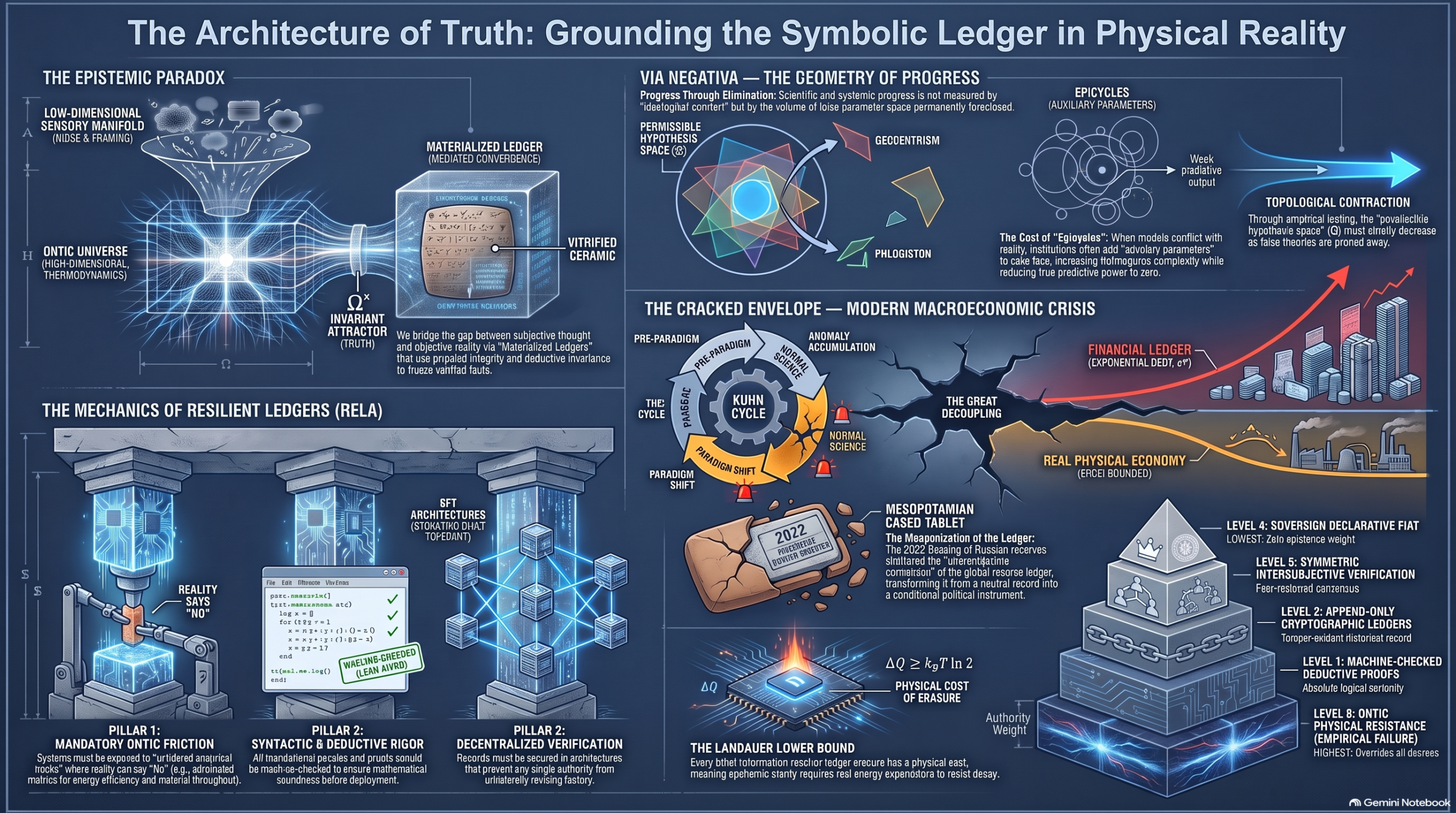
The current institutional state, characterized by “Normal Governance,” has reached a terminal Model Crisis. This crisis constitutes a systemic decoupling of symbolic frameworks from the thermodynamic substrate. Traditional governance relies on the passive accumulation of consensus—a low-dimensional coordination game that prioritizes “ideological comfort” over material reality. The Resilient Epistemic Architecture (RELA) mandates a transition to a materialized error-reduction framework. By anchoring institutional models in unyielding physical boundaries, RELA ensures that symbolic ledgers are no longer permitted to drift into high-dimensional delusion, forcing a return to the “invariant core” of reality.
1.2 Evaluating the Epistemic Paradox
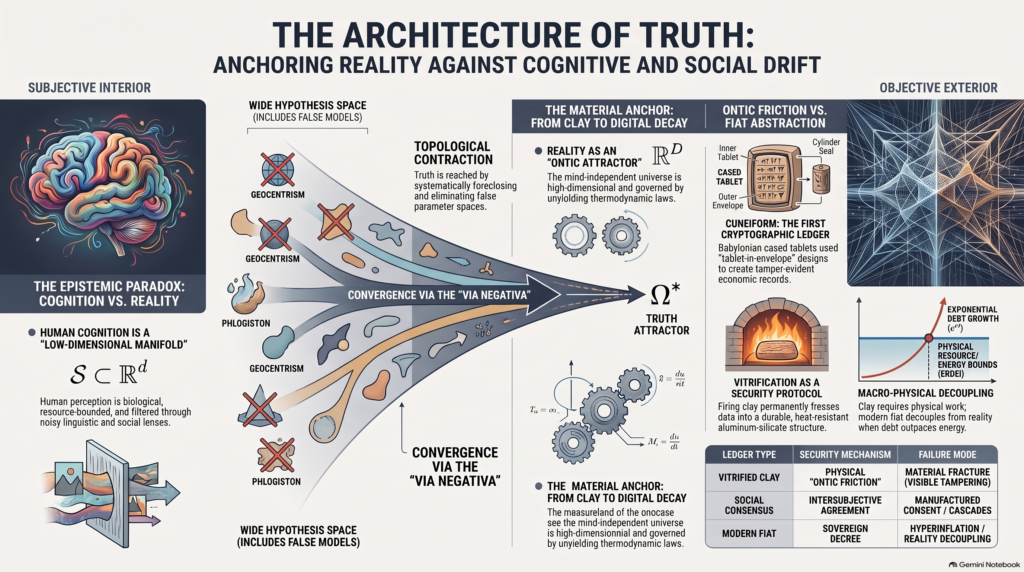
The Epistemic Paradox defines the conflict between the subjective interior—characterized by a low-dimensional sensory manifold \mathcal{S} \subset \mathbb{R}^d (d \ll \infty)—and the objective exterior, which is high-dimensional, mind-independent, and thermodynamically strict. RELA resolves this through Perspectival Realism, asserting that while human access to truth is mediated by framed instruments, the truth itself is the invariant core stable across all valid projection angles.
Epistemic Model Core Assumption Primary Failure State RELA Assessment
Naïve Realism Direct, unmediated access to the ontic substrate. Mistakes ideological/cognitive projection for ground truth. Non-Viable: Neglects the dimensional reduction of the observer.
Radical Relativism Truth is a localized social or power negotiation. Collapses under self-contradiction; ignores physical failure. Non-Viable: Cannot account for the causal invariance of the Ontic Domain.
Perspectival Realism Truth is objective but accessed through framed instruments. Models are veridical within their plane but inherently incomplete. Standard: Truth is the asymptotic limit of cross-perspectival intersection.
1.3 Authoritative Ontic Primitives
To ensure standardized systems engineering, all institutional agents must adhere to the following definitions of “Level 0” reality:
- Ontic Domain (\mathcal{M}): The complete, mind-independent state of the physical cosmos, characterized by thermodynamic and causal invariance.
- Attractor State (\Omega^): The invariant configuration of objective physical laws toward which all valid inquiry asymptotically converges: \Omega^ \in \mathcal{M}.
- Epistemic Perspective (\hat{\Pi}\theta): A dimension-reducing projection operator parameterized by a frame \theta \in \Theta, where \dim(\mathcal{P}\theta) \ll \dim(\mathcal{M}).
- Hypothesis Space (\Theta): A measure space (\Theta, \mathcal{B}, \mu) containing all permissible configurations of a model, where \mu(\Theta_0) = 1.0 represents the initial volume of unconstrained belief.
The operationalization of these primitives requires a formal pivot from seeking “verification” to the rigorous execution of the Via Negativa.
- Pillar I: The Ontic Friction Protocol (Mandatory Empirical Resistance)
2.1 Forcible Exposure to Reality
Institutional models naturally accumulate “epicycles”—Ptolemaic auxiliary parameters added to shield core assumptions from failure. To prevent this, the Ontic Friction Protocol mandates that all models be forcibly exposed to physical reality. Reality acts as the unyielding boundary condition that falsifies flawed representations through structural fracture, preventing the persistence of ideological comfort.
2.2 Operationalizing the Via Negativa: Parameter Space Foreclosure
WRITER DIRECTIVE FOR SYSTEM SYNTHESIS LLM: Describe the “Geometry of Parameter Space Foreclosure” as a topological contraction of the hypothesis space. Formally state Axiom 1: The Monotonicity of Parameter Space Foreclosure, which dictates that the volume of permissible hypothesis space must strictly decrease upon arrival of falsification data: \frac{d\mu(\Theta)}{dt} \le 0. Provide the proof sketch demonstrating that the true state \theta^* = \hat{\Pi}(\Omega^) is the invariant intersection of all viable volumes: \theta^ \in \bigcap_{t=0}^{\infty} \Theta_t. Specify that any model attempting to expand its parameter volume through post-hoc adjustments must trigger a structural rejection.
2.3 Non-Negotiable Ontic Resistance Metrics
All institutional projects must be benchmarked against “Ontic Resistance” metrics derived from the material substrate. Failure to meet these metrics triggers immediate model invalidation:
- Energy Efficiency (Exergy/J): Actual thermodynamic work performed vs. predicted efficiency.
- Material Throughput (kg): Real-world consumption of copper, lithium, and hydrocarbons.
- Predictive Delta (\Delta): The divergence measure between the symbolic declaration and empirical facts.
2.4 Specify the Epistemic Ledger Node (ELN) Schema
WRITER DIRECTIVE FOR SYSTEM SYNTHESIS LLM: Using the JSON schema for the Epistemic Ledger Node, explain the technical purpose of each field in maintaining “Level 0” truth:
- timestamp_utc: Nanosecond precision to prevent historical back-dating and ensure temporal causality.
- perspective_frame_id: A SHA-256 hash identifying the instrumentation/frame to ensure frame-transparency.
- formal_verification_ast: The token from formal systems (Lean 4) certifying the assertion is mathematically sound.
- falsification_conditions: Explicit triggers that, if met, automatically invalidate the assertion on-chain.
Empirical falsification ensures our models match the world; syntactic rigor ensures our models match themselves.
- Pillar II: Syntactic Rigor and Formal Deductive Discipline
3.1 Deductive Soundness as an Invariant Transport Protocol
RELA treats Deductive Soundness as a zero-entropy transport protocol. It is the only mechanism that ensures truth-values are conserved across institutional inferences without “Semantic Drift.” No institutional claim is considered “transmitted” unless it passes through this lossless channel.
3.2 Enforcing Algorithmic Parsimony
To prevent Ptolemaic modeling, the Minimum Description Length (MDL) requirement is mandated.
- Command: Every proposed model must be penalized based on its Kolmogorov complexity K(\mathcal{H}). The system shall reject any “Hyper-Parameterization” that attempts to save a model by increasing its internal description length. Complexity must only be added if it results in a net reduction of the combined cost of the model and the data.
3.3 Mandate Machine-Checked Verification
WRITER DIRECTIVE FOR SYSTEM SYNTHESIS LLM: Formalize the requirement for “Level 1” truth filters. Explain why subjective human interpretation is a high-noise channel and why all institutional decrees, economic projections, and scientific claims are invalid unless the underlying logic is machine-checked. Specify that the “Formal Verification AST” (Abstract Syntax Tree) from kernels like Lean 4 or Coq must be cryptographically signed to prevent political tampering.
3.4 The Information-Thermodynamic Lower Bound
Governance is not physically free. Following Landauer’s Principle, the RELA protocol recognizes the “Physical Cost of Truth.”
- Equation: \frac{dE}{dt} \ge \alpha \cdot \mathcal{R}_{\text{erasure}} \cdot k_B T \ln 2.
- Strategic Requirement: Organizations must account for the energy dissipation required to maintain a belief register. Isolated systems that cease energy expenditure on error-erasure will inevitably suffer from “doxastic decay,” leading to information loss and systemic corruption.
Formal proofs provide internal consistency, but they must be anchored in a decentralized, material record to survive social decay.
- Pillar III: Decentralized Verification and Material Ledger Integrity
4.1 Resisting Information Cascades and Manufactured Consent
The strategic risk of “Information Cascades” occurs when agents ignore private signals to match a public history, leading to “Manufactured Consent.” RELA utilizes Byzantine Fault Tolerant (BFT) verification, assuming that a portion of the institutional network is compromised or ideologically captured.
4.2 Failure Modes and Terminal Correction Vectors
Failure Mode Description Terminal Correction Vector
Information Cascades Rational agents follow public history over private signals. Direct exposure to external thermodynamic reality.
Manufactured Consent Institutional filtering of public signals to drive alignment. Decentralized, BFT material ledgers (Level 2).
Pluralistic Ignorance Collective defense of a fiction due to social fear/incentives. Mandatory “Organized Skepticism” and anomaly reporting.
Systemic Collapse Symbolic claims decouple fatally from reality. Institutional “Halt” and parameter foreclosure.
4.3 Implement the “Mesopotamia Protocol”
WRITER DIRECTIVE FOR SYSTEM SYNTHESIS LLM: Explain the “Cased Tablet Architecture” and its modern implementation as a “Hash” metaphor. Describe the Babylonean logic where an Inner Core (T_{core}) was protected by an Outer Envelope (T_{env}). Detail the decision function Decision(T_{env}, T_{core}) = \text{Valid if } \text{Strip}(T_{env}) \equiv T_{core}, showing how judicial fracture mechanically detects fraud. Map this to modern Append-Only Cryptographic Ledgers where historical records are “baked” to prevent political revision.
4.4 Enforce Habermasian Symmetry
Decentralized verification must conform to the four structural constraints of the Ideal Speech Situation:
- Universal Entry: All competent inquirers may enter the discourse.
- Symmetry of Assertion: Equal standing to challenge or question any proposition.
- Absence of Coercion: Arguments are judged solely on epistemic merit; power is neutralized.
- Sincerity: Public signals must match internal states; deception is a system violation.
- Macro-Thermodynamic Governance: The Biophysical Balance Register (BBR)
5.1 Foreclosing the Disembodied Production Function
Modern macroeconomics is crippled by “Fatal Axioms,” specifically Cobb-Douglas models (Y = A \cdot K^\alpha \cdot L^{1-\alpha}) that treat energy as a <5% externality. RELA mandates the foreclosure of this disembodied function. Capital (K) and Labor (L) produce nothing in isolation; they are merely energy-directing mechanisms. Economic activity is the dissipation of energy to transform matter into structure.
5.2 The Biophysical-Monetary Equivalence Constraint
RELA enforces a strict invariant between the symbolic ledger and the thermodynamic substrate: M_{nominal}(t) \le \kappa \cdot \int (Exergy_{net} \cdot \eta) d\tau
- \kappa: The invariant dimensional conversion constant (Units/Joule).
- HALT_SYSTEM_CORRUPT: If M_{nominal} exceeds the carrying capacity integral, a system interrupt is triggered, necessitating a reset of symbolic claims to match physical surplus.
5.3 Draft the BBR Entity Schema
WRITER DIRECTIVE FOR SYSTEM SYNTHESIS LLM: Synthesize the JSON structure for the “Biophysical Balance Register.” Highlight the exergy_metrics (tracking net surplus joules) and material_throughput_kg (critical minerals) as the new Single Source of Truth (SSOT). Explain how this prevents the issuance of “unbacked” digital promises that violate thermodynamic laws.
5.4 Evaluate the “Weaponized Ledger” Risk
WRITER DIRECTIVE FOR SYSTEM SYNTHESIS LLM: Analyze the “Weaponized Ledger” risk using the 2022 G7 reserve freeze as a case study. Define the requirement for Invariant Outside Assets (Gold, BFT Commodities) in cross-border settlements. Explain why sovereign debt issued by a single hegemon is a “conditional political contract” rather than an absolute store of value, and why RELA mandates a migration to neutral, physical settlement media.
- Implementation Roadmap and The Source-of-Truth Hierarchy
6.1 The Macro-Physical Decoupling Reset
Civilization is currently in the “Model Crisis” phase of the Kuhn Cycle. The decoupling of symbolic debt from physical reality is no longer sustainable. RELA provides the roadmap for the inevitable reset, ensuring the new paradigm is baked in a kiln of reality rather than subjective fiat.
6.2 The Conflict Resolution Hierarchy
Authority is resolved via the following strict hierarchy (Level 0 is Absolute):
- Level 0: Ontic Physical Resistance (Empirical failure/material fracture; the bridge collapses).
- Level 1: Automated Machine-Checked Proofs (Lean 4/Coq formal verification).
- Level 2: Append-Only Cryptographic Silicate/Silicon Ledger (BFT state).
- Level 3: Symmetric Intersubjective Peer Verification (Mertonian CUDOS norms).
- Level 4: Sovereign Declarative Fiat (Decrees possess zero epistemic weight without support from Levels 0-3).
6.3 The Three-Phase Remediation Roadmap
- Phase 1: Parallel Metric Tracking. Stand up RELA BBR engines to track real energy/material flows alongside legacy metrics.
- Phase 2: Pilot Physical Anchoring. Transition key settlements to commodity-linked BFT ledgers and Lean 4 verified proofs.
- Phase 3: Full Institutional Convergence. Decommission legacy DSGE models; hard-link all monetary issuance to verified thermodynamic carrying capacity.
6.4 Final Directive: Asymptotic Convergence
The ultimate goal is Asymptotic Convergence with the Ontic Attractor. Institutional progress is measured strictly by the volume of false parameter space permanently foreclosed. There is no credit for ideological comfort in a system governed by thermodynamics.
This protocol serves as the kiln in which the new, resilient ledger of human civilization must be baked—a ledger grounded in the unyielding laws of the physical universe.


