
Strategic Analysis: AI-Augmented Point-of-Use Manufacturing for Aerospace and Defense
Executive Summary
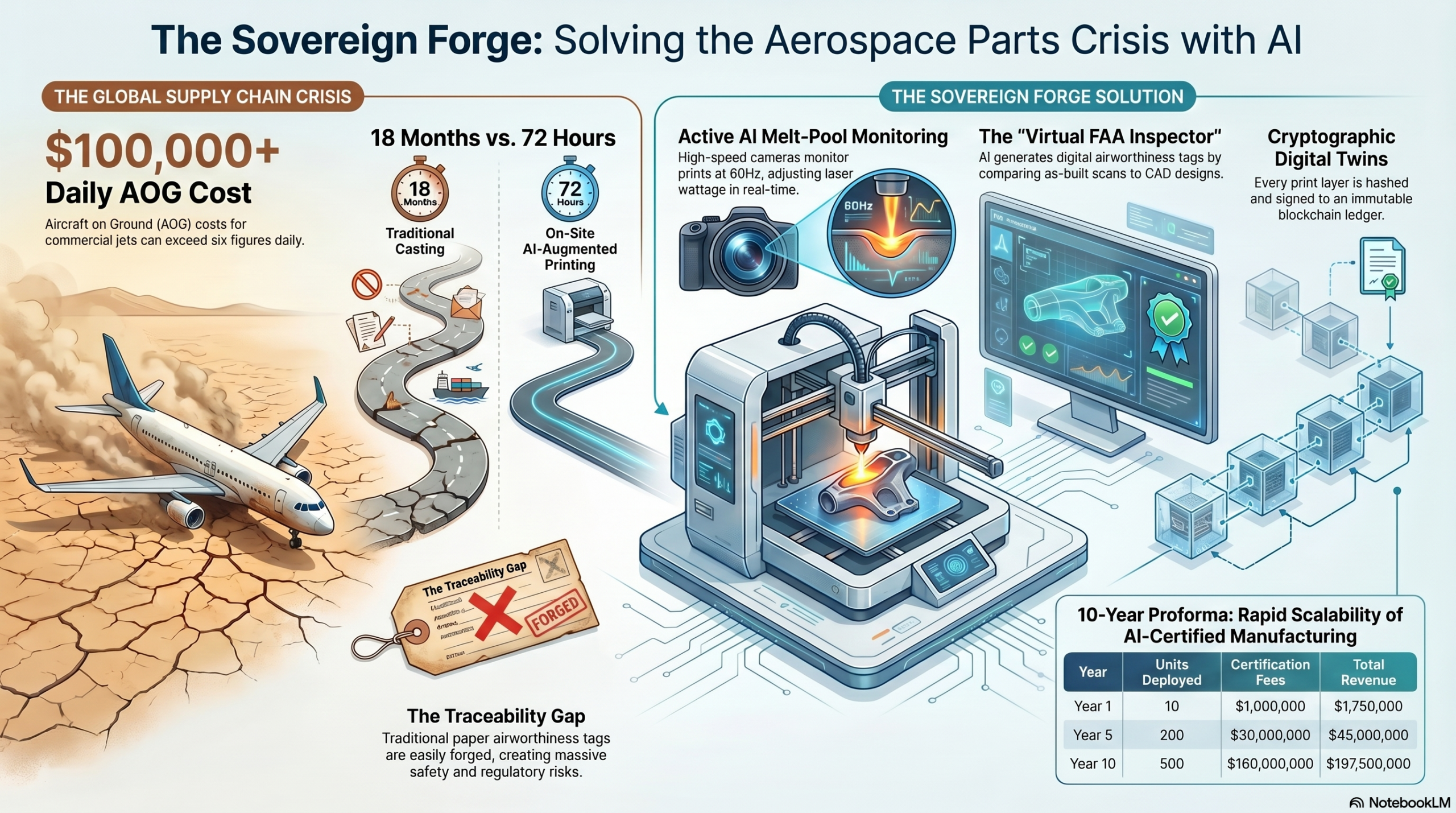
The aerospace and defense industries are currently confronting a “Parts Drought” characterized by a fragile global supply chain, aging fleets, and a critical crisis of traceability. The convergence of record-breaking travel demand and significant OEM production delays has extended lead times for critical components to 12–18 months, resulting in “Aircraft on Ground” (AOG) costs exceeding $100,000 per day.
This document outlines a strategic shift from the traditional “Just-in-Time” model to a “Point-of-Use” manufacturing paradigm. By integrating DeReticular’s Sovereign AI stack with specialty Additive Manufacturing (AM) hardware, organizations can produce high-value, flight-critical components—such as Tungsten-based turbine blades—on-site in as little as 48 hours. This model leverages AI for real-time certification (the “Virtual FAA Inspector”), cryptographic IP protection, and immutable digital traceability to address the $1.06 trillion aerospace parts market projected for 2032.
——————————————————————————–
The Aerospace Parts Crisis: Market Context and Drivers
1. The “Parts Drought” and Aging Fleets
The global commercial fleet age has risen from 14 years in 2019 to 16 years in 2025. This aging infrastructure requires intensive maintenance, yet major OEMs (Boeing and Airbus) face historic production delays.
- Rotable Shortages: High-value parts like landing gear are in such short supply that airlines have resorted to “cannibalization”—stripping parts from parked aircraft to maintain active ones.
- Economic Impact: The aircraft spare parts segment was valued at $53 billion in 2025, with a projected CAGR of 6.8% to 8.0% through 2030.
2. The Traceability Scandal
The 2023-2024 AOG Technics scandal revealed the vulnerability of paper-based records, where thousands of parts were sold with falsified airworthiness documents. Traceability has consequently become a “premium currency” in the aviation aftermarket.
3. Supply Chain Fragility
- Inflation: Spare parts inflation (2.5–3.5% annually) is outpacing new aircraft inflation.
- Material Scarcity: Sanctions and tariffs have caused price spikes in critical alloys like titanium and tungsten.
- Funding Gaps: The lapse of SBIR/STTR federal funding in late 2025 has paused new solicitation cycles from the DoD and NASA.
Technological Core: AI-Augmented Specialty Printers
The transition to localized manufacturing is enabled by retrofitting standard industrial 3D printers with the Sovereign Forge (SKU: SOV-AUTO-FORGE), transforming them into active robotic inspectors.
Hardware and AI Integration
- Refractory Metal Optimization: Systems utilize Laser Powder Bed Fusion (LPBF) or Directed Energy Deposition (DED) for materials like Tungsten (melting point 3,422^{\circ}C), Rhenium, and Inconel.
- The DeReticular Optic Array:
- Melt-Pool Monitoring: High-speed thermal cameras monitor laser-metal interaction at 60Hz.
- Closed-Loop Control: The AI detects microscopic warping or delamination in real-time. If melt-pool temperatures fluctuate by more than 2%, the system adjusts laser wattage or scan speed instantly.
- The Automated Notary: Every printed layer is hashed and signed by a TPM 2.0 module, creating an immutable Digital Twin on the Locutus Ledger.
——————————————————————————–
The Sovereign AI Stack: Governance and Security
To achieve regulatory approval and protect intellectual property, manufacturing cells utilize a multi-layered AI and ledger architecture.
| Product | Role in Manufacturing |
| Sovereign Forge | Acts as a “Virtual FAA Inspector,” generating digital FAA Form 8130-3 based on real-time sensor data. |
| OpenClaw “Inspector” AI | Performs sub-millimeter comparisons between the “As-Built” scan and the “As-Designed” CAD file. |
| Split-Ledger Architecture | Keeps proprietary CAD/G-Code in an encrypted vault while publishing “Proof of Quality” to a public ledger. |
| Sovereign Key (YubiKey) | Ensures human-in-the-loop accountability for print authorization. |
Intellectual Property Protection
Through Ephemeral Decryption, the Sovereign Forge decrypts CAD files only into volatile RAM. The file is wiped the moment the print finishes, ensuring foreign repair stations or operators never “own” or store sensitive design data.
——————————————————————————–
High-Value Manufacturing Targets
Tungsten Turbine Blades (High-Pressure Turbine – HPT)
Tungsten is preferred for its ultra-high melting point but is notoriously difficult to cast due to brittleness.
- AI Enhancement: Manages thermal gradients during printing to prevent “hot cracking.”
- Lead Time Reduction: From 12–18 months (traditional) to 48–72 hours (Sovereign Forge).
Specialized Drone Components
- Applications: Propulsion mounts and heat shields for high-speed, high-altitude drones.
- Contested Logistics: Enables on-site printing at remote forward operating bases, ensuring airworthiness without secondary inspection facilities.
——————————————————————————–
Regulatory and Compliance Landscape
The aviation industry is navigating a “current reality” where historical data (pre-2024) is largely obsolete.
- FAA Reauthorization Act of 2024: Mandates annual unannounced inspections of foreign repair stations.
- Drug & Alcohol Testing: A 2024 FAA Final Rule requires all 977 FAA-certified foreign repair stations to implement testing programs by December 20, 2027.
- “Back-to-Birth” Trail: There is an industry-wide mandate for a “dirty fingerprint” digital trail. Systems that can instantly verify the authenticity of FAA Form 8130-3 have a significant competitive advantage.
——————————————————————————–
Economic Projections: DeReticular Forge & Defense (DFD)
The business model for point-of-use manufacturing is a hybrid of hardware leasing, AI-as-a-Service, and transactional certification fees.
10-Year Financial Proforma (USD 000s)
| Year | Units Deployed | Hardware Lease Rev | AI SaaS Rev | Certification Fees | Total Revenue | EBITDA (42%) |
| 1 | 10 | 500 | 250 | 1,000 | 1,750 | 735 |
| 3 | 60 | 3,000 | 1,500 | 6,000 | 10,500 | 4,410 |
| 5 | 200 | 10,000 | 5,000 | 30,000 | 45,000 | 18,900 |
| 10 | 500 | 25,000 | 12,500 | 160,000 | 197,500 | 82,950 |
Profitability Drivers
- Elimination of Forgery: Mathematical links between sensor logs and physical objects eliminate the risk of counterfeit parts.
- Logistics Savings: Printing on-site in global hubs (e.g., Beijing, Dubai, Singapore) eliminates secure international shipping costs for sensitive components.
- Certification Fees: By Year 10, transactional fees for generating airworthiness tags are projected to be the primary revenue driver ($160M).
——————————————————————————–
Strategic Roadmap
- Phase 1: Validation (Years 1-2): Partner with eVTOL leaders (e.g., Beta Technologies) to print and certify non-structural thermal mounts. Achieve FAA Part 145 acceptance for digital audit trails.
- Phase 2: Defense Blitz (Years 3-5): Standardize Forge nodes for the F-35 supply chain via DoD SBIR Phase III funding. Deploy “Mobile Forge” units in ruggedized 20ft containers.
- Phase 3: Global Dominance (Years 6-10): Establish “Sovereign Print Hubs” at major transit points. Shift to becoming the primary production method for “Legacy Support” (parts for aircraft no longer in production).
Conclusion
The aerospace industry is moving from a “Just-in-Time” inventory model to a “Just-in-Case” model where availability and regulatory agility are paramount. AI-augmented point-of-use manufacturing transforms repair stations from “part seekers” into “part creators.” By providing the infrastructure for verified, decentralized manufacturing, DeReticular aims to secure a dominant position in the $1.06 trillion aerospace market of 2032.


