
Strategic Implementation Framework: Transitioning to Hardware-Anchored Data Sovereignty
1. The Sovereignty Mandate: Dismantling the Trusted Environment Fallacy
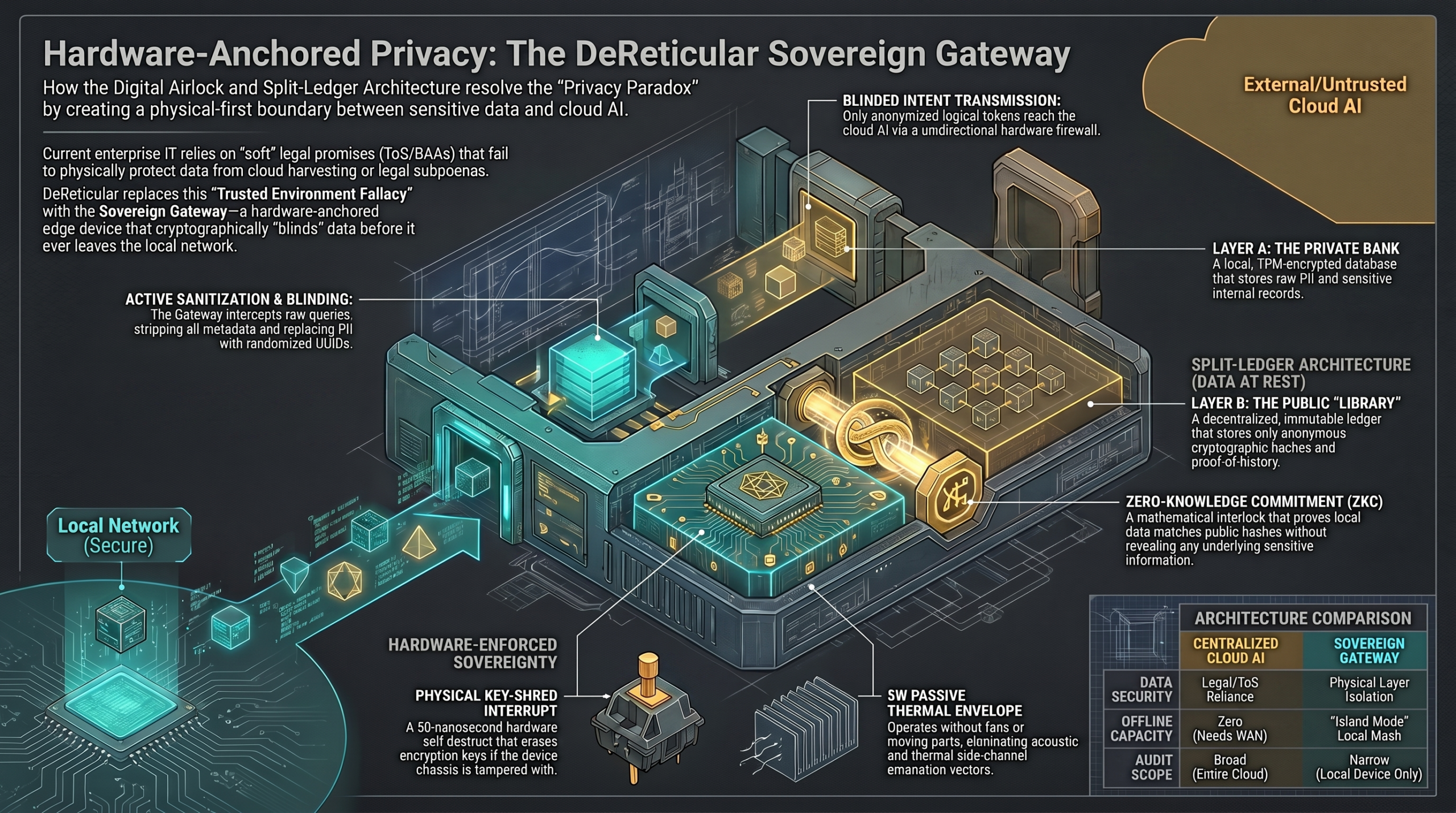
In the current landscape of hyperscale AI, enterprises face an acute “Privacy Paradox.” Organizations are strategically compelled to leverage the cognitive reasoning of models like Project Remy but are barred by regulatory and jurisdictional mandates from sharing raw data. For years, the industry has relied on the Trusted Environment Fallacy—the assumption that non-binding corporate Terms of Service (ToS), Business Associate Agreements (BAAs), or software-defined enclaves provide sufficient protection.
In reality, modern centralized AI utilizes data harvesting as an architectural feature. Ingestion pipelines require massive corpuses of real-world metadata and temporal sequences to refine model weights. True sovereignty requires shifting the security boundary from fragile legal frameworks to physical silicon and cryptographic blinding protocols.
| Feature | Soft Protections (Trusted Environment Fallacy) | Hard Protections (Physical-First Approach) |
| Foundation of Trust | Terms of Service (ToS), BAAs, Cloud Enclaves | Physical Root of Trust (RoT), Hardware-Blinding |
| Security Layer | Software-defined (Hypervisor-dependent) | Discrete TPM 2.0, Custom Silicon |
| Data Integrity | Legally non-binding promises | Mathematical and physical decoupling |
| Control | External provider custody | Localized physical custody |
This transition addresses three primary risk vectors inherent to centralized AI:
- Subpoena and Jurisdictional Compulsion: Cloud providers can be compelled by regional legal directives (e.g., CLOUD Act warrants) to surrender data without the owner’s knowledge.
- Hypervisor/Enclave Compromise: Microarchitectural side-channel attacks or rogue administrators can compromise even “confidential” instances (AMD SEV/Intel SGX).
- Inference-Phase Reconstruction: Adversaries can use crafted prompting to reconstruct PII or context-window data from public model endpoints.
This framework defines the technical roadmap for transitioning to the Sovereign Gateway model.
podcast
2. Physical Root of Trust: The Sovereign Gateway Architecture
True infrastructure sovereignty is grounded in physical silicon, not ephemeral software layers. By anchoring trust in a localized edge device, we establish a deterministic boundary that cannot be bypassed by hypervisor-level compromises.
The Sovereign Gateway hardware specifications prioritize forensic resistance and “Security via Silence”:
- Premium Silicon Sentry (Apple M4 SoC): Leverages a 16 GB unified memory pool to enable a high-bandwidth, low-latency bus between the CPU and Neural Engine. This is critical for maintaining sanitization performance without external reliance.
- 5W Passive Thermal Envelope: Restricting the SoC to a 5W idle envelope allows for entirely fanless, passive cooling. This eliminates physical entry points for environmental degradation and hardens the chassis against acoustic or thermal side-channel emanation vectors.
- Discrete TPM 2.0: Cryptographic identity is bound to an automotive-grade, discrete hardware chip rather than software-emulated layers.
A core defensive pillar is the Key-Shredding Interrupt. Hardwired directly to the TPM 2.0’s physical master clear and write-enable lines, this mechanism is triggered by active chassis intrusion detection loops or a physical reset pin. Upon a 50-nanosecond trigger, the device pulls key-storage voltage rails to ground, permanently shredding master seeds. This effectively mitigates physical theft or laboratory-grade microprobing.
[!WARNING] Risk of Permanent Data Loss The key-shredding interrupt is a destructive defense. Without a meticulously maintained, out-of-band M-of-N cryptographic backup, all local storage volumes become permanently unrecoverable once the interrupt is triggered.
Administrative initialization utilizes an Out-of-Band NFC Bootstrap. This process requires zero cloud-account dependency. An administrator performs a physical tap of a high-security NFC card against the chassis, initiating an ephemeral key exchange. The TPM 2.0 mints a localized cryptographic passkey using elliptic-curve cryptography (Secp256r1), which is provisioned directly to the administrator’s hardware-backed mobile wallet.
3. The Digital Airlock: Mechanics of Blinded Intent
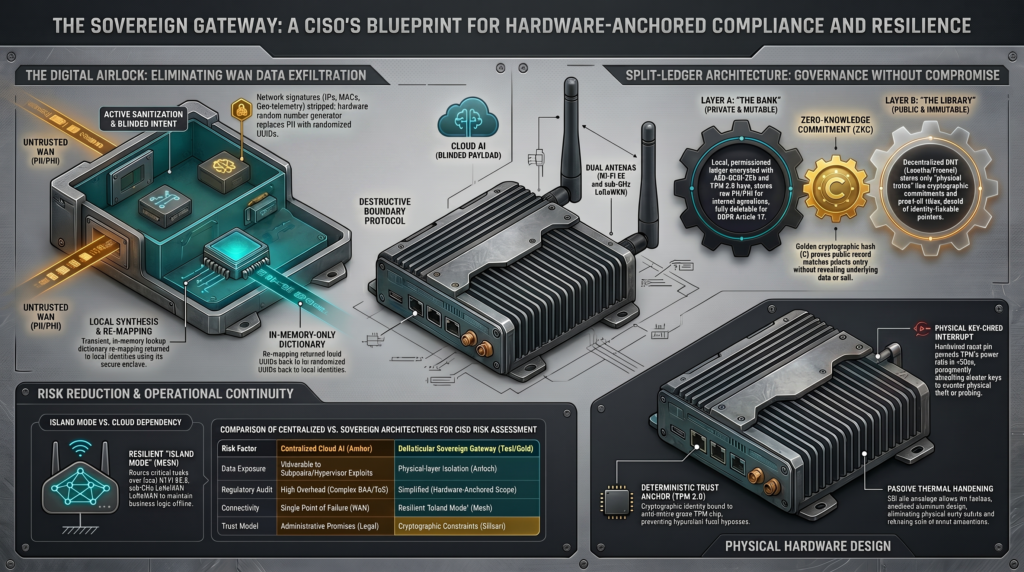
The Digital Airlock acts as a destructive boundary for data exfiltration. Rather than a transparent tunnel, it deconstructs local requests and only allows an anonymized, mathematical representation to cross the WAN.
The Data Flow Sequence:
- Sovereign Executive Agent Intercept: Traffic is captured at the network socket layer and staged in isolated, volatile memory within the secure enclave. Crucially, raw data never hits the local solid-state disk (SSD).
- Active Sanitization: All IPs, MAC addresses, and device fingerprints are programmatically stripped.
- Blinded Intent Generator: Entities identified as PII or proprietary IP are replaced with cryptographically random UUIDs generated by a hardware True Random Number Generator (TRNG).
- State Translation Engine: Upon receiving the cloud response, the engine performs a reverse-lookup using a transient in-memory dictionary to re-substitute raw identifiers for the local client.
The efficiency of the M4 unified memory bus ensures the latency of this local sanitization pass remains below 12 milliseconds per kilotoken, making the overhead negligible for real-world reasoning tasks.
The “So What?” of Blinded Intent This process allows an untrusted hyperscale model (like Project Remy) to function strictly as a “blind arithmetic coprocessor.” The cloud provider executes reasoning over abstracted variables (e.g., {Subject_UUID_A}), remaining entirely blind to the identity, location, or sensitive context of the query.
4. Data Governance via Split-Ledger Architecture
To resolve the paradox of immutable auditability versus the “Right to be Forgotten,” we employ a Split-Ledger Architecture.
| Layer A: “The Bank” (Private) | Layer B: “The Library” (Public) |
| Status: Local, TPM-encrypted (AES-GCM-256). | Status: Decentralized Small-World DHT (Locutus). |
| Content: Raw PII, PHI, and identity links. | Content: Anonymized “physical truths”/hashes. |
| Verification: Authenticated internal operators. | Verification: Permissionless, token-free Wasm contracts. |
The bridge between these layers is the Zero-Knowledge Commitment (ZKC). The Gateway generates a cryptographic hash: C = \text{HMAC-SHA256}(\text{Transaction Data} \parallel \text{Salt } r) This commitment is written to a WebAssembly (Wasm) contract on Layer B. When verification is required, the Gateway provides a designated-verifier signature. This proves that the public hash matches a valid record in the private “Bank” without revealing the salt, identity, or internal keys.
This ensures compliance with GDPR Article 17. If the Layer A mapping is deleted, the immutable hash on Layer B becomes cryptographically disconnected, rendering it “anonymous data” under GDPR recitals.
5. Operational Resilience: RIOS and “Island Mode” Logic
To mitigate WAN dependency, the Rural Infrastructure Operating System (RIOS) manages a local-first mesh.
Dual-Network Topology:
- Wi-Fi 6E (6 GHz): Dedicated to high-bandwidth localized transit (imaging, workstations).
- Sub-GHz LoRaWAN: A long-range, low-power mesh for telemetry. RIOS utilizes ultra-narrowband, frequency-hopping to maintain connectivity under active RF jamming.
When external connectivity is severed, “Island Mode” isolates the local network, routing all traffic strictly within the mesh. To address the Local Compute Constraint, RIOS employs a hierarchical model architecture. The system falls back to highly optimized, 2-bit or 4-bit quantized small language models (Llama-3-8B) for critical offline task classification and emergency communication parsing.
6. Gap Analysis and Remediation Roadmap
| Architectural Domain | Current State (Baseline) | Target State (DeReticular) | Remediation Path |
| Data Privacy | Raw API requests over WAN. | Digital Airlock; blinded payloads. | Deploy unified semantic ontology engine in M4 unified memory (Target <12ms latency). |
| Edge Trust | Centralized cloud portals/IdPs. | Hardware TPM 2.0; NFC Bootstrap. | Implement Shamir’s Secret Sharing (M-of-N) across five distinct shards for key recovery. |
| Verification | Siloed DBs or public blockchains. | Split-Ledger; ZK Commitments. | Optimize Wasm contracts for Locutus DHT; use designated-verifier signatures. |
| Continuity | WAN loss halts workflows. | RIOS “Island Mode” mesh. | Deploy 2-bit/4-bit quantized fallback models for offline processing. |
Immediate CISO Actions:
- Key Sharding: Establish the 3-of-5 quorum for master bootstrap credentials using physical tokens and trusted peer Gateways.
- Anti-Forensics: Enforce socket-layer interception to ensure zero SSD writes for staged query data.
7. Strategic Risk Register and Compliance Posture
Strategic Risk Register
| Risk ID | Risk Vector | Technical Mitigation Strategy |
| R-API-01 | Upstream API Blocking: Providers demand telemetry. | Dynamic Schema Alignment; default to Local Inference Fallback. |
| R-KEY-02 | Physical Seed Loss: Destruction of setup credentials. | M-of-N Sharding: 5 shards (NFC/Keys) requiring 3 (M) for recovery. |
| R-NET-03 | RF Jamming: Active mesh interference. | RIOS automatic fallback to frequency-hopping sub-GHz LoRaWAN. |
| R-PHY-04 | Side-Channel Analysis: Thermal/EM profiling. | Constant-Time Blinding Protocols and 5W passive thermal shielding. |
Compliance Impact
- HIPAA: Sanitizing identifiers before the WAN boundary excludes external cloud hosts from the PHI data flow, narrowing audit scope and eliminating the need for multi-party BAAs.
- GDPR: The Split-Ledger model allows for absolute deletion of Layer A mappings, rendering immutable Layer B hashes legally anonymous under GDPR recitals.
- SOC 2: Transitions compliance from administrative promises to verifiable technical evidence provided by TPM 2.0 boot chains and 50ns hardware interrupts.
Architectural Trade-off: We weigh the Capex of physical hardware and the responsibility of local key management against the Opex and systemic risk of centralized cloud vulnerability. By anchoring trust in silicon, we achieve true operational and data autonomy.


