Strategic Infrastructure Integration Plan: Quartzsite Regional Smart-Road Initiative
1. Strategic Vision: The Future of Rural Mobility in Western Arizona
The Quartzsite Boulevard widening and I-10 overpass project represents more than a routine roadway expansion; it is the foundational deployment of a “Sovereign Mobility” corridor. As La Paz County faces unprecedented demographic shifts, this initiative reimagines regional infrastructure as a decentralized network capable of delivering compassionate care and economic resilience. Under the “Human Link” philosophy—the strategic nexus of technology, capital, and real estate—we are transforming the road from a passive strip of asphalt into an active circulatory system for the community.
The mission of “Sovereign Mobility,” as executed by Node 6, is to provide reliable, on-demand transportation that functions in “Island Mode,” independent of fragile national energy and data grids. This independence is secured through the “Sovereign Stack,” a convergence of three technological pillars:
- The Muscle (Energy): Localized power generation via plasma gasification and solar arrays, ensuring the fleet remains shielded from grid instability.
- The Motion (Autonomous Logistics): The Kurb Kar fleet, an autonomous robotics network that handles the physical movement of people and goods without reliance on human driver labor.
- The Mind (Intelligence): The Rural Infrastructure Operating System (RIOS), a global network intelligence utilizing “Signal Fusion” to manage complex logistics across remote geographies.
By integrating these pillars into the Quartzsite expansion, we move beyond the “last mile” problem of rural isolation, treating it instead as a “first mile” opportunity for innovation. This shift is essential to addressing the specific logistical fractures inherent to Western Arizona’s unique landscape.
2. Regional Diagnosis: The Imperative for Technological Integration
Traditional infrastructure models are failing the permanent residents of La Paz County. With a resident population of just 1,805 and a median age of 71.2, the county faces an “Extreme Demand” scenario for healthcare access. This pressure is compounded by the “Seasonal Infrastructure Surge,” where the population swells by 750,000 to 1,000,000 “Snowbirds” during the January-February RV migration. This massive influx overwhelms roadways and local services, leaving the elderly population stranded from critical care 32 miles away in Parker, Arizona—a gap currently served by the “Camel Express,” which operates only once per week.
The most acute failure is found in the Non-Emergency Medical Transportation (NEMT) system. Current logistics are structurally incapable of meeting rural needs.
Systemic Failures in Rural Logistics
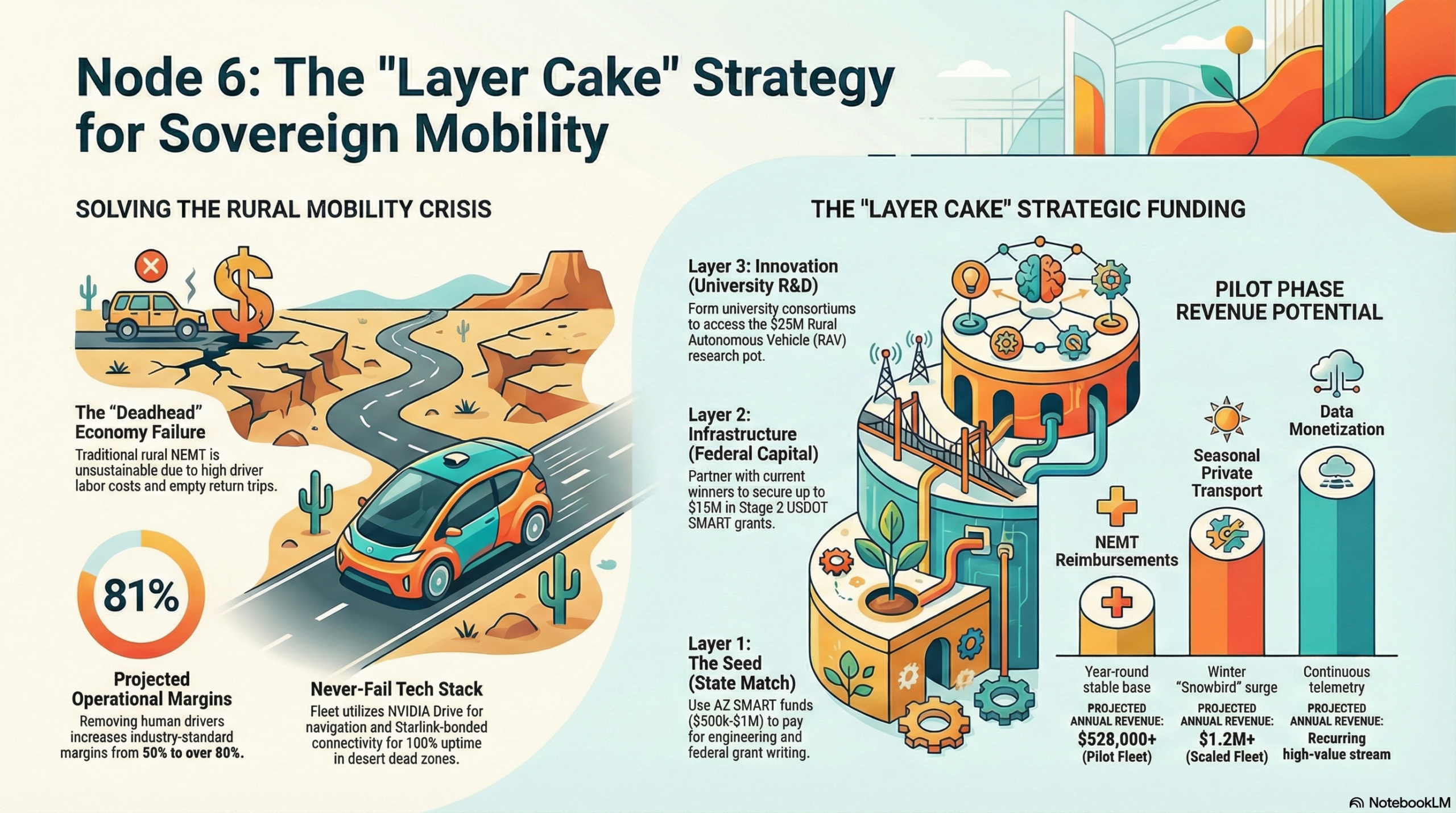
- The Deadhead Economy: Traditional providers are financially penalized for operating in remote areas. The high cost of “deadhead” miles—driving empty vehicles to distant pickups—makes rural routes unsustainable, leading to chronic provider shortages.
- The Reliability Gap: Driver shortages result in frequently missed medical appointments. For high-needs patients requiring dialysis or chronic care, a single missed ride can escalate into a life-threatening emergency.
- The Social Determinant Barrier: Transportation is the primary non-medical barrier to health. Telemedicine and “Clinic-in-a-Box” diagnostics are only effective if there is a reliable physical link to transport patients or kits between the home and the hospital.
Autonomous integration solves this crisis by providing a scalable, 24/7 on-demand transit grid that does not rely on a scarce driver pool. To achieve this, the physical road must be upgraded to support intelligent, driverless operations.
3. Engineering Specifications: Defining ‘Node 6 Ready’ Infrastructure
To avoid the prohibitive costs of future retrofitting, we must adopt a strategy of “infrastructure piggybacking.” By incorporating “Node 6 Ready” specifications into the Quartzsite Boulevard and I-10 overpass construction today, we secure a future-proof corridor at a fraction of the cost. While Node 3 (The Simulator) handles the R&D of these systems, Node 6 (The Circulatory System) is responsible for the physical deployment of these assets onto the regional grid.
A “Node 6 Ready” corridor requires the integration of specific physical and digital assets designed to ensure 100% vehicle uptime:
- V2I Communication Nodes: These Signal Fusion hubs bond high-performance Starlink satellite connectivity with CAT4 vSIM cellular data. This creates an unbreakable “Global Mesh Protocol” for vehicle-to-infrastructure telemetry.
- Smart Road Sensors: Integration of NVIDIA Drive-compatible sensor overlays allows vehicles to navigate unmapped or poorly marked rural roads, even in “Blast Furnace” conditions like Arizona dust storms.
- Autonomous Depots: Strategic sites, including converted historic motels, serve as dual-purpose charging hubs and logistics centers, revitalizing local real estate.
Infrastructure Integration Requirements
| Component | Technical Specification | Strategic Utility for Node 6 Operations |
| Connectivity Hubs | Starlink bonded with CAT4 vSIM | Ensures unbreakable “Signal Fusion” for telemetry and 24/7 remote monitoring. |
| AV Sensors | NVIDIA Drive-compatible overlays | Enables safe navigation in extreme heat and unpaved desert conditions. |
| Clinic-in-a-Box | On-board diagnostic sensor suite | Collects patient vitals during the 45-minute drive to Parker, transforming the commute into a check-up. |
| Logistics Depots | V2G-enabled charging stations | Provides physical staging while utilizing local solar power to stabilize the regional microgrid. |
| Telemetry Nodes | zkVerify Data Validation | Secures “Edge Case” driving data for monetization and Federated Learning updates. |
4. Economic Value Proposition: Cost-Benefit and Revenue Analysis
Integrating smart technology shifts roadway infrastructure from a depreciating public expense to a revenue-generating utility. As a “Borrower” within the DeReticular Venture Studio model, Node 6 utilizes intercompany debt to fund initial deployments, which are then sustained by high-margin revenue streams.
The financial foundation of the Kurb Kar fleet is the NEMT reimbursement model. Using Arizona Medicaid (AHCCCS) rates ($12.21 base + $1.53/mile), a 64-mile round trip to Parker generates approximately $110. By eliminating driver labor and utilizing locally generated solar power for charging, operating margins are projected to climb from the industry standard of 50% to approximately 81%.
Further revenue and efficiency streams include:
- Vehicle-to-Grid (V2G) Capability: When idle, Kurb Kars function as mobile batteries. They perform energy arbitrage and stabilize the local microgrid, turning a transport asset into a power utility.
- The Federated Learning Mesh: Driving data from the “Blast Furnace” of Arizona—navigating dust storms and unpaved roads—is high-value “Edge Case” data. Verified via zkVerify, this data is sold through the RIOS network to train global AI, such as agricultural tractors in Uganda (Node 4).
- Data Monetization: Every mile driven generates telemetry that improves autonomous algorithms worldwide, creating a recurring, non-physical revenue stream for La Paz County.
5. The ‘Layer Cake’ Funding Strategy: Securing Non-Dilutive Capital
Realizing this vision requires a capital-efficient approach. We utilize a “Layer Cake” strategy to capture federal and state funds prioritized for “Rural Justice” and “Tech Implementation,” protecting regional equity.
The Seed Layer (State)
The AZ SMART Fund (500k–1M) is the immediate priority. These funds cover the sophisticated engineering and grant-writing services required to compete for larger federal awards. Node 6 acts as the operational lead, partnering with La Paz County as the applicant.
The Infrastructure Layer (Federal)
- USDOT SMART Grants (Stage 2): Offering up to $15 million, this grant requires partnership with a Stage 1 winner. Node 6 will position itself as the rural testbed for the Arizona Commerce Authority’s (ACA) V2X initiatives.
- Charging and Fueling Infrastructure (CFI) Grant: With a 50% rural set-aside, we will frame autonomous depots as “Public Community Charging Hubs” to secure infrastructure for the fleet.
The Innovation Layer (Research/Operations)
- Rural Autonomous Vehicle (RAV) Research Program: This $25 million pool requires a university partner. We will establish a consortium with Arizona State University (ASU) or the University of Arizona to act as the “Prime” applicant for these R&D funds.
- FTA Section 5311: These formula grants provide the “bread and butter” operational funding to support the Kurb Kar fleet as a designated rural public transit operator.
6. Implementation Roadmap and Next Steps (2026)
The transition to a smart-road corridor begins with immediate integration into the Western Arizona Council of Governments (WACOG) Transportation Improvement Program (TIP).
Strategic Action Plan for Node 6 Integration
| Timeline | Action Item | Key Stakeholders | Target Funding/Initiative |
| Q1 2026 | Formalize Partnership Vision | WACOG, Node 6 Champion | Regional TIP Alignment |
| Q1 2026 | Secure Seed Funding | La Paz County, ADOT | AZ SMART Fund (500k-1M) |
| Q2 2026 | Smart-Road Design Overlay | WACOG, Engineering Contractors | Quartzsite Blvd Widening Specs |
| Q2 2026 | Route 66 Pilot Launch | Bill Thomas (Road Ahead), Node 6 | Official Centennial Project |
| Q3 2026 | Federal Infrastructure Bid | Arizona Commerce Authority | USDOT SMART Stage 2 ($15M) |
| Q4 2026 | Operational Status | ADOT Transit, Node 6 | FTA Section 5311 Grants |
Strategic Initiatives for 2026:
- The “Neo-Green Book” Initiative: Framing the Route 66 autonomous pilot as a means of providing unbiased, reliable transport for marginalized and elderly travelers in modern “transportation deserts.”
- Mohave Road Reconstruction: Overlaying autonomous safety sensors onto the existing $25M project to improve safety for Colorado River Indian Tribes (CRIT) elders.
Call to Action The Quartzsite Regional Smart-Road Initiative is the ultimate expression of the “Human Link.” We have the opportunity to move from a failing, labor-dependent transit model to a sovereign, high-margin autonomous network. By acting decisively in 2026, we will ensure the citizens of Western Arizona are no longer defined by their distance from care, but by their proximity to the future of mobility.


