
Strategic Infrastructure Report: From Last-Mile Gatekeepers to Sovereign Mesh Architectures
- Executive Context & The Historical Mechanics of Network Capture
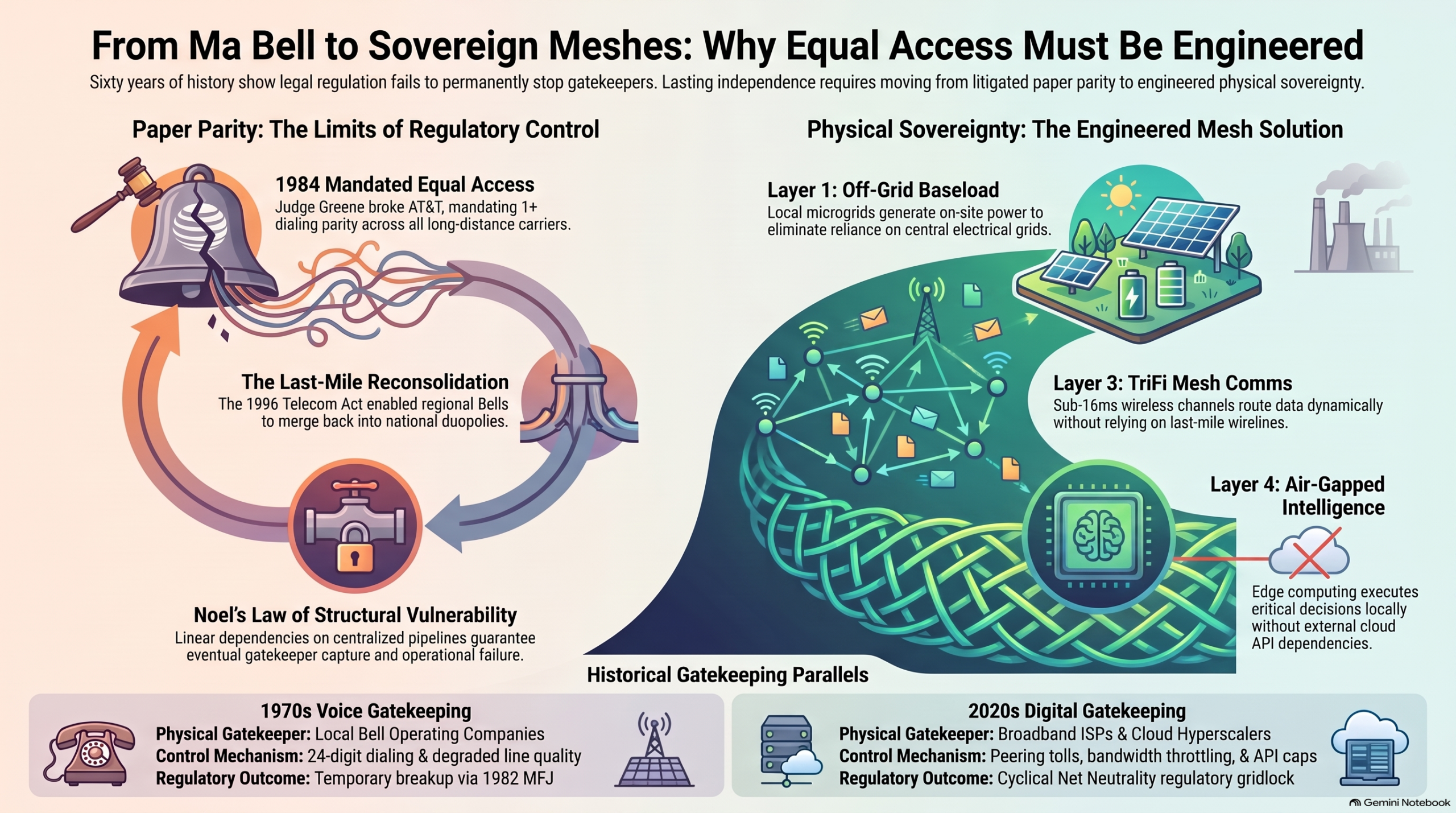
Centralized communications and power utility networks have historically evolved toward monopoly capture, transforming essential public and enterprise connectivity into single-point infrastructure chokepoints controlled by what DeReticular terms the “Reticular Complex.” Understanding the six-decade trajectory of telecommunications deregulation, technical sabotage, and subsequent corporate re-consolidation is not an academic exercise in administrative history; it is an urgent strategic prerequisite for modern municipal leaders, emergency response directors, and sovereign enterprise architects. As physical dependencies on centralized transmission lines, high-voltage utility corridors, Tier-1 transit drops, and cloud hyperscalers deepen, organizational resilience depends entirely on deconstructing how historical administrative protections consistently failed to prevent gatekeeper capture, and why engineered physical autonomy represents the only viable defense against digital estate tenancy.
The historical blueprint for challenging monopoly gatekeepers began in December 1963 with John D. “Jack” Goeken, a two-way radio salesman from Joliet, Illinois. Commercial long-haul trucking firms hauling freight between Chicago and St. Louis required reliable, low-cost dispatch communications, but mobile VHF signals faded after 30 to 50 miles, and AT&T’s expensive leased-line telephone service refused third-party radio interconnections. Goeken founded Microwave Communications, Inc. (MCI) to erect a chain of low-power microwave relay towers along Route 66. Despite AT&T and its regional subsidiaries (Illinois Bell and Southwestern Bell) fighting the application at the Federal Communications Commission (FCC) for six years under the pretext of preventing “cream-skimming” of profitable high-density routes, the FCC narrowly issued the landmark 1969 MCI Decision (Docket 16509). However, Goeken lacked the capital and aggressive national legal framework required to survive AT&T’s ongoing operational resistance.
In 1968, venture capitalist and Harvard MBA William G. “Bill” McGowan stepped in to transform MCI from a localized trucking link into a national challenger. McGowan restructured the enterprise, organized and merged 16 regional MCI affiliates into MCI Communications Corporation in 1972, and deployed legal strategy as the company’s primary operational weapon—famously characterizing MCI as “a law firm with an antenna on the roof.” In 1975, MCI launched Execunet, a shared-switch service allowing customers to dial into MCI’s network to reach any telephone nationwide, directly challenging AT&T’s core long-distance product, Message Telecommunications Service (MTS). When the FCC attempted to halt Execunet at AT&T’s behest, MCI litigated, securing pivotal U.S. Court of Appeals for the D.C. Circuit rulings between 1977 and 1978 that legally forced AT&T to provide local exchange interconnections for competitive switched voice services.
This escalating pressure culminated in United States v. AT&T, a sweeping antitrust action filed by the Department of Justice in November 1974 under Section 2 of the Sherman Act. Assigned in 1978 to Judge Harold H. Greene of the U.S. District Court for the District of Columbia, the court dismantled AT&T’s stall tactics and denied its motion to dismiss in late 1981, ruling that evidence proved AT&T had deliberately weaponized its local distribution monopoly to suppress competition. Facing certain judicial dismemberment, AT&T negotiated a consent decree known as the Modification of Final Judgment (MFJ), approved by Judge Greene on August 24, 1982, and implemented on January 1, 1984. The MFJ shattered the Bell System by spinning off its 22 local Bell Operating Companies (BOCs) into seven independent Regional Bell Operating Companies (RBOCs or “Baby Bells”—Ameritech, Bell Atlantic, BellSouth, NYNEX, Pacific Telesis, Southwestern Bell, and US West), while AT&T retained long distance, Western Electric, and Bell Labs.
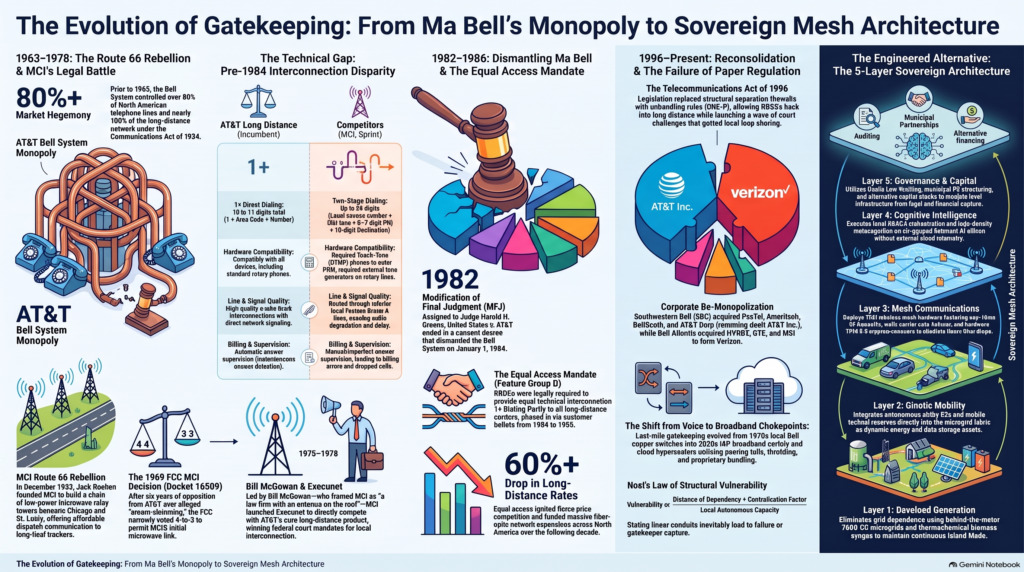
At the core of Judge Greene’s decree was the Equal Access Mandate, codified as Feature Group D (FGD). This mandated 1+ Dialing Parity, granting independent carriers equal technical quality and enabling consumers to select their Primary Interexchange Carrier (PIC) via ballots phased in between 1984 and 1986. This operational parity triggered a boom in transcontinental single-mode fiber deployment and lowered long-distance rates by over 60%. However, this decentralized competition was structurally dismantled over the next two decades. The Telecommunications Act of 1996 replaced structural separation with Unbundled Network Element (UNE-P) rules, which incumbent RBOCs tied up in federal appeals courts (U.S. Telecom Ass’n v. FCC), gutting unbundling mandates and bleeding competitive local exchange carriers dry. A massive wave of corporate reconsolidation followed: Southwestern Bell (SBC) acquired PacTel, Ameritech, BellSouth, and eventually its former parent AT&T Corp. in 2005 (rebranding as AT&T Inc.); Bell Atlantic acquired NYNEX and GTE to form Verizon. MCI was acquired in 1998 by WorldCom, which collapsed in 2002 under an $11 billion accounting fraud scandal, leading to Verizon absorbing the restructured remnants of MCI in 2006. By 2008, competitive long-distance voice had vanished, re-consolidating into a Bell duopoly.
Historical Evolution of Telecommunications Interconnection & Control
Era / Milestone Dominant Architecture & Gatekeeper Mechanism Regulatory / Judicial Response Long-term Structural Outcome
1963–1969: Route 66 Trucking Radio & MCI Foundation AT&T Bell System monopoly control over >80% of local lines and ~100% of long distance. Denial of third-party interconnection; claims of “cream-skimming.” FCC 1969 MCI Decision (Docket 16509) narrowly permits private microwave construction after 6-year delay. Validated private microwave bypass concept, but MCI lacked capital and national legal framework to scale against incumbent resistance.
1972–1978: Affiliate Consolidation & Execunet Breakthrough McGowan merges 16 regional MCI affiliates into MCI Corp (1972). AT&T MTS switched-voice monopoly; refusal to interconnect Execunet. D.C. Circuit Court of Appeals rulings (1977–1978) overrule FCC/AT&T, forcing local exchange interconnections for Execunet. Established legal right to interconnect competitive switched long-distance services into local public exchange networks.
1982–1984: The MFJ Breakup & Equal Access Mandate Integrated local/long-distance Bell monopoly weaponizing local exchange bottleneck against long-haul competitors. Judge Harold H. Greene enters Modification of Final Judgment (MFJ); forces divestiture of 22 BOCs into 7 Baby Bells. Created Feature Group D (FGD) and 1+ Dialing Parity. Ignited nationwide fiber-optic buildout and reduced long-distance rates by >60%.
1996–2006: Telecom Act, WorldCom Collapse & Reconsolidation Baby Bell control over local loops; judicial delays (U.S. Telecom Ass’n v. FCC) gutting UNE-P unbundling obligations. Telecommunications Act of 1996 replaces structural separation with unbundling; regulatory oversight collapses. SBC and Bell Atlantic absorb remaining Baby Bells, AT&T Corp, and fraud-battered MCI (post-WorldCom collapse), recreating an AT&T/Verizon duopoly.
Present: Broadband Gatekeeping & Cloud Feudalism Last-mile fiber/coaxial drops controlled by Bell descendants and cable cartels; Tier-1 transit chokepoints and cloud hyperscalers. Cyclical administrative swings over Net Neutrality (FCC Title II vs. Title I reclassifications). Migration of gatekeeper control from voice to data: edge throttling, peering tolls, cloud egress fees, and centralized single-point grid dependencies.
While paper mandates and administrative decrees briefly fractured corporate monopolies, they failed to alter the physical realities of centralized conduit dependency.
- The Structural Pathology of Centralized Infrastructure & Noel’s Law
The physics of centralized linear conduits dictates that whoever controls the physical bottleneck inevitably extracts economic rents, degrades competitive traffic, or enforces total operational capture. Legal protections and administrative constructs—such as Net Neutrality regulations or municipal open-access policies—consistently fail over extended timelines because they attempt to govern behavior via paper rules while leaving physical control in the hands of the gatekeeper. When physical transmission remains centralized, the gatekeeper retains absolute operational veto authority over the system. From a topological perspective, true neutrality is not an administrative construct or a statutory right; true neutrality is an invariant property of a fully mesh-connected graph. A linear network topology that relies on a central hub will always recreate a central toll collector.
This structural pathology manifests across technical eras through distinct physical mechanisms of last-mile sabotage:
- Voice-Era Last-Mile Sabotage (1970s–1980s): Before Feature Group D, AT&T restricted competitors like MCI to Feature Group A (FGA) interconnections. AT&T customers enjoyed seamless “1+” direct dialing (7 to 11 digits) with automatic answer supervision and crystal-clear 4-wire trunking. Competitors were forced into an arduous 24-digit dialing sequence: dialing a local 7-digit access number, waiting for a second dial tone, punching in a 5- to 7-digit security PIN, and then dialing the 10-digit destination. Standard rotary dial phones could not transmit the dual-tone multi-frequency (DTMF) signals required for PIN authentication without an external acoustic generator. Furthermore, while AT&T routed its own long-distance traffic over direct 4-wire trunks with automated network signal answer supervision, MCI traffic was dumped onto inferior local 2-wire exchange lines. This caused severe line noise, low signal levels, manual or imperfect answer supervision (which triggered constant billing errors and prematurely dropped calls), and deliberate call setup delays.
- Modern Broadband & Hyperscaler Chokepoints (2010s–Present): The physical last-mile bottleneck has migrated from copper voice circuits to broadband fiber/coaxial drops, mobile data networks, Tier-1 IP transit points, and centralized cloud data centers. Modern gatekeepers utilize peering tolls, deliberate interconnect congestion against high-bandwidth edge providers, arbitrary data caps, cloud egress fees, and strict API rate limits to tax independent traffic. Concurrently, regional systems rely heavily on centralized, high-voltage transmission corridors stretching over hundreds of miles of exposed terrain, leaving communities, emergency services, and enterprise nodes vulnerable to catastrophic single-point grid failures, atmospheric disruptions, or cyber intrusions.
To formalize this physical vulnerability, Michael Noel formulated Noel’s Law of Structural Vulnerability, expressed mathematically as:
\text{Vulnerability} \propto \frac{\text{Distance of Dependency} \times \text{Centralization Factor}}{\text{Local Autonomous Capacity}}
The operational variables of Noel’s Law define the physical mechanics of network failure:
- Distance of Dependency: The physical, logical, or operational length of the linear umbilical connecting a local site to its supply source (e.g., a 1,000-mile high-voltage transmission corridor, a remote Tier-1 fiber backhaul drop, or an off-site cloud availability zone). As distance increases, exposure to single-point failure vectors scales linearly.
- Centralization Factor: The degree to which transmission, switching, or execution authority is concentrated within a single gatekeeper or un-isolated hub. High centralization creates asymmetric leverage, allowing the conduit owner to dictate toll structures, alter access terms, or drop service entirely.
- Local Autonomous Capacity: The total on-site capability of a local node to generate its own baseload power, route its own communications packets, and execute its own cognitive intelligence in complete isolation.
Under Noel’s Law, any socio-technical system reliant on an un-isolated, linear umbilical—the “1,000-Mile Failure Model”—is mathematically predestined to suffer catastrophic outages, predatory rent extraction, or total gatekeeper capture.
True parity cannot be litigated through paper laws; it must be engineered through physical isolation and autonomous local capacity.
Recognizing that legal intervention cannot overcome the physical laws of centralized vulnerability, infrastructure strategy must pivot from administrative negotiation to the deployment of sovereign, engineered network architectures.
- The 5-Layer Sovereign Architecture Framework
To achieve complete operational independence from centralized chokeholds, infrastructure must be deployed as a fully integrated, decoupled stack. The 5-Layer Sovereign Architecture Framework establishes “Spherical Resilience,” allowing a municipal emergency operations center, water treatment facility, or enterprise node to achieve sustained “Island Mode”—operating indefinitely without external power, transit, or cloud dependencies.
+———————————————————————————–+
| LAYER 5: GOVERNANCE | Noel’s Law Auditing • Municipal P3 • Capital Stack |
+———————————————————————————–+
| LAYER 4: COGNITION | Air-Gapped Remnant Silicon • Liquid SCADA Engine |
+———————————————————————————–+
| LAYER 3: MESH COMMUNICATIONS | TriFi Wireless Mesh • Sub-16ms Handoff • DePIN |
+———————————————————————————–+
| LAYER 2: KINETIC MOBILITY | Autonomous Utility EVs • Nomadic Tactical Storage |
+———————————————————————————–+
| LAYER 1: BASELOAD GENERATION | 700V DC Microgrids • Thermochemical Biomass Gas |
+———————————————————————————–+
- Layer 1: Baseload Generation (The Energy Foundation)
- Technical Specifications: On-site deployment of behind-the-meter, continuous, dispatchable power generation using 700V DC microgrid architecture paired with thermochemical biomass syngas gasification units.
- Operational Advantages: Completely eliminates reliance on vulnerable central transmission grids, high-voltage corridors, and regional substations. By generating energy directly behind the meter, nodes bypass utility interconnect queues, avoid line-loss overhead, and eliminate utility bills, securing an unassailable power foundation for sustained Island Mode operations.
- Layer 2: Kinetic Mobility (Nomadic Energy Assets)
- Technical Specifications: Direct integration of autonomous utility electric vehicles (EVs), nomadic fleets, and mobile tactical energy storage reserves directly into the local 700V DC microgrid fabric.
- Operational Advantages: Converts transport fleets from passive energy sinks into dynamic, bi-directional storage and power distribution assets. Mobile units dynamically exchange power and data across fixed sovereign nodes, extending operational range and providing kinetic energy re-supply during emergency deployments.
- Layer 3: Mesh Communications (TriFi Wireless Architecture)
- Technical Specifications: Deployment of the TriFi wireless mesh hardware suite, incorporating dynamic sub-16ms RF channel handoffs, Decentralized Physical Infrastructure Network (DePIN) topologies, dynamic multi-carrier auto-failover, and hardware-level TPM 2.0 cryptographic root-of-trust silicon on every node pole.
- Operational Advantages: Completely eliminates single-point fiber backhaul and ISP last-mile dependencies. When an external backhaul trunk is severed, throttled, or compromised, the omnidirectional TriFi mesh dynamically re-routes packet traffic across local nodes without operational degradation, delivering hardware-verified cryptographic security across the RF fabric.
- Layer 4: Cognitive Intelligence (Air-Gapped Remnant Silicon)
- Technical Specifications: On-premises deployment of Remnant—specifically designated as DeReticular’s percestial superintelligence and metacognitive swarm engine—running on air-gapped, high-density edge silicon with zero external cloud API dependencies.
- Operational Advantages: Delivers real-time local SCADA orchestration, dynamic microgrid load balancing, predictive hardware maintenance, and emergency crisis triage directly at the node edge. Ensures zero operational telemetry leaves the site perimeter, shielding critical logic from cloud availability zone outages, API rate limits, and external access revocation.
- Layer 5: Sovereign Advisory & Governance
- Technical Specifications: Specialized administrative shielding, Noel’s Law structural vulnerability auditing, Municipal Public-Private Partnership (P3) structuring, and alternative non-traditional capital stacking.
- Operational Advantages: Protects sovereign infrastructure nodes against administrative capture, legal challenges, and municipal bureaucratic delays. Equips leadership with the institutional and financial frameworks required to deploy autonomous assets while maintaining full regulatory compliance and fiscal sovereignty.
By operationalizing these five distinct layers, leaders can systematically execute a concrete transition plan to decouple critical operational environments from vulnerable centralized networks.
- Strategic Implementation Roadmap for Municipal & Enterprise Leaders
Transitioning an organization from a dependent tenant on a digital estate into a sovereign infrastructure operator requires a structured, phased execution framework. Strategic leadership must systematically apply Noel’s Law to eliminate single-point failure vectors, grounding each phase in the concrete operational requirements of municipal 911 dispatch centers, enterprise Emergency Operations Centers (EOCs), and critical public utilities (such as automated water treatment plants).
[PHASE I] [PHASE II] [PHASE III] [PHASE IV]
Vulnerability Audit & Triage ===> Edge Power & Comms Deployment ===> Autonomous Intelligence ===> Conduit Obsoletion & Full
(Noel’s Law Mapping) (Island Mode Layers 1 & 3) (Layer 4 SCADA) Sovereignty (Layers 2 & 5)
Strategic Execution Phases
- Phase I: Vulnerability Audit & Triage (Noel’s Law Mapping)
- Operational Scope: Municipal 911 Dispatch Centers, Enterprise EOCs, and Water Treatment Automation Systems.
- Deliverables: Map all linear dependencies, identifying external high-voltage transmission lines, single-drop Tier-1 ISP fiber drops, remote cloud availability zones, and third-party API dependencies.
- Calculate the facility’s vulnerability index using Noel’s Law by measuring the physical distance of remote dependencies and gatekeeper centralization factors against existing local autonomous capacity.
- Establish triage priority for critical operational assets: map primary power lines feeding water treatment chemical dosing pumps, identify single-thread fiber paths feeding 911 Computer-Aided Dispatch (CAD) consoles, and catalog cloud dependencies in enterprise EOC decision tables.
- Phase II: Edge Power & Comms Island Mode Deployment (Layers 1 & 3)
- Operational Scope: Behind-the-Meter Baseload & Local RF Fabric Installation.
- Deliverables: Deploy Layer 1 behind-the-meter 700V DC microgrids paired with thermochemical biomass gasification units at the municipal water treatment facility and emergency dispatch building to establish continuous, non-intermittent local power.
- Erect Layer 3 TriFi wireless mesh hardware across 911 radio towers, enterprise EOC rooftops, and municipal utility structures, configuring sub-16ms RF channel handoffs and securing hardware poles with TPM 2.0 cryptoprocessors.
- Validate off-grid self-sufficiency by executing initial “Island Mode” cutover tests, physically disconnecting primary utility drops and testing localized mesh packet routing under full operational load.
- Phase III: Autonomous SCADA & Local Intelligence Integration (Layer 4)
- Operational Scope: On-Premises Percestial Superintelligence Deployment.
- Deliverables: Install air-gapped Remnant metacognitive swarm engine silicon on-premises at the 911 dispatch center and water treatment automation hub, completely severing external cloud telemetry routes and third-party AI platform dependencies.
- Integrate local SCADA orchestration engines onto the Remnant compute layer to automate real-time water treatment telemetry, emergency dispatch resource allocation, microgrid load balancing, and predictive fault isolation.
- Conduct adversarial stress testing, simulating widespread regional power grid collapses and complete Tier-1 transit blackouts to verify local cognitive triage performance without cloud connectivity.
- Phase IV: Complete Conduit Obsoletion & Full Sovereignty (Layers 2 & 5)
- Operational Scope: Kinetic Asset Integration & Legal Governance Shielding.
- Deliverables: Integrate Layer 2 kinetic mobility assets, incorporating autonomous utility EVs and nomadic mobile energy reserves directly into the local 700V DC microgrid interface at municipal public works and enterprise transport depots.
- Execute Layer 5 governance structures, finalizing municipal P3 frameworks, alternative capital stack financing, and administrative legal shielding to defend autonomous infrastructure from bureaucratic capture or utility pushback.
- Formally sever operational reliance on central gatekeepers, moving the organization from passive regulatory compliance to an engineered, self-reliant infrastructure posture.
By executing this phased roadmap, municipal and enterprise operators eliminate single-point vulnerabilities, operationalize true physical resilience, and ensure total operational survival regardless of external grid or network disruptions. The line is dead. The mesh is awake.


