
Technical Architecture Whitepaper: The RIOS Trinity Stack and Hardware-Level Cryptographic Security Protocols
1. Executive Overview: The Paradigm of Spherical Resilience
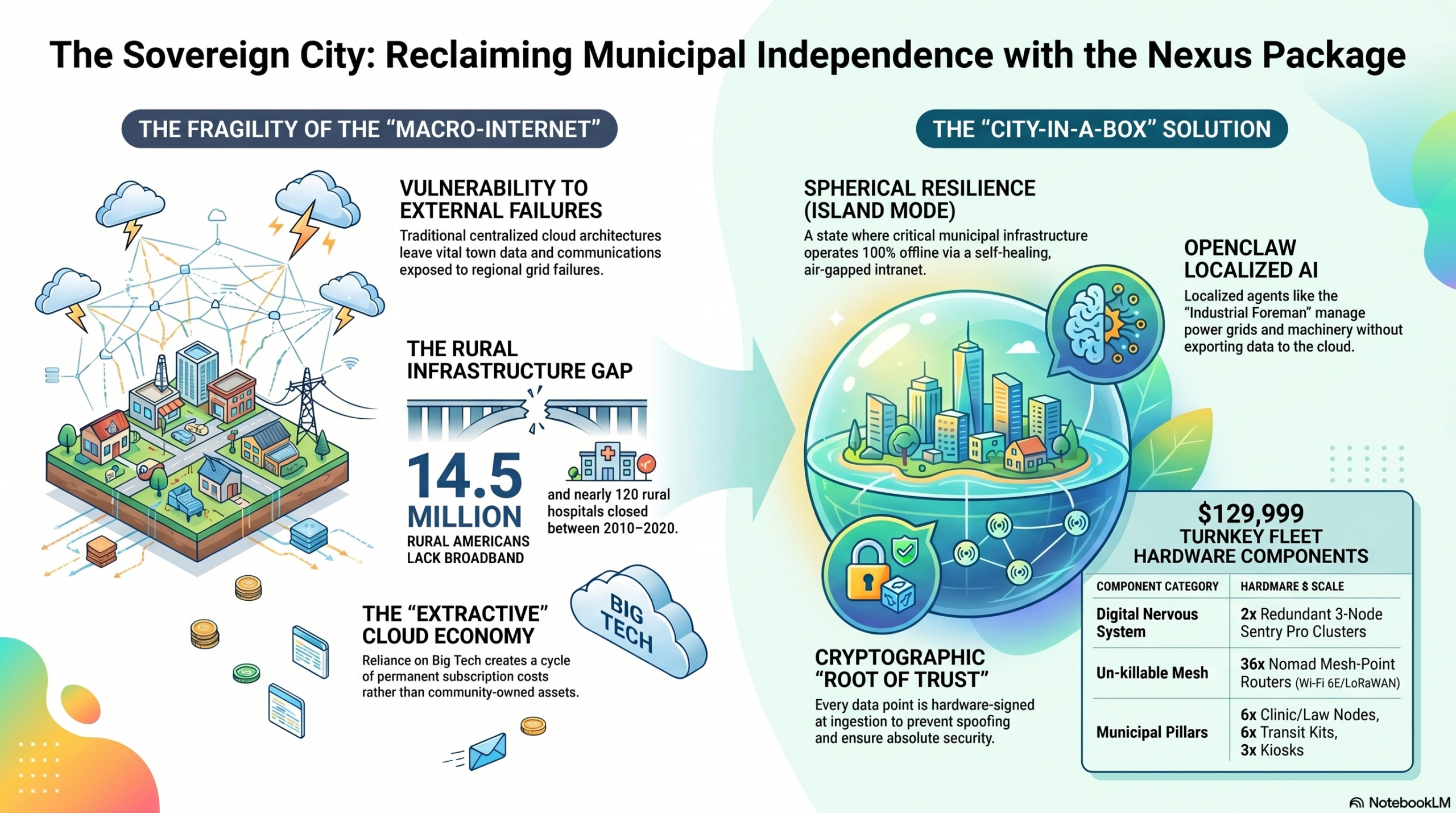
The concept of Sovereign Automation represents a fundamental shift in the defensive posture and operational logic of municipal infrastructure. For the 46.2 million residents of rural America, the “macro-internet” has transitioned from a utility into a structural vulnerability. As centralized cloud-hosted services become increasingly extractive and fragile, small-to-medium municipalities face a “natural decrease” in resilience—compounded by the closure of 120 rural hospitals and a 40% deficit in per-capita physician availability. Traditional architectures are no longer sufficient; the modern municipality requires “Island Mode,” or “Spherical Resilience,”—the ability for critical civic logic to function with absolute autonomy during total grid or telecommunications failures.
This shift necessitates a transition from extractive, cloud-dependent models to Decentralized Physical Infrastructure Networks (DePIN). By reclaiming “digital borders,” towns can transform their digital footprint into a permanent, community-owned asset. The $129,999 “City Infrastructure” Nexus Package (SKU: SOV-BNDL-CITY) serves as the definitive “City-in-a-Box” for populations of 1,000–3,000 residents. This turnkey solution achieves total operational sovereignty through the Rural Infrastructure Operating System (RIOS), a hyperconverged framework designed to treat municipal services not as cost centers, but as un-killable digital assets.
2. The RIOS Hyperconverged Framework: Architectural Foundation
The Rural Infrastructure Operating System (RIOS) is the cornerstone of the Sovereign Automation ecosystem. To maximize the efficiency of ruggedized edge hardware, RIOS utilizes a Type-1 hypervisor (Proxmox VE). This choice is a strategic mandate: the isolation of execution environments is a non-negotiable requirement for minimizing the blast radius of a potential Layer 1 compromise. By integrating compute, storage, and networking into a single, high-efficiency framework, RIOS facilitates high-survivability and local-first logic processing at the extreme edge.
This architecture ensures that failure domains are strictly contained. The strategic impact of this hyperconverged framework is the transformation of fragile IT departments into resilient assets capable of surviving macro-grid failures. System requirements for the RIOS framework include:
- Core Compute Clusters: High-capacity Sentry Pro nodes (6x 1U nodes total) equipped with 64GB RAM per node and onboard NVIDIA GPUs for localized AI inferencing.
- Active-Active Redundancy: Nodes are deployed in geographically separate municipal data centers (e.g., City Hall and Police HQ) to ensure continuous operation.
- Ruggedized Deployment: Hardware is staged and delivered in 8 heavy-duty, weather-sealed transit crates, pre-configured for “Extreme Demand” environments.
This foundational framework hosts the three-layered defense-in-depth architecture known as the Trinity Stack.
3. The Trinity Stack: Three-Layer Defense-in-Depth
The Trinity Stack serves as the “operational brain” of the RIOS platform. In an autonomous municipal environment, isolating network management, core logic, and security auditing into distinct execution layers is a tactical necessity. This defense-in-depth model ensures that system integrity is maintained even under active duress.
Layer 1: The Gatekeeper (Network Perimeter)
The Gatekeeper manages the perimeter using pfSense for rigorous firewall routing. This layer is responsible for the bonding of disparate external connections, such as Starlink satellite links and LTE backhaul, ensuring that the municipality maintains a secure gateway to the external world without compromising the internal mesh’s air-gapped status.
Layer 2: The Ledger (Operational Logic)
The Ledger is the hub of municipal processing. Running on an Ubuntu-based environment, it hosts the DevOps Sovereign (Deep Admin) and the Sovereign Executive. This layer processes all localized core logic, manages automated notary services, and maintains a peer-to-peer (P2P) decentralized data store. It ensures that civic records remain synchronized across the mesh without reliance on any external centralized database.
Layer 3: The Auditor (Active Intrusion Hunting)
The Auditor provides continuous system verification. Built on Kali Linux, this layer executes automated vulnerability scanning and active intrusion hunting across the entire municipal intranet canopy. It monitors for anomalous behavior, ensuring that internal communications remain untainted and cryptographically sound.
This three-layer structure provides the hardened environment required for the localized AI framework to manage the city’s physical assets.
4. The OpenClaw Framework: Localized AI for “Island Mode”
A central challenge in achieving “Island Mode” is the “Oracle Problem”—the difficulty of maintaining advanced AI administrative capabilities without reaching out to data-extractive cloud APIs. The OpenClaw Framework solves this by deploying localized AI agents—utilizing 4-bit quantized Llama 3 models and vision language algorithms—entirely on municipal hardware. This eliminates “Big Tech” data extraction while providing enterprise-grade automation for rural centers facing severe labor and healthcare shortages.
The framework utilizes three primary OpenClaw agents to manage the sovereign city:
- The Industrial Foreman: In Supply Chain/Logistics Mode, this agent manages power micro-grids and heavy machinery. It integrates via CAN Bus/OBD-II with municipal fleets to manage route geofencing and autonomous dispatch.
- The Field Medic: Directly addressing the “Healthcare Desert” crisis, the Field Medic processes sensitive medical telemetry locally. It utilizes Whisper AI for patient dictation and OCR for medical record processing, ensuring HIPAA-compliant healthcare services remain functional even when the town is offline.
- The Sovereign Elector: This agent is dedicated to the community’s democratic integrity, securing localized voting terminals through cryptographic verification to prevent tampering or external interference.
These agents are anchored to physical reality through DeReticular’s advanced hardware-level security protocols.
5. Hardware-Level Security: Establishing the Root of Trust
In any decentralized mesh, software-only authentication is a vulnerability. To solve the Oracle Problem and prevent the ingestion of spoofed data, the RIOS architecture employs a Split-Ledger Architecture to verify the physical reality of every node. This establishes a definitive Root of Trust that cannot be bypassed via credential theft.
TPM 2.0 Integration
Every node in the Nexus Package utilizes a factory-sealed TPM 2.0 (Trusted Platform Module) chip. Data is cryptographically signed at the exact moment of ingestion using non-exportable private keys burned into the hardware. This ensures every transaction on the municipal ledger is anchored to a verified physical device.
Radio Frequency (RF) Fingerprinting
To further harden the network, the system utilizes software-defined radios to perform RF Fingerprinting. By scanning for microscopic manufacturing imperfections in physical sensors, the system creates a unique “radio signature” for every device. The mesh instantly rejects any packet from a device whose signature does not match its registered profile, providing a physical-layer defense against simulated or cloned hardware.
6. The Sovereign Automation Mesh: Network Topography and Deployment
The physical network layer consists of 36 Nomad Mesh-Point routers, creating a “Digital Nervous System”—an un-killable intranet canopy blanketed over the municipality. This mesh utilizes Wi-Fi 6E for high-bandwidth P2P backhaul and 900MHz LoRaWAN for deep-penetration failover.
Technical Summary: SKU: SOV-BNDL-CITY Bill of Materials
- Core Compute: 2x Sentry Pro Clusters (6x 1U Nodes) providing active-active redundancy at City Hall and Police HQ.
- Mesh Infrastructure: 36x Nomad Mesh-Point Routers (Wi-Fi 6E / LoRaWAN).
- Professional Nodes: 4x Medical Nodes (Sovereign Executive/Whisper AI/OCR) and 2x Legal Nodes (Sovereign Executive/Vault Warden).
- Transit/Logistics: 6x Nomad Fleet Kits (CAN Bus integration for autonomous shuttles).
- Public Interface: 3x Ruggedized Municipal Kiosks running Vault Warden for LiDAR-based volumetric monitoring of public spaces.
Cryptographic Provisioning and Risk Mitigation
Provisioning involves a multi-tier process where DeReticular architects mint a unique SHA-256 Master Key and a city-specific Root CA, generating over 50 unique cryptographic identities.
- Pivot Attack Defense: Sub-nets (Medical, Legal, Public) are cryptographically isolated. Nodes are programmed to drop any packet not signed by their specific Sub-CA, rendering the public-facing kiosks functionally invisible to the medical or legal databases.
- Failover Logic: The dual-cluster (active-active) model ensures that if the primary cluster at City Hall is compromised, the secondary cluster at Police HQ instantly assumes Master CA duties without a single second of downtime. If dense construction interferes with Wi-Fi, the system automatically downshifts to LoRaWAN to ensure critical dispatch and CRM data persist.
7. Conclusion: The Economic and Operational Future of Sovereign Cities
The transition from extractive cloud models to community-owned digital assets marks a fundamental turning point for the rural American municipality. By deploying the RIOS/Trinity Stack architecture, towns can reclaim their digital sovereignty, transforming IT from a fragile cost center into a robust, revenue-generating asset.
The integration of hyperconverged edge software, air-gapped AI, and cryptographically sealed hardware provides the only sustainable defense in an increasingly volatile digital landscape. The “City Infrastructure” Nexus Package is not merely a technology stack; it is a verified physical reality anchor that ensures the survival and prosperity of the sovereign city of the future.


