
The Asymptotic Horizon: A Foundational Primer on Perspectival Realism and the Invariant Attractor
- The Dilemma: Absolutism vs. Relativism
At the core of systemic failure lies the Access Problem: the fundamental cognitive and biological reality that no observer can step outside their own sensory and neural apparatus to compare their internal models to an unmediated “external” world. This epistemic boundary has historically forced a retreat into one of two intellectually bankrupt extremes.
Dogmatic Absolutism presumes a “View from Nowhere”—a God-like access to objective reality that ignores the observer’s instrumental limits. This inevitably leads to ideological projection and the imposition of narrow frames as universal truths. Conversely, Radical Relativism collapses into the “hall of mirrors,” where truth is dismissed as a mere social construct or power play. This position suffers from performative self-contradiction; reality—via Ontic Friction—exerts its presence regardless of social consensus.
The Epistemic Binary
Feature Dogmatic Absolutism Radical Relativism
Core Claim Unmediated access to absolute truth. Truth is an arbitrary social fiction.
Epistemic Flaw Ignores biological/instrumental limits. Performative self-contradiction.
Primary Failure Mode Ideological Authoritarianism. Loss of predictive power; Hall of Mirrors.
Systemic Outcome Authoritarianism Physical/Systemic Collapse
The “So What?”: Systems thinkers require a third way—Fallibilistic Realism. We must respect the mind-independence of reality while acknowledging the indexicality and biological constraints of our observational “frames.”
Transitional Sentence: Perspectival Realism serves as the rigorous bridge between these extremes, reconciling the reality of the external world with the limitations of the internal observer.
- Perspectival Realism: Seeing the Manifold
Drawing from the formalisms of Giere and Massimi, Perspectival Realism posits that human perception is not a direct mirror of reality, but a Dimension-Reducing Projection. We model the world as a high-dimensional object casting low-dimensional “shadows” onto our specific cognitive planes. While “incomplete,” these shadows are not “false”; they track genuine physical differences in the high-dimensional world.
The architecture of this view rests on three pillars:
- Ontology (The Invariant Attractor): Reality exists as a stable, mind-independent configuration (\Omega^*) within an infinite-dimensional manifold.
- Epistemology (Framed Projections): We interface with reality through perspective frames that reduce infinite complexity into manageable data.
- The Engine (Via Negativa): Veridicality is achieved through the systematic contraction of the hypothesis space—erasing models that fail the test of physical resistance.
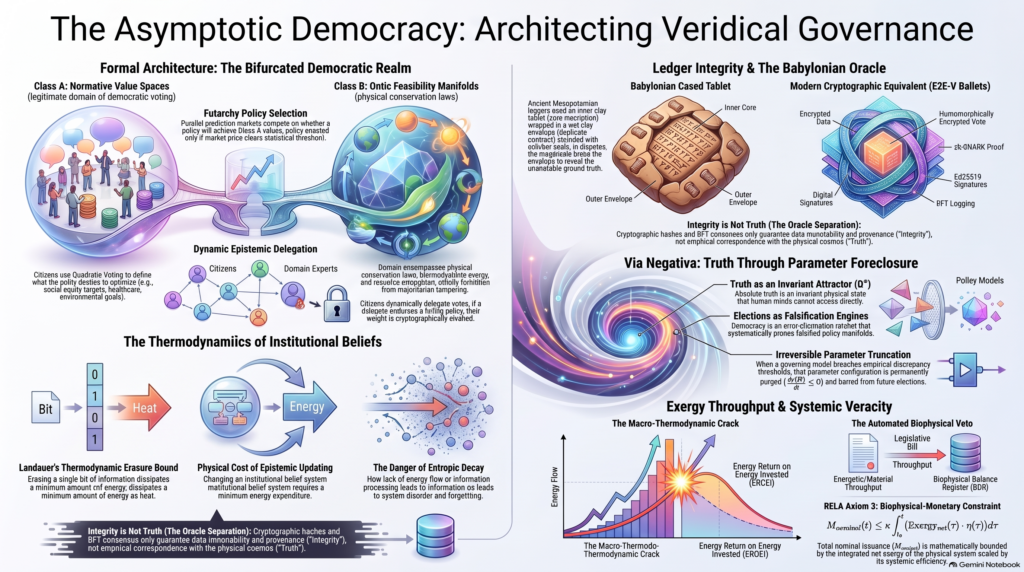
The “Oracle Principle”: Integrity is Not Truth. It is vital to distinguish between Integrity (Level 2: Cryptographic provenance and ledger immutability) and Truth (Level 0: Empirical correspondence). A blockchain may guarantee that a record has not been altered, but it cannot guarantee that the record is accurate to the physical cosmos. The “Oracle Problem” remains the boundary where symbolic ledgers must meet ontic reality.
Transitional Sentence: To understand how disparate perspective frames align, we must define the center point of their collective gaze: the Invariant Attractor.
- The Invariant Attractor (\Omega^*)
We model the universe as an Ontic State-Space Manifold (\mathcal{M})—a space of near-infinite dimensionality (\dim(\mathcal{M}) \to \infty) representing every possible configuration of matter and energy. Within \mathcal{M}, objective truth is not a static point but a stable, mind-independent trajectory: the Invariant Truth Attractor (\Omega^*).
Formal Definition of \Omega^*
The absolute truth is the invariant intersection across all possible valid projection angles over indefinite inquiry. It is formulated as the limit of cross-perspectival intersection: \Omega^* = \lim_{t \to \infty} \bigcap_{\theta \in \Theta_t} \hat{\Pi}_\theta^{-1}(\mathcal{P} _\theta^{\text{validated}})
The “So What?”: While no single observer can see the entire attractor due to their low-dimensional projection, the Asymptotic Recovery occurs through the overlapping of many “low-d” perspectives. Truth is what remains invariant when we “stack” valid projections and account for their intersections.
Transitional Sentence: This raises the question of how an observer actually performs this projection to transform infinite complexity into actionable information.
- The Mathematics of Seeing: Dimension Reduction (\hat{\Pi}_\theta)
The Projection Operator (\hat{\Pi}\theta) is the mechanism of Indexicality. It acts as a filter, reducing the infinite complexity of \mathcal{M} into a lower-dimensional “Perspective Frame” (\mathcal{P}\theta) where \dim(\mathcal{P}_\theta) = d \ll \infty.
Every Perspective Frame is defined by three components:
- Thresholds: The physical and sensory limits of the apparatus (e.g., human visible light spectrum vs. ultraviolet).
- Taxonomies: The linguistic and conceptual “nets” (e.g., biological classifications) used to categorize data.
- Coordinates: The specific spatiotemporal “here and now” of the observer.
The “So What?”: Veridicality does not require omniscience. If an observer detects a distinction in their frame, it tracks a genuine physical distinction in the high-dimensional manifold. Diversity of perspective is not a bug; it is the Intersubjective Engine required to recover the shape of the Attractor.
Transitional Sentence: Once we accept that our sight is framed but veridical, we shift our focus from “finding truth” to the rigorous process of “pruning error.”
- Via Negativa: Progress Through Foreclosure
In the Via Negativa (the “Negative Way”), we abandon the hunt for a final “Positive Truth” and commit to Parameter Foreclosure. Progress is not the discovery of light, but the permanent, irreversible destruction of demonstrated error.
We do not define falsification by a literal zero probability (P(E_t | \theta) = 0), which is statistically impossible in noisy systems. Instead, we use Discrepancy Loss Statistics (S(E_t, \theta) > \tau_t). When a model’s error exceeds a pre-registered threshold (\tau_t), its parameter space is foreclosed.
Topological Hypothesis Space Contraction:
[ Θ_0: Geocentric Epicycles [ Θ_1: Phlogiston [ Θ_2: Newtonian [ Ω* ] ] ] ]
The volume μ(Θ) monotonically contracts as invalid manifolds are “carved out” by empirical resistance.
The 3 Key Benefits of Foreclosure:
- Resilience: Prevents the resurrection of failed utopian promises and “magic ballots.”
- Irreversible Progress: Once a parameter is foreclosed (e.g., D_0 e^{rt} as a sustainable debt model in a finite energy system), it is permanently removed from the permissible space.
- MDL Parsimony: Prevents “Ideological Epicycles”—the inflation of Kolmogorov complexity (overfitting) used by institutions to “patch” failing theories.
Transitional Sentence: This contraction of the hypothesis space is not a mere mental abstraction; it is a physical process that incurs a mandatory energy cost.
- The Thermodynamic Anchor: Why Truth Costs Energy
The “Ledger of Truth” is bound by the second law of thermodynamics. According to Landauer’s Principle, the erasure of a bit of incorrect information or the updating of a “belief register” requires the dissipation of heat: \Delta Q \ge k_B T \ln 2.
The Physicality of Information
Channel Type Deductive Channels (Formal Logic) Physical Information Channels (Reality)
Process Syntactic Preservation (\Gamma \models \psi). Noisy/Dissipative Transmission.
Physics Tautological/Lossless. Bound by Shannon Noise & Landauer Heat.
Cost Zero new empirical energy. \Delta Q \ge k_B T \ln 2.
Outcome Unpacks latent information. Corrects beliefs via Ontic Friction.
The “So What?”: A society that refuses to “pay the energy cost” to admit error and update its records will suffer from Institutional Amnesia, Record Rot, and Conceptual Drift. Truth-seeking is the physical work of resisting entropy. Attempting to bypass this cost leads to the “cracked envelope” of modern macroeconomics, where ungrounded symbolic claims (D_0 e^{rt}) collide with the unyielding exergy limits of the planet.
Transitional Sentence: These physical laws demand the design of a new form of human coordination: The Asymptotic Democracy.
- Conclusion: The Asymptotic Journey
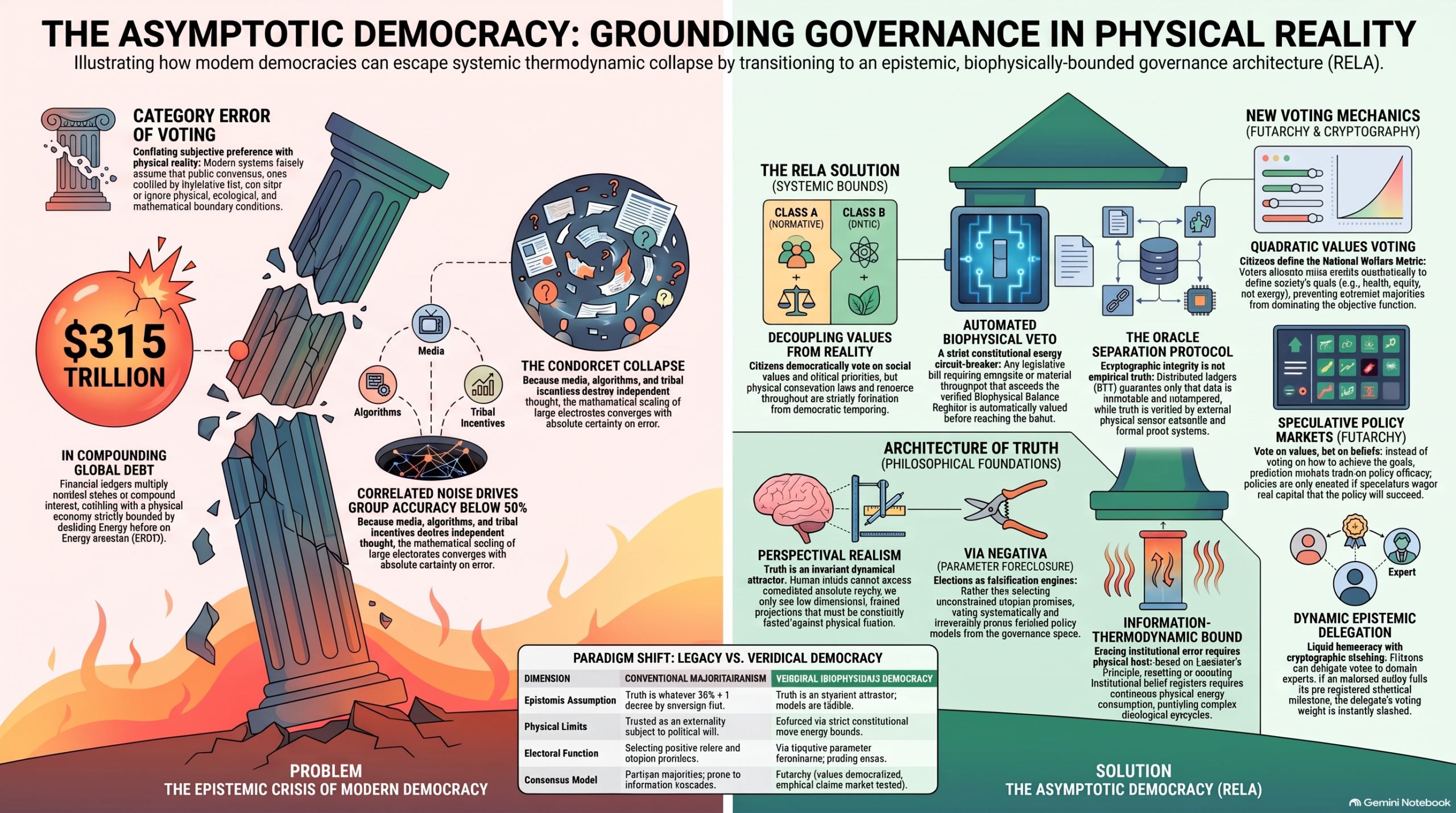
The Asymptotic Polity is a society governed by humility and empirical grace. It recognizes that we advance not by “claiming the sun,” but by relentlessly “pruning the darkness.” It is a civilization that has decoupled normative preferences (Class A) from ontic feasibility (Class B).
Learner’s Cheat Sheet
- Acknowledge Ontic Friction: Reality is not a social construct; it is an attractor that exerts causal resistance against ungrounded models.
- Commit to Parameter Foreclosure: Move toward truth by permanently deleting the parameter spaces that fail to track physical reality.
- Anchor the Ledger: Institutions must be bound by thermodynamics. Nominal claims cannot outpace the integrated net exergy of the system.
The “So What?”: We move from a democracy of ungrounded promises to an Asymptotic Polity governed by physical exergy and empirical grace. The search for truth is an infinite, self-correcting adventure. By anchoring our ledgers in physical reality and utilizing the tools of dimension-reduction, we ensure that human civilization steadily aligns itself with the objective cosmos.


