
The Evolution of Connectivity: From Digital Voice to Intelligent Fabrics
1. The Foundation: 2G and the Birth of Digital Mobile
The launch of the Second Generation (2G) in the early 1990s represented a tectonic shift in telecommunications, moving the global industry from antiquated analog systems to digital standards like GSM and CDMA. While 2G pioneered the conversion of voice into digital bits, its primary architectural legacy was the establishment of a standardized mobile footprint.
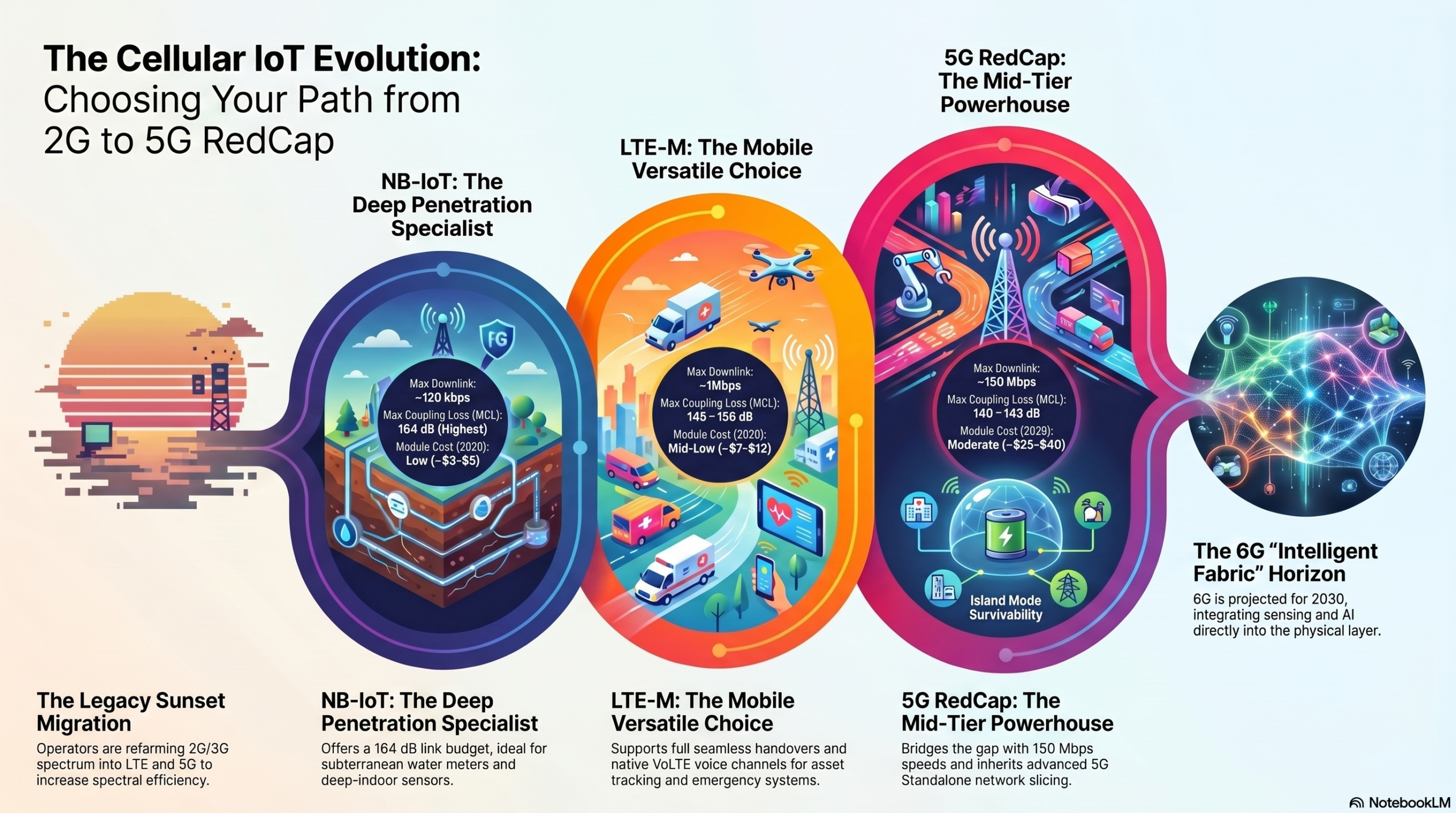
Today, we view the 2G era through the lens of a Spectrum Refarming Mandate. Regulators and operators are aggressively decommissioning 2G to recover valuable low-frequency bands—specifically 800 MHz, 900 MHz, and 1800 MHz—to reallocate them for the superior spectral efficiency of LTE and 5G.
The three most significant contributions of 2G to modern mobility include:
- The Introduction of SMS: Short Message Service created the first non-voice digital communication channel.
- Standardized Digital Voice: Digital encryption replaced the static-prone, easily intercepted analog audio of 1G.
- Basic Packet Data: Through GPRS and EDGE, 2G provided the first entry point into the mobile internet, albeit at rates often capped at 384 kbps.
Link to the Technical White Paper https://dereticular.com/technical-white-paper-securing-the-kinetic-edge-a-sovereign-stack-evaluation-of-nb-iot-lte-m-and-5g-redcap/
Security Vulnerabilities: 2G vs. Modern Infrastructure
| Security Feature | 2G (GSM/CDMA) | Modern Requirements (LTE/5G) |
| Authentication | Unidirectional: Only the device proves identity to the network. | Mutual Authentication: Both device and network must verify each other. |
| Encryption | Weak Ciphers (A5/1, A5/2): Crackable in real-time by modern hardware. | Robust Algorithms: AES-based encryption and unified key management. |
| Data Integrity | None: Data can be manipulated in transit between device and tower. | Mandatory: Cryptographic checking ensures data remains untampered. |
| Threat Resilience | Vulnerable to IMSI-catchers (Stingrays) mimicking towers. | Mitigates IMSI-catchers via IMSI Encryption (SUPI/SUCI). |
The limitations of 2G’s circuit-switched architecture—where fixed channels were required for voice calls—eventually reached a capacity ceiling, forcing the industry to pivot toward the “All-IP” packet-switched era of LTE.
——————————————————————————–
Link to the Podcast https://academy.dereticular.com/podcast/evolution-of-cellular-iot-from-5g-redcap-to-6g-foundations/
2. The Broadband Explosion: LTE and the All-IP Era
Introduced in the late 2000s, LTE (Long-Term Evolution) transformed the mobile network into a high-speed data engine. The “So what?” of this evolution was the transition to a flat, entirely packet-switched, All-IP architecture. By treating voice as just another data packet (VoLTE), the Evolved Packet Core (EPC) achieved massive throughput and the low latency required for the modern smartphone ecosystem.
A critical security milestone of LTE was the introduction of Mutual Authentication. By requiring the network to prove its identity to the device, LTE effectively ended the era of “dumb” connectivity where a device could be easily hijacked by a rogue base station.
The 2G to LTE Bridge
During the multi-decade migration, the industry developed interoperability mechanisms to prevent coverage “dead zones” as 2G was phased out.
| Mechanism | Technical Role |
| Circuit-Switched Fallback (CSFB) | Instructs an LTE device to drop to 2G/3G to complete a voice call if VoLTE is unavailable. |
| Dual-Mode Industrial Hardware | Hybrid modules (e.g., Semtech FX86E) using LTE-M as a primary path with 2G RF transceivers for fallback. |
While LTE mastered broadband for human consumption, the burgeoning Internet of Things (IoT) required specialized standards that prioritized battery life and coverage over raw speed.
——————————————————————————–
3. The Fork in the Road: NB-IoT vs. LTE-M
To address “Massive IoT,” 3GPP introduced two Low-Power Wide-Area Network (LPWAN) standards. While they share an ancestor in LTE, their physical layer differences create distinct specializations.
| Metric | NB-IoT (Narrowband IoT) | LTE-M (enhanced MTC) |
| Bandwidth | 180 kHz (Narrow) | 1.4 MHz (Moderate) |
| Max Rates (DL/UL) | ~120 kbps / ~160 kbps | ~1 Mbps / ~1 Mbps |
| Mobility Support | Limited (Cell re-selection only) | Full seamless handovers for moving assets. |
| Voice (VoLTE) | No | Yes |
| Coverage (MCL) | 164 dB (Extreme) | 145 dB to 155.7 dB (CE Mode B) |
NB-IoT’s ability to achieve “subterranean penetration” is a matter of pure physics defined by the formula: PSD \propto \frac{P}{B}. By concentrating its full transmit power (P) into a tiny 180 kHz bandwidth (B) or a 15 kHz single-tone uplink, NB-IoT achieves an extreme Power Spectral Density. This allows the signal to punch through reinforced concrete and packed soil, enabling a 120 km cell radius in rural environments and connectivity for meters buried deep in utility vaults.
While these standards conquered low-power needs, a “mid-tier” gap remained for devices needing more than 1 Mbps but less than the complexity of full 5G, leading to the development of RedCap.
——————————————————————————–
4. 5G RedCap: The “Mid-Tier” Powerhouse
5G RedCap (Reduced Capability), introduced in 3GPP Release 17, and the subsequent eRedCap (Release 18), represent a “Scaling Down” philosophy. These technologies strip away expensive antenna counts and wide bandwidths to lower costs while retaining the benefits of a 5G Standalone (5G SA) core.
RedCap inherits three primary 5G SA features essential for industrial users:
- Network Slicing: Reserving virtual bandwidth for critical fleets, ensuring smart grids don’t compete with public mobile traffic.
- Time-Sensitive Networking (TSN): Provides the deterministic timing required for synchronizing fast-moving factory machinery.
- High-Precision Positioning: Leverages 5G’s spatial resolution to locate assets with centimeter-level accuracy without the battery drain of GPS.
RedCap devices face a 3 dB to 4 dB coverage penalty due to reducing to 1 RX or 2 RX antennas. To recover this, 3GPP implemented Slot Aggregation and Inter-Slot Frequency Hopping to restore link stability at the cell edge.
The Economic Reality of 2026
Early commercial modules like the Qualcomm Snapdragon X35 and the Sony ALT1550 are now entering the market, but they face a steep price curve:
- LTE Cat-1bis Module: ~$4 – $6 (72% market share; the current dominant standard)
- 5G RedCap Module: ~$25 – $40 (Early-stage; transitioning from pilots to commercial)
- Full 5G NR Module: ~$180+ (Ultra-high complexity eMBB)
As the market matures, the focus is shifting from public carrier standards to localized, private “Sovereign” networks.
——————————————————————————–
5. The Sovereign Stack: Island Mode and Edge Resilience
The “Sovereign Stack” represents a shift toward localized infrastructure capable of “Island Mode” survivability. In this paradigm, critical infrastructure like microgrids or autonomous logistics units must function even if the link to a centralized cloud is severed.
Central to this are DeReticular Nodes—ruggedized, modular, off-grid units that run a local cellular core (such as Open5GS or srsRAN). These nodes coordinate local energy and kinetic AI, ensuring that sensitive data remains local and that operations continue during backhaul failures.
Comparing Network Sovereignty
| Feature | The “Carrier-Tethered Trap” (NB-IoT) | Practical Private Sovereignty (LTE-M & RedCap) |
| Control | Dependent on complex carrier scheduling. | Supports local core and edge orchestration. |
| Deployment | Difficult for private/non-licensed use. | Highly compatible with SDR and private EPC. |
| Security | Centralized authentication. | Localized SUPI/SUCI encryption and TPMs. |
This move toward localized edge intelligence and self-healing networks serves as the primary architectural blueprint for the 6G era.
——————————————————————————–
6. Vision 2030: 6G and the Intelligent Fabric
The roadmap for 6G, governed by the IMT-2030 framework, identifies 2026 as the critical Study Phase (Release 20). Technical specifications will follow in Release 21/22, leading to a commercial rollout in 2030. A major diplomatic hurdle remains the WRC-27 (World Radiocommunication Conference), which will finalize global spectrum allocations.
The three Core Pillars of 6G research include:
- AI-Native Architectures: Machine learning is embedded into the physical radio layer, optimizing performance in real-time.
- Integrated Sensing and Communication (ISAC): The network acts as a radar, using radio waves to sense obstacles and map environments—the network “sees.”
- Non-Terrestrial Network (NTN) Integration: Satellite and LEO platforms are built into the core to achieve ubiquitous coverage in remote regions.
The New Frequency Frontiers
6G aims for speeds potentially hitting 1 Tbps by exploring new bands:
- Centimeter-Wave (6-8 GHz): The “sweet spot” for balancing high capacity with reasonable propagation.
- Sub-THz (Above 100 GHz): Offers massive bandwidth but suffers from extreme atmospheric attenuation.
The evolution of connectivity represents a profound historical shift: we are moving from networks that merely connect to an intelligent fabric that can sense and think.


