The Great DeReticulation: 6 Surprising Realities Reshaping Rural America
The Hook: The Myth of the Dying Small Town
For seven decades, the economic development strategy of rural America has been a slow-motion hostage crisis defined by the “1,000-Mile Failure Model.” In this brittle architecture, local commissioners—desperate to stem the bleeding of their tax bases—begged out-of-state conglomerates to drop a call center or a branch manufacturing plant into their town in exchange for steep tax abatements.
This model shackled these geographies to the terminal nodes of a brittle, extractive “Line.” When global markets shifted or a quarterly earnings hiccup hit a distant corporate headquarters, the plug was pulled, leaving the community with a hollowed-out metal building and a cratered workforce. But today, geography is no longer destiny. A “Sovereign Enclave” model is emerging, where the “Distributed Micro-Enterprise” (DME) is replacing industrial recruitment. These towns are no longer peripheral casualties; they are becoming globally competitive nodes through a process of DeReticulation—moving away from the fragile, centralized net and into a state of spherical resilience.
- The “Upload” Revolution: Why Symmetrical Gigabit Changes Everything
The historic digital divide was measured in download speeds—a consumer metric for streaming entertainment. For the new rural economy, the critical bottleneck is the “Upload Bottleneck.” Most legacy residential connections are asymmetrical, offering high downloads but a narrow 5 to 10 Mbps upstream pipe, which is functionally useless for modern enterprise-grade workflows.
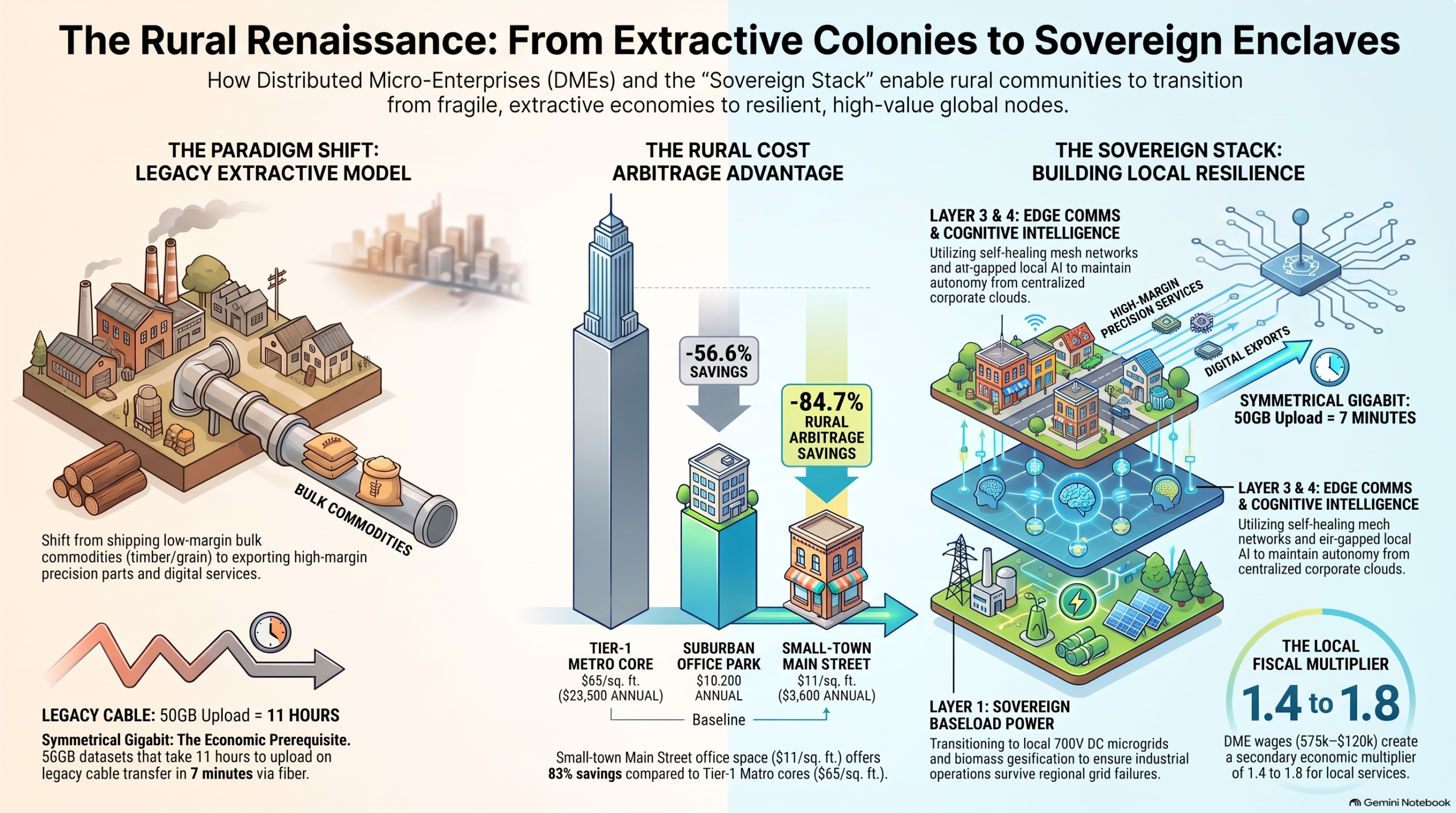
The move to a “Symmetrical Gigabit Architecture” transforms a town from a consumption zone into a precision production hub. To understand the shift, consider the transmission of a 50 GB geospatial LiDAR dataset or a finite-element engineering simulation:
- Legacy Asymmetric Cable (10 Mbps Upload): 11.1 Hours (Failure-prone, high packet loss).
- Symmetrical Gigabit Fiber (1,000 Mbps Upload): 6.7 Minutes (Secure, real-time transfer).
This technological prerequisite enables low latency (<15ms), allowing rural firms to engage in real-time CAD/CAM co-authoring and synchronous cloud-native ERP management. When the data moves as fast from Main Street as it does from Palo Alto, the geographic advantage of the city evaporates.
- The Arbitrage Advantage: Why Your Next Startup Belongs in an 1890s Bank
There is a staggering “Real Estate and Operating Cost Arbitrage” favoring non-metropolitan downtowns. Operating a 12-person firm from a Tier-1 Metro Core like San Francisco or Boston requires a facility cost of roughly $23,500 per workstation annually. On a renovated Small-Town Main Street, that cost collapses to approximately $3,600.
- Tier-1 Metro Core (3,500 sq. ft.): $227,500/year.
- Small-Town Main Street: $38,500/year.
- Rural Arbitrage Savings: 84.7% per workstation.
This 84.7% savings allows DMEs to reinvest capital into high-skill talent and specialized 5-axis CNC machines rather than high-rise rent. Furthermore, the Architecture of Downtown Repurposing offers distinct advantages:
- High Structural Ceilings: Accommodates heavy precision milling and industrial additive printing rigs.
- Thermal Mass: Thick historic brick and masonry offer natural acoustic dampening and high thermal inertia, significantly lowering utility overhead by buffering heating and cooling spikes.
- Floor Loads: Massive 19th-century timber construction can support server racks and heavy billet alloys that would buckle modern suburban office floors.
- The Appraisal Gap and the Actuarial Retreat
While capital is available, a “Construction Cost Inversion” creates an invisible barrier to growth. In isolated interior communities, the cost to build a standard home (220–320/sq. ft.) far exceeds the market appraised value (90–140/sq. ft.), which is anchored by aging, distressed “comps.” This creates a “Zero Private Speculative Construction” environment because banks cannot approve mortgages that exceed collateral value.
This decay is exacerbated by a legal hurdle: Heirs’ Property. In the Southern Black Belt and Appalachia, fractional land titles passed down without clear wills prevent residents from securing mortgages, building permits, or federal repair grants.
This physical decline is now colliding with an “Actuarial Retreat.” National insurers are withdrawing from rural ZIP codes as climate volatility meets the “ISO PPC Class 9/10” reality. Depleted volunteer fire departments and aging water systems with low pressure mean underwriters assume a total structural loss in any fire event. The resulting premium surges—often consuming 15% to 25% of a household’s net income—trigger a cycle of default and abandonment that no grant program has yet solved.
- Value-per-Pound: From Raw Commodities to Precision Exports
The historic commodity-extractive model was a race to the bottom: shipping 50,000 lbs of raw timber or corn at razor-thin margins, incurring high wear on local roads while remaining vulnerable to global price swings. The modern “Distributed Node Model” flips this through “Precision Light Manufacturing.”
A Main Street DME can now export an 8 oz. titanium medical joint pin. It is blueprinted via the edge network, machined on a local 5-axis CNC mill, and shipped via express parcel. The net local margin is thousands of dollars per pound rather than pennies. This is the essence of the “Sovereign Enclave”—exporting high-margin digital intelligence and precision parts rather than raw, unrefined materials.
“Any system that centralizes power, data, and decision-making will inevitably prioritize the preservation of its own core at the expense of its periphery. The periphery survives only by decoupling.” — Noel’s Law of Decentralization
- DeReticulation: The Sovereign Stack and “Island Mode”
The most profound shift is the move toward “Spherical Resilience” via a five-layer Sovereign Stack. Instead of being tethered to a single fiber strand or a distant power plant, communities are building the capacity for “Island Mode”—the ability to function autonomously when the centralized net fails.
- Layer 1 (Baseload Power): Utilizing 700V DC microgrids and thermochemical gasification to turn regional waste into local energy via Pawnee Rotary Engines.
- Layer 2 (Kinetic Mobility): Deploying autonomous utility EVs and Kurb Kars logistics nodes to maintain movement without dependence on global fuel supply lines.
- Layer 3 (Edge Mesh Comms): Implementing TriFi and wireless mesh arrays to provide an autonomous communications canopy that bypasses corporate pole-attachment hurdles.
- Layer 4 (Cognitive Intelligence): Running air-gapped Remnant AI nodes locally to optimize microgrids and toolpath schedules without transmitting proprietary telemetry to a vulnerable corporate cloud.
- The Capacity Chasm: The Administrative Asymmetry
The final hurdle is not technical, but administrative. While a metro area has a dedicated army of grant writers and attorneys, a non-core town often operates as a “two-desk” town hall. This “Administrative Asymmetry” causes rural communities to fail in “competitive grant tournaments.” A part-time clerk cannot navigate a 120-page NOFO or complex BABA (Build America, Buy America) domestic sourcing logs.
To survive, the Sovereign Enclave must pivot toward regional shared capacity. The future belongs to those who stop “begging for jobs” and start “building sovereign infrastructure,” leveraging regional councils to bridge the chasm between federal capital and local execution.
The Question for 2026
We are witnessing the end of an era where geography was a prison. The question for 2026 is no longer about how many miles you are from the city. It is a question of architecture: is your community still shackled to the terminal end of “The Line,” or are you building the sovereign, spherical resilience required to thrive in “Island Mode”?
No one is coming to save small-town America except small-town America. The tools of DeReticulation are ready; the only question is who will have the courage to use them first.


