The Intelligence Grid: A Primer on AI-Driven Virtual Power Plants
- Beyond the Traditional Grid: The Rise of Autonomous VPPs
For decades, the electrical grid operated on a centralized, unidirectional model known as “The Line.” In this paradigm, massive power plants distribute electricity across high-voltage transmission lines to passive consumers. A Virtual Power Plant (VPP) represents the software-driven evolution of this model, aggregating decentralized resources—such as residential batteries, electric vehicles, and solar arrays—to act as a singular, dispatchable power source.
The industry is currently transitioning from “rule-based demand-response” toward autonomous grid orchestration. This shift is necessitated by a looming capacity crisis: the U.S. Department of Energy (DOE) estimates a requirement for 200 GW of new peak capacity by 2030. Traditional VPPs, hampered by cloud latency and manual intervention, cannot meet the sub-second stability requirements of a modern, decarbonized grid. We are moving toward Sovereign Nodes—edge-native assets capable of “Island Mode” (off-grid) operation and real-time resource arbitration.
Table 1: Grid Philosophy Comparison
Feature Traditional VPPs (The Line) AI-Driven Sovereign Nodes (The Node)
Dependency Centralized: Relies on cloud-tethered orchestration and grid interconnection. Island Mode: Designed for fully autonomous, air-gapped operation.
Latency Cloud-dependent: High round-trip time; vulnerable to 4G/5G network jitter. Sub-50ms Edge: Real-time localized control via on-site hardware.
Resource Management Passive: Limited to charge/discharge cycles for grid balancing. Dual-commodity: Arbitrates between digital compute and physical fuel (ASF™).
Standardization Proprietary APIs and manual register mapping. SIDI Standards: Unified via IEC 61850 and CIM/IEC 61968.
This evolution is driven by the need to solve fundamental technical bottlenecks—specifically latency jitter, protocol fragmentation, and high-frequency market volatility—that traditional deterministic models are unable to resolve at scale.
- The AI Toolkit: Solving the Edge Bottleneck
To achieve true grid autonomy, intelligence must be deployed at the “edge”—directly on the industrial controllers where power is generated and stored.
- Deep Reinforcement Learning (DRL): Traditional systems struggle with communication latency. Sovereign Nodes utilize model-free DRL algorithms, specifically Proximal Policy Optimization (PPO) and Deep Deterministic Policy Gradient (DDPG).
- Sub-50ms Control: Policy networks are deployed to edge gateways (e.g., Sovereign Sentry Pro), mapping local bus voltage and frequency directly to control actions.
- Jitter Mitigation: Localized execution allows assets to provide frequency regulation and Volt-VAR stability even during total cloud disconnects.
- Semantic Machine Learning: To resolve “Protocol Fragmentation,” unsupervised autoencoders monitor unstructured telemetry from heterogeneous assets (Modbus/CAN bus).
- Automated Mapping: The AI discovers data patterns and automatically translates proprietary registers into the Common Information Model (CIM / IEC 61968) or IEC 61850 templates.
- Benefit: This removes the labor-intensive requirement for manual firmware development and register mapping for every new inverter or battery model.
- Kolmogorov-Arnold Networks (KAN): Traditional AC Optimal Power Flow (AC-OPF) calculations are too computationally heavy for real-time edge use.
- Acceleration: KANs approximate the “batch operational feasible regions” of the node, achieving a 64.4% reduction in calculation time.
- Engineering Compromise: While providing near-instant responsiveness, KANs operate with a 4.7% divergence from absolute mathematical optimality—a trade-off deemed acceptable for sub-second grid safety.
While AI provides the cognitive framework, this intelligence requires specialized, ruggedized hardware to survive the mechanical and thermal stresses of the field.
- The Sovereign Pod: Hardware for a Self-Sustaining Grid
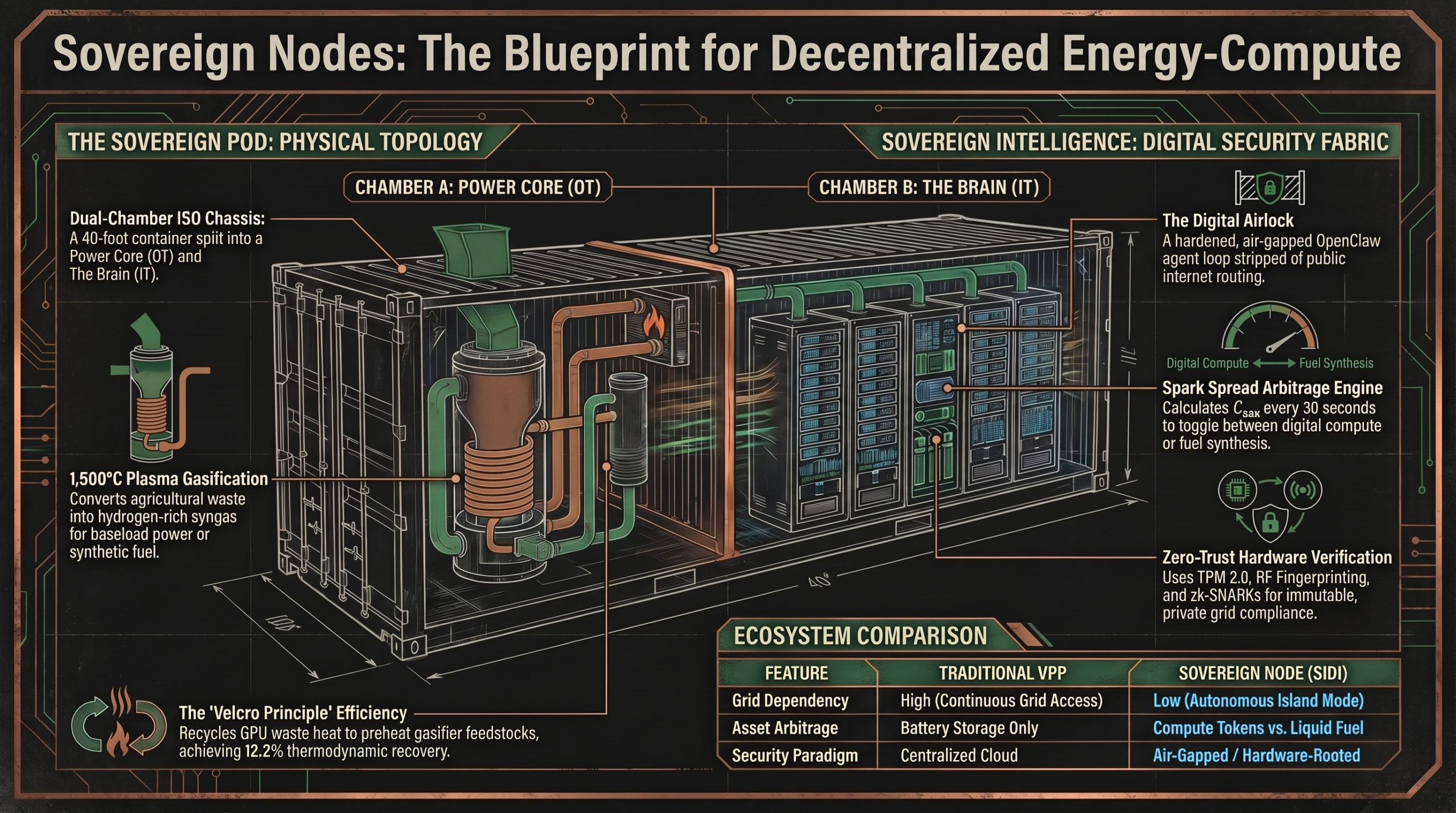
The physical manifestation of this technology is the Sovereign Pod, a dual-chamber, highly insulated 40-foot ISO container designed for zero-trust, off-grid environments.
The Dual-Chamber Architecture
- Chamber A (The Power Core): The Operational Technology (OT) zone. It houses the Agra 1,500°C Plasma Arc Gasifier, which converts agricultural waste into purified Baseload Syngas. This syngas powers a 10 MW GenSet or is refined via a Fischer-Tropsch reactor into Advanced Synthetic Fuel (ASF™). Energy is stored in the SwarmBESS™ (Lithium Iron Phosphate) battery system, featuring active thermal balancing.
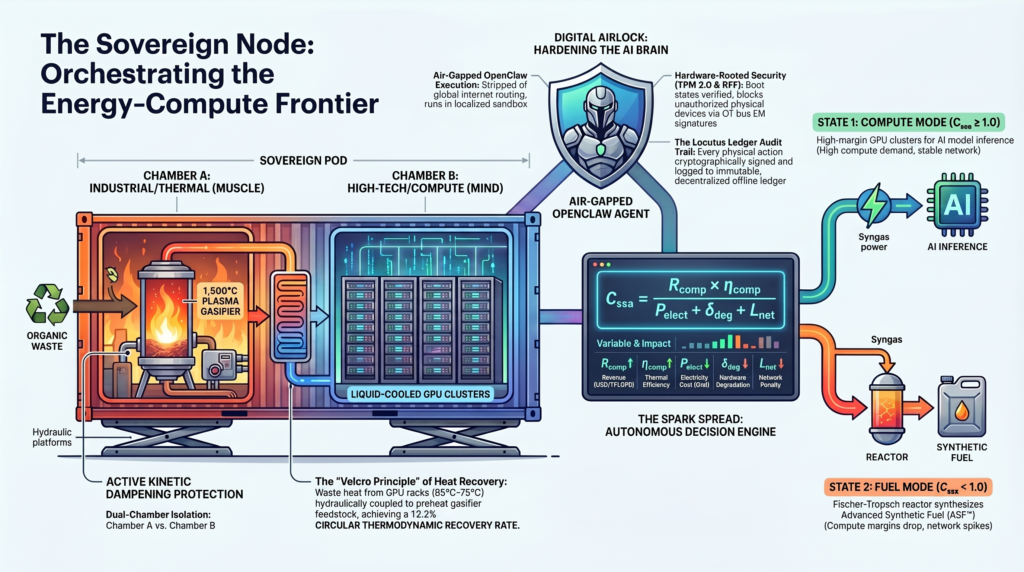
- Chamber B (The Brain): The Information Technology (IT) zone. It contains the Sovereign Sentry Pro server and liquid-cooled GPU clusters for AI inference. To protect sensitive electronics from the 1,500°C gasifier’s plasma arc, this chamber is lined with a high-attenuation copper mesh Faraday cage and mounted on active hydraulic kinetic dampening platforms to isolate the compute stack from mechanical vibration.
The “Velcro Principle” of Thermodynamics
The system implements a closed-loop thermodynamic recovery strategy. Waste heat from the GPU racks (exiting at 65°C–75°C) is hydraulically coupled to Chamber A to preheat feedstock or drive moisture removal in the gasifier. This circularity achieves a 12.2% recovery rate, essentially utilizing the “cost” of AI compute to reduce the energy required for fuel synthesis.
This co-location poses a fundamental operational question: at any given second, should the node manufacture physical fuel or process digital data?
- The Spark Spread: Economic Intelligence in Action
The Sovereign Node operates as a double-arbitrage engine governed by the Spark Spread Arbitrage Coefficient (C_{ssa}). The OpenClaw AI agent recalculates this every 30 seconds to determine the optimal economic state.
The C_{ssa} Decision Engine
The formula for determining the node’s operational mode is: C_{ssa} = \frac{R_{comp} \times \eta_{comp}}{P_{elect} + \delta_{deg} + L_{net}}
Variable Definitions:
- R_{comp}: Real-time revenue rate from edge-compute jobs ($/TFLOPS).
- \eta_{comp}: Thermal efficiency multiplier (1.122, including “Velcro” recovery).
- P_{elect}: Opportunity cost of electricity (wholesale grid rate/tariff).
- \delta_{deg}: Hardware degradation (battery cycle wear and GPU thermal fatigue).
- L_{net}: Network penalty (based on real-time satellite latency and packet loss).
Table 2: Spark Spread Decision Matrix
State Condition Primary Action
Compute Mode C_{ssa} \ge 1.0 Digital Arbitrage: Route power to GPU clusters for high-margin AI inference.
Fuel Mode C_{ssa} < 1.0 Physical Synthesis: Divert syngas to Fischer-Tropsch reactor to refine ASF™.
This logic provides a “volatility shield,” allowing the node to monetize energy in its most profitable form—digital or physical—independent of utility grid prices.
- The Digital Airlock: Zero-Trust Security & Privacy
Autonomous critical infrastructure requires a security posture that assumes the external network is compromised. Following the “Trusted Environment Fallacy” crisis of May 2026, the Digital Airlock was established as the standard for SIDI-compliant nodes.
- Hardware-Rooted Identity: All boot states are cryptographically signed via TPM 2.0. To prevent “rogue device bridging” on the physical OT bus, the system uses Radio Frequency Fingerprinting (RFF) to authenticate hardware based on its unique electromagnetic signature.
- The Industrial Foreman: The OpenClaw agent runs in a sandboxed environment, stripped of public internet routing. It uses a specialized tool-execution layer to map Modbus and CAN bus registers into the AI’s action space, allowing it to actuate physical relays without web exposure.
- zk-SNARKs (Zero-Knowledge Proofs): For market participation, the node uses zk-SNARKs to prove grid compliance or capacity availability.
- Privacy: The utility receives a mathematical proof that the node is “safe” or “compliant.”
- Security: Raw telemetry, customer data, and industrial secrets never leave the local hardware.
- Navigating the “Permitting Wall” and Market Risks
The primary barrier to new energy infrastructure is the “Permitting Wall,” with transmission interconnections averaging 4.5 years. Sovereign Nodes bypass this by utilizing Agrivoltaic Classification. By maintaining a Land Equivalent Ratio (LER) \ge 1.3, nodes qualify for agricultural easements, allowing deployment in under 90 days.
Learner’s Summary: Risks and Mitigations
Key Risk Engineering / Strategic Mitigation
Algorithmic Collusion Hardcoded deterministic guardrails and human-in-the-loop oversight to prevent anti-competitive bidding (FERC/AER compliance).
High CapEx Standardized Pod Kits: Factory-prefabricated ISO units to reduce site-specific engineering overhead.
Thermal Strain Hierarchical multi-timescale control loops (100 microseconds to 24 hours) to coordinate cooling and pre-shave power consumption.
SIDI Standard: Sovereign Intelligence & Decentralized Infrastructure All nodes must adhere to SIDI-STD-2024-V4, requiring:
- Hardware: TPM 2.0 and RFF active monitoring.
- Software: OpenClaw Digital Airlock with zero active public DNS.
- Environment: Agricultural LER \ge 1.3 for easement validity.
Ultimately, these nodes represent the shift from “The Line” to “The Node,” establishing a self-healing foundation for a decentralized digital economy that is carbon-negative and grid-independent.


