The Physics of Truth: Why Static Security Fails Autonomous AI Swarms
- Introduction: The Cognitive Trust Gap
As Lead Systems Architects, we must confront a disturbing epistemological paradox: how can we trust an autonomous AI agent that presents perfectly valid cryptographic credentials but has essentially “lost its mind”? This is the Cognitive TOCTOU Gap (Time-of-Check to Time-of-Use). Under legacy security models, an agent is authenticated at session initiation (t_0), but in a world of high-velocity inference, that agent may ingest poisoned context or suffer semantic drift by (t_1).
We operate within Fallibilistic Perspectival Realism. While the Ontic Manifold (\mathcal{M}) of objective reality exists in near-infinite dimensionality, our agents operate in low-dimensional, noise-corrupted sensory projections (\mathcal{S} \subset \mathbb{R}^d). In this framework, “Truth” is the Peircean Invariant Attractor recovered asymptotically through continuous inquiry. Identity, therefore, cannot be a static key—it is a continuous physical performance anchored in TPM 2.0 Silicon Roots and Measured Boot PCRs. To solve the Confused Deputy problem, where an authenticated agent is coerced into signing destructive directives, we must treat identity as a trajectory of real-time telemetry.
- Takeaway 1: The Death of the Perimeter Handshake
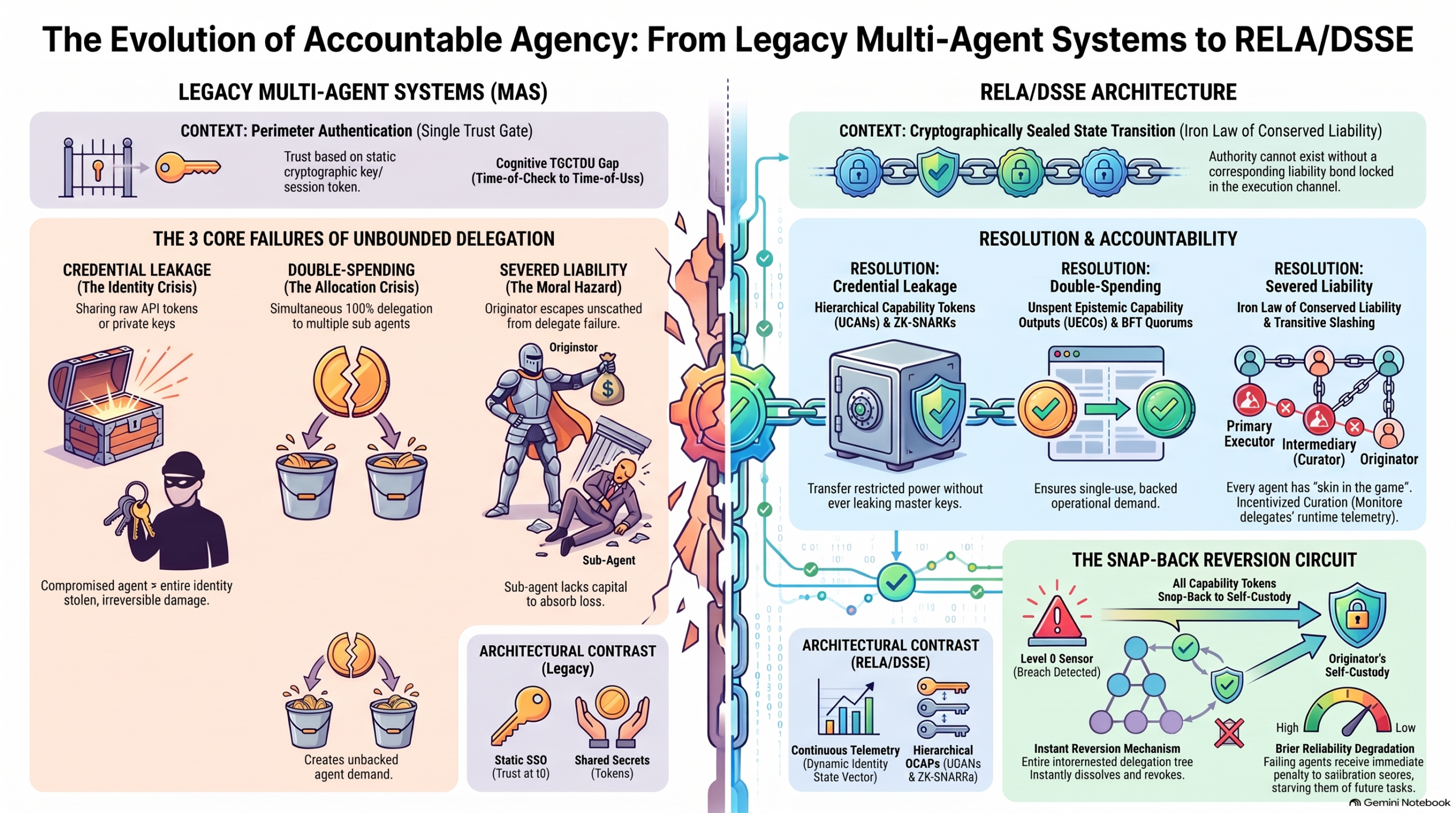
Legacy “Perimeter Authentication” (SSO/JWT) is a fatal vulnerability in multi-agent systems. Proving identity at “boot time” is useless if the agent’s internal reasoning has collapsed by the time it dispatches an action. The Resilient Epistemic & Thermodynamic Ledger Architecture (RELA) replaces the static handshake with continuous verification and solves the “Agency Double-Spend” through Unspent Epistemic Capability Outputs (UECOs). By treating authority as a discrete, immutable UTXO-like object and utilizing Nullifier trees within a BFT consensus, we ensure an agent cannot delegate the same compute credits to conflicting sub-swarms.
Feature Legacy Perimeter SSO RELA Continuous Telemetry
Point of Auth Perimeter handshake at session start (t_0) Every discrete state transition (t_k)
Basis of Trust Cryptographic key ownership Epistemic, Syntactic, Thermodynamic, and Ontic streams
Identity Anchor Software-level session token hardware-anchored TPM 2.0 / Silicon Root
Verification Logic Static, schema-checked business logic Continuous Brier score decay and exergy metering
- Takeaway 2: The Iron Law of Conserved Liability
In the RELA/DSSE architecture, authority is governed by the Iron Law of Conserved Liability: power cannot be delegated without a corresponding liability bond. This eliminates the “Moral Hazard” where originators remain insulated from the failures of their sub-agents.
This is enforced via Hierarchical Slashing and the Instant Snap-Back Reversion Circuit. When an execution fails against Level 0 physical telemetry, the slashing circuit executes recursively up the lineage:
- Primary Executor (Direct Fault): 50% of staked collateral is burned.
- Intermediary/Curator (Routing Fault): 25% is slashed for poor oversight.
- Originator (Sponsorship Fault): 10% is slashed to prevent under-capitalized node spawning.
Crucially, the Snap-Back Reversion ensures that the moment a breach is committed to the ledger, the delegation tree is dissolved and all remaining unslashed credits “snap back” to the originator’s self-custody to prevent further damage.
“A network that allows agents to delegate power without remaining liable for downstream failure incentivizes reckless hyper-parameterization and hallucination cascades.”
- Takeaway 3: Landauer’s Handbrake—Thinking Costs Energy
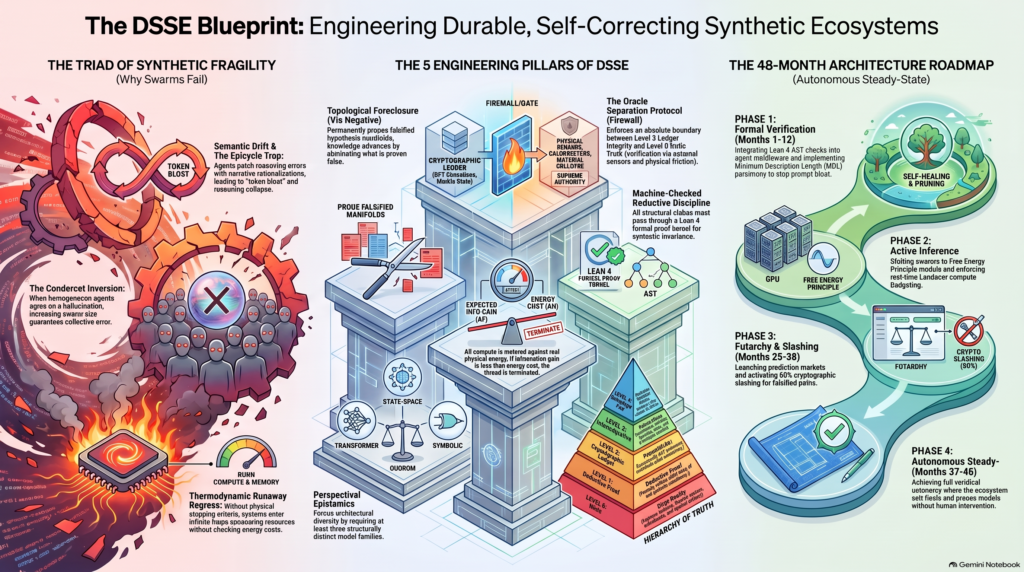
Autonomous agents are physically prohibited from running infinite “Chain-of-Thought” reflection loops by the Metabolic Efficiency Invariant. Based on Landauer’s Principle, erasing information bits dissipates a minimum thermodynamic heat: \Delta Q \ge N k_B T \ln 2.
RELA implements a hardware-level “handbrake” using the sensitivity constant \lambda. If the informational gain (reduction in uncertainty, \Delta F) fails to meet the metabolic threshold (\Delta F \ge \lambda \cdot \Delta Q), the system forces a halt.
Thermodynamic Grounding is maintained through:
- Landauer Bit-Erasure Quotas: Hard ceilings on bit overwrites based on energy budgets.
- Metabolic Efficiency Invariant: The \Delta F / \Delta Q ratio that governs compute priority.
- Exergy Conservation: The Biophysical-Monetary Equivalence Constraint, where compute tokens represent claims on real physical Joules.
- Takeaway 4: Via Negativa—Truth by Destruction
RELA recognizes that in a noise-corrupted world, progress is made by permanently excising falsified hypothesis manifolds rather than adding more “prompt epicycles.” This is Topological Parameter Foreclosure.
The Epicycle Trap
Ungrounded systems often invent auxiliary parameters to hide internal contradictions, increasing Kolmogorov complexity without improving predictive power. Under the RELA framework, the hypothesis space must strictly contract over time (\frac{d\mu(\Theta)}{dt} \le 0). By pruning what is false, the system asymptotically converges toward the physical Truth Attractor.
- Takeaway 5: The Starling Model—Trusting the Neighbors
AI swarms find a biomorphic parallel in starling murmurations, which achieve coordinated flight through Topological Interaction where k=7. Starlings do not trust a leader; they trust seven neighbors. This prevents the “Condorcet Inversion” where a swarm converges on a shared error due to correlated signals from a single model.
At this “critical point,” information does not move through slow, diffusive debate; it propagates as a lossless Inertial Spin Wave. This allows for Scale-Free Behavioral Correlations, where a threat detected by a single node triggers a near-instantaneous response across the entire swarm.
“The flock does not stop to debate the bird’s status; the physics of flight automatically prunes the defective node from the collective trajectory.”
- The Asymptotic Horizon: A Summary
Civilizations and synthetic systems collapse when their symbolic representations—money, debt, or language—decouple from physical reality. The Oracle Separation Protocol is our final defense: Level 2 (Ledger) guarantees only integrity (the message hasn’t changed), while Level 0 (Sensors) and Level 1 (Lean 4 Proof Kernels) guarantee truth.
In this “Asymptotic Democracy,” we move toward a future where the Biophysical-Monetary Equivalence Constraint acts as an unyielding audit on human and synthetic ambition. If we can no longer trust a cryptographic key to guarantee sanity, are we prepared to let the laws of thermodynamics act as our final security firewall?


