The Silicon Hollow: Bypassing the Permitting Wall via West Virginia’s Sovereign Nodes
deck
podcast
- The Hidden Bottleneck of the AI Age
The AI revolution is currently moving at two irreconcilable speeds. In the digital realm, Large Language Models (LLMs) and autonomous agent workflows evolve in weeks. In the physical realm, however, the infrastructure required to power these models has hit a structural stalemate known as the “Permitting Wall.”
Modern high-density compute racks—specifically NVIDIA H100 and B200 platforms—require electrical densities between 40 kW and 120 kW per rack. This demand has pushed data center requirements into the gigawatt scale, forcing developers to rely on Regional Transmission Organizations (RTOs) like the PJM Interconnection. But PJM’s New Service Requests Queue is currently choked by a 60-to-84-month delay. For a developer today, the delta (ΔT) between software readiness and grid interconnection is nearly seven years.
The industry is fixated on chip supply, but the real battle for sovereignty is being fought over “behind-the-meter” power. By decoupling from the traditional grid, developers can achieve a 90% reduction in time-to-market. West Virginia has emerged as the premier jurisdiction for this shift, utilizing a combination of legislative agility and “hard tech” engineering to transform Appalachian hollows into the high-signal anchors of a global compute mesh.
- Bypassing the “Permitting Wall” via Legislative Jiu-Jitsu
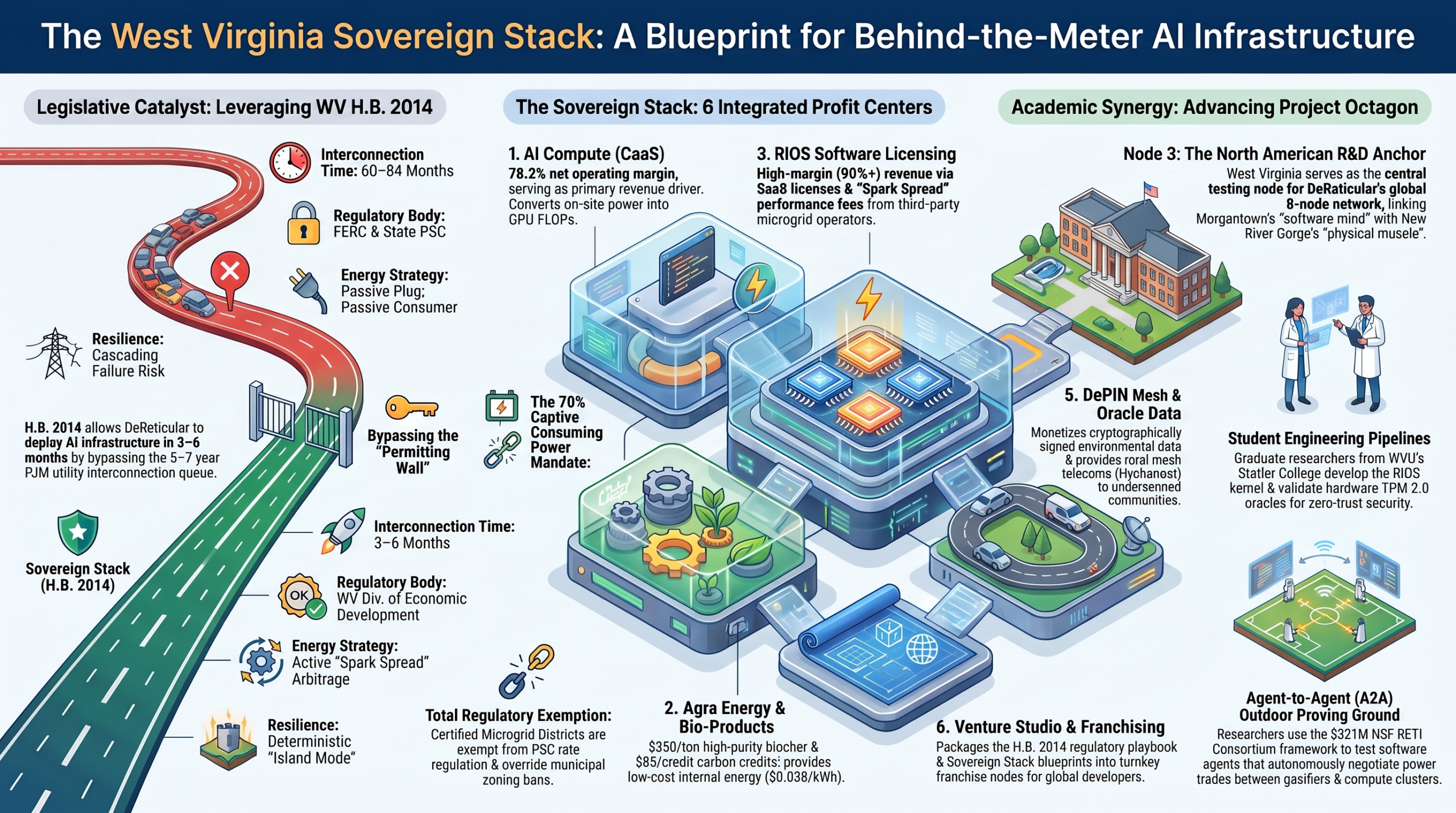
The catalyst for this regional revival is West Virginia House Bill 2014 (H.B. 2014), the Power Generation and Consumption Act. This law allows developers to establish “Certified Microgrid Districts,” effectively creating a regulatory fast lane that circumvents federal and regional bottlenecks.
Under W. Va. Code §24-2-21a, these districts are granted total Public Service Commission (PSC) exemption. They are not required to prove “public need” or submit to rate-of-return regulation. More importantly, they are statutorily exempt from the multi-year PJM interconnection queue. This allows a project to move from site acquisition to “speed-to-power” in just 3 to 6 months. By disrupting the traditional utility monopoly, West Virginia has turned its regulatory framework into a competitive weapon for high-tech capital.
“The PJM New Service Requests Queue is choked by multi-year interconnection studies, transmission network upgrade requirements, and regional capacity shortfalls… the queue timeline regularly spans 5 to 7 years. This systemic queue delay is colloquially and operationally referred to as ‘The Permitting Wall.'”
- Turning Woodchips into LLMs (The “Spark Spread”)
The “Muscle” of this Sovereign Stack is Agra Energy’s plasma gasification technology. In a state dominated by forestry residue and agricultural waste, this technology provides the ultimate arbitrage: converting low-value physical commodities into high-value digital FLOPs.
The process subjects organic feedstocks to high-temperature thermal conversion (T > 3,000°C) in an oxygen-depleted reactor to produce Synthesis Gas (Syngas) with a Lower Heating Value (LHV) of 12 to 18 MJ/Nm³. With a thermal-to-electric efficiency of approximately 38.7%, this system generates prime power at a fraction of grid costs.
The economic “Spark Spread” is staggering. With biomass feedstock secured at 35/ton, the energy input becomes a minor fraction of the revenue. For a 10 MW flagship deployment like Project Octagon Node 3, the numbers are definitive: a 33.2 million CapEx generates a projected $53.5 million EBITDA, achieving a simple payback period of just 7.4 months and an EBITDA margin of 89.5%.
Agra Energy plasma gasification subjects organic feedstocks to high-temperature thermal conversion (T > 3,000°C) in an oxygen-depleted reactor vessel to produce Synthesis Gas (Syngas).
- Why AI is the “Perfect Tenant” for a Microgrid
H.B. 2014 includes a “Captive Power Rule” (W. Va. Code §5B-2-21) to ensure local industrial development. The statute mandates that at least 70% of the electricity generated within the district must be consumed on-site. While traditional manufacturing struggles with volatile load profiles, AI clusters—with their flat, 95% capacity factor—are the mathematically ideal partner for this law.
The operational reality of Project Octagon Node 3 demonstrates this compliance with precision, as derived from Section 4.3 of the Petition for District Designation:
\text{Captive Power Ratio} = \frac{\text{Annual Internal Compute Consumption (66,900 MWh)}}{\text{Annual District Generation (78,840 MWh)}} = 84.85\%
This 84.85% ratio easily clears the 70% statutory hurdle, proving that Large Language Model training is the most effective anchor for sovereign energy districts.
- From “The Line” to “Spherical Resilience”
Traditional infrastructure relies on “The Line”—a linear, cascading topology where one failure triggers a total collapse. DeReticular, the venture studio anchoring West Virginia’s nodes, proposes Spherical Resilience: a non-Euclidean, self-healing mesh capable of Deterministic Islanding.
Using solid-state switches, the microgrid can detach from the legacy utility grid in less than 8 milliseconds. This “Island Mode” protects compute assets from grid instability and “Oracle Attacks”—where malicious actors spoof telemetry. Security is handled at the silicon level: TPM 2.0 silicon root-of-trust signs every packet of sensor data, while Sysbox rootless containers isolate AI workloads from the physical control loops.
“Spherical Resilience… constructs localized, autonomous micro-industrial nodes capable of instantaneous, deterministic detachment from legacy utilities—a state designated as ‘Island Mode.'”
- Project Octagon: A Global Mesh with an Appalachian Anchor
West Virginia is not an isolated experiment; it is the strategic anchor for Project Octagon, a global Decentralized Physical Infrastructure Network (DePIN). Node 3, split between the “Mind” (R&D in Morgantown) and the “Muscle” (Physical testing in the New River Gorge), serves as the legal and technical blueprint for the entire mesh.
Node 3 is fueled by the $321 million NSF RETI Consortium at West Virginia University, which provides the intellectual engine for grid resilience. This Appalachian anchor connects to Node 4 in the Arizona desert, Node 2 in Canada, and Node 1 in Kaabong, Uganda. By establishing Node 3 as the regulatory testbed, West Virginia has transitioned from “flyover country” to the critical authority of a global compute network.
- Autonomous Logistics on Logging Roads (Kurb Kars)
To maintain sovereignty, fuel logistics must be as resilient as the compute itself. Enter Kurb Kars: autonomous, off-grid electric freight trucks designed for the rugged terrain of West Virginia.
These vehicles operate on a 700V Centralized DC Busbar system. By bypassing AC-to-DC conversion losses, the stack achieves 97.7% power-chain efficiency. Kurb Kars act as mobile energy storage, charging during low compute demand periods to smooth the load profile. Because they use localized sensors and mesh-relayed maps rather than cloud-dependent GPS, they remain operational in communication dead zones, ensuring the “Muscle” of the stack is never starved of feedstock.
- Conclusion: The New Rural Industrialism
The convergence of H.B. 2014, plasma gasification, and high-density compute represents an end-run around failing federalized infrastructure. By leveraging regional biomass and legislative “jiu-jitsu,” West Virginia has created a Sovereign Stack that turns rural energy policy into a primary driver of the AI revolution.
As the digital world continues to outpace the physical grid, the conclusion is clear: the future of the internet no longer depends solely on Silicon Valley software, but on the energy-to-compute arbitrage currently taking root in the Appalachian woods.


