
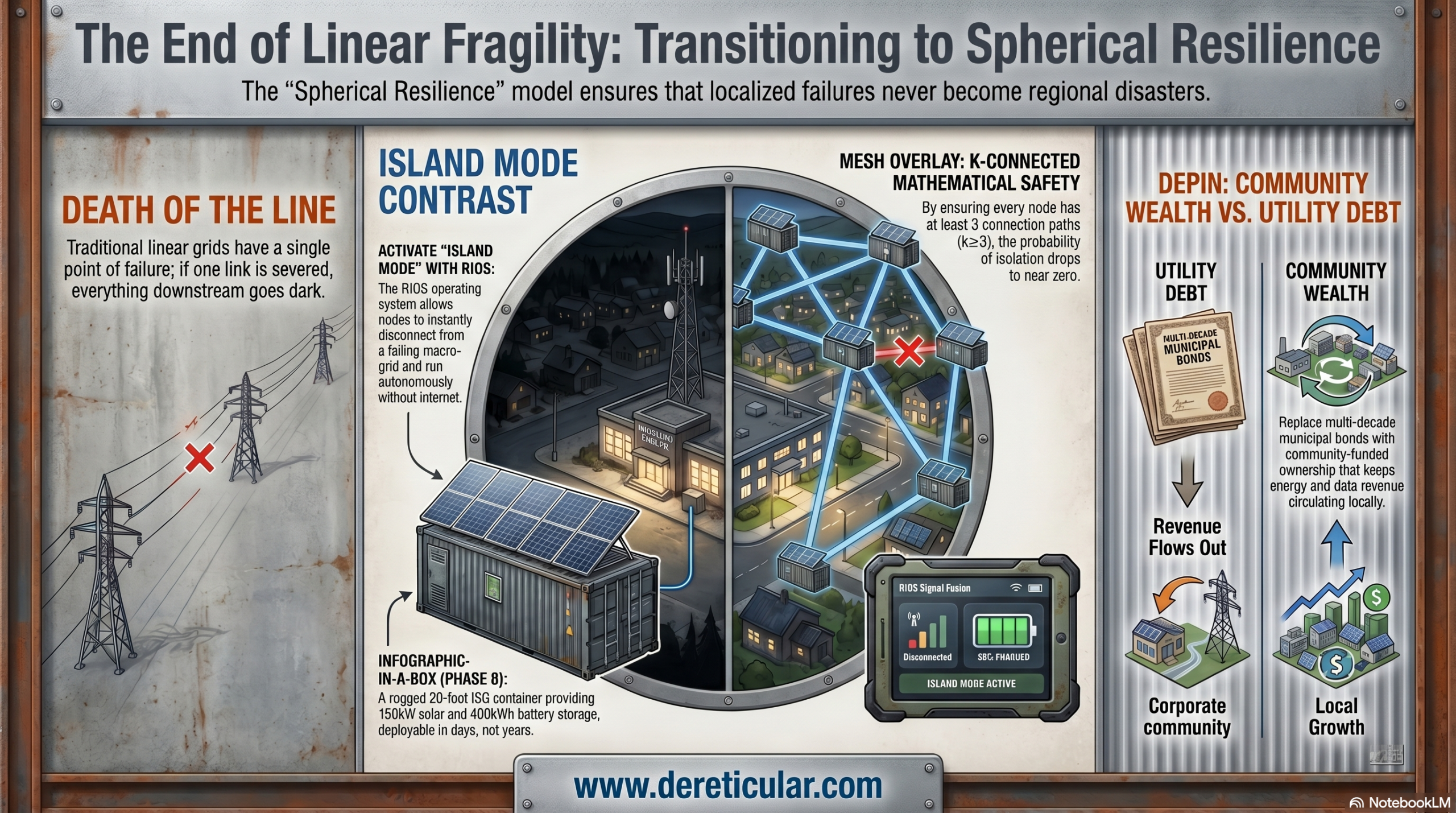
Transitioning to Spherical Resilience: A Briefing on Island Mode Node Architectures and DePIN Models
Executive Summary
Modern public infrastructure suffers from “Linear Fragility,” a design paradigm where high-capacity, centralized corridors—such as transmission lines and fiber-optic backbones—create single points of physical and digital failure. The cost of maintaining this fragility is rising, with prolonged outages resulting in millions of dollars in daily economic losses.
To mitigate these risks, a transition to Spherical Resilience is proposed. This framework utilizes decentralized, k-connected mesh networks (where k \ge 3) and “Island Mode” node architectures. By deploying modular “Infrastructure-in-a-Box” units managed by the Rural Infrastructure Operating System (RIOS), municipalities can decouple critical services from the macro-grid. This transition is catalyzed by Decentralized Physical Infrastructure Network (DePIN) economics, which democratizes capital investment and keeps utility revenue within local communities.
The technology for this transition is not speculative; it is currently deployable using open-source software, commodity hardware, and edge AI, allowing rural and developing regions to “leapfrog” traditional centralized cloud dependencies.
——————————————————————————–
1. The Core Problem: Linear Fragility
Historical civil engineering has prioritized linear concentration for economic efficiency. However, this creates a system where a single disruption cascades downstream.
- Mathematical Vulnerability: In traditional tree or linear topologies, the edge connectivity is \lambda(G) = 1. As the scale of the network grows, the probability of a systemic partition event approaches 100%.
- Cascading Failures: Legacy nodes cannot function without real-time synchronization or high-voltage reference signals from the macro-grid. When one node fails, the redistributed load often exceeds the capacity of neighbors, triggering a total collapse.
- Economic Impact: Beyond physical damage, outages disrupt emergency services, data processing, and supply chains, costing municipal economies millions in lost productivity and stagnant services.
——————————————————————————–
2. The Solution: Spherical Resilience and Island Mode
Spherical Resilience replaces linear corridors with dense, multi-directional meshes.
Graph Theory of Resilience
A spherically resilient network is modeled as a k-vertex-connected graph where k \ge 3.
- Path Redundancy: Isolation of a node requires the simultaneous failure of at least k independent paths.
- Reduced Failure Probability: The probability of node isolation is reduced to the product of the failure rates of all independent ingress/egress paths (\prod p_j).
Island Mode Operations
When upstream quality-of-service falls below a specific threshold, nodes activate an internal control loop to enter “Island Mode.”
- Isolation: Solid-state transfer switches isolate local electrical and data systems.
- Autonomy: Nodes generate their own reference voltage and data synchronization signals.
- Bounded Failure: By containing the load locally, the probability of regional cascade is effectively eliminated (\lim_{\theta_i \to 1} P_{\text{cascade}} = 0).
——————————————————————————–
3. The DeReticular Technical Stack
The transition is executed through a three-layer sovereign autonomous stack.
| Layer | Component | Description |
| Layer 1: Physical | Infrastructure-in-a-Box | A 20-foot ISO High-Cube container featuring 150 kW solar, 400 kWh BESS (LiFePO4), and a 30 kW hydrogen-ready auxiliary generator. |
| Layer 2: OS | RIOS | An edge-native microkernel managing Signal Fusion (LEO/LTE/RF), load balancing, and local consensus (RAFT/PBFT). |
| Layer 3: Network | DeReticular Mesh | Peer-to-peer protocols (Babel/OLSRv2) that allow nodes to self-organize and route traffic even if national backhauls are severed. |
Key Physical Specifications
- Energy Storage (BESS): 400 kWh Lithium Iron Phosphate cells, selected for thermal stability and a lifespan of >6,000 cycles.
- Climate Resilience: Dual-redundant closed-loop HVAC systems rated for -30^\circ\text{C} to +55^\circ\text{C}.
- Edge Compute: IP67-rated three-node high-availability cluster with hardware security module (HSM) cryptography.
——————————————————————————–
4. Gap Analysis: Transitioning from Legacy to Mesh
The transition faces several structural deltas between current baselines and the target architecture.
| Dimension | Legacy Baseline | Gap/Delta | Path to Resolution |
| Grid Topology | Linear/Tree configuration; single point of failure. | Legacy substations lack fast-acting isolation switches. | Deploy Phase 0 nodes at critical loads behind-the-meter (BTM). |
| Finance | Capital-intensive bonds; centralized debt. | Lack of structures for multi-owner decentralized accounting. | Implement DePIN models and Microgrid-as-a-Service (MaaS). |
| Regulation | Strict PUC rules; multi-year interconnection queues. | Outdated codes classify microgrids as public utilities. | Leverage state-level policy exemptions (e.g., CA AB2175); prioritize BTM deployment. |
| Skills | Reliance on centralized utility technicians. | Deficit of edge-compute and battery maintenance skills in rural areas. | Standardize modular, hot-swappable physical components (FRUs). |
——————————————————————————–
5. Economic Catalyst: DePIN and MaaS
Traditional infrastructure relies on centralized Capital Expenditure (CapEx). DeReticular shifts this to a modular, community-driven model.
- Capital Democratization: DePIN protocols allow for fractionalized ownership. Local cooperatives and investors can crowdsource funding for nodes, representing ownership on tamper-resistant ledgers.
- Microgrid-as-a-Service (MaaS): Municipalities can avoid upfront CapEx by leasing hardware through Power Purchase Agreements (PPAs) or capacity service contracts.
- Revenue and Data Sovereignty: Local data processing and surplus energy trading keep economic value circulating within the community rather than exporting it to multinational utilities.
——————————————————————————–
6. Strategic SWOT Analysis
Strengths
- High topological redundancy (k \ge 3).
- Edge-autonomous operations via RIOS (works air-gapped).
- Rapid deployment (standardized ISO form factor).
Weaknesses
- Higher localized unit cost (/kW) compared to massive utility-scale plants.
- Regional technical skill gaps for maintaining power electronics.
- Interoperability friction with legacy SCADA systems.
Opportunities
- Rising demand due to weather anomalies and cyber threats.
- Federal/regional resilience grants for rural broadband and energy security.
- Infrastructure “leapfrogging” in developing regions.
Threats
- Utility monopoly litigation and steep interconnection fees.
- Supply chain volatility for Lithium Iron Phosphate (LFP) cells.
- Physical security and vandalism in remote, unattended zones.
——————————————————————————–
7. Operational Roadmap: The Phased Approach
Municipalities are advised to follow a structured transition to minimize fiscal and regulatory risk.
- Phase 1: Define Resilience Hubs (Months 1-3): Map critical facilities (water pumps, emergency shelters) and identify local regulatory boundaries.
- Phase 2: BTM Phase 0 Deployment (Months 4-6): Install Infrastructure-in-a-Box units behind facility meters. This establishes “Island Mode” security immediately without waiting for long-term utility reviews.
- Phase 3: Mesh Scaling and P2P Integration (Months 7-18): Activate peer-to-peer protocols between multiple nodes to allow for regional load-sharing and localized data routing.
——————————————————————————–
8. Conclusion: The Readiness of Autonomous Systems
The sovereign autonomous infrastructure model is no longer a futuristic concept. It is currently viable due to the maturity of:
- Open-Source Infrastructure: Linux, Kubernetes, and pfSense eliminate licensing dependencies and vendor lock-in.
- Commodity Hardware: Edge AI now runs effectively on consumer GPUs and ARM systems, lowering capital barriers.
- Decentralized Networking: P2P systems and mesh networks enable functionality even when national telecom systems collapse.
By adopting these modular, self-healing systems, regional planners can secure energy, communication, and data sovereignty “one resilient island at a time.”


