The Rural Renaissance: Architecting Sovereign Platform Economies in Late 2026
1. The 2026 Macroeconomic Landscape: A Call for Sovereign Resilience
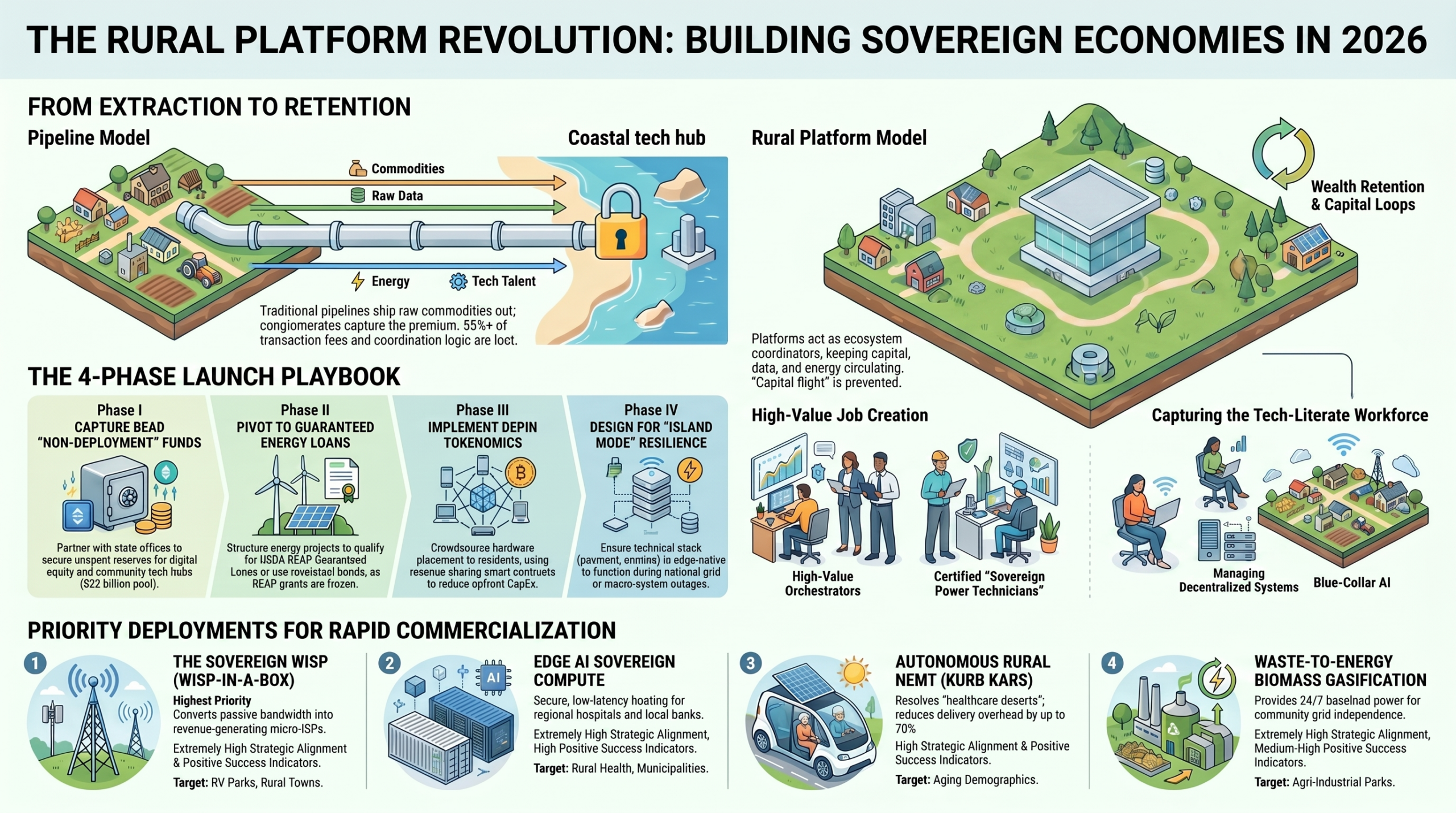
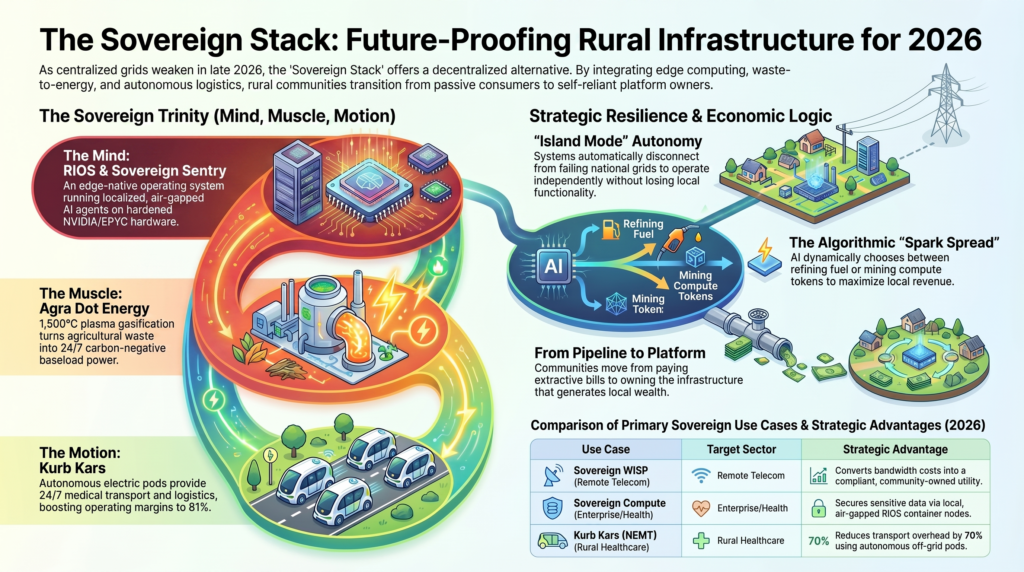
In late 2026, Rural America stands at a critical juncture where “Linear Fragility”—the systemic vulnerability of centralized utility and data pipelines—has been laid bare. For decades, rural communities operated as extractive pipelines, exporting raw commodities and digital wealth to coastal tech hubs while receiving only a fraction of the value. The strategic imperative has now shifted to the “Sovereign Stack”: a transition from these extractive chains to localized “sovereign nodes.” This pivot is necessitated by a unique convergence of federal friction and demographic opportunity.
A “Demographic Reversal” is currently underway, as remote-work flexibility and a return to agricultural heritage have driven a surge of tech-literate families back to rural counties. However, this repopulation faces immediate infrastructure hurdles:
- BEAD Program Bottlenecks: The 42.5 billion Broadband Equity, Access, and Deployment program has stalled due to administrative delays and cost inflation. While fiber rollouts are paused, states are actively distributing **22 billion in “non-deployment” reserves**, prioritizing tech-neutral, community-led wireless mesh and edge-compute initiatives.
- REAP Funding Pause: On March 31, 2026, the USDA halted all direct grants for the Rural Energy for America Program (REAP) to eliminate foreign supply-chain subsidies. This freeze on cash grants has forced a pivot toward private cooperative financing and bankable baseload energy projects.
- Public Infrastructure Construction Boom: Despite grant delays, historic levels of public capital are flowing into physical assets—water systems, regional healthcare, and transport—providing the hardware “nodes” upon which sovereign digital platforms must now be constructed.
video
| Traditional Extractive Pipeline | Rural Platform Model |
| Focus: Resource and capital export to coastal hubs. | Focus: Local capital, energy, and data loops. |
| Ownership: Centralized conglomerates/Global ISPs. | Ownership: Local cooperatives, municipalities, and DAOs. |
| Resilience: Dependent on national grid/cloud uptime. | Resilience: “Island Mode” (autonomous air-gapped operation). |
| Value Capture: Minor fraction of final retail value. | Value Capture: 95%+ of transaction fees/utility retained locally. |
To navigate this landscape, founders must stop acting as passive consumers and begin operating as Rural Platform Developers.
2. High-Priority Deployments: The Top-Tier Sovereign Use Cases
Sovereign Use Cases are the foundational building blocks for rural wealth retention. Prioritization is determined by Strategic Alignment (the ability to transition from “pipelines” to “platforms”) and Positive Success Indicators (market tailwinds and regulatory compatibility).
Rank 1 Use Case: The Sovereign WISP (SKU: RIOS-KIT-WISP)
The Sovereign WISP is the fastest path to positive unit economics. It hyperconverges authorized Starlink Business satellite backhaul with the Sovereign Sentry Pro compute engine and TriFiWireless enterprise mesh networks.
- Strategic Advantage: By utilizing professional APIs pre-configured for Starlink Business compliance, operators avoid the service termination risks associated with reselling residential bandwidth. This model is perfectly positioned to capture the $22 billion BEAD non-deployment reserves.
- Target Markets: Remote worksites, RV parks, and off-grid townships.
- Critical Risks: Single-source provider reliance (SpaceX) and the necessity for multi-constellation integration (Amazon’s Project Kuiper).
podcast
Rank 2 Use Case: Edge AI Hardware & Sovereign DePIN Compute (RIOS-CC-1000)
The physical “mind” of the Sovereign Stack is the RIOS-CC-1000, a NEMA 4X weather-sealed, 10-foot High-Cube ISO shipping container coated in solar-reflective paint. It operates entirely “Behind-the-Meter” in “Island Mode” to serve regional hospitals and banks.
- Standard Edition: Quad-core Intel N100; ideal for ledger validation and quiet network gateways.
- Pro Edition: 8-core Intel i3-N305. To prevent thermal throttling in high-heat rural environments, it utilizes Honeywell PTM7950 Phase Change Material directly on the silicon die.
- Enterprise/Epyc Edition: AMD EPYC (16-Core/32-Thread) with dual Nvidia L4 GPUs (48GB VRAM) for heavy industrial hyperconverged infrastructure.
Rank 3 Use Case: Autonomous Rural NEMT (Kurb Kars)
Legacy Non-Emergency Medical Transportation (NEMT) is crippled by the “Deadhead Economy,” where empty vehicles burn 40-50% of revenue in fuel and labor. Kurb Kars utilizes autonomous pods to boost net margins from 10% to over 60%.
- Ruggedized Pods: Electric low-speed vehicles (LSVs) designed for unpaved “murram” dirt roads.
- NVIDIA Drive: AZDOT-approved AI navigation for unmapped rural routes.
- Signal Fusion: Bonding Starlink High-Performance Business with CAT4 vSIM for unbreakable telemetry.
- Vehicle-to-Grid (V2G): Mobile batteries that stabilize the local microgrid when docked at regional hubs.
The convergence of these hardware layers ensures that essential utilities remain under community control, protected from external price volatility.
3. The Wealth Retention Engine: Capital Loops and “Spark Spread” Optimization
Traditional rural economies suffer from digital and financial capital flight. “Spherical Resilience” prevents this by utilizing multi-directional mesh networks and energy-backed settlement layers to keep local wealth in circulation.
Algorithmic “Spark Spread” Optimization
Sovereign nodes operate as real-time arbitrage engines. The node calculates:
Spark Spread = Value of Compute Tokens – On-site Energy Cost
Operators toggle between two modes:
- Liquid Refining Mode: Converting syngas into ASF™ (Advanced Synthetic Fuel) for local mechanical machinery and transport.
- Digital Alchemy Mode: Directing power to RIOS-CC-1000 GPU clusters to process high-margin Edge AI inference, earning DePIN utility tokens.
Locutus Ledger and Energy-Backed Settlement
To hedge against inflation and Forex volatility, the Locutus Ledger enables peer-to-peer (P2P) clearing using local “Energy Tokens.”
“Joules-to-Value Pegging: By settling transactions in physical energy units, communities hedge against the devaluation of national currencies and external banking shocks.”
Sovereign-Public-Private Partnership (S-P3) and IRA Direct Pay
To bypass extractive commercial banks, founders utilize the S-P3 model. By partnering with tax-exempt municipalities or 501(c)(3) cooperatives, projects qualify for Section 6417 (Direct Pay) of the Inflation Reduction Act. This allows the cooperative to receive direct cash refunds for 30-50% of energy CapEx. Crucially, this bypasses tax-equity middlemen, saving the project 10-15% in legal and structuring fees.
4. Job Creation and Talent Development: The DeReticular Academy Model
The transition to a sovereign economy requires “High-Value Orchestrators” whose competitive advantage lies in Curiosity, Curation, and Judgment.
The DeReticular Academy and the SPT Role
The DeReticular Academy trains the Sovereign Power Technician (SPT) through a 12-block curriculum including:
- RIOS Core Setup and Microkernel Programming.
- Sovereign Cloud Management and Air-Gapped Virtualization.
- Edge-AI Configuration (Sovereign Sentry/Industrial Foreman).
- Decentralized Financial Coordination and Ledger Settlement.
The “Blue-Collar AI” Specialist
SPTs use OpenClaw agents running locally on Sovereign Sentry hardware as force multipliers:
- The Field Medic: Uses Mistral-7B-Instruct to provide step-by-step repair guidance via mesh headsets.
- The Industrial Foreman: Automates machinery and microgrid flows using CAN Bus translation protocols.
- The DevOps Sovereign: Uses Llama-3-8B-Instruct to audit network health and self-heal configurations offline.
By shifting from a “Consumer Mindset” (paying bills) to a “Developer Mindset” (owning infrastructure), rural areas attract tech-literate families seeking resilience and ownership.
5. Strategic Playbook: The 90-Day Launch Framework for Rural Founders
This operational roadmap provides the path for municipal leaders and entrepreneurs to move from theory to utility generation.
The 90-Day Execution Framework
- Days 1–30 (Asset Audit): Mapping energy inputs (biomass, solar) and compute needs using GIS tools.
- Days 31–60 (Entity Design): Forming S-P3 cooperatives and establishing DAO governance via the DAOSRUS interface. DAOSRUS utilizes Radio Frequency Fingerprinting (RFF) to verify the unique electromagnetic transient of a device’s antenna, securing Sovereign Badges against spoofing.
- Days 61–90 (Deploy & Scale): Provisioning Node-as-a-Service (NaaS) hardware and activating “Island Mode.”
The “Layer Cake” Funding Strategy
- Tier I: Seed/State Layer: 500k–1M from the AZ SMART Fund for feasibility studies.
- Tier II: Capital Acquisition Layer: USDA REAP Guaranteed Loans or Municipal Bonds to acquire RIOS containers and Kurb Kars.
- Tier III: Innovation Layer: Partnering with regional universities to capture a portion of the $25 million Rural Autonomous Vehicle (RAV) Research Program.
Remediation Engineering: The Founder’s Checklist
- [ ] The Silicon Supply Chain Paradox: Avoid closed ecosystems like Apple M4 silicon (unprocurable for third parties). Standardize on NVIDIA Jetson or Rockchip RK3588 SoCs.
- [ ] Network Segregation: Do not run Wasm state machines over LoRaWAN. Use TriFiWireless (Wi-Fi 7/5G) for real-time apps; reserve LoRa for heartbeats.
- [ ] Deterministic Safety: AI agents must never write directly to physical actuators. Enforce a hardware boundary using deterministic PLCs.
- [ ] Legal Franchise Shielding: Structure the WISP as a “Private Research and Industrial Intranet” to bypass legacy telecom franchise monopolies.
6. Conclusion: Constructing the Planetary Geometry of Sovereign Nodes
The platforms of late 2026 transform Rural America from the “last mile” of a fragile system into an interconnected, planetary geometry of sovereign nodes. By integrating autonomous mobility, decentralized power, and air-gapped intelligence, we achieve “Spherical Resilience” over “Linear Fragility.”
The mandate of Sovereign Infrastructure is absolute operational continuity and the return of ownership to the people who work the land. The opportunity is here: stop waiting for centralized solutions and start architecting the sovereign future of your community. The Rural Platform Developer is the architect of the new American resilience.


