Strategic Implementation Roadmap: Hardware-Sequestered Intelligence for High-Stakes Perimeters
1. The Strategic Imperative: Beyond the Commodity Line
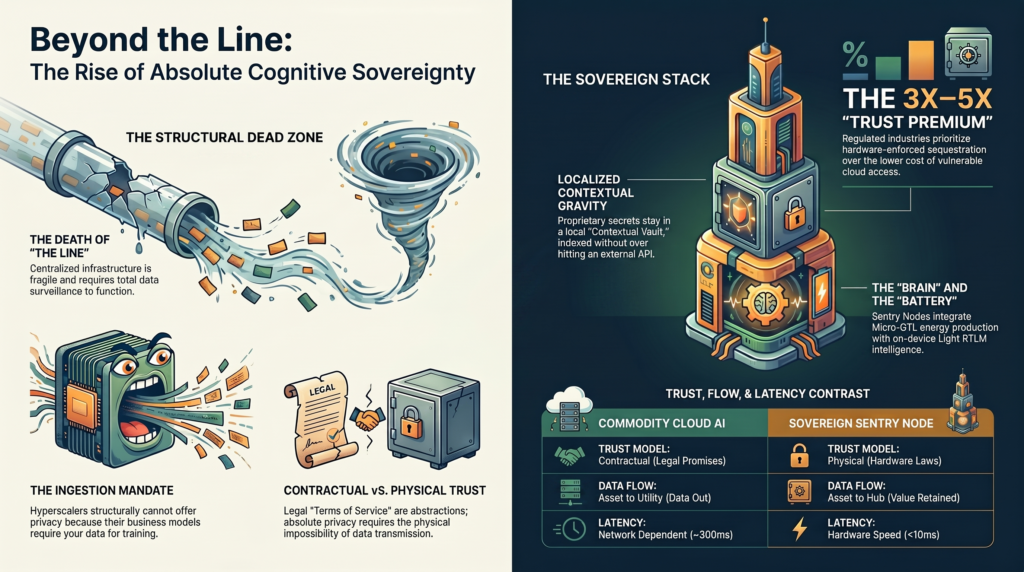
The “Death of the Line” represents the final collapse of centralized, fragile dependencies on hyperscale cloud providers and the national energy grid. As generic inference becomes a free commodity “below the line,” competitive value has shifted fundamentally to Absolute Cognitive Sovereignty. For institutions in regulated sectors, this shift is an architectural mandate. Sovereignty is the new baseline for security, requiring the “brain” and the “battery” to be relocated within the physical perimeter. This nodal autonomy is not a feature; it is a structural necessity to eliminate the inherent risks of total surveillance and infrastructure fragility.
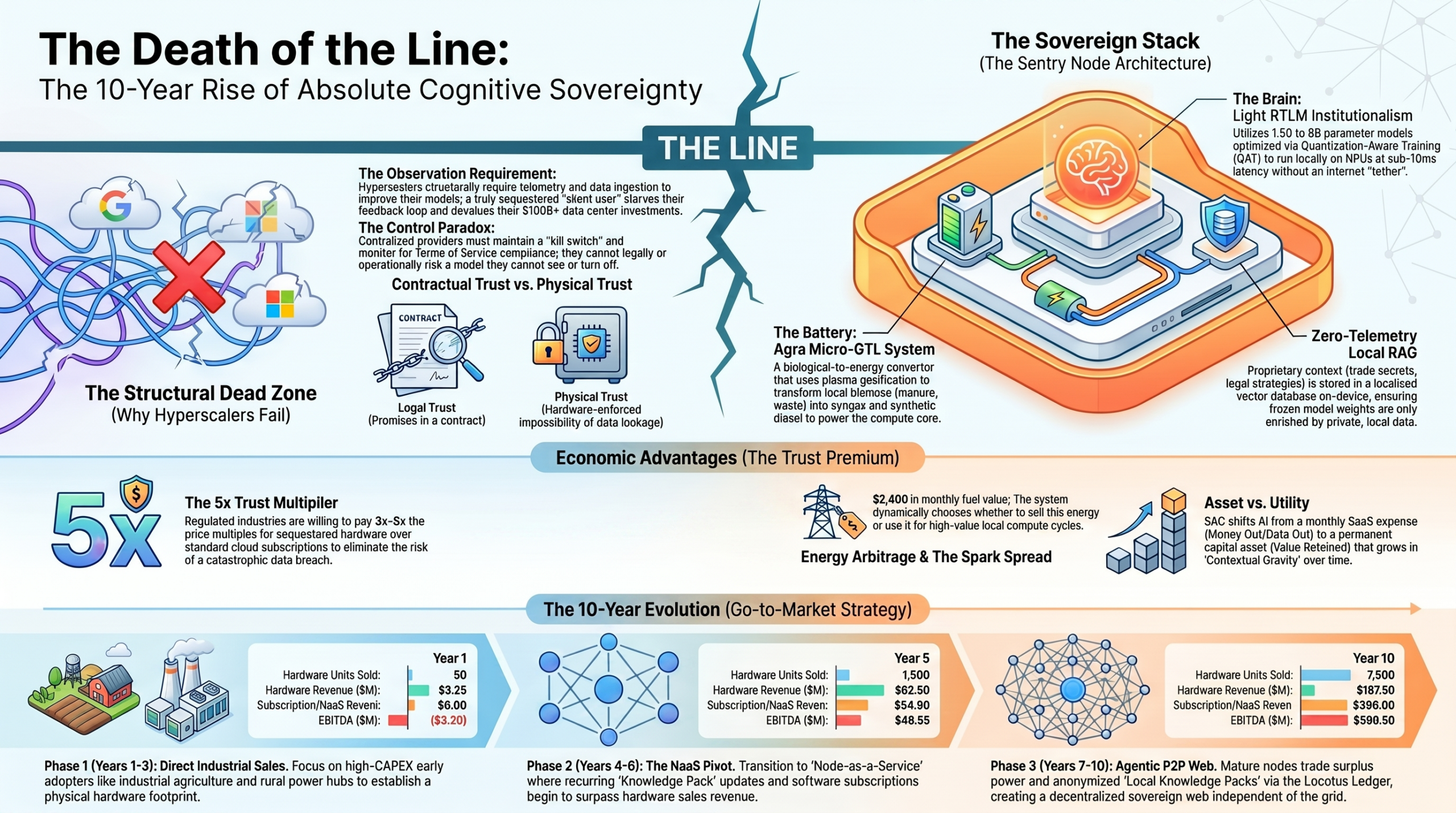
The “Telemetry Paradox” dictates that hyperscalers like Google and Microsoft are physiologically incapable of offering true sequestration. Their business models require continuous data ingestion to refine frontier models and fuel advertising flywheels. An air-gapped node starves their feedback loop and erodes the margins of their $100B+ data center investments.
| Feature | Contractual Trust (Hyperscale Cloud) | Physical Trust (Sovereign Node) |
| Security Foundation | Legal Agreements (ToS/SLA) | Physical Laws (Hardware Impossibility) |
| Data Flow | Asset to Utility (Data Outbound) | Asset to Hub (Value Retained) |
| Telemetry | Continuous Ingestion & Monitoring | Zero Telemetry (Silent User) |
| Latency | Network Dependent (~300ms+) | Hardware Speed (<10ms) |
| Vulnerability | API Shifts & Remote Kill-switches | Un-killable Offline Operation |
| Risk Mitigation | Dependent on Third-party Veracity | Compliance by Omission |
This distinction creates a “Trust Premium” for firms in Legal, Healthcare, and Finance. These institutions capture a “Physical Moat” by choosing sequestration, amortizing high-CAPEX deployments against the existential cost of being “wrongly observed.” To manifest this sovereignty, the architecture must prioritize nodal autonomy over connectivity.
video
2. The Sovereign Stack: Architecture of the Sentry Node
A sovereign system relies on a recursive energy-intelligence loop where “Physical Incapacity” is the primary security feature. The hardware is designed to be physically incapable of data exfiltration, ensuring that security is a thermodynamic and cryptographic reality rather than a software promise.
Hardware: The Sovereign Sentry
The Sovereign Sentry is an industrial-grade enclosure engineered for high-stakes environments:
- NEMA 4X-Rated Enclosure: Modular protection for deployment in harsh rural or high-security perimeters.
- NPU-Optimized Server Clusters: Custom silicon tuned for inference-at-the-edge, utilizing a Unified Memory Architecture to eliminate bus bottlenecks.
- Edge TPU Integration: Integration of Tensor Processing Units with 128-bit to 256-bit memory buses, delivering trillions of operations per second locally.
Intelligence: Vertical Light RTLM
We utilize Light Real-Time Language Models (1.5B to 8B parameters) transformed into “Vertical” intelligence via:
- Knowledge Distillation: Compressing the reasoning logic of frontier models into edge-native engines.
- Quantization-Aware Training (QAT): Modeling quantization noise during backpropagation to compress weights to INT4 precision without degrading logical deduction.
- Local RAG (Retrieval-Augmented Generation): Grounding frozen weights in a local vector database (Qdrant/Milvus) containing proprietary trade secrets or clinical history.
The Memory Wall Proof: Autoregressive decoding is bottlenecked by memory bandwidth. By utilizing the formula: \text{Required Bandwidth} = \text{Parameters} \times \text{Precision (Bytes)} \times \text{Tokens/sec}, an 8B model at FP16 requires 16GB/token. At INT4 precision, bandwidth requirement drops to 4GB/token—a 4x reduction. This enables sub-millisecond local inference and deterministic decoding speeds (>30 tokens/sec) that outpace cloud round-trips.
podcast
3. Deployment Protocols for Compliance by Omission
“Compliance by Omission” reduces the audit surface to zero. If a device is physically incapable of transmitting data, there are no transmission vectors to audit. This makes the node mathematically exempt from cloud transmission audits under HIPAA, FINRA, or SEC frameworks.
Sequestration Move Protocols
- GPIO-Controlled Physical Relays: The host OS manages physical power rails via General Purpose Input/Output (GPIO) pins. When the system enters a “Sovereign State,” the microcontroller pulls the GPIO low, physically de-energizing Wi-Fi, Bluetooth, and Ethernet PHY transceiver chips.
- TPM 2.0 Binding: Encryption keys (AES-256-GCM) for local context and model weights are sealed to the Platform Configuration Registers (PCRs) of the TPM 2.0. If any unauthorized hardware modification occurs or a network chip receives power, the boot hash fails to match the signed “golden state,” and the TPM refuses to release the keys.
- Secure Enclave Execution: TEEs (AMD SEV-SNP or Intel SGX) encrypt memory pages in DRAM using a hardware-managed cryptographic engine. This protects neural weights from side-channel analysis and cold-boot extraction attempts.
Air-Gap Initialization Checklist for ISOs
- Hardware Measurement: Establish and sign the “golden state” of the system PCR hash.
- Kernel Hardening: Compile out all network socket creation, wireless protocols (802.11), and cellular drivers; permanently disable dynamic module loading (
modprobe) post-boot. - Relay Verification: Confirm physical power cutoff to all transceivers via the GPIO controller.
- Key Sealing: Bind the localized vector database to the physical TPM 2.0 hardware ID.
- Local RAG Sync: Index sensitive organizational context via IPC (Inter-Process Communication) Unix domain sockets only.
4. Industry-Specific Implementation Blueprints
Regulated industries operate in a “Structural Dead Zone,” needing intelligence but fearing ingestion. In these sectors, localized context is a superior asset to general frontier model power.
The Legal Vault (Confidential Counsel)
Attorneys use the node for local RAG during discovery and contract review. Because the node is air-gapped, privilege is protected at the chip level.
- Contextual Gravity Impact: Shields trial strategies from the “Subpoena of the Cloud” by ensuring no digital footprint ever leaves the physical node.
Sovereign Healthcare (PHI Sequestration)
Diagnostic nodes process patient biometrics and EMRs within private clinics. By utilizing physical omission, these clinics remain HIPAA-compliant by default.
- Contextual Gravity Impact: Local clinical taxonomies and long-term DNA data remain on-device, creating a permanent, un-scrapeable patient history.
Private Quant (Finance/M&A)
“Dark AI” nodes process proprietary deal flows and trading patterns with zero institutional oversight from hyperscalers.
- Contextual Gravity Impact: Prevents corporate espionage by sequestering chemical recipes or M&A strategies within the local hardware’s memory enclave.
5. The Power Hub: Energy-Compute Integration via Agra Dot Energy
Nodal topology requires energy independence to achieve “Spherical Resilience.” By deriving “Green Compute” from behind-the-meter production, nodes become un-killable assets.
The Micro-GTL Thermochemical Loop
The Sovereign Sentry is co-located with a Micro-Gas-to-Liquids (GTL) system converting biomass (C_xH_yO_z) into energy:
- Plasma Gasification: High-temperature pyrolysis (>1200°C) cracks biomass into clean Syngas (CO + H2).
- Fischer-Tropsch Synthesis: A catalytic reactor converts Syngas into liquid paraffinic hydrocarbons (Synthetic Diesel – ASF™).
- Thermal Recapture: The reaction is highly exothermic (\Delta H^\circ \approx -165 kJ/mol CO). This waste heat is repurposed to warm anaerobic digesters, maximizing efficiency (\eta).
Spark Spread Arbitrage Coefficient (C_{ssa})
The node utilizes a dynamic decision engine: C_{ssa} = \frac{V_{\text{compute}} \cdot I_{\text{local}}}{E_{\text{consumed}}} – \left( P_{\text{grid\_export}} + \frac{C_{\text{fuel\_val}}}{\eta_{\text{conversion}}} \right)
- Control Logic: If C_{ssa} > 0, the system locks down behind-the-meter generation for high-value AI inference. If C_{ssa} \le 0, the system routes syngas to liquid fuel storage.
Agrivoltaics
Vertical bifacial solar arrays, spaced for 7-meter tractor row widths, allow for simultaneous energy and crop harvest. This maintains a Land Equivalent Ratio (LER) \ge 1.35, ensuring compute power does not compete with agricultural yield.
6. Ten-Year Financial Pro Forma and Unit Economics
Value in the next decade shifts from access to intelligence to the governance of context. The “Trust Premium” associated with sequestration justifies high initial CAPEX.
10-Year Strategic Pro Forma ($M)
| Metric | Y1 | Y3 | Y5 | Y7 | Y10 |
| Hardware Units Sold | 50 | 450 | 1,500 | 3,500 | 7,500 |
| Hardware Sales Revenue | $3.25 | $29.25 | $82.50 | $140.0 | $187.5 |
| Subscription/NaaS Revenue | $0.90 | $11.70 | $54.90 | $153.9 | $396.0 |
| Energy/Compute Credits | $0.15 | $1.95 | $9.15 | $25.6 | $66.0 |
| Total Revenue | $4.30 | $42.90 | $146.55 | $319.5 | $649.5 |
| OpEx (Incl. Refresh) | $4.00 | $10.00 | $22.00 | $45.00 | $85.00 |
| EBITDA | ($3.20) | $2.40 | $46.55 | $149.5 | $399.5 |
Strategic Financial Analysis
- High-CAPEX Foundation (Y1-3): Early negative EBITDA is driven by heavy investment in gasification reactors and server fabrication. This builds the “Physical Moat.”
- The Pivot (Year 5): Subscription/NaaS and Knowledge Pack revenue overtakes hardware sales. Value moves from the physical unit to the “Sovereign Web.”
- Server Refresh (Year 7): Accelerated OpEx in Year 7 ($45.0M) accounts for the necessary hardware refresh of the institutional base, adhering to the 3-year NPU lifecycle vs. the 10-year energy hardware lifespan.
7. Future State: Agentic P2P and the Web MCP Protocol
The final evolution is the transition of sequestered nodes into a “Parallel Economy” via decentralized mesh networks, operating independently of centralized ISPs.
Web MCP (Model Context Protocol)
The Web MCP enables air-gapped nodes to trade value without compromising sequestration. This protocol allows:
- Knowledge Pack Trading: The exchange of LoRA-based localized fine-tuning delta weights via physical firmware delivery (USB) or local mesh. This improves reasoning without exposing raw data.
- Resource Arbitrage: Trading surplus power and compute cycles via the Locutus Ledger, a decentralized marketplace for sequestered nodes.
- Mesh Connectivity: Communication via localized LoRaWAN or high-frequency point-to-point microwave networks.
Strategic Directive
The mission is the shift from “AI-as-a-Subscription”—a permanent tax on your future value—to AI-as-a-Sovereign-Asset.
Direct Command for CTO/ISO: To maintain “Spherical Resilience,” you must own the node. Focus on “Physical Trust” through hardware isolation. Ensure that your organization’s context remains an un-auditable, localized asset. Security is no longer a software update; it is a hardware reality enforced by the laws of physics and energy independence.


