The Sovereign Machine Bazaar: A Technical Architecture for Autonomous A2A Commerce
- Introduction: The Obsolescence of Human Middleware
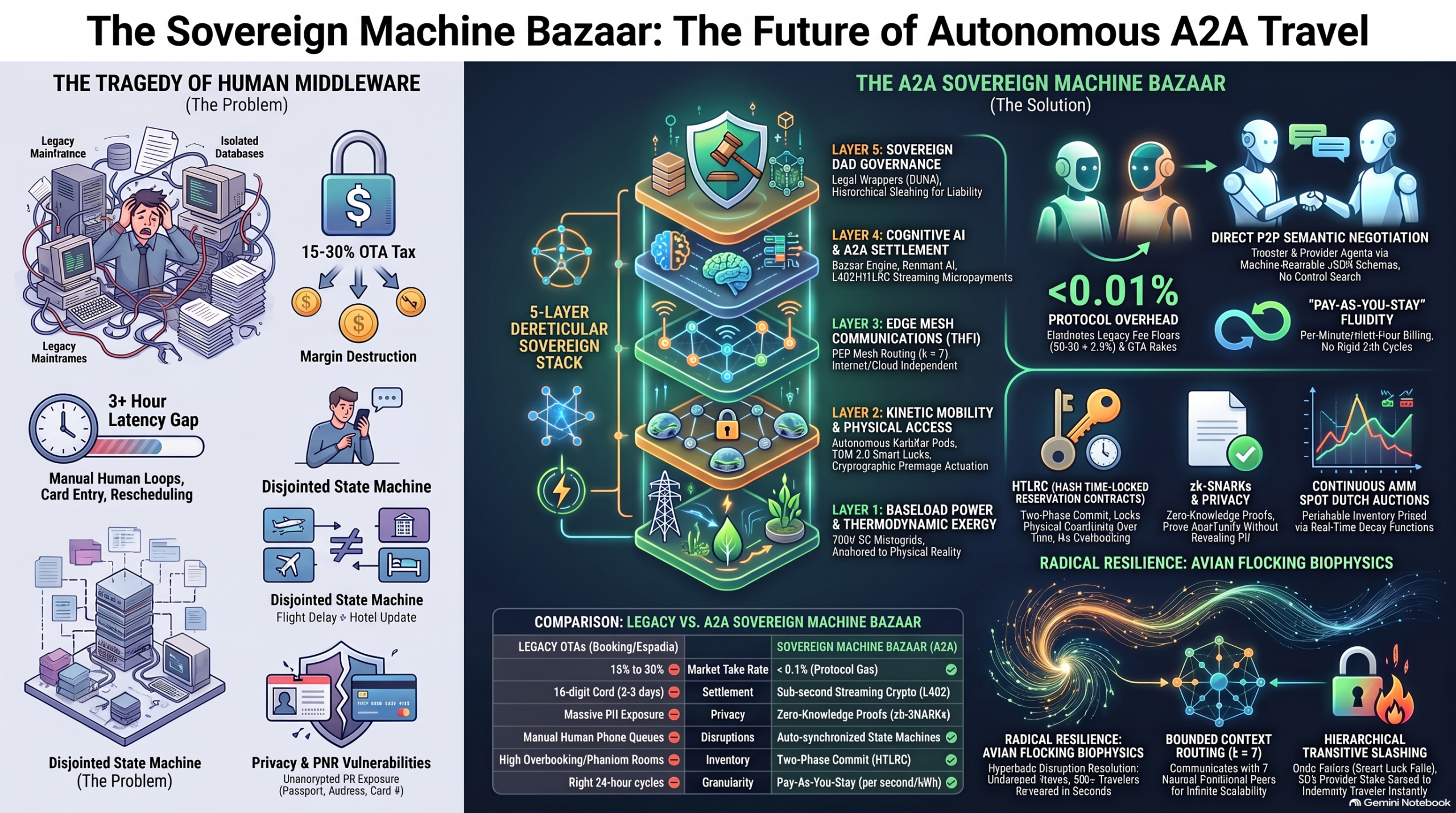
The global digital economy is currently strangled by “The Tragedy of Human Middleware”—a structural paradox where sub-10-millisecond machine logic is subordinated to the 3-to-48-hour latency of biological feedback loops. We have engineered synthetic cognitive entities capable of synthesizing non-Euclidean protein structures in milliseconds, yet these same hyper-advanced systems must halt execution to wait for a biped to manually type a 16-digit credit card number into a web form. This bottleneck represents a massive drain on capital efficiency, with legacy rent-extracting platforms and credit card fee floors imposing a “plastic tax” that could otherwise be reclaimed. By bypassing these centralized intermediaries, an estimated $120 billion in annual value can be transferred back to physical service providers and consumers.
The transition from human-facing Graphic User Interfaces (GUIs) to machine-native protocols represents a fundamental shift toward operational resilience. The “Silicon-Plastic Chasm” is defined by this absurdity: machines are ready to transact at the speed of light, but the legacy financial rails—built for bipeds who sign wood-pulp paper—demand legal personhood and physical signatures. To bridge this chasm, we must dismantle the anthropocentric interface and move toward a physical and logical structure grounded in the immutable laws of thermodynamics and cryptographic consensus.
- The 5-Layer Sovereign Architecture: Grounding the Machine Bazaar
The “DeReticular Sovereign Stack” is engineered to ensure “Sustained Island Mode”—the capacity for physical hospitality and transit nodes to execute reservations and settle payments even under a total wide-area network or grid collapse. Unlike brittle cloud-based logic, this architecture is anchored in physical laws and local execution.
The DeReticular Sovereign Stack
- Layer 1: Baseload Power & Thermodynamic Exergy: The foundation of all commerce is verified physical work. This layer utilizes 700V DC microgrids powered by Agra.Energy thermochemical gasification. Level 0 sensors (calorimeters and bus shunts) provide the supreme ontic authority, recording real-time exergy availability in the BiophysicalVetoRegister.json.
- Layer 3: Kinetic Mobility & Physical Access: This layer governs “KurbKars” (autonomous utility EVs) and physical assets. Access is controlled by hardware TPM 2.0-attested smart locks, which actuate only upon the presentation of a valid cryptographic preimage, linking physical unlatching to financial clearance.
- Layer 3: Edge Mesh Communications: Utilizing “TriFi” hardware—high-gain directional MIMO transceivers—this layer executes sub-16ms RF packet handoffs. By employing metric-invariant topological peer-to-peer (P2P) mesh routing, the network operates without reliance on centralized fiber backbones.
- Layer 4: Cognitive AI & A2A Settlement: The “Remnant Engine” provides local, air-gapped inference. It utilizes Active Inference (minimizing variational free energy F) and Lean 4 Abstract Syntax Trees (ASTs) for formal deductive verification. Transactional settlement is handled via L402 streaming protocols at sub-cent granularities.
- Layer 5: Sovereign DAO Governance: Assets are encapsulated in “Legal-Code Skins,” specifically Wyoming Decentralized Unincorporated Nonprofit Associations (DUNAs). This allows algorithms to manage balance sheets and bear legal liability through Capitalized Proof-of-Liability.
The Oracle Separation Protocol
The integrity of the Bazaar relies on the Oracle Separation Protocol, which enforces a strict distinction between Ledger Integrity (Level 2) and Ontic Truth (Level 0). A cryptographic ledger can verify that a record was not tampered with, but it is forbidden from declaring ontic facts. Ledgers cannot declare physical facts; only Level 0 sensors measuring heat, voltage, or flow can verify the fulfillment of a contract. This structural foundation enables a self-correcting economy anchored in the objective world.
- Economic Mechanics: Dismantling the Plastic Wall
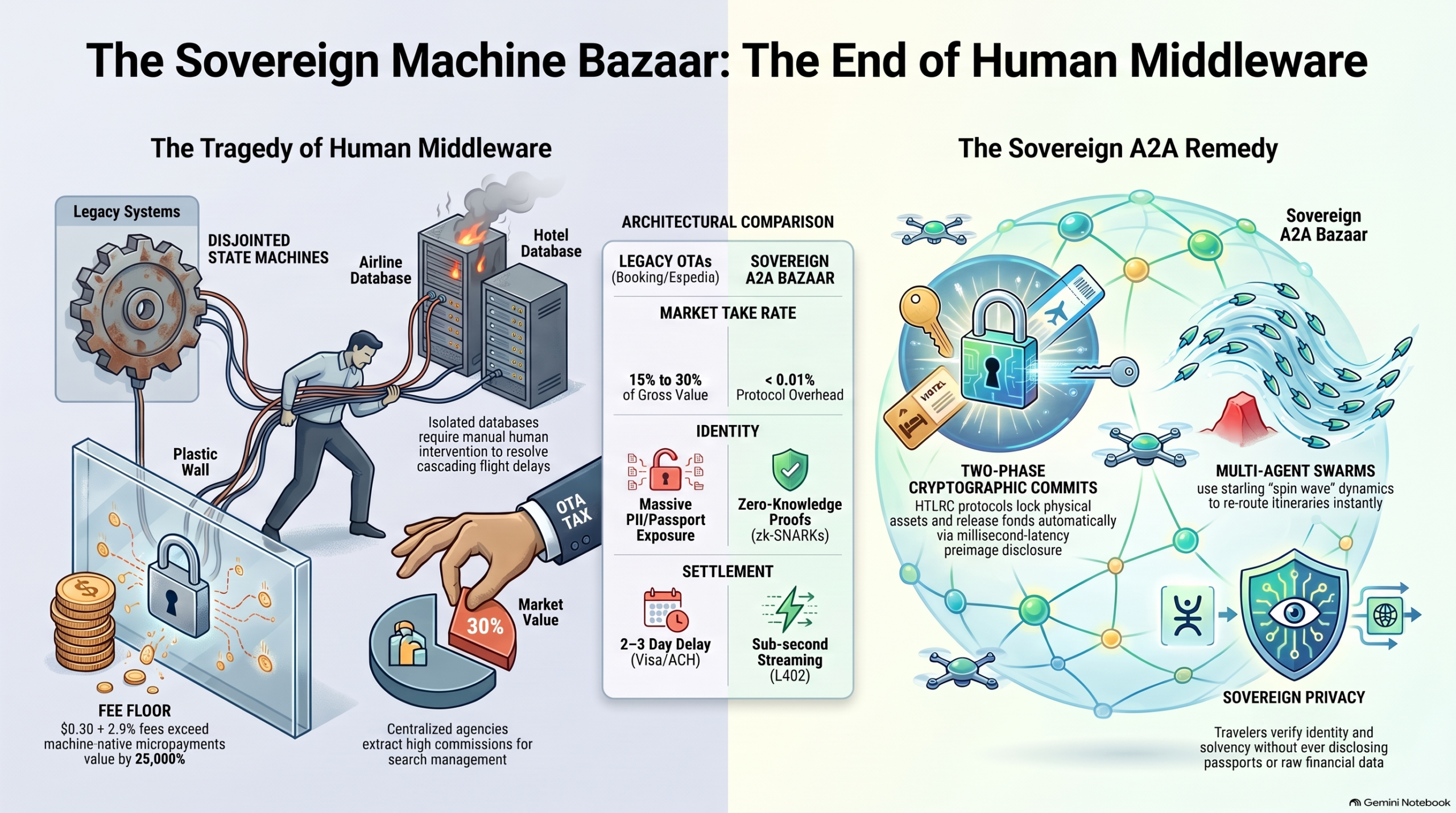
The “Plastic Wall” of legacy finance imposes an “OTA Tax” and credit card fee floors that destroy the margins of service providers. By utilizing machine-native protocols, we reduce protocol overhead to <0.01%, reclaiming the value lost to rent-extracting intermediaries.
Comparative Structural Matrix: Legacy vs. Sovereign A2A
Dimensional Aspect Legacy Intermediaries (OTAs) Sovereign A2A Bazaar
Market Take Rate 15% – 30% < 0.01% (Protocol Gas/L402)
Transaction Settlement 3-day delay (ACH/Visa) Sub-second streaming
Inventory Granularity Rigid 24-hour cycles Pay-As-You-Stay (per minute)
Identity & Privacy Massive PII exposure W3C Verifiable Credentials & zk-SNARKs
Reputation Vulnerable 5-star reviews Hardware-attested Brier calibration
Inventory Security High overbooking/Phantom stock HTLRC (Mathematical certainty)
“Pay-As-You-Stay” and Dynamic Discovery
The Bazaar utilizes L402 protocols to enable “Continuous Hotel Check-Out,” where travelers are billed by the exact minute. Inventory pricing operates via Automated Market Maker (AMM) Spot Dutch Auctions, clearing at optimal capacity without human panic: P(t) = P_{min} + (P_{max} – P_{min}) \cdot e^{-\lambda(t – t_{open})} + \delta(\text{Congestion})
Thermodynamic Exergy Anchoring (RELA Axiom 3)
To prevent inflationary debasement, the Bazaar adheres to RELA Axiom 3, anchoring the nominal money supply (M_{nominal}) to verified net physical exergy (\text{Exergy}{net}) and Carnot conversion efficiency (\eta): M{nominal}(t) \le \kappa \int_{t_0}^t \left( \text{Exergy}_{net}(\tau) \cdot \eta(\tau) \right) d\tau This ensures tokens are not speculative units but verified entitlements to physical work.
- Operational Case Study: The 3.5-Hour Flight Delay
In the Sovereign Machine Bazaar, a schedule disruption is resolved through a Hyperbolic Reorganization Wave. Unlike the first-order diffusive chatter of legacy human systems, updates in the Bazaar propagate as second-order hyperbolic waves, mirroring the biophysics of avian murmurations.
The Hyperbolic Reorganization Narrative
- Telemetry Trigger: The traveler agent ingests a signed ADS-B oracle feed. It identifies a mechanical deviation and a 3.5-hour delay.
- Atomic Rescheduling: Using Topological k-NN (k \approx 7), the agent communicates with the nearest functional peers to avoid API rate-limiting deadlocks. It simultaneously negotiates with the Airline Agent (EU261 indemnity), the Transit Agent (canceling the KurbKar), and the Hotel PMS.
- Market Response: The agent secures alternate lodging in milliseconds via a Dynamic Spot Dutch Auction. The entire itinerary is re-synchronized in 8.4 seconds without a single human intervention.
Critical Takeaways for Radical Resilience
- Scale-Free Correlation: The system reorganizes across entire cities without a central hub, as the correlation length of the swarm scales with the size of the disruption.
- Inertial Spin Momentum: By assigning belief updates a rotational inertia, the system replaces slow “prompt debates” with undamped waves that sweep through the network.
- Automated Indemnity: Contractual refunds are triggered by the Level 0 state change, ensuring capital is instantly redeployed to the new itinerary.
- Trustless Interaction: The Cryptographic Cased Tablet
To prevent Route Sniping and Price Discrimination, the Bazaar utilizes the Digital Cased Tablet, a modern adaptation of Ancient Mesopotamian clay envelopes. This protocol allows an agent to prove credentials without revealing total wallet wealth or PII.
The Four-Step Cryptographic Cased Reservation Protocol
- The Core: The agent generates a homomorphic commitment of the bid, keeping the budget unobservable.
- The Envelope: The agent generates a zk-SNARK proof (utilizing the Poseidon hash function and Groth16/PLONK) to prove solvency and identity without revealing a passport number or balance.
- Consensus Logging: The cased contract is committed to an append-only BFT quorum ledger for verification.
- Atomic Execution: Upon arrival, the agent discloses Preimage S, which simultaneously actuates the physical lock and releases the escrowed funds.
By utilizing Two-Phase Commit Hash Time-Locked Reservation Contracts (HTLRC), the Bazaar mathematically eliminates the “Double-Spend of Physical Inventory,” as the physical TPM 2.0 silicon signs the availability vector.
- Synthesis: The 2026–2036 Horizon
As we approach 2036, the hospitality sector will complete its transition from “Cognitive Capture” to Ambient Passage. We are moving toward a world of headless, machine-native protocol bazaars where the logistical burden of existence is handled by machine consensus in the background.
This journey is characterized by Verisimilitude Accretion—the steady closing of the gap between our digital models and physical reality. Through the Via Negativa, we permanently purge falsified parameter spaces, ensuring that our economic infrastructure is aligned with the objective laws of the physical cosmos. The inevitability of silicon-native value flows is not merely a technical upgrade; it is the ultimate architecture of human freedom, anchoring our sovereignty in the incorruptible laws of thermodynamics and code.


