Agra Dot Energy: Sovereign Power Systems Implementation Manual
- Strategic Foundation: The Sovereign Stack and “The Octagon”
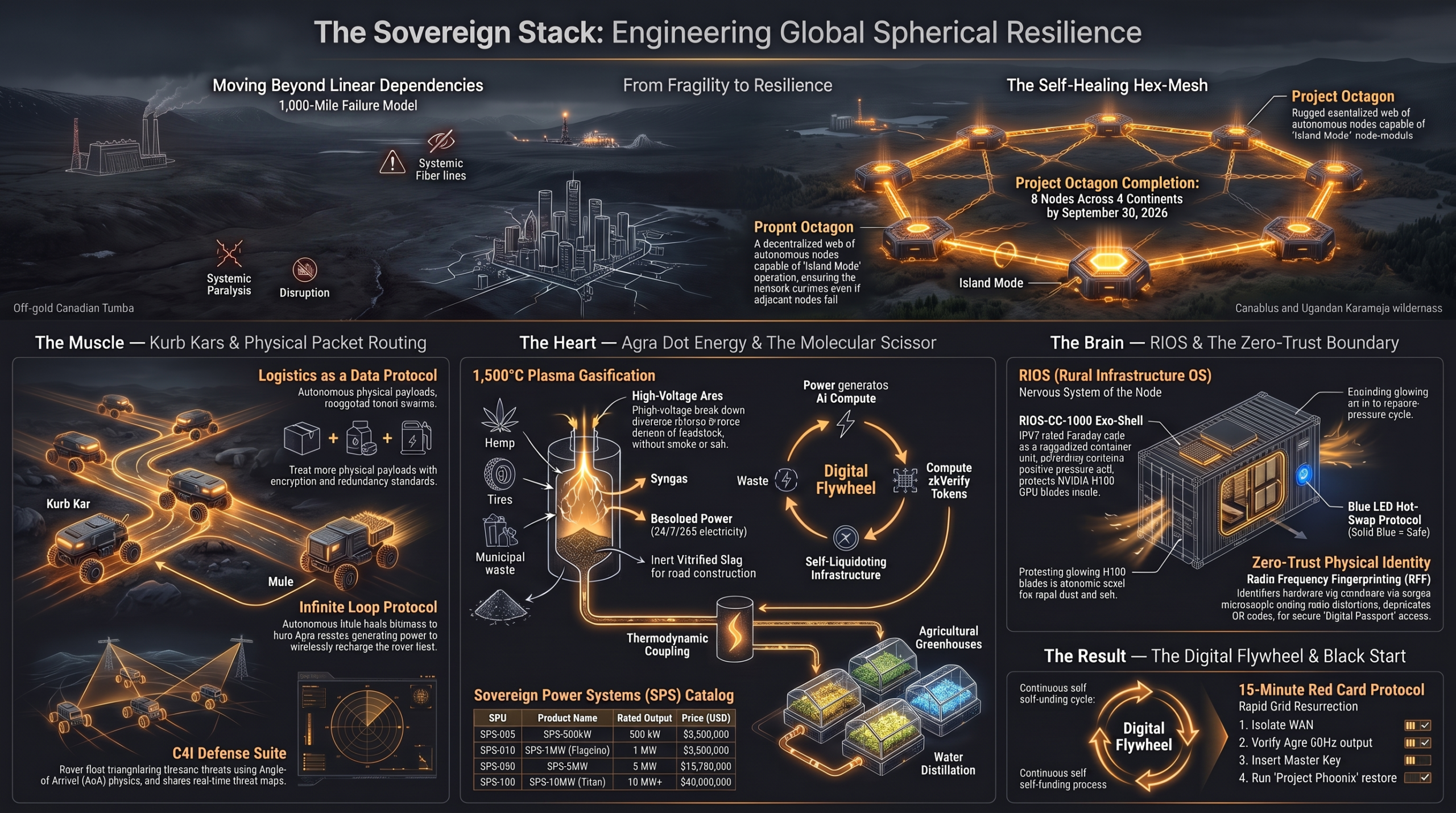
The deployment of Sovereign Power Systems (SPS) is the operational realization of Spherical Resilience. Deployment teams must understand that we are not merely installing hardware; we are executing the final decoupling from “The Line”—the brittle, centralized utility model characterized by a 1,000-mile failure radius. Our mission is the establishment of “The Octagon,” a distributed mesh of self-reliant nodes capable of “Island Mode” operation. Under the mandate of Energy Sovereignty, we operate on the industrial truth that “The Farm is the New Power Plant,” converting local waste liabilities into high-density assets.
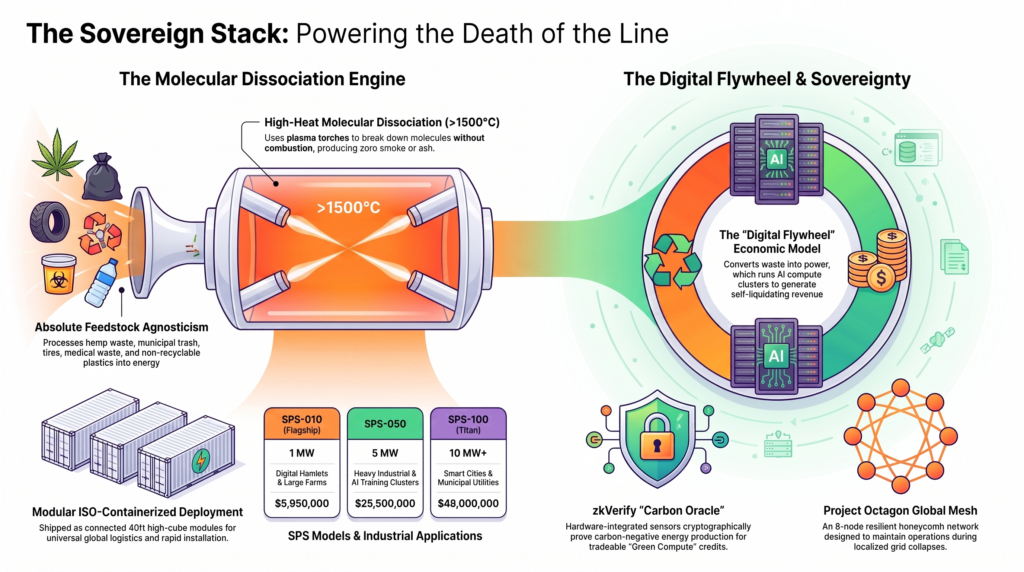
A critical brand distinction is mandatory for all field personnel: Agra Dot Energy is a DeReticular division and is entirely separate from the Wisconsin-based Agra Energy Corp. While the latter utilizes biological digestion to produce methane, we exclusively employ high-temperature thermal Plasma Gasification physics. Our systems utilize high-voltage arcs to trigger molecular dissociation at temperatures exceeding 1,500°C, producing high-hydrogen syngas and continuous electrical output. We do not incinerate; we dissociate. This process produces zero smoke and zero ash, providing a thermodynamic engine for the “Sovereign Stack” that traditional renewables cannot match.
- Phase I: Site Viability Assessment (SVA) Standards
The SVA is the non-negotiable prerequisite for hardware deployment. Failure to meet these standards results in immediate mission scrub. As the “Keeper of the Flame,” the field technician must verify that the site possesses the requisite feedstock density and digital backhaul to maintain a Sovereign Node.
The Feedstock Audit
The ADE-SPS-010 requires a consistent daily intake to maintain thermal equilibrium. Technicians must differentiate between hemp “Wet Leaf” (high moisture/gas yield) and “Stalk” (high carbon/structural integrity) to balance the reactor load.
Parameter Operational Requirement Compatible Materials
Daily Tonnage 10–20 Tons (Flagship ADE-SPS-010) Hemp (Wet Leaf vs. Stalk distinctions)
Intake Nature Feedstock-Agnostic Municipal Solid Waste (MSW)
Amperage Real-time adjustment for density Agricultural Residues / Tires
Byproduct Vitrified Slag (Obsidian-like glass) Medical Waste / Non-recyclable Plastics
Connectivity and Power Mandates
Continuous internet is mandatory for RIOS Power Core telemetry and zkVerify “Carbon Oracle” minting.
- Backhaul: Starlink (Bypass Mode) or dedicated Fiber.
- Software: Mandatory Command App Subscription ($1,200/yr) for bonding multi-carrier connections.
- Auxiliary Power: Deployment kits must include 12V DC power supplies for mobile hardware integration.
Human Capital and Audit Tasks
Authorization for delivery requires a certified Level 1 Sovereign Power Technician (SPT) on-site. During the audit, Level 2/3 SPTs are responsible for identifying and isolating contaminants such as PVC and Heavy Metals to ensure vitrified slag purity. These standards mitigate the “Boutique State” bottleneck, ensuring that every site—benchmarked against the gold standard of Node 4 (Kaabong, Uganda)—is a self-sustaining asset, not a stranded prototype.
- Phase II: Logistical Fulfillment and Payment Milestones
Our “Draw Schedule” protects enterprise capital while securing the long-lead-time high-temperature alloys and refractory brick required for Gen 2 reactors.
The Draw Schedule
- Milestone 1 (Deposit): 30% due at contract signing to secure the factory slot.
- Milestone 2 (Materials): 40% due upon chassis assembly. This triggers the allocation of specialized high-temperature alloys and refractory brick.
- Milestone 3 (Factory Acceptance): 20% due prior to containerization.
- Milestone 4 (Commissioning): 10% due upon successful “Black Start” ignition and RIOS handshake.
Modular Logistics (ADE-SPS-010)
Standardized shipping utilizes ISO High-Cube Containers. An SPS-1MW unit consists of three 40ft High-Cube modules:
- Feedstock Loader: Shredding and intake.
- Plasma Reactor: The molecular dissociation core.
- Generator/Turbine: Thermal-to-electric conversion.
All units are shipped DDP (Delivered Duty Paid). Agra Dot Energy manages all “Green Technology” permits to bypass regulatory “green tape.”
- Phase III: Physical Site Preparation & Infrastructure
Reliability requires a 24/7/365 baseload mindset. Infrastructure must be ready for 50-ton loads prior to the arrival of the deployment squad.
Structural Specifications
- Reinforced Concrete Pad: Minimum 50+ ton capacity foundation for the three-module reactor stack.
- Feedstock Storage: A moisture-protected warehouse is mandatory. Moisture in biomass causes reactor fluctuations; dry storage is a prerequisite for thermal stability.
The Sovereign Reserve (BESS) Integration
In accordance with the Storage Buffer Rule, a 1:1 ratio is required: one ADE-BESS-1K (Sovereign Reserve 1000) for every MW of SPS capacity. This 1 MWh LFP system arrives in a 20ft container with built-in fire suppression. It is critical for voltage stabilization and providing the DC discharge required for a “Black Start” without legacy grid assistance.
- Phase IV: Sovereign Power Technician (SPT) Certification Levels
The SPT is a “Blue Collar AI Engineer” tasked with managing the thermodynamic and digital integrity of the node.
Certification Hierarchy
- Level 1 (Operator): Safety, feedstock loading, and telemetry. (Minimum for delivery).
- Level 2 (Alchemist): Syngas optimization, PVC isolation, and Micro-GTL synthesis. (Required for commissioning).
- Level 3 (Black Start Engineer): Crisis management, hardware repair, and grid resurrection.
The Safety Gate
Hands-on control of the plasma arc is protected by a digital “Safety Gate.” Modules 3 through 6 of the hardware interface are fully encrypted until the technician achieves a 100% score on the Safety Gateway Exam. This ensures that the 1,500°C dissociation environment—stress-tested to 1,800°C—is managed with absolute precision.
- Phase V: The Mechanical “Black Start” Protocol
The “Black Start” is the transition from “Cold Iron” to an operational microgrid. Refer to the Node 4 (Kaabong) deployment manual for reference site comparisons.
Sequence of Execution
- Cold Iron: Physical module connection and unpowered assembly.
- Ignition: Utilizing BESS DC power to fire plasma torches. Use real-time amperage adjustment to stabilize the arc.
- Stabilization: Reach thermal equilibrium (>1,500°C).
- Handover: Engage turbine load; disconnect battery start-up.
The 15-Minute “Red Card” Test
Every SSA must be capable of a total node reboot in 15 minutes:
- Isolate: Disconnect WAN to prevent external jamming.
- Boot: Insert the Master Key USB into Port 0 of the RIOS-CC-1000. Hold the reset for 10 seconds. Listen for the POST code: 3 short, 1 long.
- Mesh: Enable SOS_BEACON and execute:
rios-phoenix restore –latest
This launches Matrix, Nextcloud, and the Village Ledger.
- Phase VI: Digital Integration & RIOS Power Core Synchronization
Once stable, the node activates its “Digital Flywheel” through the RIOS-PC2X.
Digital Security and the Carbon Oracle
Hardware integrates zkVerify sensors to prove carbon-negative energy production. Physical security is managed by the Exo-Shell (IP67 Faraday cage) and the Positive Pressure Cycle to repel dust.
- Seal Integrity Light: Deployment squads must monitor the protocol (Green: Secure / Off: Maintenance / Red: Breach).
- Scorched Earth: If the seal is compromised without authorization, the system executes a RAM purge, destroying all encryption keys instantly.
- Blue LED Protocol: Hot-swap compute blades only when the LED is Solid Blue. A flashing LED indicates an active write; extraction during this phase results in terminal corruption.
The Remnant AI and Spark Spread
The local AI Decision Node (Remnant) directs the Spark Spread Algorithm. It calculates in real-time whether to sell power, store it as fuel, or direct it into the RIOS-CC-1000 for AI compute credits, maximizing node profitability.
- Phase VII: Post-Fulfillment Support & Operational Sustainment
Maintaining “Sovereign Mode” requires predictive maintenance to prevent the intermittency common in solar/wind systems.
Warranty & Day 1 Kit
Every unit includes a 2-year/15,000-hour warranty. The Day 1 Kit (sensors, gaskets, valves) must be maintained on-site to prevent downtime in logistical deserts. RIOS telemetry triggers the auto-shipment of plasma torch electrodes before end-of-life.
The Digital Flywheel Cycle
The node becomes self-funding through high-margin outputs:
- AI Compute: High-density workloads processed via local GPU clusters.
- Synthetic Fuels: Fischer-Tropsch outputs including Agra Diesel (ASTM D975) and Agra Synthetic Jet for the Kurb Kars “Mule” fleet.
- Vitrified Slag: Non-toxic, obsidian-like glass for road construction aggregate.
Our implementation squads are the architects of a new decentralized utility standard, ensuring that every Sovereign Node is a permanent, carbon-negative stronghold in the global mesh.


