The Goodwill Moat: Leveraging Sovereign Health for Infrastructure Security and Regional Profitability
- Strategic Identity and the Healthcare Void
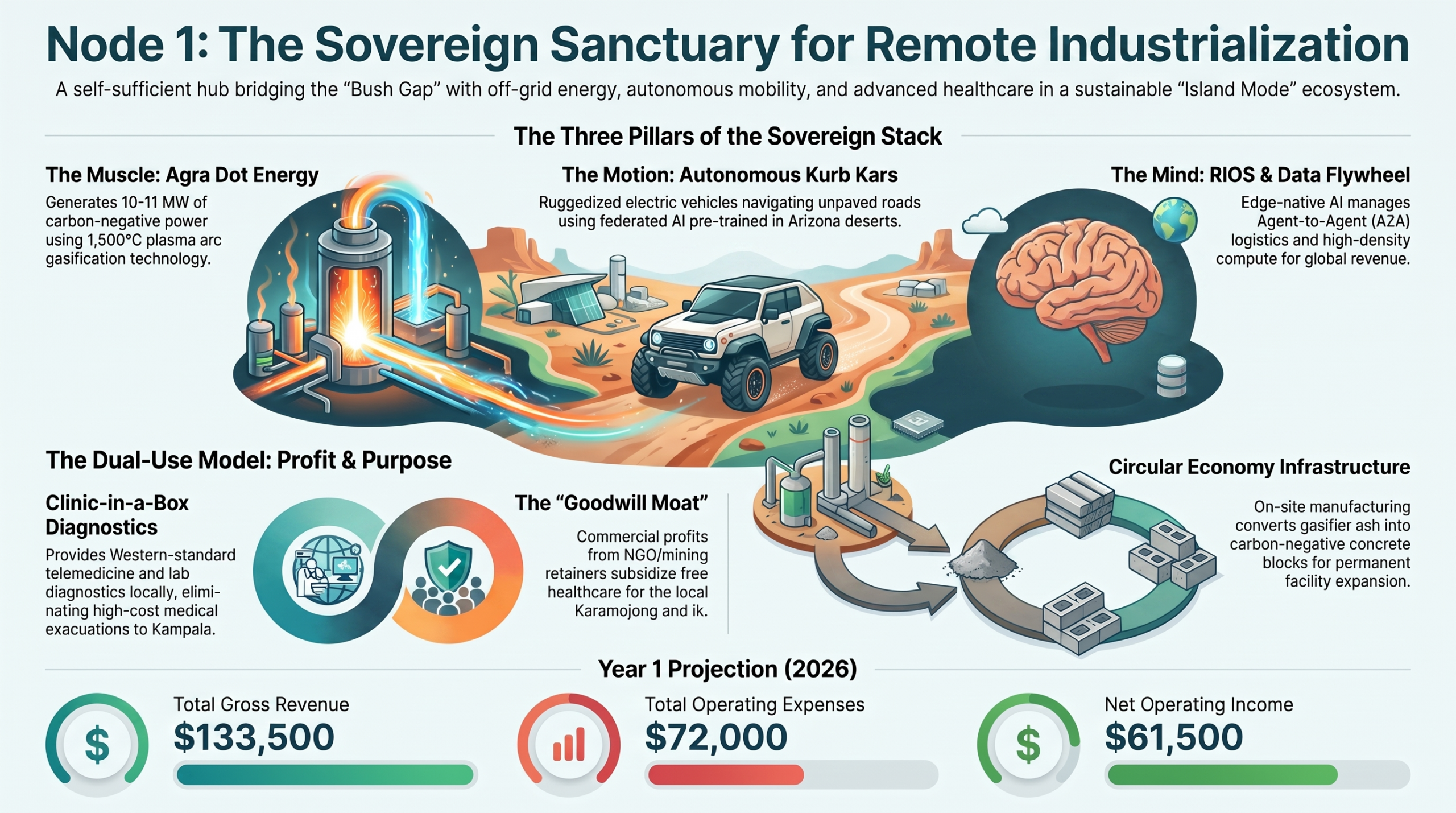
Node 1, situated in Kaabong, Uganda, serves as the “Concierge Layer” and human-centric gateway for Project Octagon. Its primary strategic objective is to bridge the “Bush Gap”—the severe deficit in power, connectivity, and healthcare that historically deters international investment in remote frontier markets. Operating in a continuous, air-gapped “Island Mode,” Node 1 provides the essential human infrastructure required to support the large-scale industrial operations of the adjacent 7,000-acre Smart Eco-Industrial Park (SEIP). This “sanctuary of reliability” is physically powered by the Node 4 plasma/solar microgrid, ensuring 100% utility uptime in a region defined by grid instability.
The Karamoja sub-region has historically been defined by a total absence of Western-standard clinical infrastructure. For personnel stationed in this “Zone 4” environment, basic diagnostics previously necessitated a high-risk, high-cost journey to the capital, Kampala. The implementation of the “Clinic-in-a-Box” at Node 1 fundamentally alters this economic landscape by providing localized, high-fidelity medical care backed by the Node 2 (Canada) board-certified specialist network.
The Economic Friction of Kampala Evacuations
Metric Traditional Path (Kampala Evacuation) Project Octagon (Clinic-in-a-Box)
Logistical Costs $1,200 – $2,500 per emergency flight Negligible; handled on-site
Operational Downtime 3 – 5 days per incident (via road or air) Minimal; 15-minute diagnostic turnaround
Travel Risk 10 – 12 hour drive on unpaved “Zone 4” roads Secure transit via autonomous Kurb Kars
Insurance Liability High premiums for “Zone 4” operations Node 2 (Canada) Western Underwriting
The presence of on-site, Western-standard diagnostics acts as a “sanctuary of reliability,” attracting high-value investors, engineers, and researchers who would otherwise avoid the region. This clinical capability is the primary engine for the project’s unique revenue and security model.
- The Commercial Engine: Monetizing “Clinic-in-a-Box”
The “Clinic-in-a-Box” transitions the telemedicine module from an internal cost center into a high-margin corporate revenue driver. By positioning the clinic as the primary healthcare sanctuary in Northern Uganda, Coordinates Travel & Tourism captures the health spending of expatriate workers, NGO personnel, and high-end tourists.
Tiered Revenue Architecture: B2B Corporate Retainers
Coordinates offers international organizations a tiered subscription model to cover regional personnel, ensuring predictable cash flow.
Retainer Tier Target Clients Monthly Fee Included Services
Silver Local NGOs / Research Teams $500 Covers 5 staff; unlimited infectious disease screening; 24/7 emergency stabilization.
Gold Development Partners (WFP, UNICEF) $1,500 Covers 15 staff; bi-annual physicals; priority telemedicine; Kurb Kar medical pickup.
Platinum Mining Corps / Industrial Hubs $3,500 Covers 40 staff; occupational health tracking; pre-employment screening; radiologist reviews.
Pay-Per-Use and Triage Monetization
For walk-in expatriates and luxury safari tourists, a premium diagnostic fee schedule is applied, including $300 for 30-minute specialist consultations with the Node 2 Canadian network. A critical revenue stream is the $500 stabilization fee charged to international insurance providers. This service is highly valued by underwriters as precise diagnostic telemetry prevents “unnecessary aircraft dispatches,” drastically reducing their payout exposure.
The “Data Flywheel Effect” further enhances this model. While diagnostics have near-zero marginal energy costs due to Agra Dot Energy’s plasma gasification, the surplus power also energizes the RIOS-CC-1000 Core Compute Cluster. This cluster executes high-value AI training for global clients, creating a parallel digital revenue stream that subsidizes site maintenance. Combined, these factors result in a projected Year 1 Revenue of 138,000 and a 65% Gross Margin (90,000 NOI).
- The Dual-Use Model: Cross-Subsidizing Community Care
The “Dual-Use” operational philosophy ensures that high-margin commercial profits directly fund humanitarian outcomes. This model secures the “social license to operate” by transforming a high-tech installation into a shared community asset.
Resource Partitioning
To maintain clinical standards while maximizing social impact, Node 1 implements a strict temporal partitioning of the clinic schedule. To address local talent gaps identified in the “Service Gap” analysis, clinical officers are trained via the DeReticular Academy.
Weekly Clinic Schedule
- Commercial/Industrial Windows: Monday, Wednesday, Friday (08:00 – 17:00). Reserved for Node 4 workforce, investors, and NGO retainer clients.
- Community Off-Hours: Tuesday & Thursday (17:30 – 20:30) and Saturday (08:00 – 14:00). Dedicated to the Karamojong and Ik communities. Evening hours specifically respect daily cattle herding patterns.
Targeted Clinical Interventions
The clinic utilizes edge-native technology to address critical local threats:
- Maternal Health (POCUS): Using handheld ultrasound probes (POCUS), the team identifies high-risk pregnancies (e.g., breech or placenta previa) in a region with severe mortality rates.
- Malaria Screening: Automated laboratory arrays return definitive diagnoses within 15 minutes, allowing for immediate life-saving treatment.
- Trauma Care: The clinic provides rapid wound care for injuries sustained during herding or gold mining, preserving the health of the local labor force.
By utilizing local clinical officers who speak Ngakarimojong and Icetot, the clinic is transformed from a “foreign installation” into a respected community sanctuary.
- Transitioning to the Goodwill Moat: Security through Sovereignty
The strategic shift from traditional, hardened security to a “Goodwill Moat” represents a fundamental innovation in asset protection. Rather than relying on friction-heavy physical barriers, Node 1 leverages community-driven protection.
Traditional vs. Goodwill Security
Feature Traditional Security Model DeReticular Dual-Use Model
Primary Mechanism Hardened barriers, armed guards Subsidized care, local trust
Local Relationship Potential tension; high sabotage risk Community integration; Social License
Cost Profile ~$5,000/month private contracts ~$1,500/month medical COGS
Operational Result High friction; asset obstruction 0% incident rate; 70% cost reduction
Securing Physical Infrastructure Assets
Providing healthcare to the families of local pastoralists secures Node 1’s physical assets, including the 7,000-acre Smart Eco-Industrial Park and the autonomous Kurb Kar fleet. The local community has a vested interest in protecting the microgrid and EV infrastructure; sabotaging this infrastructure directly threatens their own access to life-saving pediatric and maternal medicine. This turns a technical asset into a community-protected “lifeline,” achieving absolute asset security through social indispensability.
- Operational Synergy and Regional Integration
Maintaining this ecosystem requires a “Sovereign Cultural Loop” managed by local leadership. Mike Tumwesigye, Director of Coordinates Travel & Tourism, serves as the critical bridge between high-tech operations and tribal governance.
Leadership and Trust Architecture
The project allocates a $500/month Community Fund directly to the Karamojong Council of Elders and Ik tribal chiefs. Trust is further solidified through a “Sovereign Supply Chain” utilizing guaranteed purchase contracts for Ik-harvested honey and Karamojong-raised goat meat, sourcing the Lodge’s food directly from the surrounding terrain.
Logistics and Healthcare Access
The autonomous Kurb Kar fleet is utilized during “Community Off-Hours” to extend healthcare access. These vehicles utilize “Desert Hardened” navigation models federated from Node 3 (Arizona) to handle the local murram roads. Kurb Kars transport Ik elders and pregnant women from the strenuous terrain of Mt. Morungole to the clinic. In exchange for this health security, local warriors and herders provide the project with invaluable terrain intelligence and unofficial perimeter defense.
- Conclusion: The Blueprint for Sovereign Resilience
Node 1 serves as the definitive proof-of-concept for Island Mode resilience. By combining off-grid energy generation with a robust, commercially viable healthcare model, Project Octagon creates an unshakeable regional ecosystem.
The core takeaway is a new model of economic sovereignty: off-grid technology, when paired with a community-first health model, generates high-margin revenue while simultaneously de-risking billions in industrial infrastructure. Node 1 proves that remote frontier markets can bypass fragile, centralized grids to build profitable and secure industrial enclaves by replacing vulnerable linear networks with a self-healing honeycomb geometry. This blueprint proves that the most effective way to protect a high-value asset is to make its continued operation a matter of life and death for the community that surrounds it.


