Beyond “The Line”: 5 Ways Spherical Resilience is Quietly Ending the Era of Centralized Fragility
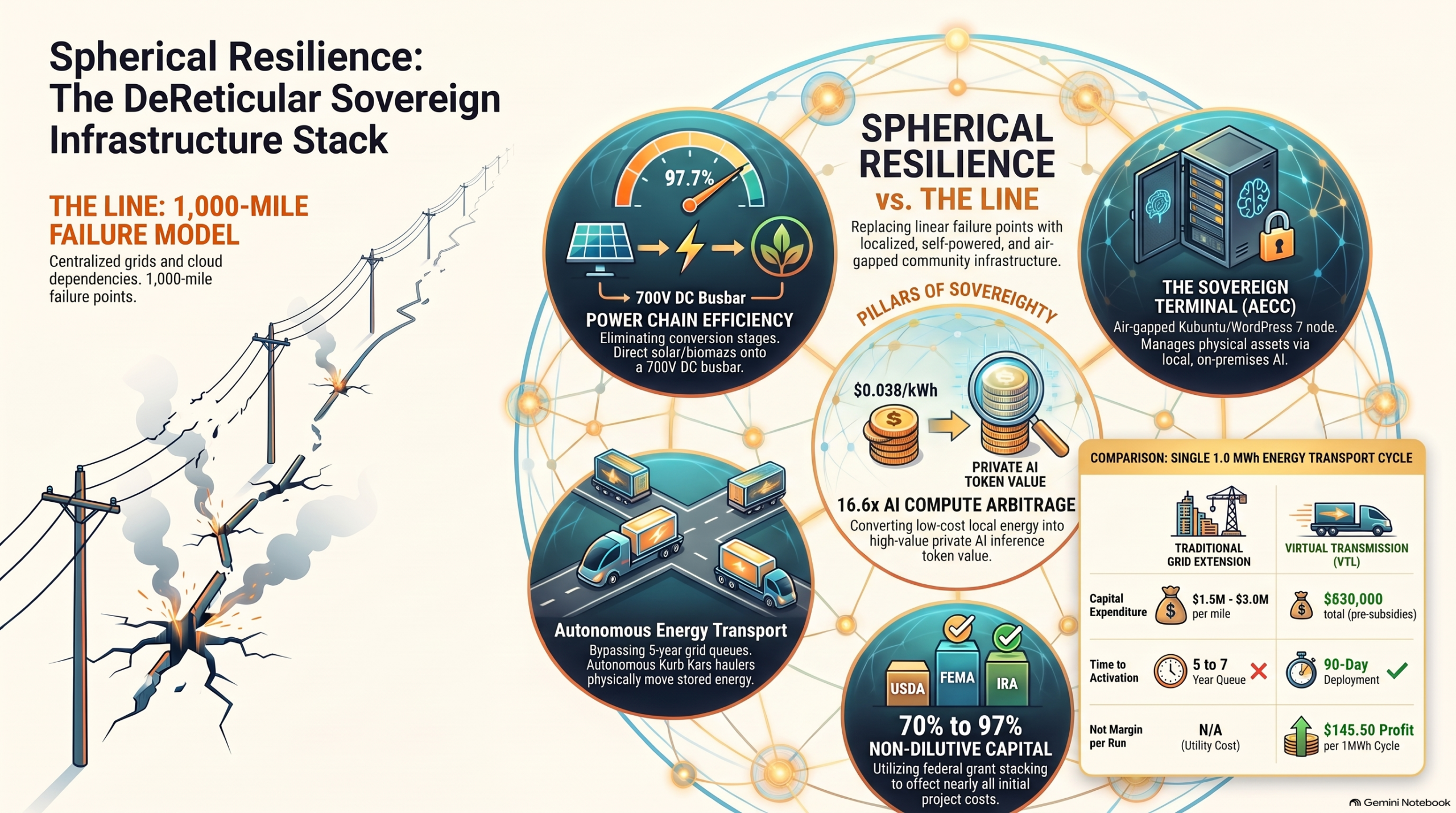
Modern life is built upon a profound structural illusion known as “The Line”—a hyper-centralized, 1,000-mile failure model. This model assumes that our most critical needs, from electricity to intelligence, must travel across massive, vulnerable distances to reach us. We see the fragility of this paradigm when an undersea fiber cable severance or a single high-voltage substation trip triggers a cascade of failure that can paralyze an entire region. When the cloud goes dark or the grid sparks, the community collapses.
The alternative is Spherical Resilience, an architectural shift governed by the RIOS™ (Rural Infrastructure Operating System). In this model, every node—a hospital, a farm, or a municipality—operates in “Island Mode,” possessing absolute physical, computational, and economic autonomy. By stepping off the reticulum of centralized dependency, we replace a brittle linear network with a sovereign matrix of self-sustaining cells.
Takeaway #1: The “Virtual Transmission Line”—Why Roads Beat Power Lines
In the current landscape, the primary barrier to infrastructure expansion is the “Transmission Monopoly.” Traditional grid extensions face a brutal reality: 5-to-7-year utility interconnection queues and construction costs of $1.5M to $3M per mile.
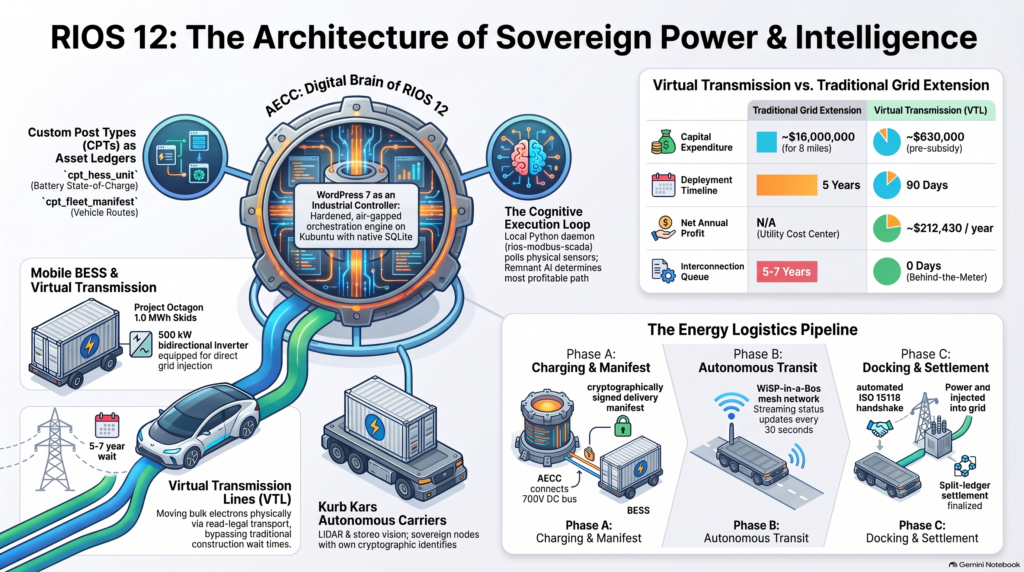
The breakthrough lies in Physical Energy Logistics, or the “Virtual Transmission Line” (VTL). Instead of waiting years for copper wires, bulk electrons are moved physically via autonomous Kurb Kars transport platforms carrying 1.0 MWh Project Octagon Mobile BESS (Battery Energy Storage System) skids.
- Traditional Grid Extension: 5–7 year wait; $1.5M – $3M per mile.
- Virtual Transmission: 90-day deployment; $630,000 total CapEx.
- Net Efficiency: Through strategic grant stacking (USDA REAP, IRA Section 6417 Direct Pay), the net out-of-pocket cost can drop to ~$189,000—a 90%+ offset.
By charging at the source (with a levelized cost of $0.038/kWh) and discharging at the destination, these nodes achieve a 97.7% power chain efficiency. Crucially, the system utilizes a sub-16ms automatic transfer switch (ATS), ensuring that even during a grid perturbation, the transition to “Island Mode” is faster than a server rack’s power drop.
Noel’s Law of Decentralization: System resilience is inversely proportional to its dependency on single-path centralized choke points. As external infrastructure dependencies approach zero, local economic survival approaches unity (1.0).
Takeaway #2: The Sovereign Terminal—WordPress as an Industrial SCADA Controller
A key pillar of Spherical Resilience is the transition from cloud dependency to Zero-Telemetry Air-Gap Cores. The most counter-intuitive element of this stack is the use of WordPress 7 as an Autonomous Economic Command Center (AECC).
No longer a mere web publisher, the WordPress interface is repurposed as a serverless, air-gapped industrial orchestrator. It runs on a hardened NixOS implementation—selected for its declarative immutability and atomic rollbacks—to manage complex physical assets. Using Custom Post Types, the AECC treats physical resources as local state ledgers:
- cpt_bess_unit: Monitors real-time state-of-charge and cell health.
- cpt_energy_auction: Manages dynamic bids for local power.
- cpt_ore_assay_lot: Tracks mineral purity in mining operations.
By integrating local Remnant AI, the stack allows for sophisticated decision-making without a single byte of data leaving the premises. The terminal is published via Freenet WebAssembly (Wasm) contracts, creating a serverless, unblockable command-and-control layer that persists even if the node’s external connections are severed.
Takeaway #3: The 16.6x Economic Arbitrage of Turning Energy into AI Tokens
The DeReticular architecture solves the problem of energy curtailment—where renewable sites are forced to shut down because the grid cannot accept more power—through Captive AI Compute Arbitrage.
By placing RIOS-CC-1000 liquid-cooled GPU compute clusters directly at the generation site, operators can monetize prime power behind-the-meter. Instead of exporting electrons to a grid that pays wholesale cents, the energy is used for private AI inference, turning raw electricity into high-value data.
The Economic Expansion Factor:
- Grid Export Yield: $0.04 – $0.06 per kWh (wholesale Net Metering).
- Captive AI Inference Yield: $0.65 – $1.00 per kWh (in billable token value).
- Result: A 16.6x multiple on the value of every kilowatt-hour produced.
This transforms an energy asset into a high-margin data factory, solving the “energy trilemma” by prioritizing the most profitable local use of every electron.
Takeaway #4: Compliance-by-Architecture—Healthcare Without the Paperwork
Healthcare compliance has traditionally been a matter of “Compliance-by-Paperwork”—signing Business Associate Agreements (BAAs) with cloud providers who, as we saw in the 2024 Change Healthcare attack, cannot physically protect data.
The Sovereign Clinical Terminal replaces this with Compliance-by-Architecture. By utilizing physical air-gapping and TPM 2.0 hardware attestation, the system achieves HIPAA compliance through engineering rather than legal contracts. Under 45 CFR § 164.402, the system invokes a Statutory Safe Harbor. Because the data is mathematically unreadable without the unique hardware-bound TPM key, a lost or stolen node is not considered a “breach” under federal law. It is an architectural guarantee of privacy that eliminates the need for third-party business associates.
“True HIPAA compliance and clinical resilience are achieved not by trusting ‘The Line,’ but by building Spherical Resilience.” — Regulatory & Engineering Report
Takeaway #5: The “Bush Gap” Solution—Waste-to-Cold Transformation in Frontier Markets
The “Bush Gap” describes the lack of power and connectivity that keeps frontier markets trapped in poverty. In our Uganda Campus case study, we bridge this gap by transforming agricultural waste, such as coffee husks, into prime power using Agra Dot mini-gasifiers.
This power doesn’t just provide lights; it drives an ammonia-water absorption chilling cycle. This “waste-to-cold” mechanism fuels a communal agro-cold-chain, reducing post-harvest spoilage from 45% to near zero. Furthermore, the campus hosts an Agent-to-Agent (A2A) commodity clearinghouse. Farmers trade inventories in encrypted Freenet River rooms, bypassing middleman cartels and centralized banking failures. Because the mesh operates on local P2P hardware, high-value trade continues even with zero internet connectivity.
Summary: Stepping Off the Reticulum
The transition from a linear failure model to a Sovereign Matrix is more than a technical upgrade; it is a declaration of independence. On one side of the horizon is the stormy, dystopian collapse of the old grid, where “The Line” snaps under the weight of its own centralization. On the other is the tranquil, self-sustaining DeReticular node, illuminated by its own generation and governed by its own intelligence.
By replacing vulnerable dependencies with Spherical Resilience, we ensure that infrastructure serves the community rather than holding it hostage. We are finally stepping off the reticulum.
If your community were cut off from the world’s infrastructure tomorrow, would your life continue in “Island Mode,” or would your world go dark?


