Strategic Redesign of Content Operations: Leveraging WordPress AI Automation
- The Architectural Shift: Capability-Based Content Workflows
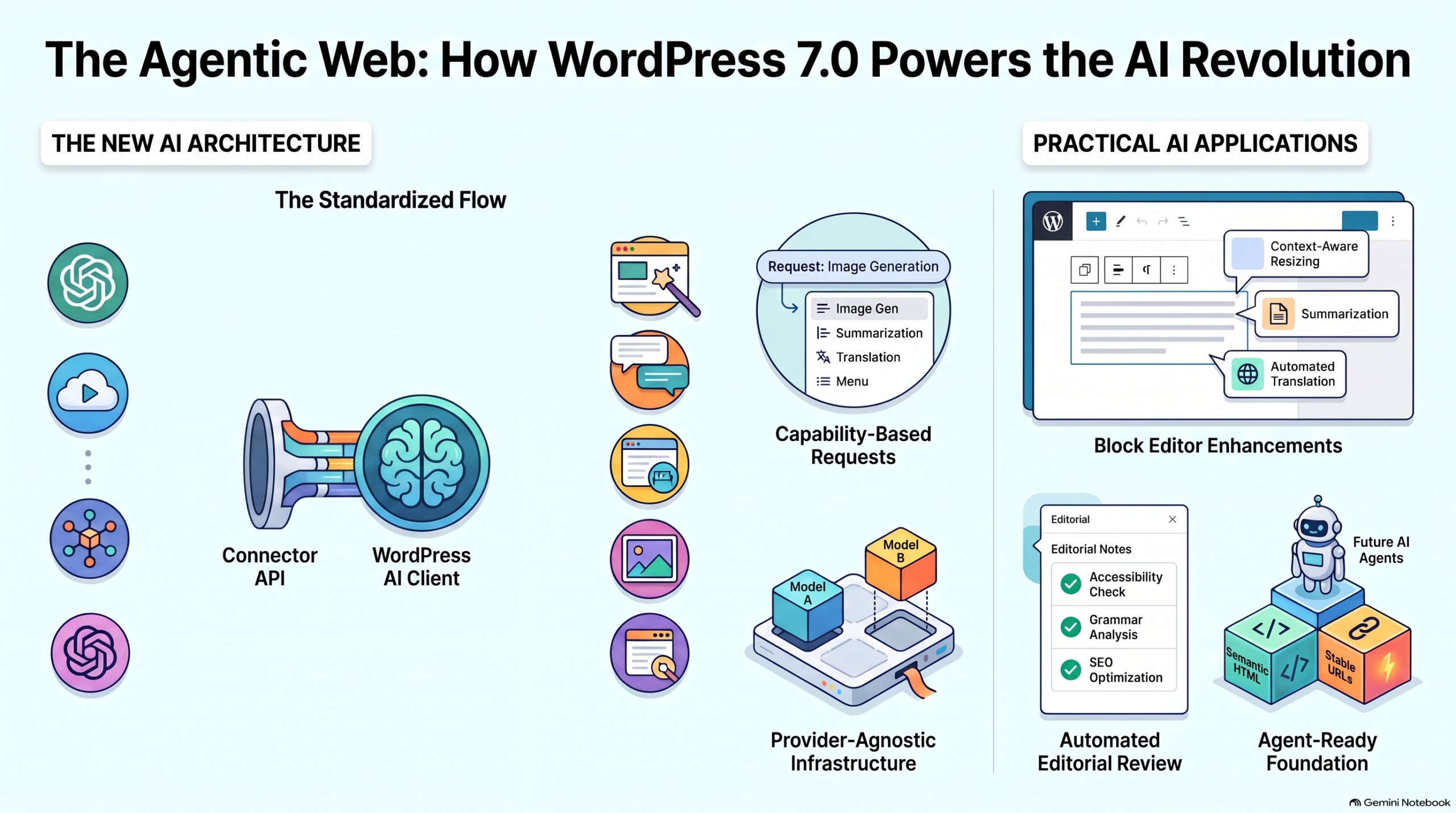
The transition from provider-specific integrations to the WordPress 7.0 “AI Client” and “Connector API” represents a fundamental pivot in our content supply chain optimization. Historically, editorial workflows were brittle, tethered to specific AI providers via bespoke integrations that invited significant technical debt and “model lock-in.” By migrating to a provider-agnostic framework, we achieve true operational agility. This shift ensures that our tech stack remains a stable, long-term foundation where the specific AI vendor is abstracted from the editorial experience, allowing us to swap underlying models based on performance or cost without re-engineering our entire workflow.
The WordPress AI architecture now follows a standardized logic flow designed for scalability:
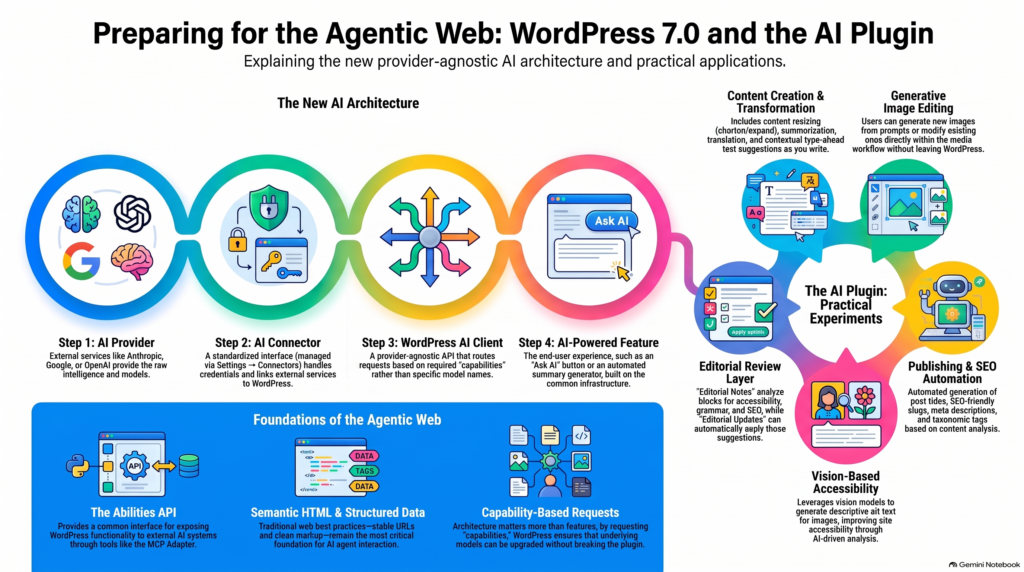
AI Provider → AI Connector → WordPress AI Client → AI-powered Feature
A critical component of this infrastructure is the Connector API, which centralizes credential management and vendor relationships through the Settings → Connectors screen. This allows operations teams to manage API keys and model access for providers like OpenAI, Anthropic, or Google in one secure location. Strategically, we are no longer requesting specific models (e.g., “GPT-4o”); instead, we request “capabilities” such as text generation or vision analysis. This separation ensures operational durability: as providers update or deprecate models, our internal features continue to function seamlessly by routing requests to the next compatible capability, effectively mitigating the financial and technical risks of vendor volatility.
This standardized infrastructure serves as the essential baseline for the advanced editorial tools explored in the following sections.
- Redesigning the Editorial Layer: From Drafting to Review
The evolution of the block editor into an active editorial partner is central to our strategy of reducing cognitive load for content creators. Our goal is to move from manual, labor-intensive content polishing to a structured “editorial layer.” By automating routine refinements, we allow our talent to focus on high-level narrative strategy rather than the mechanics of drafting.
The current “Writing and Editing” experiments transform the drafting phase into a highly efficient, assisted experience:
- Content Resizing: Shortens, expands, or rephrases selected blocks, enabling rapid tone adjustments.
- Content Summarization: Distills long-form content into overviews for TL;DR sections or internal briefs.
- Content Translation: Translates paragraph and heading blocks directly, facilitating rapid multi-market distribution.
- Type-ahead Text: Predicts and suggests contextual “ghost-text,” significantly reducing the friction of content creation.
Beyond drafting, we have implemented an “Editorial Review Engine” that provides block-by-block granularity for quality control—a level of precision previously impossible at scale.
Feature Name Operational Role (Identify vs. Execute) Focus Areas
Editorial Notes Identify: Analyzes content block-by-block to pinpoint quality gaps. Accessibility, Readability, Grammar, SEO
Editorial Updates Execute: Automatically applies suggested changes to the content. Accessibility, Readability, Grammar, SEO
While these tools ensure the integrity of the content body, our operational efficiency also depends on automating the technical metadata required for final publication.
- Streamlining Publishing and SEO Standards
The “last mile” of publishing—the administrative metadata required for search visibility—is frequently a bottleneck in high-volume operations. Automating these repetitive SEO tasks allows us to maintain brand integrity at scale while freeing agency talent for strategic planning. By utilizing AI-driven metadata generation, we ensure that every piece of content meets our technical standards without manual intervention.
The current framework evaluates four critical areas of publishing metadata:
- Title Generation: Suggests relevant headlines based on real-time content analysis.
- Excerpt Generation: Drafts concise summaries for archives and RSS feeds.
- Slug Generation: Produces readable, SEO-optimized permalinks.
- Meta Description Generation: Creates search-optimized snippets for SERPs.
This system is built for SEO Plugin Synergy. The Meta Description Generation tool is designed to integrate with established SEO plugins, ensuring that AI-generated suggestions respect our existing technical standards and site-wide configurations. This hybrid approach—combining AI efficiency with proven SEO frameworks—streamlines the content supply chain without introducing risk. Once these technical markers are set, we look toward visual and organizational optimization.
- Advanced Classification and Vision-Based Accessibility
Structured data and accessibility are foundational to our content discoverability and legal compliance. By utilizing AI vision and classification models, we reduce the friction of maintaining complex site taxonomies and meeting ADA requirements.
The Taxonomy Redesign The “Content Classification” feature leverages our site’s established taxonomies to suggest appropriate tags and categories. By analyzing the narrative structure of a post, it ensures that content is correctly indexed, directly improving internal search performance and audience discoverability.
Vision and Creative Workflows The plugin also introduces Image Generation and Editing directly into the block editor. This allows creators to generate or modify images from prompts within the publishing workflow, eliminating the “context switching” and technical debt associated with external design tools. For accessibility, the Alt Text Generation feature uses vision models to analyze imagery.
CRITICAL WARNING
Human Review is Mandatory. While AI vision models can generate descriptive text, effective alt text is highly dependent on the specific context and purpose of the image within the article. All AI-generated accessibility metadata must be reviewed by an editor to ensure accuracy and contextual relevance.
As we optimize for human readers and search engines, we must also architect our sites for the emerging “Agentic Web.”
- Future-Proofing for the Agentic Web
The “Agentic Web” represents a shift where AI agents retrieve and act on site information on behalf of users. For an agency, preparing for this shift means looking beyond traditional human-centric UX to ensure our sites are “machine-readable” and actionable by autonomous systems.
The Agentic Infrastructure WordPress is establishing the necessary infrastructure to expose site functionality to external AI:
- Abilities API: Provides a standardized interface for exposing specific WordPress functionalities (e.g., searching or commenting) to external systems.
- MCP Adapter: Acts as a bridge to make these “Abilities” available to external AI systems via the Model Context Protocol.
Maintaining Foundational Excellence Despite the emergence of experimental techniques like llms.txt or Markdown-specific endpoints, current research (including findings from Miriam Schwab) indicates that AI agents still favor traditional semantic HTML. Experimental endpoints are frequently bypassed by current models in favor of the raw, existing markup. Therefore, our primary strategic focus must remain on the technical fundamentals.
Non-Negotiable Foundations Checklist:
- Stable URLs: Preventing link rot and ensuring persistent data access for agents.
- Semantic HTML: Using standard tags to define content structure, as this is the primary data source for agents.
- Structured Data: Implementing Schema to help machines parse and categorize information.
- Accessible Markup: Ensuring screen-reader compatibility, which inherently aids AI parsing.
Final Strategic Summary The WordPress AI plugin is a foundation for testing what is currently possible within the content supply chain, rather than an end-state solution. It provides the standardized infrastructure required to experiment with AI today, while ensuring we remain flexible enough to adapt to the agentic landscape of tomorrow.


