Briefing Document: The Karamoja 50 MW Eco-Industrial Park (Project Oasis)
Executive Summary
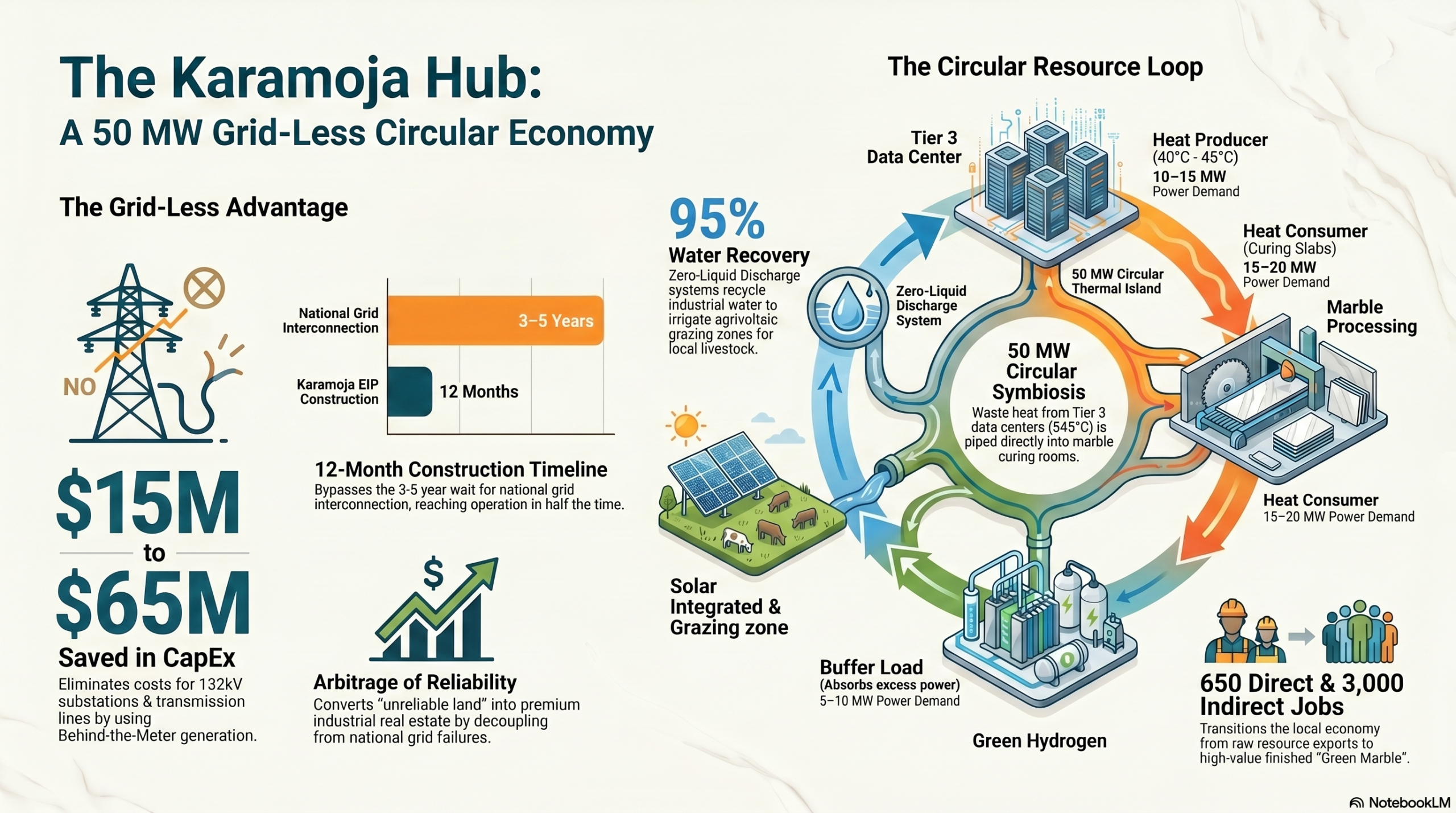
Project Oasis is a strategic proposal for a 50 MW “Behind-the-Meter” (BTM) Eco-Industrial Park (EIP) located in the Karamoja region of Uganda. Designed to operate entirely independent of the national grid, the park eliminates between $15 million and $65 million in infrastructure costs typically associated with grid interconnection. The project utilizes a “Circular Resource” strategy, where four high-load industrial “engines”—Marble Processing, Cold Storage, Data Centers, and Green Hydrogen—form a symbiotic ecosystem. By sharing waste heat and recycled water, the EIP achieves a 22% reduction in operating expenses compared to standalone facilities. Key outcomes include the creation of over 600 direct jobs, the production of carbon-neutral “Green Marble” for export, and the integration of agrivoltaics to support local pastoralist livelihoods.
——————————————————————————–
I. Strategic Advantage: “Behind-the-Meter” (BTM) Independence
The Karamoja EIP is configured as a private microgrid, physically co-locating 50 MW of power generation with its industrial consumers. This “grid-less” approach turns the region’s remoteness into a competitive advantage.
Financial and Operational Benefits
By bypassing the Uganda Electricity Transmission Company Limited (UETCL) grid, the project achieves significant savings and speed-to-market:
| Benefit Category | Impact | Financial/Time Value |
| Substation Savings | Avoids 132/33kV substation requirements | $12M – $25M |
| Transmission Savings | Eliminates 30km of 132kV lines ($333k/km) | ~$10M |
| Interconnect Wait Times | Operational in 18–24 months vs. 3–5 years | ~2-year lead time reduction |
| Tariff Arbitrage | Avoids T&D charges (30–40% of industrial bills) | Significant OpEx reduction |
Infrastructure Requirements for Grid-less Operation
To maintain stability without a national grid “spark,” the park employs three critical systems:
- Microgrid Controller (EMS): Utilizes load-shedding logic; for example, disconnecting hydrogen electrolyzers first to protect “mission-critical” cold storage.
- Battery Energy Storage System (BESS): A 10–20 MWh buffer (within a larger 150 MWh bank) handles “inrush” currents from heavy industrial machinery like marble saws.
- Black-Start Capability: The ability to restart the entire park independently after a shutdown.
II. The “Karamoja Symbiosis Hub”: Industrial Engines
The park is anchored by four sectors designed to provide a stable baseline load while offering flexibility to absorb peak generation.
| Industry Sector | Power Demand | Strategic Fit for Karamoja |
| Industrial Marble Processing | 15–20 MW | Powers 5–8 facilities for sawing/polishing local deposits. |
| Industrial Cold Storage | 10 MW | Essential for meat and dairy export value chains. |
| Tier 3 Data Center | 10–15 MW | Provides regional digital sovereignty and AI-readiness. |
| Green Hydrogen Pilot | 5–10 MW | Acts as a “buffer” load, converting excess power to fuel. |
——————————————————————————–
III. Circular Resource Strategy and Industrial Symbiosis
The “Eco” designation stems from “Industrial Symbiosis,” where the waste of one facility serves as the raw material for another, creating a “Circular Thermal Island.”
1. The Thermal Symbiosis Loop
Electricity is used for mechanical work, while waste heat is captured for value-added processes:
- Low-Grade Loop (Data \rightarrow Marble): Waste heat (35-45^\circC) from servers is piped to marble curing rooms to stabilize resins, saving 2–4 MW of electricity.
- Medium-Grade Loop (Hydrogen \rightarrow Water): Heat from electrolyzers (60-80^\circC) powers Multi-Effect Distillation (MED) to purify water for the park and local communities.
- Cold-Chain Loop (Meat \rightarrow Hydrogen): Rejection heat from refrigeration compressors (50-70^\circC) pre-heats water for the hydrogen electrolyzer, increasing its efficiency by 10–15%.
2. The “Net-Zero Water” Strategy
In the semi-arid Karamoja climate, the park employs a “Recovery” over “Consumption” model.
- Air-Cooled Condensers (ACC): Used to eliminate the 2,000 m^3/day required by traditional evaporative cooling, despite a 4% drop in electrical efficiency.
- Water Recycling: 95% of water used in marble polishing is recycled.
- Water Dividend: The park provides a surplus of 50,000 liters/day of purified water to surrounding Manyattas (homesteads).
——————————————————————————–
IV. Socioeconomic Integration and Agrivoltaics
The EIP is designed to coexist with and enhance the traditional pastoralist culture of the Ateker Cluster (Bokora, Pian, Matheniko, etc.).
Agrivoltaic “Solar-Plus-Grazing” Model
The 50 MW solar array is elevated 2.5 meters, allowing livestock to graze underneath.
- Environmental Impact: Shading reduces soil evaporation by 25–30%, allowing forage to remain green for 3–5 weeks longer during the dry season.
- Carrying Capacity: The 150-hectare park supports a “Peace Herd” of 40-54 cattle and 100-360 goats, exceeding open-range stocking rates.
Employment and Economic Growth
The transition from raw material export to high-value finished goods is projected to create:
- Direct Jobs: 415 – 650 roles (Saw operators, IT technicians, veterinary staff).
- Indirect Jobs: 2,000 – 3,000 roles (Multiplied by a factor of 4.8x).
- Household Income: A projected 40% increase for participating Manyattas through local dairy industrialization.
——————————————————————————–
V. Financial Viability and Market Positioning
Project Oasis is framed as an “Infrastructure-as-a-Service” play with high-margin export potential.
Return on Investment (ROI) Analysis: Marble Unit
- Initial CapEx: $4.2 Million.
- Internal Rate of Return (IRR): 26.4%.
- Payback Period: 2.8 Years.
- Net Profit Margin: 38%, driven by the spread between raw blocks (180/ton) and finished slabs (1,200/ton).
“Green Marble” Export Strategy
To dominate high-end EU and North American markets, the park targets “Green Marble” status:
- Certification: ANSI/NSI 373 Platinum level.
- EU Compliance: Exempt from the Carbon Border Adjustment Mechanism (CBAM) due to zero-carbon production.
- Transparency: Blockchain ledgers track the energy source for every slab, meeting the requirements for LEED-certified “Billion Dollar” projects.
——————————————————————————–
VI. Comparative Benchmark: CGN Wumatang (Tibet)
The Karamoja project draws technical parallels from the Wumatang Integrated Energy Project, the world’s highest-altitude Parabolic Trough Concentrated Solar Power (CSP) plant (4,550m).
Key Lessons from Wumatang:
- Hybrid Stability: Combining PV with CSP (thermal storage) allows for 24/7 baseload power.
- Energy Arbitrage: Using electric molten salt heaters to convert excess PV electricity into storable heat.
- Extreme Engineering: Custom turbines and heat exchangers are required for high-altitude, low-oxygen environments.
- Land Use: Proven success of the “Solar-Plus-Grazing” model for nomadic populations (sheep/yak in Tibet; cattle/goats in Karamoja).
——————————————————————————–
VII. Implementation Roadmap (12-Month Construction)
The BTM approach allows for a compressed timeline by bypassing national grid delays.
- Months 1–3: Civil works, foundation drilling for the “Karamoja Diamond” layout, and water hub construction.
- Months 4–7: Installation of bifacial solar panels and 150 MWh BESS containers; data center shell completion.
- Months 8–10: Installation of marble processing saws, “Thermal Backbone” piping, and green hydrogen electrolyzers.
- Months 11–12: Symbiosis testing and full-load endurance testing; final audit for Platinum certification.
Strategic Takeaway: The 50 MW Karamoja EIP transforms a region defined by isolation into a “Green Island” of high-value industry. By decoupling growth from the national grid and integrating with pastoralist traditions, it creates a self-sustaining ecosystem where “the community is the primary protector of the asset.”


