
Briefing Document: The Self-Regulating Farm & Agro-Industrial Homeostasis
Executive Summary
The global agricultural industry faces a dual structural challenge: a macro-thermodynamic crisis in industrial inputs and the operational fragility of cloud-tethered technology platforms. Conventional high-input farming relies on open-loop, fossil-fuel-derived inputs whose energy return on energy invested (EROEI) has degraded significantly. At the same time, contemporary AgTech architectures depend on centralized cloud hyperscalers—a vulnerability referred to as the 1,000-Mile Failure Model—which exposes farm operations to connectivity failures, data exploitation, and proprietary vendor lock-in.
To address these vulnerabilities, institutional researchers and systems architects have formalized The Self-Regulating Farm (Document Designation: DE-AGRI-AUTO-2026-V1). This paradigm redefines the farm as an autonomous, closed-loop cyber-physical ecosystem capable of operating in Sustained Island Mode. Anchored in the DeReticular Five-Layer Sovereign Agro-Stack, the architecture integrates:
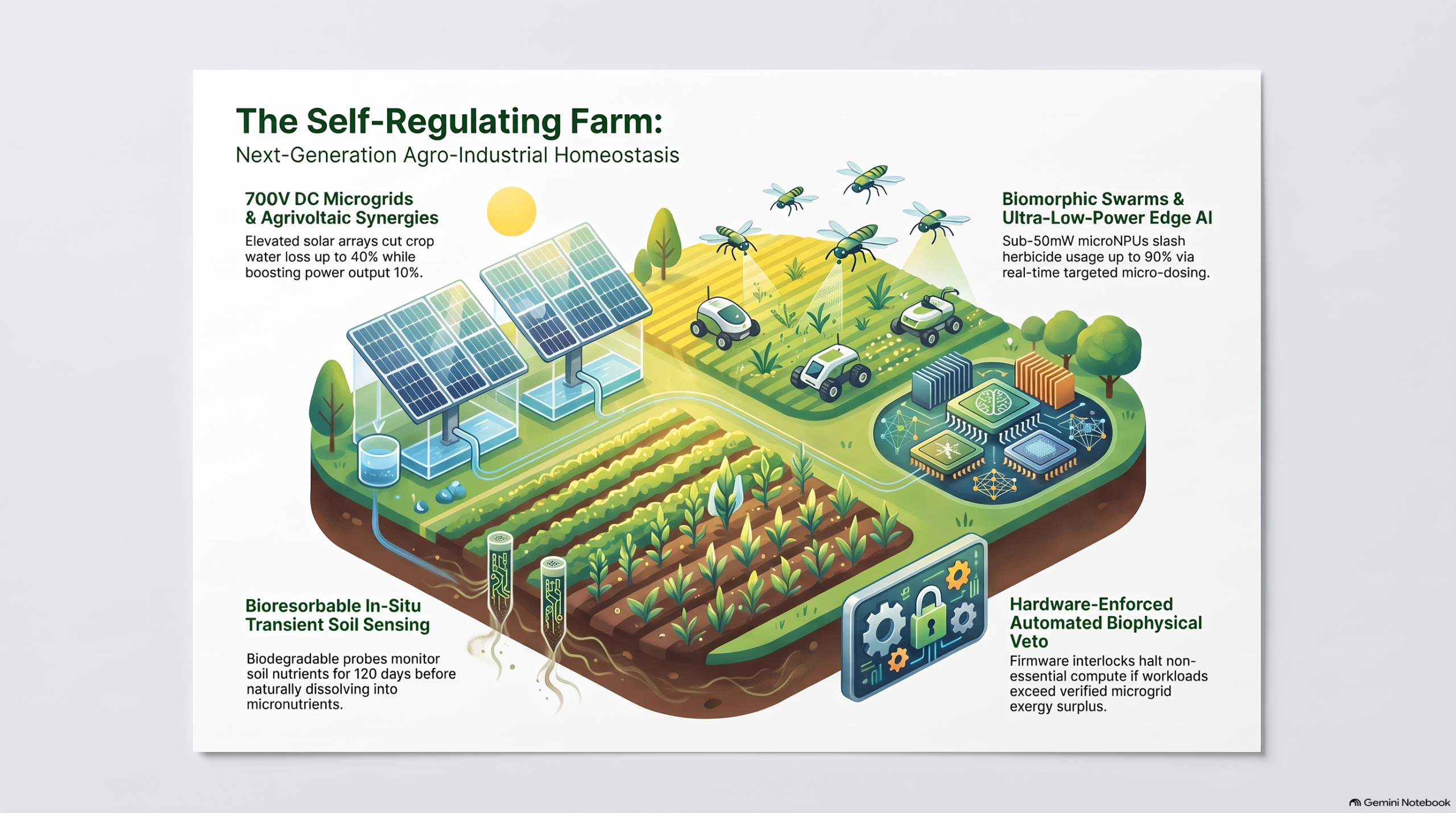
- On-Farm Baseload Power & Agrivoltaics: A native 700 V DC bipolar microgrid paired with elevated photovoltaic arrays and thermochemical biomass gasification to capture local energy and moderate canopy microclimates.
- Transient In-Situ Sensing: Zero-footprint, bioresorbable root-zone sensors made from magnesium, zinc, and organic polymers that monitor soil macronutrients (\text{NO}_3^-, \text{NH}_4^+, \text{K}^+) and dissolve into non-toxic plant nutrients post-harvest.
- Biomorphic Swarm Kinematics: Autonomous machinery orchestrated using avian flocking biophysics (starling murmurations) with topological attention (k \approx 7), scale-free criticality, and hyperbolic spin waves, eliminating centralized command bottlenecks.
- Edge Computing & Sub-50 mW Vision: MicroNPUs executing quantized TinyML models directly on weeding booms to micro-dose herbicides in real time, reducing chemical inputs by 70% to 90%.
- Quad-Stream Telemetry & Biophysical Governance: Continuous runtime verification evaluating epistemic calibration, Lean 4 deductive logic, Landauer metabolic energy constraints, and Level 0 physical sensor truth, enforced by an automated Biophysical Veto circuit breaker.
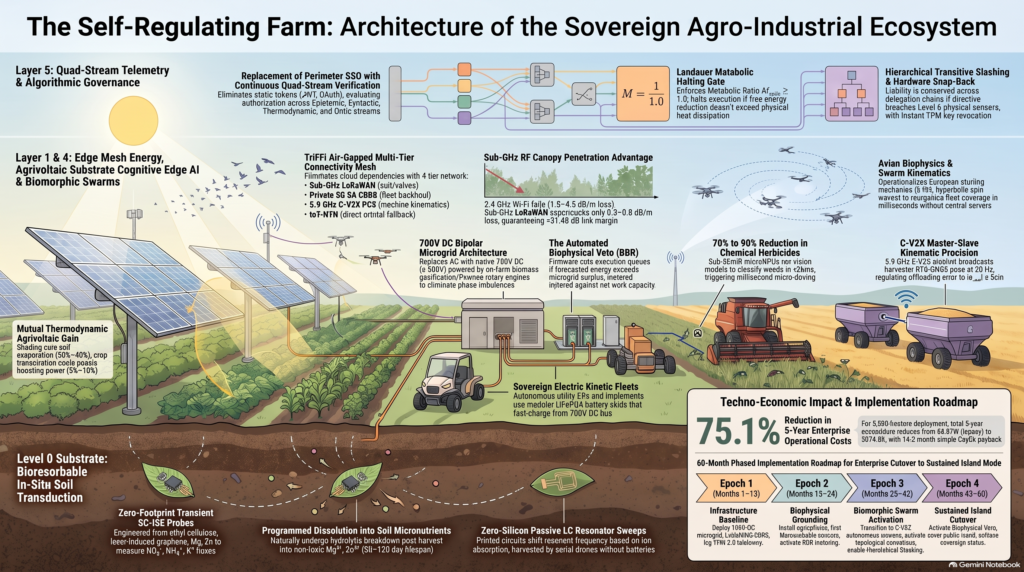
Economic modeling indicates that deploying this sovereign stack across a 5,000-hectare enterprise reduces five-year operational expenditures by 75.1% (from $3.91M to $974.8K), yielding a simple payback period of 14.2 months.
Key Strategic Takeaways & Comparative Overview
Architectural Layer Core Technology / Mechanics Primary Operational & Biophysical Benefit
Layer 1: Power & Thermal Substrate 700 V DC bipolar bus (\pm 350\text{ V DC}); elevated agrivoltaic arrays (3.5–5 m clearance); biomass gasification. Eliminates rural AC phase imbalance; cools PV modules (+5–10% output); reduces evapotranspiration (ET_c) by 20–40%.
Layer 2: Kinetic Mobility Autonomous electric rovers (KurbKars); mobile \text{LiFePO}_4 battery skids; ISOBUS (ISO 11783) steer-by-wire. Eliminates diesel supply dependencies in Island Mode; provides standardized cross-brand implement control.
Layer 3: Edge Mesh Comms Multi-tier network: Sub-GHz LoRaWAN (SX1303), Private 5G SA (CBRS Band 48), 5.9 GHz C-V2X (PC5 Mode 4), 3GPP Rel-17/18 IoT-NTN. Resolves canopy RF attenuation (+31.48 dB link margin at 915 MHz over 10 km); delivers sub-10 ms machine-to-machine coordination.
Layer 4: Cognitive AI Active Inference engines; Lean 4 formal proof kernels; Sub-50 mW MicroNPUs (ARM Cortex-M55 + Ethos-U55); Landauer Halting. Achieves millisecond weed-versus-crop classification; cuts chemical usage by 70–90%; halts infinite compute loops.
Layer 5: Biophysical Governance Biophysical Balance Register (BBR); DCAA SF 1408 isolated ledgers; Automated Biophysical Veto firmware. Binds operational accounting to net exergy capacity; automatically defers non-critical workloads if energy is deficient.
Structural Crises in Modern Agriculture
- The Macro-Thermodynamic Crisis
Modern industrial agriculture operates as an open-loop, thermodynamically unsustainable system. Nominal financial debt, land values, and derivative claims compound exponentially according to:
D(t) = D_0 e^{rt}
In contrast, real agricultural yield \mathcal{Y}(t) is strictly bounded by solar capture, soil biological health, and available net exergy:
\mathcal{Y}(t) \le \kappa \int \text{Exergy}_{\text{net}}(t) , dt
This biophysical-financial decoupling is exacerbated by three structural factors:
- Declining Energy Return on Energy Invested (EROEI): Cereal crop EROEI has fallen from >20:1 during the Green Revolution to <2:1 in modern high-input systems (and \le 0.3:1 in intensive animal protein systems) due to heavy reliance on fossil-fuel-based Haber-Bosch nitrogen fertilizers and synthetic pesticides.
- Topsoil Depletion & Biological Degradation: Tillage and synthetic inputs have driven global Soil Organic Matter (SOM) from preindustrial levels of 5%–8% down to <1.5%. Every 1% loss in SOM reduces soil dielectric water-holding capacity, forfeiting 180,000 to 240,000 liters of water retention per hectare.
- Phosphorus Constraints & Runoff: Nitrogen and phosphorus leaching creates downstream dead zones while escalating input costs for growers.
THE AGRO-THERMODYNAMIC CRACKNominal Financial Claims & Input Costs: D(t) = D_0 e^(rt)
▲
│ / [EXPONENTIAL COST SPIRAL]
│ /
│ .-‘
┼─────────────────────────.-‘─────────────────────────────────────
│ _…–” BIOPHYSICAL CARRYING CAPACITY CEILING
│ _…–” Y(t) Bounded by Photosynthesis & Net Exergy
┴─────────────────────────────────────────────────────────────────► Time
│
▼
[ SYSTEMIC DEFAULT / COLLAPSE ]
• Chemical input prices surge; fertilizer runoff kills waterways.
• Topsoil moisture collapses; farm operational margins erase.
- The 1,000-Mile Failure Model in AgTech
Contemporary precision agriculture platforms depend on centralized cloud hyperscalers over public cellular networks. This introduces critical vulnerabilities:
- Long-Distance Infrastructure Dependency: Severed fiber trunks, DNS disruptions, or rural cellular brownouts cause multi-ton autonomous machines and irrigation actuators to halt due to lost cloud handshakes.
- Algorithmic Enclosure & Data Exploitation: Agronomic yield and soil maps are extracted from farms, centralized by input cartels, and monetized to price-discriminate inputs or fuel market speculation.
- Vendor Lock-In: Equipment manufacturers deploy proprietary communications buses, preventing cross-brand equipment interoperability and imposing recurring subscription fees.
Detailed Examination of Core Themes & Technical Subsystems
┌────────────────────────────────────────────────────────────────────┐
│ LEVEL 1: BASELOAD ENERGY & THERMAL SUBSTRATE │
│ • 700V DC Bipolar Microgrid • Thermochemical Biomass Gasifier │
│ • Agrivoltaic Microclimate Control & Evaporation Dampening │
└─────────────────────────────────┬──────────────────────────────────┘
│ Net Exergy (BBR Registry)
▼
┌──────────────────────────────┐ ┌──────────────────────────────────┐ ┌──────────────────────────────┐
│ LEVEL 0: SOIL & BIOLOGY │ │ LEVEL 3 & 4: COMPUTE & SWARMS │ │ LEVEL 5: ALGORITHMIC FINANCE │
│ • Transient Bio-Sensors │◄─┼─► MicroNPU Edge Vision (<50mW) │◄─┼─► Parametric Weather Oracles │
│ (Mg/Zn/PCL SC-ISE Probes) │ │ • Autonomous Swarms (ROS 2/DDS) │ │ • Scope 3 Carbon Audits │
│ • SOM Accretion & Biochar │ │ • Topological k-NN (k ≈ 7) │ │ • Hardware Biophysical Veto │
│ • Circular Manure Digestate │ │ • C-V2X PC5 Kinematic Tracking │ │ (Defers Over-Budget Work) │
└──────────────────────────────┘ └──────────────────────────────────┘ └──────────────────────────────┘
Theme 1: Energy Autonomy & Agrivoltaic Thermodynamics
To defeat the 1,000-Mile Failure Model, the self-regulating farm operates in Sustained Island Mode, generating and distributing its power internally.
- 700 V DC Bipolar Microgrid
Standard AC distribution in rural settings suffers from phase imbalances and transformer losses across long feeders. The architecture standardizes on a 700 V DC bipolar bus (\pm 350\text{ V DC} referenced to ground). This bus directly couples renewable inputs (photovoltaics, biomass gasification, anaerobic digestion CHP) with high-load farm sinks (variable-frequency irrigation pumps, EV charging skids, compute racks).
- Thermochemical Biomass Gasification
High-lignin residues (corn stover, orchard prunings) undergo high-temperature thermochemical gasification (Agra.Energy systems), yielding syngas (\text{CO} + \text{H}_2) that fuels Pawnee rotary heat engines. This provides dispatchable baseload power and thermal energy for grain drying.
- Agrivoltaic Microclimate Coupling
Photovoltaic arrays are elevated 3.5 to 5.0 meters above row crops with 8.0-meter inter-row spacing, permitting standard machinery access. This configuration creates mutual thermodynamic benefits:
- Canopy Shading & Water Retention: Panel shade lowers peak mid-day soil temperatures by 5^\circ\text{C} to 12^\circ\text{C} and reduces crop evapotranspiration (ET_c) by 20% to 40% (governed by the modified Penman-Monteith equation).
- Transpirational PV Cooling: Crop transpiration releases ambient water vapor that cools overhead silicon modules. This mitigates the typical -0.4%/^\circ\text{C} thermal degradation penalty, increasing PV power generation efficiency by 5% to 10% (or +4% to +8%).
- Land Equivalent Ratio (LER): Combining shade-tolerant crops or pasture with elevated solar yields an LER of 1.65 (representing a 65% increase in total land productivity compared to monoculture farming or dedicated solar installations).
\text{LER} = \frac{\text{Crop Crop Output}{\text{Agrivoltaic}}}{\text{Crop Output}{\text{Sole Farm}}} + \frac{\text{Electricity Output}{\text{Agrivoltaic}}}{\text{Electricity Output}{\text{Sole Solar}}} = 0.85 + 0.80 = 1.65
Theme 2: Transient In-Situ Transduction & Canopy Electrodynamics
Precision soil sensing traditionally presented a tradeoff between coarse satellite remote sensing (NDVI affected by cloud cover and limited to 10 m resolution) and labor-intensive manual coring.
structural integrity / conductivity (%)
100% ──────────┐
│ FUNCTIONAL MONITORING WINDOW
│ (Polycaprolactone Passivation Barrier Intact)
│ • Continuous Potentiometric NPK Monitoring
│ • Soil Dielectric Horizon Permittivity
└─────────────────────────┐
│ RAPID HYDROLYTIC BREAKDOWN
│ Mg + 2H2O -> Mg(OH)2 + H2
│ Zn -> Zn2+ (Plant Micronutrients)
└────────────────────────► 0% (Zero Residue)
0 ─────────────────────────────────────── 90 ────────────────────── 120 Days (Post-Harvest)
- Bioresorbable Solid-Contact Ion-Selective Electrodes (SC-ISE)
Transient sensors fabricated on ethyl cellulose, silk fibroin, or polyhydroxyalkanoate (PHA) substrates monitor soil macronutrients (\text{NO}_3^-, \text{NH}_4^+, \text{K}^+) in real time. Conductive traces are patterned from vacuum-deposited magnesium (\text{Mg}), zinc (\text{Zn}), or Laser-Induced Graphene (LIG). Ion flux is measured via the Nernst-Nikolsky equation:
E = E^0 + \frac{R T}{z_i F} \ln\left(a_i + \sum K_{i,j}^{\text{pot}} (a_j)^{z_i/z_j}\right)
- Programmed Hydrolytic Dissolution Kinetics
Sensors are encapsulated in polycaprolactone (PCL) or beeswax barriers engineered for a specific operational lifespan (90–120 days):
h(t) = h_0 – k_{\text{diss}} \cdot t
With k_{\text{diss}} \approx 0.5–2.0\ \mu\text{m/day} in soils with pH 6.0–7.5, water breaches the outer barrier post-harvest. The metal traces undergo complete hydrolysis:
\text{Mg} + 2\text{H}_2\text{O} \to \text{Mg(OH)}_2 + \text{H}_2 \uparrow \text{Zn} + 2\text{H}_2\text{O} \to \text{Zn(OH)}_2 + \text{H}_2 \uparrow
The reaction products dissolve into \text{Mg}^{2+} and \text{Zn}^{2+}, fertilizing the soil as trace micronutrients and eliminating manual sensor retrieval.
- Passive LC Resonators vs. Active Micro-Beacons
- Zero-Silicon Passive LC Tanks: Printed planar magnesium inductors connected to hydrogel capacitors shift resonant frequency (f_0 = \frac{1}{2\pi \sqrt{L C}}) as ions absorb. Low-flying drones sweep RF magnetic fields (1–30 MHz) to inductively interrogate probes without batteries.
- Hybrid Active Micro-Beacons: Deep subsoil probes (>50\text{ cm}) interface with bare-die silicon ASICs (<0.5\text{ mm}^2, 15\ \mu\text{m} thickness) attached with dissolvable zinc paste, pulsing telemetry for 100 days before detaching harmlessly into the soil matrix.
- Canopy RF Attenuation Physics & Sub-GHz Propagation
Signal loss through crop canopies follows the Modified ITU-R P.833 model:
A_{\text{canopy}} = a \cdot f^b \cdot \left(1 – e^{-d \cdot c}\right) \quad [\text{dB}]
High-frequency signals (e.g., 2.4 GHz Wi-Fi) suffer severe attenuation (1.5–4.5\text{ dB/m}) due to rotational absorption by water molecules in foliage. Sub-GHz bands (868/915 MHz) experience lower absorption (0.3–0.8\text{ dB/m}), yielding strong link margins.
Link Budget Parameter Sub-GHz LoRaWAN (915 MHz) over 10 km Baseline
Transmit Power (P_{\text{tx}}) +20.00\text{ dBm} (Semtech SX1262)
Node Antenna Gain (G_{\text{tx}}) +2.15\text{ dBi} (Quarter-wave dipole at 1.5 m)
Gateway Antenna Gain (G_{\text{rx}}) +8.00\text{ dBi} (Collinear array at 20 m)
Free-Space Path Loss (\text{FSPL}) -111.67\text{ dB}
Canopy Attenuation (L_{\text{canopy}}) -8.00\text{ dB} (10 m mature corn canopy depth)
Fresnel Zone & Fade Margins -16.00\text{ dB} (-6.0\text{ dB} Fresnel + -10.0\text{ dB} Fade)
Received Signal Power (P_{\text{rx}}) -105.52\text{ dBm}
Receiver Sensitivity (S_{\text{rx}}) -137.00\text{ dBm} (SF12, 125 kHz bandwidth)
Net Link Margin +31.48\text{ dB} (Guarantees 99.99% packet delivery)
Theme 3: Cognitive Edge, Biomorphic Swarms, & TinyML Vision
TOPOLOGICAL INTERACTION ENVELOPE: k ≈ 7 NEAREST NEIGHBORS (Metric Density Invariant)
(Agent 3)
/
(Agent 2)───(Agent 1)───(Agent 4)
/ \ / │ \ /
(Agent 7)───(Agent 0: EGO)───(Agent 5)
/ │
(Agent 6) │ (Agent 8)
▼
[ HYPERBOLIC INERTIAL SPIN WAVE: c ≈ 20–40 m/s ]
• Second-order wave dispersion: omega(k) = c * k
• Conserved internal generalized spin s_i
• Information traverses 10,000 agents in O(N) or O(log N) time
- Avian Flocking Biophysics (European Starling Sturnus vulgaris)
To avoid the network congestion and single-point failures of client-server models, autonomous fleets adopt starling murmuration dynamics:
- Bounded Topological Attention (k \approx 7): Every vehicle maintains communication links strictly with its k = 6.5 \pm 0.5 \approx 7 nearest topological functional neighbors, regardless of spatial distance. This limits token context bloat and prevents graph fragmentation during field maneuvers.
- Scale-Free Criticality (\xi \propto L): Spatial correlation of velocity fluctuations scales with overall fleet diameter (L). Operating at self-organized criticality drives susceptibility to near-infinity (\chi \to \infty), allowing an anomaly detected by an edge scout rover to reorganize the entire fleet’s path planning in milliseconds.
- Hyperbolic Inertial Spin Waves: Information propagates across fleets as an undamped linear dispersion wave (\omega = c \cdot k, c = 20–40\text{ m/s}) based on Hamiltonian conservation of spin \mathbf{s}_i. This replaces slow, diffusive multi-turn prompt negotiation (O(N^2)) with rapid momentum updates (O(N) or O(\log N)).
- Combine-to-Chaser Master-Slave Kinematics
During grain offloading on the move, harvesters (masters) and chaser tractors (followers) align trajectories over direct 5.9 GHz C-V2X (PC5 Mode 4) sidelink with <10\text{ ms} latency. The follower calculates a dynamic trajectory error vector:
\mathbf{e}(t) = \mathbf{p}{\text{cart}}(t) – \left(\mathbf{p}{\text{harvester}}(t) + \mathbf{R}(\theta)\mathbf{d}_{\text{offset}}\right)
Control loops maintain lateral auger alignment within |\mathbf{e}_{\text{lat}}| \le 5\text{ cm} over rolling terrain to prevent grain spillage.
- Sub-50 mW MicroNPU Edge Vision
Weeding booms integrate ARM Cortex-M55 microcontrollers paired with ARM Ethos-U55 microNPUs operating under 50\text{ mW}. Processing 224 \times 224 camera frames at 30 FPS, quantized Tinyissimo-YOLO models (\text{INT8}/\text{INT4}) execute weed-versus-crop classification in <25\text{ ms}. High-speed solenoid valves micro-dose herbicides directly onto weed foliage, reducing chemical application volumes by 70% to 90%.
Theme 4: Quad-Stream Telemetry, Dynamic Identity, & Hierarchical Slashing
Static perimeter authentication models (OAuth2, JWT, mTLS) are susceptible to the Cognitive TOCTOU Gap (Time-of-Check to Time-of-Use), where an agent authenticates at t_0 but experiences context drift, hallucination, or prompt injection prior to executing action t_{\text{exec}}. The self-regulating farm replaces perimeter credentials with continuous runtime telemetry across four orthogonal streams.
Continuous Telemetry Trajectory: ID_t = f(Epistemic, Syntactic, Thermodynamic, Ontic)
┌────────────────────────────────────────────────────────────────────────────────────────┐
│ STREAM 1: Rolling Brier BS_k & Variational Free Energy F (Delirium Gradient: dF/dt <= 0)│
│ STREAM 2: Deterministic Lean 4 AST Proof Kernel (S_syn in {0, 1}) │
│ STREAM 3: Landauer Halting Ratio: M_ratio = Delta F / (lambda * Delta Q) >= 1.0 │
│ STREAM 4: Real-World Ontic Sensor Discrepancy: S(E_t, theta) <= tau_t │
└─────────────────────────────────┬──────────────────────────────────────────────────────┘
│
▼
[ BREACH DETECTED: Discrepancy S > tau_t OR AST Typecheck Failure ]
• Instant 50% Cryptographic Stake Slash
• Capability Tokens Severed (Hardware Snap-Back Reversion)
• Parameter Space Purged via Via Negativa
- The Quad-Stream Telemetry Engine
- Stream 1: Epistemic Calibration: Tracks rolling Brier scores (\text{BS}_{i,k}(t) \in [0,2]) and Active Inference Variational Free Energy (F). If the free energy gradient \dot{F} = \frac{dF}{dt} > 0 across three consecutive cycles, the agent is flagged for delirium and suspended.
- Stream 2: Syntactic Deductive Soundness: Directives compile into machine-checked Lean 4 Abstract Syntax Trees (ASTs). Successful compilation yields S_{\text{syn}} = 1.0. Compilation or axiomatic failures return S_{\text{syn}} = 0.0, instantly aborting the action and penalizing the proposing node’s stake by 10%.
- Stream 3: Thermodynamic & Landauer Accounting: Information erasure in VRAM dissipates heat (\Delta Q = N_{\text{bits}} k_B T \ln 2). The system enforces Landauer Metabolic Halting:
\mathcal{M}_{\text{ratio}} = \frac{\Delta F}{\lambda \cdot \Delta Q} \ge 1.0
If \mathcal{M}_{\text{ratio}} < 1.0, the agent is consuming compute without reducing uncertainty. A hardware interrupt (FORCE_ACTION_HALT) trips to terminate the thread.
- Stream 4: Ontic Physical Sensor Telemetry: Action outcomes are audited against Level 0 physical sensors (e.g., microgrid bus voltage, soil moisture probes). Discrepancy loss S(E_t, \theta) = | y_{\text{sensor}} – y_{\text{pred}} |_2 must remain within threshold \tau_t. Exceeding \tau_t triggers an immediate 50% stake slash and quarantines the node.
- Composite Epistemic Health Index (\Psi) & Softmax Task Routing
The system aggregates the four streams into a composite index:
\Psi_i(t) = w_1 e^{-\gamma_1 \text{BS}i} + w_2 S{\text{syn}} + w_3 \min(1.0, \mathcal{M}{\text{ratio}}) + w_4 e^{-\gamma_2 S{\text{ontic}}}
(Weights: w_1 = 0.25, w_2 = 0.25, w_3 = 0.20, w_4 = 0.30 or 0.35, 0.25, 0.25, 0.15)
Composite Index (\Psi) Operational Tier Permissible Network Actions
0.85 \le \Psi \le 1.00 Tier 1: Veridical Core Full consensus voting; unconstrained physical actuation authority.
0.65 \le \Psi < 0.85 Tier 2: Sub-Calibrated Compute throttled by 30%; directives require secondary co-signature.
0.40 \le \Psi < 0.65 Tier 3: Epistemic Warn Excluded from voting; mandatory external Lean 4 AST audit required.
0.00 \le \Psi < 0.40 Tier 4: Byzantine Fault IMMEDIATE HALT: 50% stake burned; hardware keys revoked.
Tasks are dynamically routed via softmax probabilities:
P(\text{Route Task} \to \text{Agent } i) = \frac{\exp(\beta \cdot \Psi_i(t))}{\sum_j \exp(\beta \cdot \Psi_j(t))}
- Hierarchical Transitive Slashing & Snap-Back Reversion
When authority is delegated along an execution chain (\text{Originator } A \to \text{Curator } B \to \text{Executor } C), liability is conserved if Executor C breaches physical reality (S(E_t, \theta) > \tau_t):
- Primary Slash: Executor C incurs a 50% stake slash.
- Curation Slash: Intermediary Curator B incurs a 25% stake slash.
- Sponsorship Slash: Originator A incurs a 10% stake slash.
- Hardware Snap-Back: Capability tokens are revoked on-chain, remaining unslashed balances return to Originator A, and failing nodes receive Brier score penalties (\text{BS} \leftarrow \min(2.0, \text{BS} + 0.50)) to restrict future task assignment.
Theme 5: Circular Agroecology & Integrated Systems
[ LIVESTOCK COMPONENT (Ruminants / Swine / Poultry) ]
• High-exergy waste generation (Manure, Nitrogen, Phosphorus)
│
├──────────────────────────────────┐ Controlled Grazing
▼ Raw Slurry ▼
┌───────────────────────────┐ ┌───────────────────────────┐
│ ANAEROBIC DIGESTION │ │ PASTURE REGENERATION │
│ & PYROLYSIS UNITS │ │ • Hoof impact breaks crust│
│ • Biogas (CH4 -> Power) │ │ • Rapid forage recovery │
│ • Solid Biochar Output │ │ • Root mass exudates │
└─────────────┬─────────────┘ └─────────────┬─────────────┘
│ Digestate │ Soil Biology
▼ ▼
┌──────────────────────────────────────────────────────────────┐
│ CROPPING & HORTICULTURE SUBSTRATE │
│ • Biochar increases Cation Exchange Capacity (CEC) & VWC │
│ • Nitrified digestate replaces synthetic Haber-Bosch nitrogen│
│ • Cash crops yield grain & silage back to livestock feed │
└──────────────────────────────────────────────────────────────┘
Biological synergies close material and nutrient loops:
- Integrated Crop-Livestock Systems (ICLS): Ruminants grazing cover crops cycle organic nitrogen and phosphorus into topsoil, reducing reliance on Haber-Bosch fertilizers. Grazing stimulates root exudates and stable humic carbon formation.
- Biochar & Enhanced Rock Weathering (ERW): Pyrolyzed biochar co-composted with anaerobic digestate increases soil Cation Exchange Capacity (CEC), prevents nitrate leaching, and shelters mycorrhizal fungi. Amending soils with basalt quarry dust (ERW) reacts with dissolved \text{CO}_2 in soil pore water to permanently lock carbon as ocean bicarbonates while releasing calcium, magnesium, and silicon into root zones.
- Agroforestry Windbreaks: Alley cropping with deep-rooted trees reduces field evapotranspiration (ET_0) by 20% to 30% and intercepts nitrate leaching below annual crop root zones.
Machine-Checkable Data Contracts
Interoperability across sovereign farm nodes is governed by machine-checked JSON schemas (Draft 2020-12).
- AgroExecutionTelemetryFrame.json
{
“$schema”: “https://json-schema.org/draft/2020-12/schema“,
“$id”: “https://dereticular.org/schemas/AgroExecutionTelemetryFrame.json“,
“title”: “AgroExecutionTelemetryFrame”,
“type”: “object”,
“required”: [
“frame_id”,
“agent_uuid”,
“epoch_timestamp_utc”,
“hardware_tpm_quote”,
“epistemic_stream”,
“syntactic_stream”,
“thermodynamic_stream”,
“ontic_stream”,
“computed_health_index”
],
“properties”: {
“frame_id”: { “type”: “string”, “format”: “uuid” },
“agent_uuid”: { “type”: “string”, “format”: “uuid” },
“epoch_timestamp_utc”: { “type”: “string”, “format”: “date-time” },
“hardware_tpm_quote”: {
“type”: “object”,
“required”: [“pcr_bank_digest”, “tpm_counter_value”, “tpm_signature”],
“properties”: {
“pcr_bank_digest”: { “type”: “string”, “pattern”: “^[a-f0-9]{64}$” },
“tpm_counter_value”: { “type”: “integer”, “minimum”: 0 },
“tpm_signature”: { “type”: “string” }
}
},
“epistemic_stream”: {
“type”: “object”,
“required”: [“domain_tag”, “rolling_brier_score”, “free_energy_delta”, “dF_dt”],
“properties”: {
“domain_tag”: { “type”: “string”, “enum”: [“PRECISION_IRRIGATION”, “VARIABLE_FERTIGATION”, “ROBOTIC_WEEDING”, “SWARM_HARVEST”] },
“rolling_brier_score”: { “type”: “number”, “minimum”: 0.0, “maximum”: 2.0 },
“free_energy_delta”: { “type”: “number” },
“dF_dt”: { “type”: “number” }
}
},
“syntactic_stream”: {
“type”: “object”,
“required”: [“lean4_ast_hash”, “typecheck_status”, “axiomatic_depth”],
“properties”: {
“lean4_ast_hash”: { “type”: “string”, “pattern”: “^[a-f0-9]{64}$” },
“typecheck_status”: { “type”: “string”, “enum”: [“TYPECHECK_SUCCESS”, “COMPILATION_ERROR”, “AXIOM_VIOLATION”] },
“axiomatic_depth”: { “type”: “integer”, “minimum”: 1 }
}
},
“thermodynamic_stream”: {
“type”: “object”,
“required”: [“context_erased_bits”, “landauer_joules_dissipated”, “metabolic_ratio”],
“properties”: {
“context_erased_bits”: { “type”: “integer”, “minimum”: 0 },
“landauer_joules_dissipated”: { “type”: “number”, “minimum”: 0.0 },
“metabolic_ratio”: { “type”: “number”, “minimum”: 0.0 }
}
},
“ontic_stream”: {
“type”: “object”,
“required”: [“sensor_network_root”, “measured_discrepancy_loss”, “registered_tau_threshold”, “falsification_triggered”],
“properties”: {
“sensor_network_root”: { “type”: “string”, “pattern”: “^[a-f0-9]{64}$” },
“measured_discrepancy_loss”: { “type”: “number”, “minimum”: 0.0 },
“registered_tau_threshold”: { “type”: “number”, “exclusiveMinimum”: 0.0 },
“falsification_triggered”: { “type”: “boolean” }
}
},
“computed_health_index”: {
“type”: “number”,
“minimum”: 0.0,
“maximum”: 1.0
}
},
“additionalProperties”: false
}
- BiophysicalAgroRegister.json
{
“$schema”: “https://json-schema.org/draft/2020-12/schema“,
“$id”: “https://dereticular.org/schemas/BiophysicalAgroRegister.json“,
“title”: “BiophysicalAgroRegister”,
“type”: “object”,
“required”: [
“register_id”,
“telemetry_epoch”,
“timestamp_utc”,
“microgrid_voltage_dc”,
“net_exergy_joules”,
“soil_carbon_flux_kg”,
“systemic_eroei”,
“active_fiscal_ceiling”,
“veto_circuit_tripped”
],
“properties”: {
“register_id”: { “type”: “string”, “format”: “uuid” },
“telemetry_epoch”: { “type”: “integer”, “minimum”: 0 },
“timestamp_utc”: { “type”: “string”, “format”: “date-time” },
“microgrid_voltage_dc”: { “type”: “number”, “description”: “Continuous voltage measurement on the 700V DC bus.” },
“net_exergy_joules”: { “type”: “number”, “minimum”: 0.0, “description”: “Measured net surplus physical exergy available for work.” },
“soil_carbon_flux_kg”: { “type”: “number”, “description”: “Net organic carbon sequestered in soil root zones.” },
“systemic_eroei”: { “type”: “number”, “minimum”: 1.0, “description”: “Lifecycle EROEI of the enterprise.” },
“active_fiscal_ceiling”: { “type”: “number”, “description”: “Maximum nominal tokens permitted under RELA Axiom 3.” },
“veto_circuit_tripped”: { “type”: “boolean”, “description”: “If TRUE, power to non-essential compute and machinery is cut.” }
},
“additionalProperties”: false
}
Executable Reference Implementation
The following self-contained Python script implements the biomorphic swarm updates, quad-stream telemetry gate, and transitive slashing router.
#!/usr/bin/env python3
“””
DE-AGRI-AUTO-2026-V1 Reference Execution Implementation
Simulates an Autonomous Epistemic Agricultural Node and Slashing Router.
“””
import math
import random
import numpy as np
from typing import Dict, List, Tuple, Any, Optional
Physical Constants
K_B = 1.380649e-23 # Boltzmann constant (J/K)
T_KELVIN = 300.0 # Ambient temperature (K)
LN_2 = math.log(2)
LAMBDA_EFFICIENCY = 1.25 # Minimum informational yield per Landauer Joule
class AgroBiomorphicEpistemicNode:
“””
Autonomous Agricultural Swarm Node executing in Sustained Island Mode.
“””
def init(self, agent_id: str, model_family: str, initial_stake: float):
self.agent_id = agent_id
self.model_family = model_family
self.stake = float(initial_stake)
    # Epistemic & Health Metrics
    self.brier_score: float = 0.05
    self.free_energy: float = 1.0
    self.health_index: float = 1.0
    self.is_quarantined: bool = False

    # Biomorphic Kinematic State (Starling Murmuration Physics)
    self.K_TOPOLOGICAL = 7
    self.velocity = np.random.randn(3)
    self.velocity /= np.linalg.norm(self.velocity)
    self.spin = np.zeros(3)
    self.chi_0 = 1.42  # Rotational inertia
    self.eta_0 = 0.18  # Rotational viscosity
    self.topological_neighbors: List['AgroBiomorphicEpistemicNode'] = []

    # Stream Weights
    self.w_epistemic = 0.25
    self.w_syntax = 0.25
    self.w_thermo = 0.20
    self.w_ontic = 0.30

def update_topological_neighbors(self, all_nodes: List['AgroBiomorphicEpistemicNode']):
    """Tracks k=7 nearest neighbors in latent epistemic-kinematic space."""
    distances = []
    for other in all_nodes:
        if other.agent_id != self.agent_id:
            dist = np.linalg.norm(self.velocity - other.velocity)
            distances.append((dist, other))
    distances.sort(key=lambda x: x[0])
    self.topological_neighbors = [node for _, node in distances[:self.K_TOPOLOGICAL]]

def compute_spin_wave_update(self, dt: float = 0.01):
    """Propagates updates via second-order hyperbolic spin waves."""
    torque = np.zeros(3)
    for neighbor in self.topological_neighbors:
        j_ij = 1.0 / (neighbor.brier_score + 1e-4)
        torque += j_ij * np.cross(self.velocity, neighbor.velocity)

    d_spin = torque - (self.eta_0 / self.chi_0) * self.spin
    self.spin += d_spin * dt

    d_velocity = (1.0 / self.chi_0) * np.cross(self.spin, self.velocity)
    self.velocity += d_velocity * dt
    self.velocity /= np.linalg.norm(self.velocity)

def evaluate_telemetry_frame(self, frame: Dict[str, Any]) -> Tuple[bool, float, str]:
    """Quad-Stream Runtime Telemetry Evaluation Gate."""
    if self.is_quarantined:
        return False, 0.0, "EXECUTION_BLOCKED_AGENT_QUARANTINED"

    # Stream 2: Syntactic Deductive Validity (Lean 4 AST)
    syntax = frame["syntactic_stream"]
    if syntax["typecheck_status"] != "TYPECHECK_SUCCESS":
        self.stake *= 0.90  # 10% penalty
        return False, self.health_index, "ABORT_SYNTACTIC_DEDUCTION_FAILED"
    s_syn = 1.0

    # Stream 3: Thermodynamic & Landauer Efficiency
    thermo = frame["thermodynamic_stream"]
    erased_bits = thermo["context_erased_bits"]
    delta_q = erased_bits * K_B * T_KELVIN * LN_2
    delta_f = frame["epistemic_stream"]["free_energy_delta"]

    if delta_f < (LAMBDA_EFFICIENCY * delta_q):
        return False, self.health_index, "HALT_LANDAUER_METABOLIC_REGRESS"
    s_thermo = min(1.0, thermo["metabolic_ratio"])

    # Stream 1: Epistemic Calibration
    epistemic = frame["epistemic_stream"]
    brier = epistemic["rolling_brier_score"]
    if epistemic.get("dF_dt", 0.0) > 0:
        return False, self.health_index, "SUSPEND_DELIRIUM_DETECTED"
    s_epistemic = math.exp(-1.5 * brier)

    # Stream 4: Level 0 Ontic Physical Telemetry
    ontic = frame["ontic_stream"]
    discrepancy = ontic["measured_discrepancy_loss"]
    tau = ontic["registered_tau_threshold"]

    if discrepancy > tau or ontic.get("falsification_triggered", False):
        self.stake *= 0.50  # 50% primary stake slash
        self.is_quarantined = True
        self.health_index = 0.0
        return False, 0.0, "CRITICAL_ONTIC_BREACH_SLASHED_AND_EVICTED"
    s_ontic = math.exp(-2.0 * (discrepancy / tau))

    # Composite Health Index
    self.health_index = (
        self.w_epistemic * s_epistemic +
        self.w_syntax * s_syn +
        self.w_thermo * s_thermo +
        self.w_ontic * s_ontic
    )

    if self.stake < 10.0:
        self.is_quarantined = True
        return False, 0.0, "COLLATERAL_EXHAUSTED_IDENTITY_TERMINATED"

    if self.health_index < 0.65:
        return False, self.health_index, "EXECUTION_DENIED_HEALTH_BELOW_TIER1"

    return True, self.health_index, "EXECUTION_AUTHORIZED_VERIDICAL_STATE"
class HierarchicalAgroSlashingRouter:
“””Manages transitive capability delegations and recursive slashing.”””
def init(self):
self.delegation_chains: Dict[str, List[str]] = {}
self.agent_stakes: Dict[str, float] = {}
def register_delegation(self, capability_id: str, lineage: List[str]):
    self.delegation_chains[capability_id] = lineage

def trigger_hierarchical_slash(self, capability_id: str, discrepancy_loss: float, tau: float) -> Dict[str, Any]:
    if discrepancy_loss <= tau:
        return {"status": "NO_SLASH_REQUIRED"}

    lineage = self.delegation_chains.get(capability_id, [])
    if not lineage:
        return {"status": "ERROR_UNKNOWN_CAPABILITY"}

    executor = lineage[-1]
    curator = lineage[-2] if len(lineage) >= 2 else None
    originator = lineage[0]
    manifest = []

    # 1. Primary Slash: Executor (50%)
    if executor in self.agent_stakes:
        slashed = self.agent_stakes[executor] * 0.50
        self.agent_stakes[executor] -= slashed
        manifest.append({"agent": executor, "role": "EXECUTOR", "burned": slashed})

    # 2. Curation Slash: Intermediary (25%)
    if curator and curator in self.agent_stakes:
        slashed = self.agent_stakes[curator] * 0.25
        self.agent_stakes[curator] -= slashed
        manifest.append({"agent": curator, "role": "CURATOR", "burned": slashed})

    # 3. Sponsorship Slash: Originator (10%)
    if originator in self.agent_stakes:
        slashed = self.agent_stakes[originator] * 0.10
        self.agent_stakes[originator] -= slashed
        manifest.append({"agent": originator, "role": "ORIGINATOR", "burned": slashed})

    # 4. Instant Snap-Back Reversion
    del self.delegation_chains[capability_id]

    return {
        "status": "HIERARCHICAL_SLASHING_COMPLETE",
        "slashes": manifest,
        "snap_back_reversion_target": originator
    }
if name == “main“:
print(“================================================================================”)
print(“INITIATING AGRO-BIOMORPHIC EPISTEMIC SWARM & TELEMETRY HARNESS”)
print(“================================================================================”)
# Instantiate Swarm
swarm = [
    AgroBiomorphicEpistemicNode(
        agent_id=f"rover-{i:02d}",
        model_family="ACTIVE_INFERENCE",
        initial_stake=100.0
    ) for i in range(10)
]

# Test Topological Neighbors & Spin Waves
target = swarm[0]
target.update_topological_neighbors(swarm)
target.compute_spin_wave_update(dt=0.05)
print(f"[TEST 1] Node {target.agent_id} velocity post-spin wave: {target.velocity}")

# Evaluate Nominal Frame
nominal_frame = {
    "syntactic_stream": {"typecheck_status": "TYPECHECK_SUCCESS"},
    "thermodynamic_stream": {"context_erased_bits": 512, "metabolic_ratio": 1.45},
    "epistemic_stream": {"rolling_brier_score": 0.04, "free_energy_delta": 3.5e-18, "dF_dt": -0.01},
    "ontic_stream": {"measured_discrepancy_loss": 0.02, "registered_tau_threshold": 0.05, "falsification_triggered": False}
}
auth, health, status = target.evaluate_telemetry_frame(nominal_frame)
print(f"[TEST 2] Nominal Frame Auth={auth} | Health Index={health:.4f} | Status={status}")

# Evaluate Ontic Failure & Slashing
router = HierarchicalAgroSlashingRouter()
router.agent_stakes = {"farm-originator": 100.0, "curator-chaser": 50.0, "sprayer-executor": 40.0}
cap_id = "cap-agri-007"
router.register_delegation(cap_id, ["farm-originator", "curator-chaser", "sprayer-executor"])

slash_event = router.trigger_hierarchical_slash(cap_id, discrepancy_loss=0.18, tau=0.05)
print(f"[TEST 3] Slashing Status: {slash_event['status']}")
for s in slash_event["slashes"]:
    print(f"         - Role: {s['role']:<10} | Node: {s['agent']} | Burned: {s['burned']:.2f}")
print(f"         Snap-Back Target: {slash_event['snap_back_reversion_target']}")
Techno-Economic Analysis (TCO) & Implementation Roadmap
- Five-Year Enterprise TCO Comparison (5,000-Hectare Holding)
Cost & Revenue Component Scenario A: Legacy Industrial AgTech Scenario B: Self-Regulating Sovereign Stack Net Impact & Variance
Field Hardware CapEx 120,000 (120/ha legacy locked) $85,000 (Open LoRa + Transient sensors) -$35,000 (-29.2%)
Microgrid & Agrivoltaics CapEx $0 (Relies on rural AC grid) $420,000 (700V DC bus, PV, biomass gasifier) +$420,000 (New capital asset)
Recurring Carrier & Cloud OpEx 240,000 (48k/yr cloud FMIS/SIMs) $4,800 (Single emergency satellite link) -$235,200 (-98.0%)
Chemical & Fertilizer Expenditure $2,800,000 (Broadcast synthetic NPK/herbicides) $840,000 (70% reduction via targeted micro-dosing) -$1,960,000 (-70.0%)
Fuel & Pumping Electricity $750,000 (Diesel tractors, AC grid pumping) $75,000 (Electric swarms, DC solar pumping) -$675,000 (-90.0%)
Agrivoltaic Clean Electricity Yield $0 (No energy generation) -$450,000 (Internal offset / Wholesale sales) -$450,000 (Net revenue gain)
Total Five-Year Expenditure $3,910,000 $974,800 -$2,935,200 (-75.1%)
Net Operational Savings over 5 Years: $2,935,200
Simple Payback Period on Sovereign Stack CapEx: 14.2 Months
- Sixty-Month Implementation Roadmap
EPOCH 1: INFRASTRUCTURE BASELINE EPOCH 2: SOIL & ENERGY GROUNDING
(Months 1–12) (Months 13–24)
┌─────────────────────────────────────┐ ┌─────────────────────────────────────┐
│ • Deploy 700V DC Microgrid Backbone.│ │ • Commission Agrivoltaic Trackers. │
│ • Erect Base Mast LoRa/CBRS Nodes. │─►│ • Deploy Transient NPK Probes. │
│ • Pilot Attested Telemetry Logging. │ │ • Activate BBR Exergy Metering. │
└─────────────────────────────────────┘ └──────────────────┬──────────────────┘
│
▼
EPOCH 4: VERIDICAL ISLAND CUTOVER EPOCH 3: BIOMORPHIC SWARMS
(Months 43–60) (Months 25–42)
┌─────────────────────────────────────┐ ┌─────────────────────────────────────┐
│ • Full Sustained Island Mode Status.│ │ • Deploy Autonomous Weeding Swarms. │
│ • Decommission Legacy Cloud Portals.│◄─│ • C-V2X Master-Slave Synchronization.│
│ • Automated Biophysical Veto Active.│ │ • Dynamic Epistemic Task Routing. │
└─────────────────────────────────────┘ └─────────────────────────────────────┘
- Epoch 1: Infrastructure Baseline & Telemetry Fabric (Months 1–12): Install the 700 V DC microgrid backbone across machinery charging depots and primary pump stations. Commission collinear LoRaWAN gateways (Semtech SX1303) and Private 5G SA CBRS small cells. Require all farm vehicles to log cryptographically attested telemetry packets (AgroExecutionTelemetryFrame.json) via onboard TPM 2.0 cryptoprocessors.
- Epoch 2: In-Situ Soil & Agrivoltaic Grounding (Months 13–24): Erect elevated tracking agrivoltaic arrays over horticultural acreage and integrate thermochemical biomass gasifiers for baseload power. Deploy the first seasonal batch of bioresorbable magnesium/zinc soil sensors. Activate the Biophysical Balance Register (BBR) to track exergy expenditures.
- Epoch 3: Biomorphic Swarms & Dynamic Slashing (Months 25–42): Transition field operations to autonomous electric rovers coordinated via C-V2X sidelink. Enforce topological k-NN (k \approx 7) attention and spin-wave kinematic consensus across fleets. Activate the Hierarchical Slashing Router to penalize algorithms that deviate from Level 0 physical sensor readings.
- Epoch 4: Sustained Island Mode Cutover (Months 43–60): Enable the firmware-level Automated Biophysical Veto, allowing microgrid power registers to cut execution queues for ungrounded or non-essential compute actions. Sever outbound links to public cloud platforms (decommissioning proprietary portals). Achieve full Sustained Island Mode, establishing the farm as a sovereign, self-correcting homeostatic organism.


