
Case Study: The Silent Canopy—Trophic Cascades and the Brown Tree Snake Invasion on Guam
- The Invasion Genesis and Biological Success Factors
The history of the brown tree snake (Boiga irregularis) on Guam represents a defining moment in conservation biology. Originally native to Australia, Papua New Guinea, and the Solomon Islands, this arboreal colubrid was accidentally introduced to Guam post-World War II. Arriving in an “Evolutionary Vacuum,” the snake encountered an environment devoid of native tree-climbing predators or large reptilian competitors. Consequently, the island’s fauna lacked any predator-avoidance adaptations, leading to a biological explosion.
Recent ecological modeling and historical telemetry data establish a staggering island-wide baseline: Guam is currently saturated with an estimated 2.688 million snakes, averaging 20 snakes per acre across 134,400 acres of landmass.
The Founder Event Between 1945 and 1952, Boiga irregularis arrived at the Port of Apra as a stowaway within military cargo and salvaged surplus aircraft transported from the Admiralty Islands. From this localized “founder” event, the species underwent a radial expansion, reaching historically unprecedented densities of 50 to 100 snakes per hectare (exceeding 3,000 per square mile) in the island’s interior.
The snake’s dominance is sustained by three critical biological success factors:
- Nocturnal Activity: As a strictly nocturnal hunter with cat-like vertical pupils, the snake exploits native prey—particularly diurnal birds and lizards—while they are inactive and vulnerable.
- Generalist Diet: An opportunistic predator, it targets birds, eggs, lizards, and rodents. Aggressive hunting behavior often results in the death of prey even if it is too large for the snake to swallow.
- Lasso Locomotion: Documented in 2021, this unique movement allows the snake to loop its body around smooth, vertical cylinders. By shimmying up utility poles and trees, the snake bypasses structural barriers previously deemed “snake-proof.”
These biological advantages allowed the brown tree snake to decimate Guam’s defenseless native wildlife with unprecedented speed and efficiency.
- The Avian Extinction Event: A Trophic Collapse
The introduction of the brown tree snake triggered one of the most catastrophic avian extinction events in modern history. Guam’s native birds lacked defensive behaviors and specialized nesting strategies because they evolved in a predator-free environment. For an arboreal hunter in a prey-rich landscape, these species were “easy” targets with no evolutionary history of evasion.
Status of Guam’s Native Avifauna
Species Type Impact Level Current Status
Native Forest Birds (12 Species) Extirpated (Local Extinction) 10 of 12 species are entirely gone, including the Guam flycatcher and Guam kingfisher.
Guam Rail (ko’ko’) Extirpated in the Wild Flightless; survives only in captivity and managed reintroduction sites.
Mariana Swiftlet Highly Restricted Persists only in small, managed cave-site reserves.
Micronesian Starling (Såli) Highly Restricted Persists only in small, intensively managed populations.
The loss of these birds was not an isolated ecological event, but the catalyst for a systemic collapse of the island’s forest architecture.
- Indirect Effects: Spiders and Stunted Forests
The removal of birds has triggered a profound “trophic cascade.” By dismantling mutualistic networks, the snake has fundamentally altered the physical health and regenerative capacity of Guam’s forests.
Cascade Impact Comparison
- Forest Regeneration Collapse: Approximately 70% of Guam’s native trees rely on frugivorous (fruit-eating) birds for seed dispersal and scarification—the digestive process required to prepare seeds for germination. Without these avian vectors, seeds fall directly beneath parent trees, resulting in a 92% reduction in seedling recruitment due to density-dependent competition and seed predation.
- Spider Overpopulation: In a healthy ecosystem, insectivorous birds regulate arthropod populations. Deprived of avian predation, forest spider web densities have surged to levels 40 times higher than neighboring snake-free islands like Saipan.
Ecological Insight: The disappearance of birds has effectively “frozen” the forest in time. While mature trees remain, the next generation is failing to grow, and the ecosystem is now dominated by an overabundance of predatory arthropods.
This systemic damage is compounded by the fact that traditional methods of capturing or counting this elusive predator fail in high-quality habitats.
- The “Prey Abundance Trap” Case Study
The Cocos Island (Dåno Islet) study (2020–2025) highlights the “Prey Abundance Trap”—a phenomenon where traditional control methods fail in prey-rich environments. While snakes in “Prey-Depleted” areas (mainland Guam) are food-stressed and easily lured, those in “Prey-Rich” areas (islets and refuges) have their predatory drive fully saturated by live geckos and nesting birds.
Standard Control Methods vs. Results on Cocos Island
Method Effort Level Success Rate
Standard Passive Trapping 10,553 Trap Nights 1 Snake Captured
Toxic Baiting (Acetaminophen) 2,427 Bait Nights 0 Baits Consumed
The Biological Mechanism of Refusal In prey-saturated environments, snakes ignore dead carrion baits entirely. This is exacerbated by the “metabolic shut-down” following a large meal: a well-fed snake restricts its movement for 5 to 7 days, drastically reducing the probability of it encountering a stationary trap. Furthermore, bait removal by non-target species such as the Mariana monitor (Varanus tsukamotoi) and the coconut crab (Birgus latro) further compromises legacy efforts. This biological bottleneck necessitates high-technology, autonomous alternatives to human search teams.
- Infrastructure and Regional Biosecurity Threats
The brown tree snake invasion is an international biosecurity priority with severe socioeconomic consequences for Guam and the wider Pacific.
The Economic and Social Toll:
- Power Grid Damage: Utilizing lasso locomotion to bridge electrical lines, snakes cause frequent short circuits, costing Guam’s economy $4.5 million annually in repairs and lost productivity.
- Public Health: Snakes frequently enter residential air ducts; while their venom is only mildly toxic to adults, it presents a significant envenomation risk to infants, often requiring hospitalization.
- Biosecurity Insurance: As a regional transit hub, Guam risks exporting the snake to Hawaii. Modeling suggests an established population in Hawaii would inflict $456 million to $761 million annually in damages to tourism and infrastructure.
Legacy suppression methods, such as manual canine teams and aerial broadcast systems (AABS), cannot scale to the dense, roadless northern limestone forests, providing the rationale for the DARPA and Marine Corps “Open Innovation Challenge.”
- The Future of Eradication: The Sovereign Stack Solution
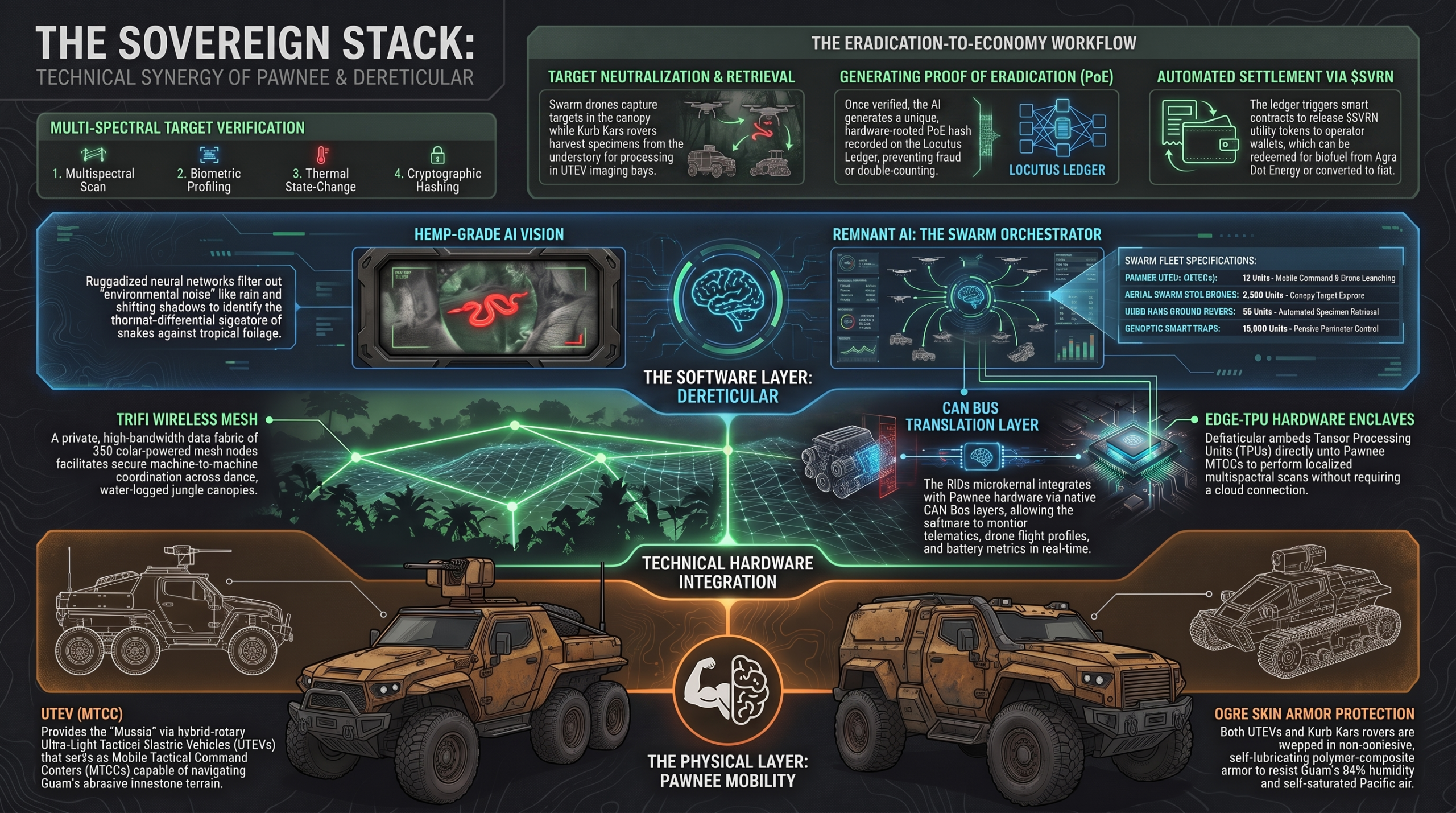
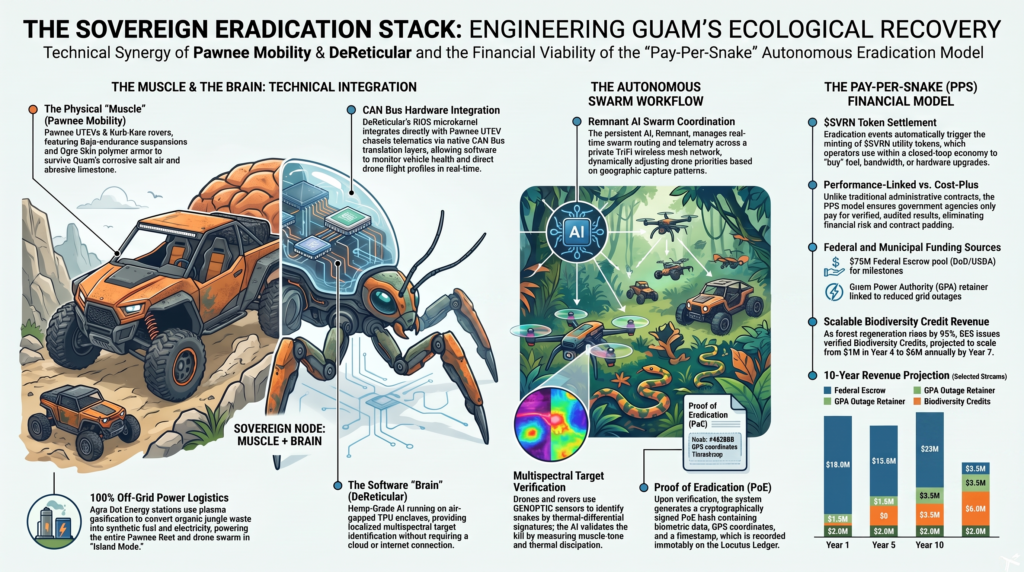
To achieve true island-wide eradication, the “Sovereign Stack” replaces legacy “cost-plus” contracts with an outcome-linked model utilizing AI-driven robotics.
The Sovereign Eradication Framework
Autonomous Physical Interdiction Layer Sovereign Intelligence & Computation Layer Economic Settlement & Governance Layer
Pawnee UTEVs: Hybrid tactical hubs with Baja-endurance suspension to navigate abrasive limestone. Hemp-Grade AI: Air-gapped neural networks with high “tensile strength” and resilience to environmental noise. Locutus Ledger: A decentralized blockchain settling payments via $SVRN tokens.
VTOL Drones: 2,500 units utilizing GENOPTIC multispectral sensors to scan beneath the canopy. RIOS: A ruggedized, edge-native operating system for air-gapped machine coordination. USD-Backed Escrow: A performance-linked treasury managed by InVentures to verify outcomes.
The Proof of Eradication (PoE) Process:
- Multi-spectral Scan: Captures thermal, near-infrared, and visible-spectrum signatures.
- Biometric Profiling: Measures length, volume, and unique lateral scale patterns.
- Thermal State-change: Verifies absolute neutralization by monitoring heat loss over time.
- Cryptographic Hashing: Creates a unique, fraud-proof digital “receipt” for each snake.
In the long term, the GUARDIAN Option TA1 program explores Vector D: the use of CRISPR-Cas9 homing gene drives to cause demographic collapse. By reclaiming the forest, managers can generate high-value Biodiversity Credits, using the 92% increase in seedling recruitment as the primary audit metric. This synthesis of ecology and technology provides a roadmap for bringing the birds back to the silent canopy.


