From Waste to Wisdom: A Systems Overview of Behind-the-Meter AI
1. The Crisis: Understanding the “Permitting Wall”
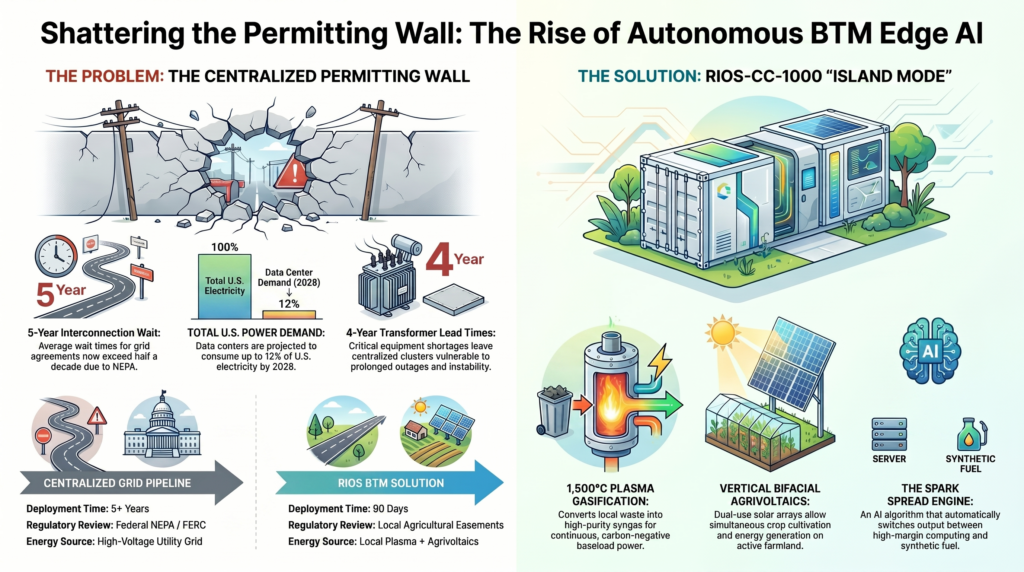
The rapid maturation of agentic Artificial Intelligence (AI) has collided with the physical realities of a decaying centralized electric grid. Current projections indicate that U.S. data centers will consume up to 12% of total electricity generation by 2028. However, the infrastructure required to support this growth is currently trapped behind what we call the Permitting Wall—a combination of regulatory logjams and physical transmission limits.
| Feature | Centralized Grid Model | Behind-the-Meter (BTM) Solution |
| Wait Times | 5+ years for interconnection agreements | Rapid 90-day deployment cycle |
| Regulatory Hurdles | NEPA reviews and FERC cluster studies | Local Agricultural Easement protections |
| Physical Infrastructure | Multi-state high-voltage lines | Localized, modular compute containers |
| Resiliency | Vulnerable to regional outages and cyberattacks | Operational “Island Mode” independence |
| Economic Logic | Subject to utility pricing and grid fees | Self-funding via “Spark Spread” arbitrage |
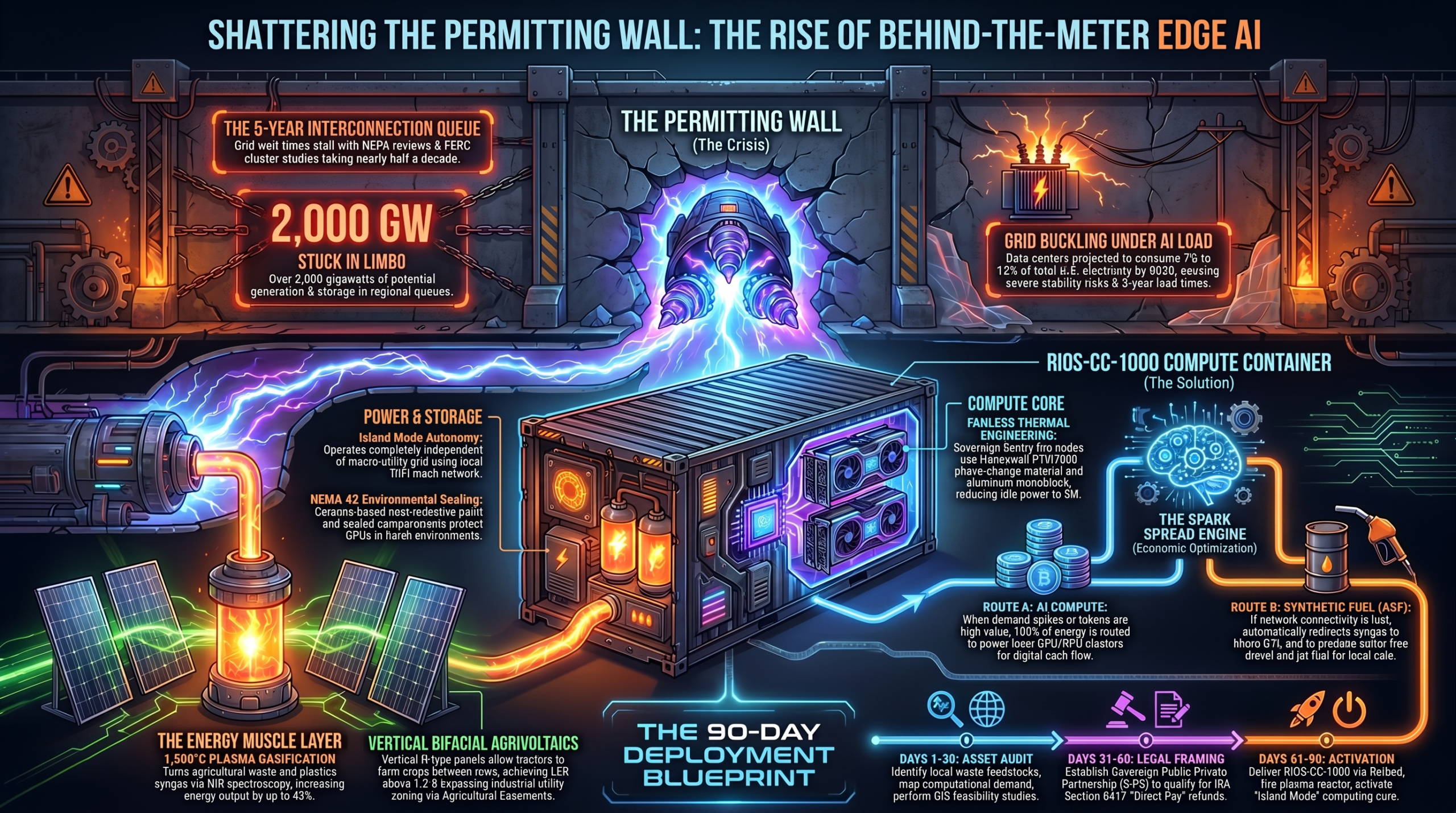
The Permitting Wall is the primary obstacle to computational sovereignty. Interconnection queues managed by regional transmission organizations now exceed 2,000 GW, while the National Environmental Policy Act (NEPA) review process adds an average of 4.5 years for environmental impact statements. To solve this, we must move the computer to the power, utilizing modular compute containers as the “islanded” brain of the operation.
2. The RIOS-CC-1000: The “Island Mode” Brain
The RIOS-CC-1000 (Pilot Command Center) is a ruggedized, off-grid compute module designed to bypass the transmission logjam entirely. As an architect, I view the container not just as a box, but as a resilient ecosystem designed for thermal and operational autonomy.
Physical and Technical Specifications:
- Enclosure: 10-foot High-Cube ISO shipping container with NEMA 4X environmental sealing against dust and moisture.
- Thermal Protection: Multi-layered, ceramic-based heat-reflective paint to mitigate solar thermal gain.
- Energy Buffer: Integrated 400 kWh Lithium Iron Phosphate (LFP) Battery Energy Storage System (BESS).
- Connectivity: Private, self-healing TriFi mesh network utilizing unlicensed 5.8 GHz and 6 GHz spectrum bands for high-uptime communication.
Deep Dive on Cooling: Sovereign Sentry Pro Active fan assemblies are a point of failure in remote infrastructure. The Sovereign Sentry Pro thermal engineering utilizes a fanless, anodized aluminum monoblock chassis. By employing Honeywell PTM7950 Phase Change Material (PCM), which transitions from solid to liquid at 45°C, the system achieves a thermal conductivity rate of 8.5 W/mK. This allows heat to move directly from processor dies to the chassis, reducing the node’s idle power draw to a mere 5W and eliminating mechanical risks.
Note: What is “Island Mode”? “Island Mode” is the system’s ability to maintain 100% operational uptime independently of the macro-utility grid. By running RIOS Core—an edge-native microkernel—the unit processes AI workloads and maintains local ledger validation even if national fiber lines or regional power grids suffer total failure.
To maintain this computational independence, the system requires a robust, local energy “muscle” to provide 24/7 baseload power.
3. The Energy Muscle (Part A): 1,500°C Plasma Gasification
The foundation of the system’s energy independence is the plasma gasification reactor. This process uses “Molecular Cracking”—an ionized gas arc exceeding 1,500°C—to break carbonaceous molecular bonds into their basic elemental components.
Unlike standard incinerators that produce toxic fly ash, this high-temperature conversion ensures complete thermal breakdown. The system integrates Near-Infrared (NIR) Spectroscopy to analyze feedstock composition in real time. This automated tuning of oxygen levels and plasma intensity increases total energy output by 30% to 43% compared to unmonitored systems.
Waste to Wealth: Output Conversion | Input Feedstock | Output Products | Primary Use / Value | | :— | :— | :— | | Ag Waste / Biomass | High-Purity Syngas | Direct electricity for compute racks | | Plastics / Rubber Tires | Advanced Synthetic Fuel (ASF™) | High-value, sulfur-free diesel and jet fuel | | Organic Residues | Biochar | Carbon sequestration and soil enhancement | | Inorganic Materials | Vitrified Slag | Inert, glass-like aggregate for road construction |
By converting negative-cost waste into high-purity syngas and ASF™, the gasifier provides a continuous, carbon-negative power source. This baseload is then complemented by the sun.
4. The Energy Muscle (Part B): Vertical Bifacial Agrivoltaics
To supplement the gasifier, the RIOS-CC-1000 integrates Vertical Bifacial Agrivoltaic arrays.
- N-Type Bifacial Panels: These vertical arrays capture sunlight on both sides—utilizing direct morning/afternoon sun and ground reflection.
- 7-Meter Spacing: This is a critical functional requirement. Spacing the rows at exactly 7 meters allows standard agricultural machinery (tractors and combines) to cultivate crops like hemp or soy between the arrays.
The Land Equivalent Ratio (LER) Advantage By co-locating energy and agriculture, we achieve a Land Equivalent Ratio (LER) of 1.2. This means the land is 20% more productive than if used for a single purpose. Crucially, this dual-use design ensures the property retains its active agricultural classification, allowing developers to bypass industrial zoning and utilize local Agricultural Easement protections to accelerate deployment.
With energy being generated from both waste and the sun, the system requires an intelligent “brain” to determine the most profitable use of that power.
5. The Brain: The Spark Spread Algorithm
The Spark Spread Algorithm is the optimization engine that governs the node’s economic viability. It performs real-time dynamic arbitrage between two primary monetization routes:
- Route 1: Synthetic Fuel (ASF™): Refining syngas into liquid fuels via a Micro-GTL (Gas-to-Liquids) unit to capitalize on local fuel shortages or low compute demand.
- Route 2: AI Compute: Powering high-performance GPUs to process AI inference validation and earn high-velocity digital cash in the form of DePIN tokens.
The Logic of Dynamic Arbitrage:
- Objective Function: The algorithm maximizes net yield by comparing the value of AI inference (/kWh) against the value of liquid fuel (/kWh), minus the cost of feedstock.
- Hardware Protection: The engine continuously monitors the Battery State of Charge (SOC) and temperature thresholds to ensure hardware longevity and system stability.
- Community Sovereignty: This “Node-as-a-Service” (NaaS) model allows the unit to remain self-financing. Even if the network goes offline, the node continues to generate value by producing liquid ASF™, protecting the asset from market volatility.
This logic transforms the container from a simple data center into a self-correcting financial engine.
6. The Blueprint: 90 Days to Independence
To shatter the Permitting Wall, we follow a streamlined 90-day deployment blueprint that leverages existing federal incentives.
- Days 1–30: Asset Audit We identify local agricultural/municipal waste streams and map the specific edge-compute needs of the region while conducting initial feasibility for solar spatial alignment.
- Days 31–60: Entity Design We form a Sovereign-Public-Private Partnership (S-P3) or local cooperative. This legal vehicle is essential to leverage IRA Section 6417 “Direct Pay” provisions, which allow tax-exempt entities to receive direct cash payments from the federal government for clean energy hardware.
- Days 61–90: Deploy & Scale The RIOS-CC-1000 is delivered via flatbed, the plasma reactor is fired, and “Island Mode” is activated, bringing computational and energetic self-determination to the community.
7. Summary Checklist for the Learner
A system is only truly “Sovereign” and capable of bypassing the Permitting Wall if it integrates these five core components:
- [ ] Local Energy: 1,500°C plasma gasification and vertical bifacial agrivoltaics for continuous baseload.
- [ ] Modular Compute: Ruggedized RIOS-CC-1000 enclosures that operate behind-the-meter.
- [ ] Thermal Engineering: Fanless cooling using Honeywell PTM7950 (8.5 W/mK) to ensure durability.
- [ ] Real-time Arbitrage: The Spark Spread algorithm to manage SOC and maximize DePIN/ASF yield.
- [ ] Mesh Communication: Private TriFi mesh (5.8/6 GHz) to maintain uptime without external fiber.


