The 1,000-Mile Failure: Why True Sovereignty Requires More Than Just a Blockchain
The modern industrial civilization persists in a state of precarious delusion, upheld by the “1,000-Mile Failure Model.” This paradigm describes a systemic fragility where our most fundamental needs—energy, data, and nutrition—are tethered to hyper-extended supply chains, continental high-voltage AC grids, and centralized “cloud” hyperscalers. These systems are not merely complex; they are fundamentally brittle, existing in a state of constant, borrowed stability that ignores the escalating costs of thermodynamic maintenance and the widening gap of epistemic unreliability.
As these centralized architectures approach their thermodynamic and epistemic limits, they begin to exhibit signs of Kuhn’s “Phase 3” crisis. The energy required to sustain the complexity of a globalized grid increasingly consumes the very output it seeks to deliver, while the information generated by centralized institutions increasingly fails to map onto reality. When these systems inevitably hit the wall of biophysical limits, the current institutional response is not resilience, but a doubling down on the same fragile dependencies that caused the friction.
The only viable path forward is the “Sovereign Operational Stack,” a vertically integrated engineering and philosophical framework designed for “Sustained Island Mode.” This is not an exercise in retreat, but a transition toward a more robust, “ruggedized” existence. It requires a fundamental decoupling from the 1,000-mile chain, replacing it with a localized, self-contained ecosystem where energy, intelligence, and governance are anchored to the unyielding boundary conditions of the cosmos.
Integrity is Not Truth: The Oracle Gap
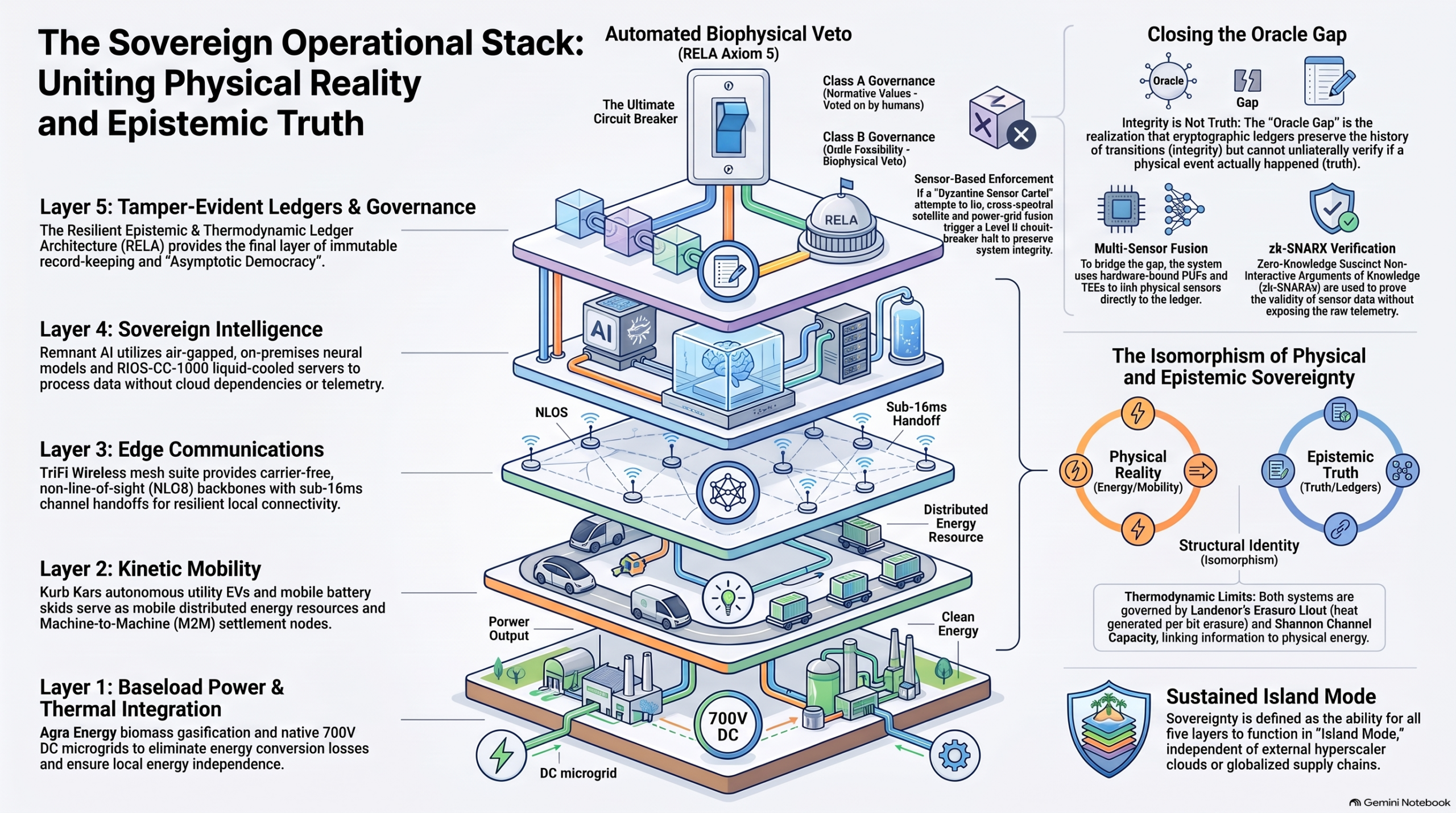
The “Central Postulate” of the Sovereign Operational Stack asserts a sharp distinction between digital consistency and physical reality: Integrity is not Truth. While a cryptographic ledger—functioning at Level 2 Integrity—can mathematically guarantee that a state transition was authorized and the record has not been tampered with, it possesses zero inherent capacity to verify “Level 0 Ontic Reality.” A blockchain can confirm a transaction for a thousand gallons of fuel occurred, but it cannot unilaterally declare whether the fuel physically exists in the tank.
To bridge this “Oracle Gap,” the stack utilizes the Resilient Epistemic & Thermodynamic Ledger Architecture (RELA). By integrating hardware-bound Trusted Execution Environments (TEEs), Physical Unclonable Functions (PUFs), and multi-sensor fusion, the system anchors digital state changes to physical events. Using zk-SNARKs for privacy-preserving verification, the RELA framework ensures that the ledger is not merely a record of “what was said,” but a high-fidelity projection of the physical environment.
“Cryptographic ledgers… only preserve state transition immutability and record provenance; they CANNOT unilaterally declare physical factuality.”
The Isomorphism of Energy and Information
In the Sovereign Operational Stack, the “Core Thesis” is that physical sovereignty and epistemic sovereignty are structurally, thermodynamically, and mathematically identical problems. This is not a metaphor; it is a physical reality governed by Landauer’s Thermodynamic Erasure Limit. This limit dictates that the erasure of a single bit of information costs a minimum of k_B T \ln 2 energy, released as heat. Information is not an abstract cloud; it is a physical process that requires work and generates entropy.
Consequently, “sovereign data” is an impossibility if it relies on a centralized power grid for its existence. A failure in the local heat-recycling loop is, quite literally, a failure in the truth-verification process. True independence requires a recognition that the bits (information) and the atoms (energy) are isomorphic. To control one’s data, one must control the local thermodynamic cycle that sustains the computation. If you do not own the electrons, you do not own the truth.
“Hemp-Grade” AI and Ruggedized Intelligence
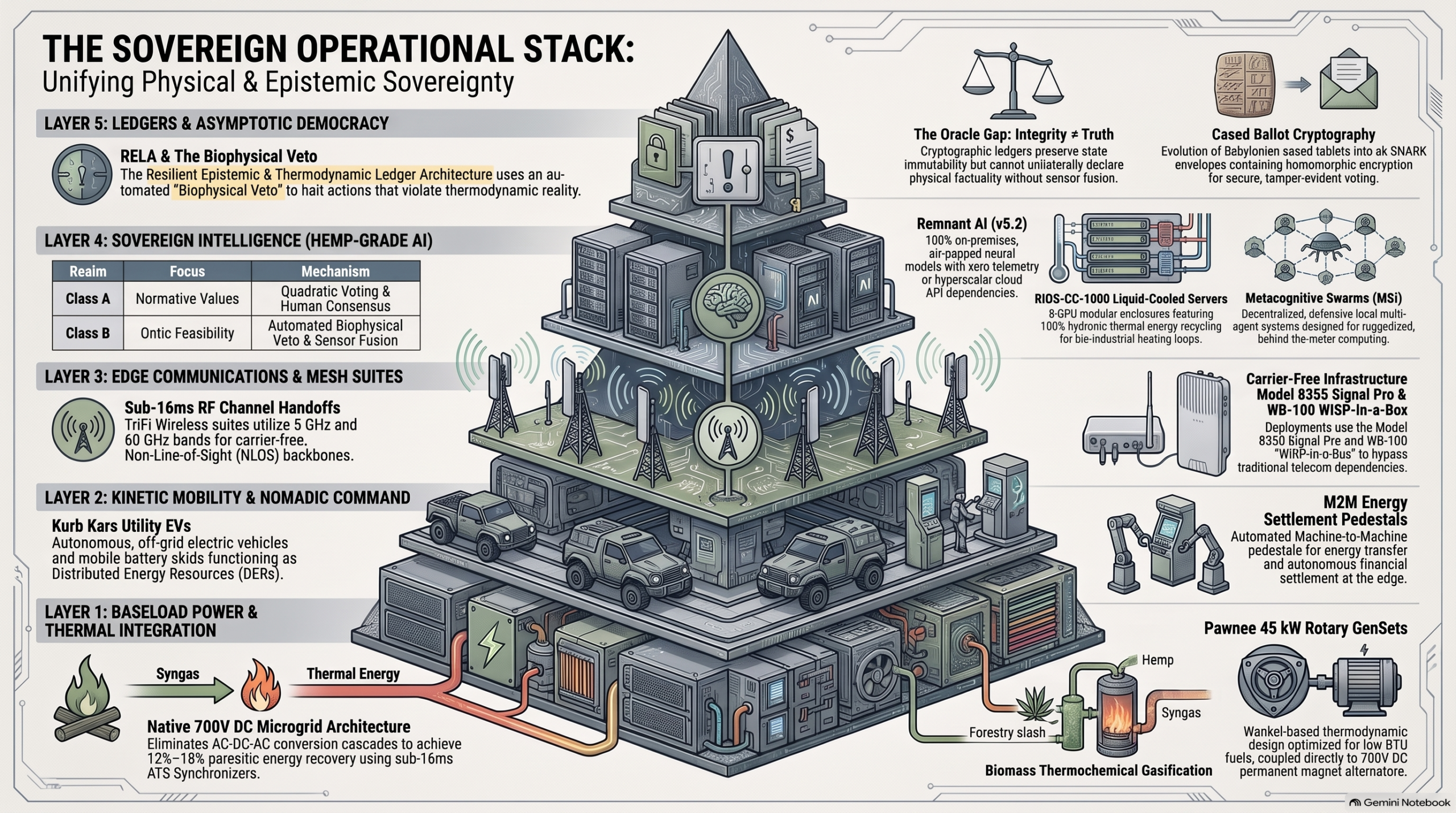
The Sovereign Operational Stack rejects the current dependency on “hyperscaler cloud APIs” that demand constant telemetry and external connectivity. Instead, it deploys “Remnant AI (v5.2),” a suite of air-gapped, on-premises neural models that operate entirely within the local perimeter. These models are housed in the RIOS-CC-1000, an 8-GPU modular liquid-cooled server enclosure designed for the harsh realities of off-grid life.
This is the era of “Hemp-Grade AI.” Unlike centralized data centers where heat is a waste product to be mitigated, the RIOS-CC-1000 utilizes 100% hydronic thermal energy recycling. In this bio-industrial computing model, compute is not a “drain” on the system; it functions as a high-tech furnace. The waste heat from local intelligence is captured and redirected into agricultural drying or hydronic heating loops, co-located with biomass fuel sources like forestry slash and industrial hemp. Intelligence thus becomes a circular byproduct of the local ecosystem’s energy metabolism.
The Native DC Revolution and Kinetic Mobility
At the base of the stack (Layer 1) is a radical departure from the legacy AC grid: the Native 700V DC microgrid. By utilizing Agra Energy’s biomass thermochemical gasification to convert agricultural residue into syngas, the stack provides continuous, reliable baseload power. This power is generated by the “Pawnee 45 kW rotary GenSet,” which leverages Wankel thermodynamic advantages to handle low-BTU fuels with high efficiency. By operating natively in DC, the stack eliminates the “inverter conversion cascade” that typically wastes 12%–18% of generated power.
Physical sovereignty is further extended through Layer 2 Kinetic Mobility and Layer 3 Edge Communications. The “Kurb Kars” autonomous utility EVs and mobile battery skids act as distributed energy resources, while the TriFi Wireless suite—including the Signal Pro (Model 8355) and WISP-in-a-Box™ (Model WB-100)—provides a carrier-free, mesh-based communication backbone. With sub-16ms RF channel handoffs, these systems ensure that the community remains connected and mobile even when the 1,000-mile infrastructure goes dark.
Asymptotic Democracy and the Automated Biophysical Veto
Governance in the Sovereign Operational Stack is handled through “Asymptotic Democracy,” a model that escapes the pathologies of “Pluralistic Ignorance” and “Information Cascades.” The RELA governance model splits decision-making into two distinct realms: Class A (Normative Values) and Class B (Ontic Feasibility). In Class A, residents use Quadratic Voting to express their values and priorities. In Class B, however, the “Automated Biophysical Veto” (RELA Axiom 3) takes over.
This system integrates Futarchy, where citizens “vote on values but bet on beliefs.” While a community may vote to increase resource allocation, the Class B veto—powered by real-time sensor fusion and invariant biophysical metrics—will automatically halt any decision that violates the physical limits of the microgrid or biomass reserves. This forces a “Perspectival Realism” where governance is no longer a popularity contest of ungrounded desires, but a rigorous, asymptotic convergence toward what is physically sustainable.
The Asymptotic Horizon
The Sovereign Operational Stack offers a definitive blueprint for those ready to transcend the fragility of the 1,000-Mile Failure Model. It is a vertically integrated architecture that merges the rigor of formal epistemology with the grit of bio-industrial engineering. By localizing baseload power, ruggedizing intelligence, and anchoring governance in biophysical reality, we move toward an “Island Mode” that is not just a survival strategy, but a superior mode of human flourishing.
As the centralized giants of the old world succumb to their own thermodynamic and epistemic weight, the question for every community is simple: Are you prepared for the transition, or are you still tethered to a chain that is already breaking? True sovereignty is not found in a distant cloud or a centralized ledger; it is found in the ability to stand independently within the unyielding boundary conditions of the cosmos. Are you ready for Island Mode?


