
The Invisible Graveyard: Why Most Scientific “Breakthroughs” Never Reach You
Every month, headlines announce a new “miracle cure” for cancer or a “breakthrough” in reversing Alzheimer’s disease. Yet, for the average person, medical reality moves at a glacial pace. If science is advancing as quickly as the news suggests, why are these life-changing treatments still decades away—or, more often, never heard from again?
The answer lies in a systemic phenomenon known as the “file drawer effect.” Modern science has become a “funhouse mirror” that reflects only the success stories while burying the failures. In the invisible graveyard of research, thousands of failed experiments—data that could have saved billions of dollars and decades of time—are locked away, hidden from public view because they didn’t produce a flashy, positive result.
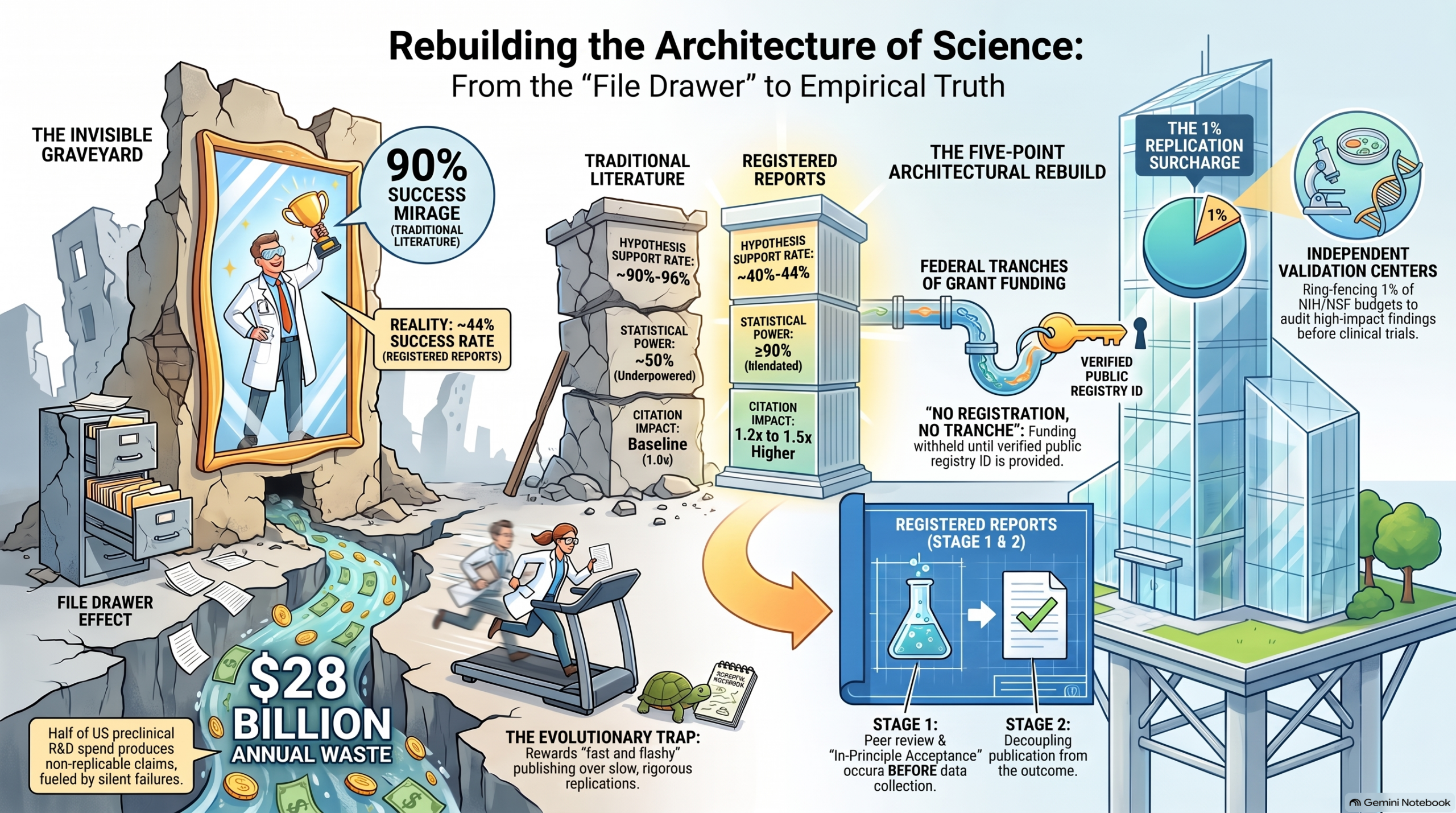
Takeaway 1: The “Funhouse Mirror” Effect (90% Success vs. 40% Reality)
In a healthy scientific ecosystem, discovery is difficult and rare. However, the current body of published literature suggests otherwise. Statistical audits show that roughly 90% to 96% of standard published studies claim to have successfully supported their hypotheses.
This success rate is a statistical impossibility. To understand why, we must look at the Ioannidis Transformation and Positive Predictive Value (PPV). In cutting-edge “discovery science,” the pre-study odds of a hypothesis being true are naturally low. When you factor in high levels of publication bias (the “u” parameter), the PPV—the probability that a published result is actually true—frequently falls below 50%. This mathematically transforms the literature into an index of surviving false positives rather than a record of reality.
When we look at “Registered Reports”—a model where protocols are peer-reviewed before results are known—the success rate drops to approximately 40% to 44%. This suggests that over half of the “breakthroughs” in standard journals are actually the result of selective reporting or statistical noise.
As noted in Rebuilding the Architecture of Science:
“This selective reporting does not merely introduce publication bias; it breaks the empirical feedback loop. Hundreds of laboratories independently and expensively repeat the same failed experiments in total isolation, squandering billions in taxpayer-funded grants, sacrificing millions of research animals, and funneling terminally ill patients into clinical trials built on irreproducible preclinical artifacts.”
Takeaway 2: The $28 Billion Game of Parallel Waste
The economic cost of this silence is staggering. According to benchmarks from Freedman et al. (2015), approximately $28 billion is wasted annually in the U.S. on preclinical research that cannot be reproduced.
However, this figure only counts the “primary waste.” The true crisis is the “Redundant Secondary Waste Factor.” Because a lab’s failure is never published, dozens of other labs independently spend their own grants attempting the exact same experiment. The math is brutal: if one flawed $250,000 study is published as a “success,” it can trigger 15 other labs to spend 250,000 each trying to build on it. In this scenario, the secondary waste (3.75 million) is 15 times higher than the cost of the original study.
This waste manifests in three devastating ways:
- Capital: Billions in taxpayer-funded grants are spent on reagents and equipment for “phantom targets” that have already been disproven elsewhere.
- Human: PhD students are subjected to “epistemic gaslighting,” believing they have failed personally because they cannot replicate a famous study that was actually a statistical fluke.
- Ethical: Millions of research animals are sacrificed in experiments that other institutions have already quietly proved to be dead ends.
Takeaway 3: The Myth of “Data Available Upon Request”
Scientific papers often end with a promise: “Data available from the corresponding author upon reasonable request.” A study by Gabelica et al. (2022) audited over 3,400 articles to see if this promise held water.
Metric Outcome
Authors who ignored or refused requests 96.4%
Common Excuses “Lost files,” “Hardware dead,” “No permission”
Actual Compliance (Usable Data Received) 3.6%
This “gentleman’s agreement” is a death sentence for data. Research by Vines et al. (2014) shows that the probability of retrieving raw data drops by 17% every year after publication. Within 20 years, the probability of retrieval falls below 10%, making independent verification of the “breakthroughs” of the past nearly impossible.
Takeaway 4: The “Amyloid Cabal” and the Dark Side of Peer Review
The graveyard is also patrolled by “Scientific Elites” who protect their life’s work through Sunk-Cost Academic Feudalism. A prominent example is the “Amyloid Hypothesis” in Alzheimer’s research. For decades, alternative theories were suppressed because the researchers who built their careers on the amyloid model also controlled the grant review panels and editorial boards.
These incumbents use the “Incumbent’s Playbook” to block dissenting data. When a lab tries to publish a failure to replicate a major finding, they are met with the “Bad Hands” accusation.
As documented in The Guarded Fortress:
“The authors clearly lack the delicate technical touch or tacit knowledge required to conduct this assay. Their failure to observe the effect reflects technical deficiency in their hands, not a flaw in the original foundational paradigm.”
By shifting the blame from the phenomenon’s non-existence to the challenger’s manual competence, the elite can protect their grant renewals and biotech spin-outs from the “existential threat” of the truth.
Takeaway 5: “Mad-Libs” Science: The Rise of the Paper Mills
The “publish-or-perish” mandate has fueled an industrial-scale fraud known as commercial paper mills. These syndicates use a “modular assembly” approach, swapping variables into master templates—changing one specific microRNA for another across different disease models to manufacture thousands of “unique” fake papers.
While forensic sleuths have identified the “Tadpole” image artifact (a distinct defect in digitally manipulated Western blots used in hundreds of papers), the fraud runs deeper. Tools like Seek & Blastn have uncovered “Sequence-Target Incongruity,” where the reagents described in a paper (like DNA primers) have zero homology with the genes they claim to target. These papers are entirely synthetic, written by algorithms to fulfill the graduation requirements of clinicians who have no time to conduct real lab work.
Takeaway 6: The “Zombie Paper” Phenomenon
Even when a paper is proven false and retracted, it becomes a “zombie.” Over 90% of subsequent citations continue to treat retracted papers as valid science. These zombies persist because reference management software often fails to flag retractions effectively.
To fix this, we need a “Citation Health Infrastructure”—automated alerts in tools like Zotero or EndNote that flag retracted papers in a researcher’s library in real-time, preventing new work from being built on hollow foundations.
The Solution: A Blueprint for a Better Science
To restore the scientific engine, we must overhaul the architecture of how research is funded. We propose four structural fixes:
- Registered Reports: Journals must review the plan for an experiment before it begins, committing to publish the findings regardless of the outcome.
- The 1% Replication Tax: We must ring-fence 1% of the annual budgets of the NIH (~470 million) and NSF (~95 million) specifically to fund independent verification of the top 100 most-cited findings.
- Cryptographic Notebooks: Digital lab notebooks with append-only audit trails make it impossible to tamper with data after the fact.
- The “No Registration, No Tranche” Policy: This “Tranche-Lock” mechanism would withhold Year 2 through Year 5 grant funds from researchers until they provide a verified public registry ID for their experiments.
Conclusion: Restoring the Self-Correcting Engine
The current crisis is not a failure of the scientific method, but a failure of the architecture of publishing. We have built a system that rewards narrative novelty over empirical truth, leading to an immense squandering of human talent and capital.
We must remember that an experiment is valuable not because it produced a flashy headline, but because of the truth it uncovered. If we continue to treat negative results as failures rather than essential data, how many more decades will we spend running in circles around claims that were never true to begin with?


