The Death of the Line: Why the Rural “Sovereign Node” is the Only Viable Exit from Grid Paralysis
Modern civilization is currently held hostage by “The Line.” Our survival depends on linear, centralized, and profoundly fragile corridors—high-tension power wires, global supply chains, and hyperscale cloud data centers. For the rural entrepreneur, this dependency has become a terminal liability. We are witnessing a state of “Operational Sclerosis,” where the wait time to connect a new solar or battery project to the national grid has ballooned to a staggering four to seven years.
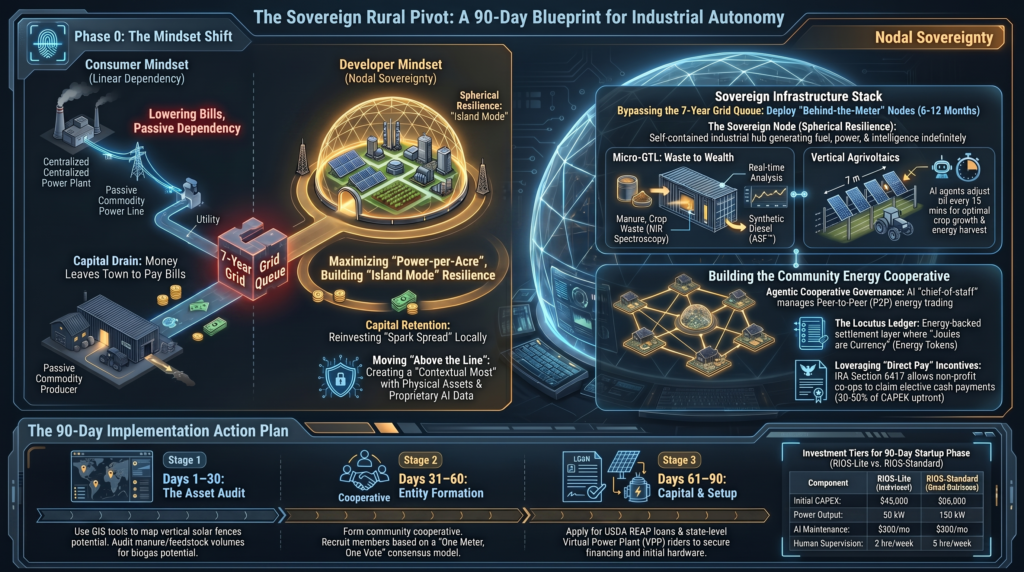
Instead of waiting for a failing legacy system to heal itself, a new paradigm of “Spherical Resilience” is emerging. By deploying “Sovereign Nodes,” rural operators are transforming from the vulnerable “tail end” of the utility line into self-contained industrial orbs. These nodes generate their own power, synthetic fuels, and high-density intelligence, allowing them to thrive in “Island Mode” regardless of whether the external network is functional.
Are we witnessing the end of rural dependency and the birth of the high-density intelligence refinery?
Takeaway 1: The “Death of the Line” and the Rise of Island Mode
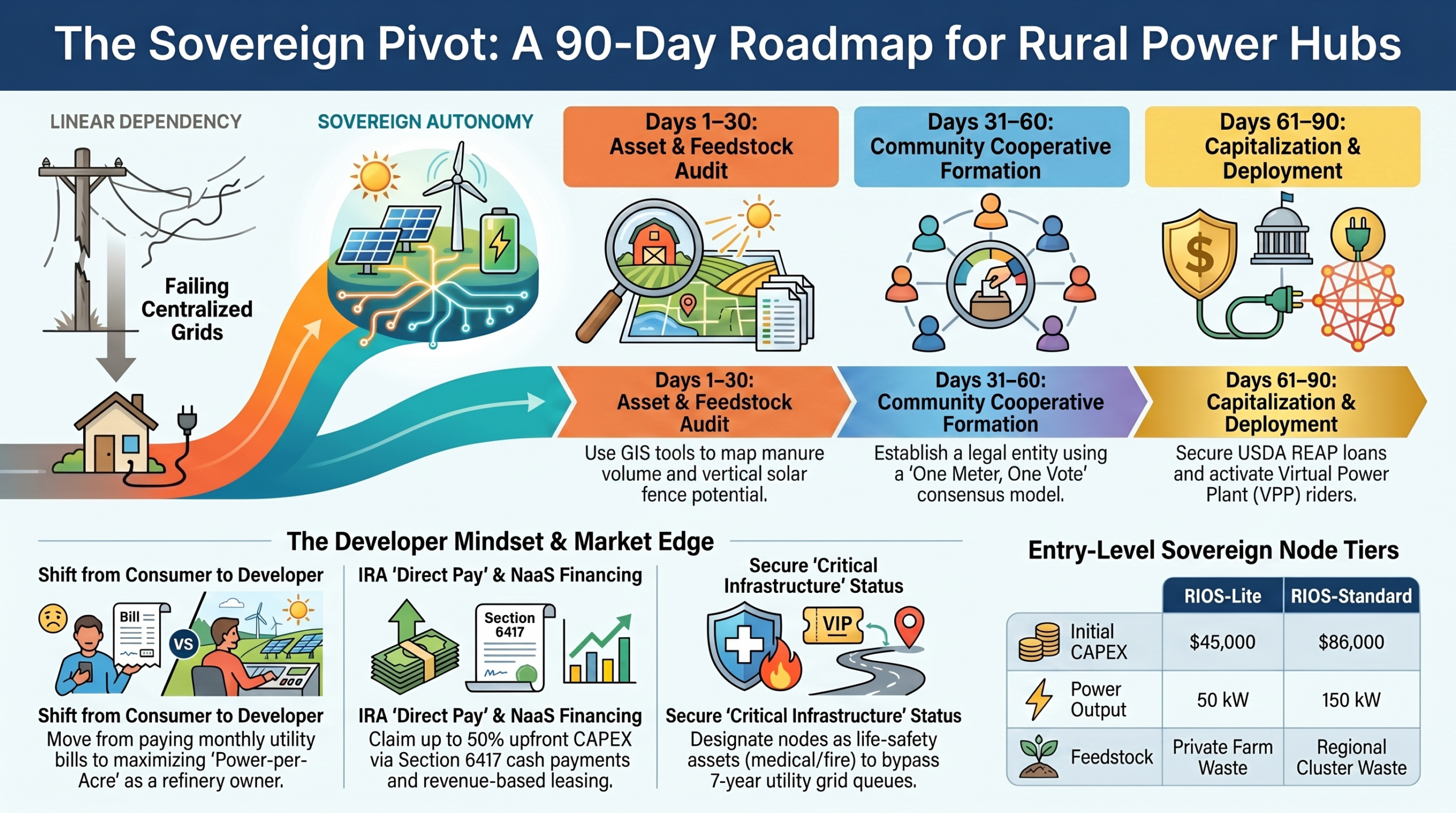
The core philosophy of the DeReticular ecosystem is the aggressive transition from “Linear Dependency” to “Sovereign Autonomy.” In the traditional model, a single break in the line—whether caused by a physical storm or a digital outage—results in the total failure of the civilization it serves.
The Sovereign Node represents a shift toward “Island Mode,” a state of operational autonomy where a farm or industrial site continues to function indefinitely without an external network connection. By moving from a “tail end” position to a self-contained orb, rural entrepreneurs fundamentally change their risk profile. They are no longer victims of the grid; they are the grid.
“Modern civilization rests upon ‘The Line’—linear, centralized, and fragile corridors of power, data, and logistics. When the line breaks, the civilization it serves fails. DeReticular is engineering the transition to ‘Spherical Resilience.'” — Investment Prospectus
Takeaway 2: Bypassing the 7-Year Queue via “Behind-the-Meter” Deployment
The most significant bottleneck in the modern economy is the grid’s inability to scale. While large utilities are paralyzed by decadal build-out timelines, the sovereign strategy involves “opting out” of this dysfunction through behind-the-meter deployment.
By focusing on localized generation for direct-to-device consumption, rural hubs can be fully operational in 6 to 12 months. This turns a regulatory nightmare into a massive competitive speed advantage. To bridge the initial capital gap, the RIOS-Lite hardware starts at a CAPEX of 45,000**, while the RIOS-Standard unit sits at **86,000. Through a “Node-as-a-Service” (NaaS) model, entrepreneurs can deploy this infrastructure with minimal upfront friction, paying for the hardware through a percentage of the “Spark Spread”—the arbitrage of the $0.04/kWh production cost against the $0.12/kWh retail grid price.
Takeaway 3: The 43% Yield Boost—AI as the “Biological Brain”
Traditional anaerobic digestion (AD) has long been the “messy” stepchild of renewable energy. Manual, reactive management typically captures only 40–60% of a feedstock’s methane potential, a level of inefficiency that makes small-scale operations unviable. AI is collapsing this complexity barrier.
By utilizing Digital Twins to simulate biological conditions and NIR (Near-Infrared) Spectroscopy to analyze the chemical makeup of waste at the intake, the RIOS platform calculates the optimal “feedstock recipe” in real-time. This predictive intelligence optimizes methane yield by up to 43%, shifting the farm from a volatile manual operation to a high-efficiency energy node providing non-intermittent, 24/7 baseload power.
“Traditional centralized utilities, structured for stable gigawatt-scale production and decadal build-out timelines, are facing a ‘structural mismatch’ with the spiky, high-density demand of the AI economy.”
white paper
Takeaway 4: Vertical Agrivoltaics and the 160% Land Productivity Secret
A breakthrough in rural land use is the “Vertical AI Fence”—bifacial solar panels that capture light from both sides without clogging the land. These arrays are installed with 7-meter spacing, specifically designed to accommodate the turning radius of standard tractors and combines, ensuring that energy production does not come at the cost of crop yield.
The intelligence lies in the “15-Minute Shift.” AI agents monitor weather and irradiance data in real-time, adjusting panel angles every 15 minutes to balance three conflicting metrics: maximum energy harvesting, optimal light for crop growth, and structural safety. During high-wind events or typhoons, the AI automatically levels the panels to minimize load. This dual-use strategy achieves a Land Equivalent Ratio (LER) of 1.2 to 1.6, meaning the land is up to 160% more productive than traditional single-use acreage.
Takeaway 5: The Farm as a “Digital Refinery” (Selling Joules and Flops)
As urban power costs skyrocket and “Digital Capital Flight” drains rural wealth toward Big Tech cloud providers, sovereign nodes are reclaiming the value chain. These hubs function as “Digital Refineries,” utilizing the Micro-GTL (Gas-to-Liquids) unit to convert negative-cost farm waste into ASF™ (Agra Synthetic Fuel)—synthetic diesel and jet fuel produced directly at the source.
Simultaneously, the nodes host liquid-cooled RIOS-CC-1000 server clusters, providing “Green Compute” for industries like Healthcare and Legal that cannot risk sending data through the public cloud. This ecosystem is governed by the Locutus Ledger, an energy-backed settlement layer where energy and compute (joules and flops) become a local currency. This allows for frictionless peer-to-peer (P2P) trading, keeping capital within the community.
“Rural America is no longer at the ‘tail end’ of civilization… we activate the land as a high-density intelligence and energy refinery. [It is a] shift from being a ‘Price Taker’ to a ‘Market Maker.'” — Investment Prospectus
podcast
Takeaway 6: The “Agentic Labor” Shift—The 70/30 Rule
The transition to a high-tech Power Hub does not require an army of specialized contractors. It relies on “Agentic Labor.” Under the 70/30 Rule, AI agents—the Field Foreman, Vault Warden, and Field Medic—handle 70% of routine preparatory, maintenance, and diagnostic tasks, leaving humans to focus on high-level judgment.
The “Field Foreman” agent is a critical weapon in the “Right to Repair” movement. It utilizes an automated software-defensive layer to bypass predatory OEM software locks on essential machinery, returning diagnostic control to the owner. This “Sovereign Foreman” ensures that the node remains operational and un-killable, even when legacy manufacturers attempt to gatekeep the hardware.
Conclusion: The Sovereign Pivot
The rural landscape is undergoing a profound structural inversion. By abandoning the “Consumer Mindset”—passive dependency on monthly utility bills—and adopting a “Developer Mindset,” rural entrepreneurs are building the most resilient infrastructure on the planet.
The farm is no longer just a source of food; it is a refinery of synthetic fuel, 24/7 power, and sovereign intelligence. As centralized systems continue to buckle under the weight of operational sclerosis, the sovereign node stands as the only viable hedge for a stable, high-tech future.
Are you still relying on “The Line,” or are you ready to build your own node?


