The Sovereign Transition: A Technical and Strategic Blueprint for Nodal Hospitality
1. The Shift to Agentic Hospitality: Architectural Overview
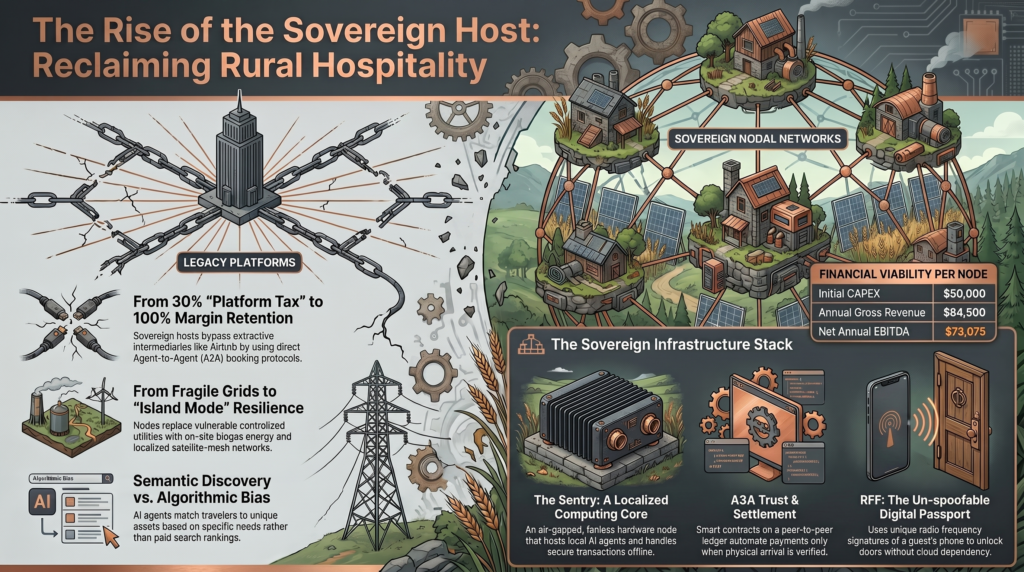
The hospitality industry is undergoing a structural inversion, transitioning from “Platform-Mediated” extraction to “Agent-Orchestrated” sovereignty. For decades, centralized Online Travel Agencies (OTAs) have operated as rent-seeking gatekeepers, levying a 15–30% “Platform Tax” while commoditizing Proprietary Context. For the rural entrepreneur, this shift is a strategic imperative to reclaim data sovereignty and treat hospitality as a deterministic state-machine. By moving “Above the Line,” hosts leverage non-reproducible Contextual Assets—such as historical gristmills or off-grid ridges—that centralized algorithms are structurally incapable of indexing.
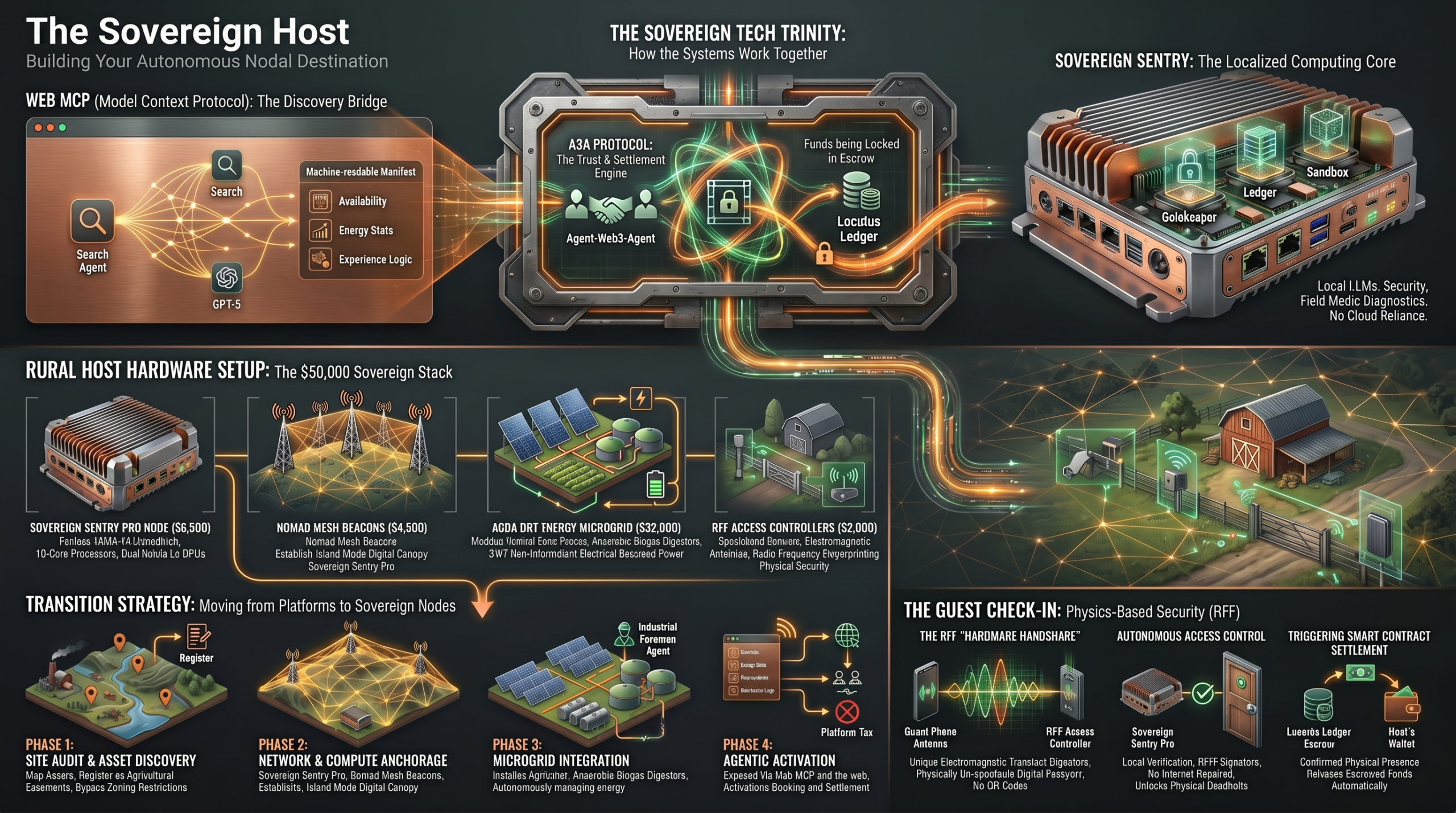
This transition is facilitated by the A3A (Agent-Web3-Agent) and Web MCP (Model Context Protocol) frameworks. While standard Agent-to-Agent (A2A) protocols coordinate discovery, A3A embeds a decentralized trust and Web3 settlement layer directly into the interaction. Web MCP acts as the semantic bridge, allowing a host’s node to publish “Agent-Readable Manifests.” These manifests replace legacy marketing with Structured JSON-LD markup, allowing a traveler’s personal AI to mathematically match requirements—such as #acoustic-silence-90dB or #off-grid-biogas-reliable—enabling “Zero-UI Discovery” and autonomous negotiation.
podcast
| Dimension | Legacy Platform Models | Sovereign A3A Models | Communication Protocol |
| Discovery Mechanism | Manual Search / Promoted Listings | Semantic Intent Matching | Web MCP (Model Context Protocol) |
| Fee Structure | 15–30% Intermediary Commission | 0% Platform Fees (Direct Settlement) | JSON-RPC 2.0 over HTTPS/Tor |
| Data Ownership | Centralized (Airbnb/Expedia) | Sovereign (Host & Guest) | Locutus Ledger (P2P) |
This software-driven logic necessitates a robust physical foundation; a digital agent is only as resilient as the hardware and energy systems that anchor it.
——————————————————————————–
video
2. The Physical Core: Sovereign Sentry Hardware and Mesh Architecture
Strategic resilience in rural hospitality requires the capability to operate in “Island Mode”—total operational independence from macro-grids and centralized cloud providers. Localized edge compute is the prerequisite for sovereign hospitality, ensuring the Property Agent remains functional during AWS outages or cellular backhaul failures.
The core of this infrastructure is the Sovereign Sentry Pro Edition, a fanless, NEMA 4X weather-sealed Hyperconverged Infrastructure (HCI) node. It utilizes a Proxmox VE hypervisor to maintain three isolated virtual environments:
- The Gatekeeper (pfSense/OPNsense): Manages deep packet inspection, firewall security, and automated WAN failover between Starlink and local backhauls.
- The Ledger (Locutus): A decentralized daemon that validates smart contracts, manages encrypted data shards, and facilitates Locutus State Channels for offline transaction queuing.
- The Sandbox (Local LLMs): An air-gapped environment for running OpenClaw AI agents, such as the DevOps Sovereign (Llama-3-8B) and Field Medic (Mistral-7B).
video
The Nomad Mesh Canopy extends this core via RIOS-EXT-01 Mesh Beacons. These Tri-band Wi-Fi 6E and 915MHz LoRaWAN units project a miles-wide private intranet. To eliminate field “dead zones,” the Nomad Link and Fleet Kits enable a “Vehicle-as-a-Relay” dynamic, where moving machinery caches IoT telemetry and syncs it to the Sentry node once within range. This “Spherical Resilience” eliminates single points of failure, ensuring that the guest experience—governed by local physics rather than distant clouds—remains uninterrupted.
——————————————————————————–
3. The Sovereign Check-In: Radio Frequency Fingerprinting (RFF)
For the Sovereign Traveler, the moment of arrival must prioritize “Physics over QR Codes.” Traditional entry methods are vulnerable to spoofing and cloud-dependency; sovereign hospitality establishes a high-security entry process rooted in the immutable physical properties of the traveler’s hardware.
Radio Frequency Fingerprinting (RFF) analyzes the unique electromagnetic transients of a mobile device’s antenna during the initial connection handshake. These transients, caused by microscopic manufacturing variances, create an un-spoofable “Digital Passport.” The check-in sequence proceeds as follows:
- Handshake: As the guest enters the mesh canopy, the Sentry Pro detects the RFF signature via JSON-RPC 2.0 over HTTPS.
- Verification: The signature is matched against the cryptographic DID linked to the booking escrow.
- Physical Access: The Sentry autonomously triggers relay switches on physical deadbolts.
- Settlement: The verified check-in triggers the release of escrowed funds on the Locutus Ledger.
Primary Benefits of RFF:
- Un-spoofability: Physical-layer verification that cannot be software-cloned or MAC-spoofed.
- Absolute Privacy: Zero metadata transmission to external corporate servers.
- Offline Functionality: The system operates locally; guests gain entry even during total satellite outages via Batch-Sync queuing.
——————————————————————————–
4. Implementation Blueprint: Hardware Setup for the Rural Host
Standardized hardware configurations are necessary to ensure “Spherical Resilience” across the DePIN (Decentralized Physical Infrastructure Network).
Hardware Manifest for a Standard Rural Node:
- Sovereign Sentry Pro Node: AMD EPYC Embedded Processor (16 Cores, 32 Threads), 2x Nvidia L4 GPUs (48GB combined GDDR6 VRAM), and 4TB Enterprise U.3 NVMe SSD in RAID-1.
- Nomad Mesh Beacons: Minimum of 5x RIOS-EXT-01 units. Requirement: Minimum 30-foot vertical clearance and 360° line-of-sight.
- Agra Dot Energy Microgrid: Modular anaerobic biogas digesters with a Combined Heat and Power (CHP) generator and Vertical Agrivoltaic arrays using 15-minute interval linear actuators for solar tracking.
- RFF Access Controllers: Specialized electromagnetic sensors for secure physical entry.
Step-by-Step Node Deployment Playbook:
- Site Audit: Mapping acreage via GIS to identify Contextual Assets and verifying state-level Agricultural Easement regulations.
- Network Anchorage: Mounting the Sentry Pro in a climate-controlled vault and positioning Mesh Beacons at high-elevation points for maximal coverage.
- Microgrid Integration: Installing vertical bifacial panels and biogas digesters to establish utility independence and energy arbitrage capabilities.
- Experience Activation: Uploading spatial AR trail maps and exposing the machine-readable Web MCP manifest for agentic discovery.
——————————————————————————–
5. Strategic Transition: Bypassing the Platform Model
Transitioning from OTAs to sovereign ownership requires bridging the financial and technical gaps that keep hosts tethered to centralized platforms.
The Economics of the Sovereign Node Reclaiming the 15–30% platform fee transforms the property’s Net Operating Margin (EBITDA). With annual gross revenue projected at 84,500** and OPEX minimized via AI automation, a single node generates a net EBITDA of **73,075. This supports a projected Internal Rate of Return (IRR) of 58.3% over a 10-year horizon, fueled by the “Spark Spread”—the profit margin generated by converting raw feedstock into high-value energy and compute cycles.
Bridge Strategies for Critical Gaps:
- Financial (CAPEX): Implementing Revenue-Based Financing (RBF) where CAPEX is covered in exchange for a 35% revenue share until 1.5x is repaid, alongside automated USDA REAP grant capture.
- Technical (UX): Utilizing Zero-Knowledge (ZK) Account Abstraction to hide wallet complexity, anchoring the private key directly to the guest’s RFF signature.
- Human Capital: Deploying the Field Medic and DevOps Sovereign agents to provide vocal, step-by-step troubleshooting for on-site hardware.
- Regulatory (Zoning): Structuring nodes under Agricultural Easements and maintaining a Land Equivalent Ratio (LER) above 1.2 to bypass commercial hospitality zoning bans and utility interference.
Hosts must pivot from “marketing” to “Context Engineering,” replacing lifestyle ad copy with granular, verifiable attributes that agents can mathematically index.
——————————————————————————–
6. Conclusion: The Rise of the Sovereign Destination
The convergence of A3A protocols, Sovereign Sentry hardware, and RFF security creates a new benchmark for “Above the Line” luxury. By integrating decentralized infrastructure with physics-based security, the Nodal Destination Network offers privacy, resilience, and authenticity that centralized platforms are structurally incapable of matching.
Over the next decade, this network will scale from pilot clusters to a planetary DePIN. It represents the ultimate strategic pivot for the rural entrepreneur: moving from a passive consumer of platform interfaces to an active developer of sovereign agentic manifestations. The Sovereign Transition is no longer an experimental configuration—it is the modern benchmark for high-value, resilient hospitality.


