The Founder’s Fork: A Comparative Handbook on Equity vs. Non-Dilutive Financing
- The Strategic Mismatch: Why “Default” VC Fails Deep-Tech
For ventures architecting sovereign infrastructure—microgrids, autonomous kinetic platforms, and modular energy systems—the traditional Venture Capital (VC) path often represents a fundamental structural mismatch. The high Capital Expenditure (CapEx) and long-cycle technical validation required for physical hardware clash with the 7–10 year fund cycles and rapid-return economics of standard equity models.
Funding physical infrastructure solely through conventional equity creates three existential risks:
- Aggressive Equity Dilution
- Founder’s Impact: High upfront R&D costs require massive early injections. Founders are often forced to surrender 20–25% of the cap table before achieving a Minimum Viable Product (MVP), leaving them with negligible ownership by the time the technology scales.
- Loss of Strategic Governance
- Founder’s Impact: Traditional equity rounds mandate board seats and “veto rights” (protective provisions). This allows investors to block annual budgets, executive hires, or strategic pivots, potentially stripping the original inventors of their technical vision.
- Misaligned Exit Pressure
- Founder’s Impact: The “Power Law” mandates 10x–100x returns to cover portfolio losses. This forces hardware founders into “grow-or-die” trajectories, often prioritizing top-line revenue velocity over critical technical de-risking and safety certifications.
Warning: The Valuation Trap High early-stage valuations create a “valuation trap.” If a hardware venture fails to meet hyper-growth milestones due to regulatory or technical delays, the resulting “down-rounds” trigger punitive cram-downs and washouts, effectively erasing founder and employee equity.
To escape this cycle, sophisticated founders are adopting “sovereign” funding architectures that prioritize ownership preservation while de-risking core technology through public-sector channels.
- The Non-Dilutive Engine: Milestone-Based De-Risking
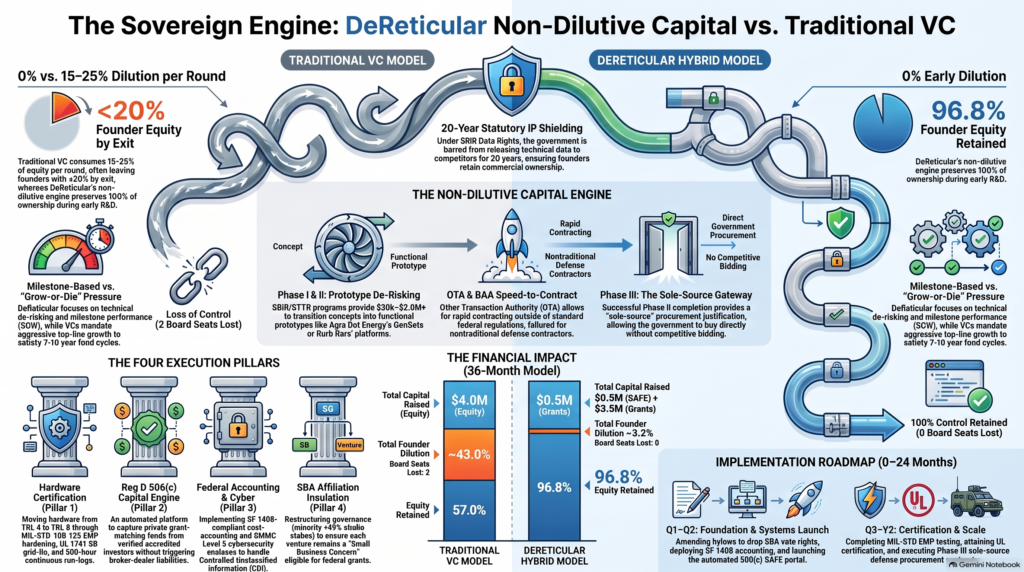
The DeReticular Non-Dilutive Capital Architecture replaces early equity rounds with federal and state capital vehicles. This approach de-risks the technology using “free” capital, allowing the company to set significantly higher valuations when they eventually approach private markets.
Core Non-Dilutive Vehicles
Vehicle Maturity Stage Role in Technical Validation
SBIR/STTR Phase I Feasibility / Concept Establishes technical merit (50k–275k) to prove feasibility.
SBIR/STTR Phase II Prototyping Transition to functional prototypes (750k–2.0M+) for field validation.
OTAs (Other Transaction Authority) Prototyping / Pilot Rapid contracting outside the FAR for dual-use defense tech.
BAAs (Broad Agency Announcements) Agency-Direct Research Solicitations addressing specific capability gaps (DARPA/AFWERX).
SBIR Phase III Commercialization Sole-source procurement. The ultimate prize: direct government sales without competitive bidding.
The Prime Contractor Bridge (TriFi Wireless)
Navigating federal procurement involves high friction, including CAGE/SAM registration and facility clearances. Within the DeReticular ecosystem, TriFi Wireless acts as the “Prime Contractor Bridge,” allowing hardware spinouts to enter multi-phase defense awards as specialized subcontractors. This routes them around administrative hurdles while establishing necessary “Past Performance” ratings.
Statutory Intellectual Property Shielding
A primary advantage of the federal pathway is 20-year SBIR Data Rights. Unlike VC models where IP is effectively collateral for investors, these statutory rights protect technical data, blueprints, and source code from public disclosure or competitor appropriation. Note: While you retain ownership, the government receives a non-exclusive license for government use, a critical distinction for deep-tech IP strategy.
The Zero-Dilution Flywheel
- Funding: Secure federal/state grants (Phases I & II).
- R&D: Execute the Statement of Work (SOW) to build physical assets.
- Data Rights: Secure 20-year statutory protection for all developed IP.
- De-risked Assets: Emerge with a TRL 7–8 certified asset and a clean cap table.
- The Traditional Venture Path: The “Grow-or-Die” Pressure Cooker
The traditional path is optimized for low-CapEx software. In hardware, it often leads to premature valuation anchors and governance loss.
Core Instruments
- SAFEs (Simple Agreements for Future Equity): A promise of future equity, often used to bypass valuation debates at the Pre-Seed stage.
- Convertible Notes: Interest-bearing debt that converts into equity during a “priced round.”
- Priced Rounds (Series Seed, A, B): The formal sale of Preferred Stock, establishing pre-money and post-money valuations.
The Power Law & Veto Rights
VC is a game of outliers. To protect their “home run” potential, investors demand Veto Rights over:
- Annual operating budgets and major expenditures.
- The hiring and firing of executive officers (CEO/CTO).
- Future debt issuance or major corporate restructuring.
The Cumulative Dilution Staircase
- Seed Round: 10–20% Dilution
- Series A: 15–25% Dilution (Board Seat added; Veto rights established).
- Series B: 15–20% Dilution (Total Founder Equity frequently falls below 40%).
- Series A: 15–25% Dilution (Board Seat added; Veto rights established).
- Head-to-Head: Structural Comparison by Domain
Vector DeReticular Non-Dilutive Traditional Venture Capital
Equity & Ownership 0% Dilution 15–25% Dilution Per Round
Board & Governance 100% Founder Control Board Seats, Veto Rights, Covenants
IP Ownership Retained (20-Year Data Rights) Retained (Assigned to Investors)
Capital Cost High Labor / Low Capital $ Low Upfront Labor / High Equity $
Growth Pressure Milestone / Tech De-Risking Top-Line “Grow-or-Die” Pressure
Down-Round Vulnerability Non-Existent Severe (Cram-downs, Washouts)
Hardware / CapEx Fit High (Absorbs Early R&D) Low (Reluctant to Fund CapEx)
The “So What?” for Hardware Founders The non-dilutive approach is valuation-agnostic. Grants do not set a price on your equity, insulating the venture from down-rounds during macro-economic contractions. This is vital for hardware because maturing a “Gen 5 Pod” or tactical vehicle requires high-CapEx events like MIL-STD-188-125 EMP hardening or UL 1741 SB certification—technical hurdles traditional VCs are notoriously reluctant to fund.
- Strategic Synthesis: The “Dual-Track” Hybrid Model
The most capital-efficient deep-tech enterprises utilize a two-stage roadmap.
- Stage 1: Technology De-Risking (Non-Dilutive Dominance): Use SBIR/STTR and state grants to fund all physical tooling and TRL 4-6 testing.
- Stage 2: Production Scale (Selective Equity): Raise private capital only after the technology is de-risked to fund mass production. This creates a Phase III Sole-Source revenue moat, as the government can now buy the proven technology without competitive bidding.
Comparative Success Card (Month 36)
Comparison for a venture completing $4.0M in R&D over 36 months:
Metric Traditional VC Model DeReticular Hybrid Model
Total Capital Raised $4.0M (Equity) $4.0M (Grants + SAFE Match)
Founder Equity Retained 57.0% 96.8%
Board Seats Lost 2 (Loss of Control) 0 (100% Control)
- Operational Friction: The “Hidden Costs” of Non-Dilutive Capital
Grant capital is not “free.” It requires rigorous administrative posture and compliance to avoid False Claims Act exposure.
SBA Affiliation Insulation (13 CFR § 121.103)
To stay eligible for grants, you must remain under the 500-employee limit. If a Venture Studio or VC is seen as “controlling” your company via vetoes or board majority, the SBA will aggregate the headcounts of all their portfolio companies, potentially disqualifying you. Strategic Guardrail: Ensure minority studio equity (<49%) and eliminate negative control vetoes.
Federal Pre-Award Accounting (SF 1408)
Founders cannot spend grant money like VC cash. Government funds require a “firewall” between allowable and unallowable costs (like marketing or securities fees).
The Math of Indirect Rates
To recover “Profit/Fee” and overhead, you must establish defensible formulas:
- Fringe Rate: (Total Fringe Costs) / (Total Labor Base)
- Overhead Rate: (R&D Facility Rent + Lab Utilities) / (Direct Labor + Fringe)
- G&A Rate: (Executive Salary + General Legal/IT) / (Total Cost Input)
Compliance Checklist for DCAA Readiness:
- 13 CFR § 121.702 Audit: Verify small business size and US ownership status.
- Cost Segregation: Automated firewalls to exclude “unallowable” costs (e.g., SAFE legal fees).
- FAR-Compliant Timekeeping: Daily audit logs of direct vs. indirect employee hours.
- Enclave Architecture: NIST SP 800-171/CMMC Level 2 secure cloud for technical drawings.
- Conclusion: Choosing Your Financing Architecture
Replacing high-dilution early rounds with structured R&D capture establishes a transition pathway to Phase III sole-source contracts. By the time private capital is introduced for scale, the technology is no longer a “bet”—it is a certified asset.
Founder’s Decision Matrix
- Choose the Non-Dilutive Path if you are building high-CapEx sovereign infrastructure requiring MIL-STD/UL validation and want to preserve 100% control through the prototype phase.
- Choose the Traditional Venture Path if you have a low-CapEx software product with zero marginal distribution costs that requires immediate, aggressive market capture.
- Choose the Dual-Track Hybrid if you are building “Sovereign Infrastructure” that requires government de-risking (TRL 4-6) but needs private capital for rapid mass-production (TRL 8+).
Final Strategic Summary: Your funding architecture is as critical as your engineering. By leveraging non-dilutive capital first, you preserve the sovereignty of your cap table and ensure the long-term autonomy of your technical vision.


