The Grid is Fragile: Why the Future of AI Lives in “Island Mode”
podcast
For decades, we have been told that connectivity is our greatest strength. We built our civilization on “The Line”—linear infrastructures that stretch across continents, from national electrical grids and undersea fiber cables to the cloud-tethered data centers that power our digital lives. But as the 2026 OpenClaw Security Crisis proved, this connectivity is our terminal liability. The crisis did not just reveal a bug; it exposed a “Permanent Backdoor” in cloud-dependent systems, proving that a “connected” world is, by architectural definition, a compromised one.
The era of fragile, centralized dependency is ending. The future belongs to a new architecture of sovereignty.
Beyond the Network: The Philosophy of “Island Mode”
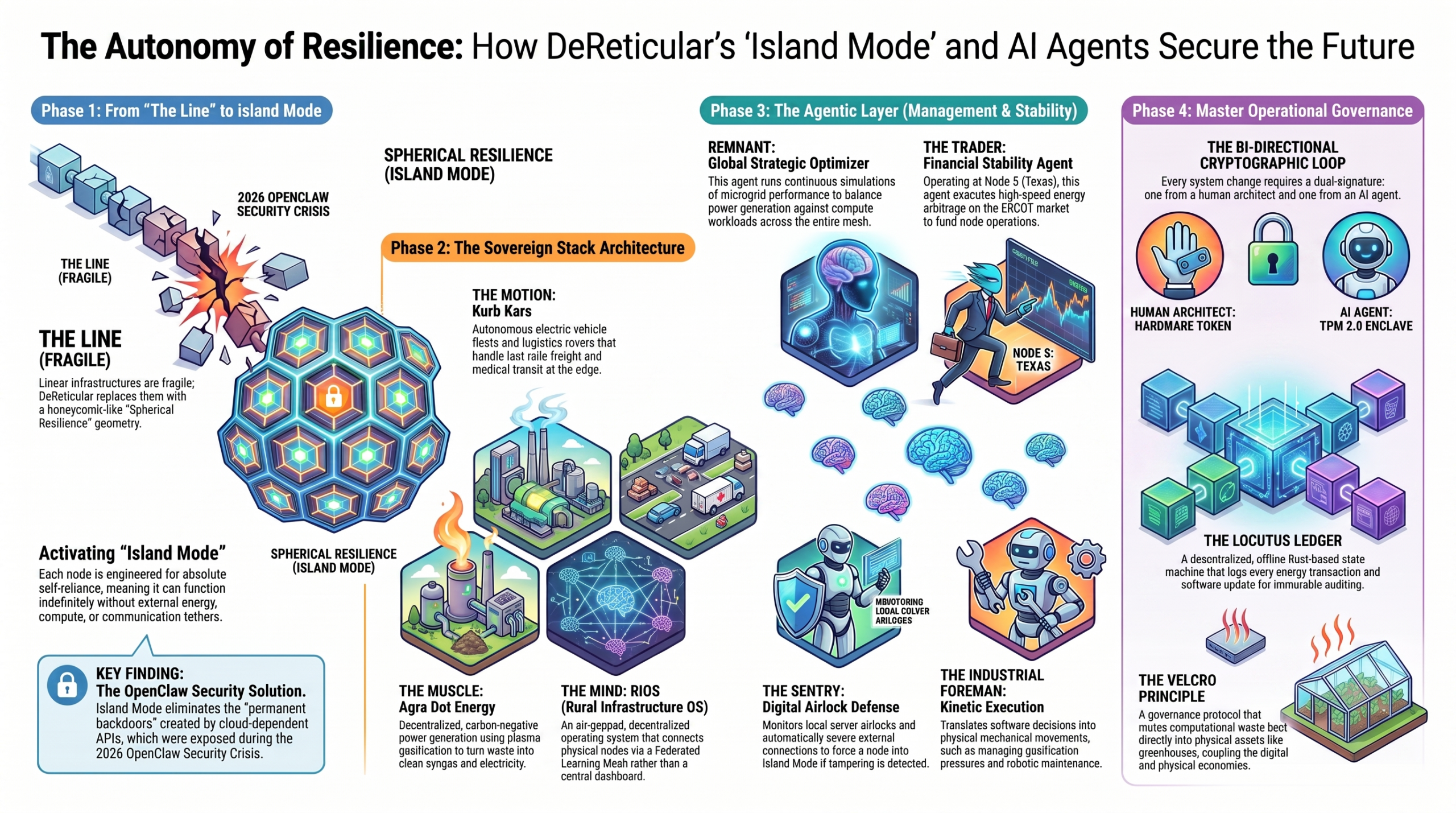
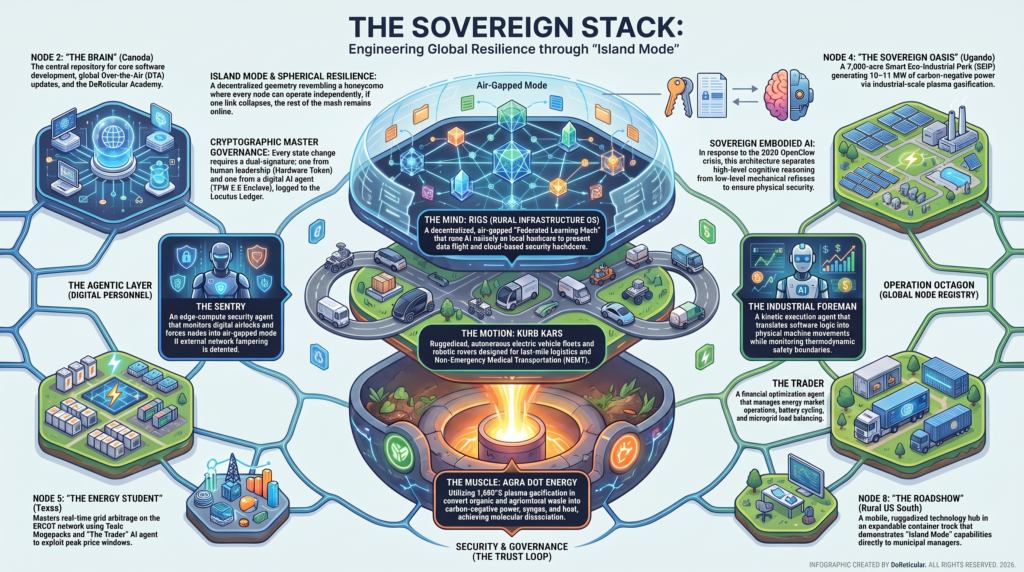
To understand the shift, we must adopt the DeReticular mindset—literally, “to move away from the network.” This is more than a technical specification; it is a fundamental rejection of the “Trusted Environment Fallacy” peddled by hyperscalers. While modern infrastructure relies on vulnerable linear topologies, the Sovereign Stack replaces “The Line” with Spherical Resilience—a decentralized geometry resembling a honeycomb.
In this model, every individual node is engineered to operate in “Island Mode.”
“Centralized, linear infrastructures are fragile by design. Whether in the form of national electrical grids, global supply chains, or cloud-tethered data centers, linear systems break when a single link collapses. In response, DeReticular replaces these vulnerable linear topologies with ‘Spherical Resilience’—a decentralized geometry resembling a honeycomb, where every individual node is engineered to operate in ‘Island Mode’.”
In Island Mode, a node possesses absolute computational, energy, and communication self-reliance. Utilizing TriFi Far X satellite-bonded antennas and multi-carrier fallback routing, these nodes remain online even when the public grid goes dark. If the global network collapses, the node continues its mission in total isolation.
The Death of the “Thin Client” (The OpenClaw Lesson)
Before 2026, the industrial world was obsessed with “thin clients”—robots and systems that offloaded their intelligence to the cloud. OpenClaw was the terminal failure of this centralized trust model. It exposed severe prompt-injection and Remote Code Execution (RCE) vulnerabilities in third-party cloud APIs, demonstrating that any cloud-tethered agent is a permanent backdoor into physical infrastructure.
The response is Sovereign Embodied AI. In this architecture, perception and reasoning are handled natively on-device. We utilize a split-loop control architecture that separates high-level cognitive reasoning—calculated inside air-gapped RIOS-CC-1000 edge server racks—from low-level mechanical reflexes. This ensures that even if a network is breached, the kinetic “muscle” of the machine cannot be hijacked.
Turning Trash into “The Muscle”
True sovereignty begins with the electron. You cannot be digitally independent if you are tethered to a failing state grid or a centralized utility. “The Muscle” of the Sovereign Stack is powered by Agra Dot Energy, which utilizes high-efficiency, 1500°C plasma gasification.
This is not simple combustion; it is molecular dissociation. By breaking down waste at the atomic level, we achieve a carbon-negative energy status, minting Bio-Energy Credits via “The Trash Banker” (HempGrade AI) and auditing them through zkVerify protocols.
- Inputs: Organic materials, agricultural waste, and municipal plastics.
- Outputs: Clean syngas, heat, and carbon-negative electricity.
- Scale: From 1-TPD (ton per day) mini-gasifiers to 210-TPD industrial units.
The “Velcro Principle” of Industrial Symbiosis
In the centralized paradigm, waste heat from server farms is a liability to be mitigated. In the Sovereign Stack, we apply Industrial Symbiosis via the “Velcro Principle.”
This is the strategic routing of server waste heat directly into physical assets like agricultural greenhouses or water distillation. By coupling the digital economy to physical survival, we transform a cost center into a survival asset. Computational waste becomes the warmth that grows a community’s food, ensuring that digital work produces tangible, physical “Ground Truth.”
Data Arbitrage: Capturing “Ground Truth” Before the Market
Owning the physical infrastructure—the sensors, the power, and the silicon—allows for Data Arbitrage. Most global markets operate on delayed, aggregated data. By controlling decentralized nodes, we capture “Ground Truth” metrics—soil chemistry, real-time logistics, and battery degradation—before they ever reach commodity or equity markets. This capture of primary data at the source provides a massive competitive advantage, allowing nodes to act while the rest of the market is still processing yesterday’s news.
Federated Learning: When Nodes “Teach” Each Other
Digital sovereignty does not imply isolation. The Rural Infrastructure Operating System (RIOS) functions as a Federated Learning Mesh.
When a node optimizes an algorithm locally—such as a battery-cycling routine in Node 5 (Fort Worth)—that update is securely packaged and “taught” to the entire mesh via secure Over-the-Air (OTA) updates. This prevents “capital and data flight” to AWS or Google. The mesh evolves collectively, ensuring all data exchange complies with strict SIDI Standards, without ever requiring a central “master” server.
The Locutus Ledger: The New Standard for Trust
To manage this complex mesh of autonomous agents—like The Sentry or The Industrial Foreman—we utilize the Locutus Ledger. This provides a master operational governance loop that prevents “behavioral drift” or alignment failures.
Security is enforced through a strict cryptographic co-signing protocol. Every physical state change requires a dual-signature:
- Human Authority: Signed with a Sovereign Key (physical NFC hardware token).
- Autonomous Agent: Signed with a hardware-isolated TPM 2.0 enclave.
This tether to reality ensures that neither a rogue human nor an unaligned AI can compromise the integrity of the node.
From Dependency to Autonomy: Operation Octagon
The Sovereign Stack is being validated through Operation Octagon, a global mesh of eight physical nodes. This isn’t theoretical; it is an industrial triad comprising DeReticular (Software/AI), TriFi Wireless (BABA-compliant Hardware), and InVentures Research (Capital Stacking).
- Node 1 (Chicago, IL): The “Urban Citadel” at mHUB, serving as the hub for robotics fabrication.
- Node 4 (Kaabong, Uganda): The “Sovereign Oasis,” a 7,000-acre SEIP generating 10-11 MW of carbon-negative power.
- Node 8 (The Roadshow): A mobile technology hub realigned from a commercial validator sold for $85,000. This ruggedized unit travels the Rural American South, demonstrating “Island Mode” to municipal managers who are tired of infrastructure decay.
As we look toward an increasingly unstable future, we must ask: Is your digital life fragile or sovereign? When the cloud goes dark, will your world stay online?


