The Regulatory Hedge: Sovereign Nodes as Critical Resilience Infrastructure
1. The Industrial Stagnation: Addressing Utility Sclerosis and “The Death of the Line”
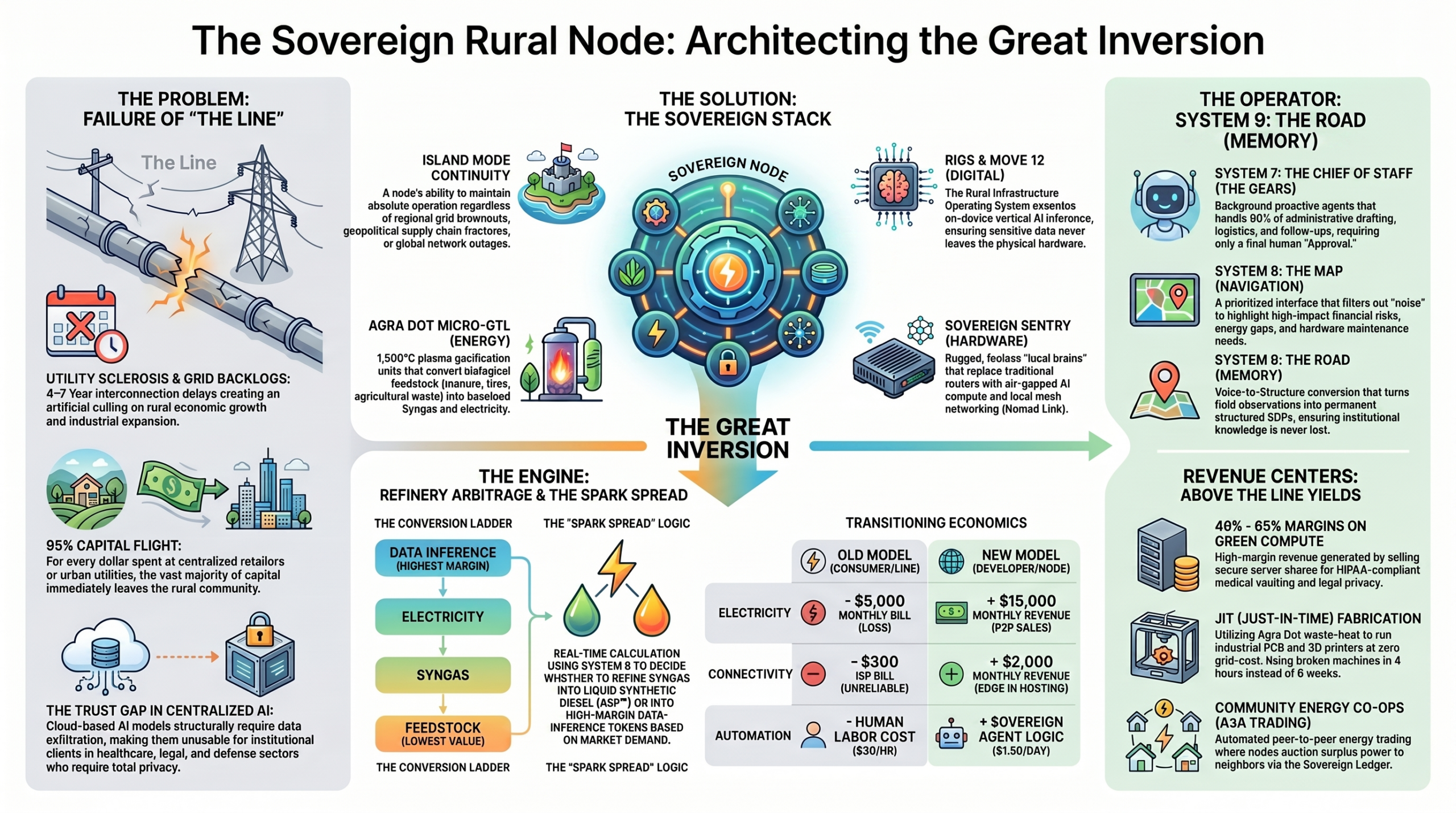
The modern industrial complex is currently grappling with “The Death of the Line,” a systemic crisis where centralized infrastructure—high-tension power grids, cloud-dependent AI, and urban telecom cores—has reached its breaking point. For decades, rural development has been tethered to a “Line Model” where electricity and capital travel in long, vulnerable chains from urban hubs to the regional “tail end.” This model is no longer a facilitator of growth; it is a capital siphon that extracts 95% of rural wealth to fund urban headquarters while leaving local communities vulnerable to sequential failure. In this paradigm, regional expansion is effectively “permissioned” by slow-moving urban utility commissions, turning infrastructure into a bottleneck of geographic entropy.
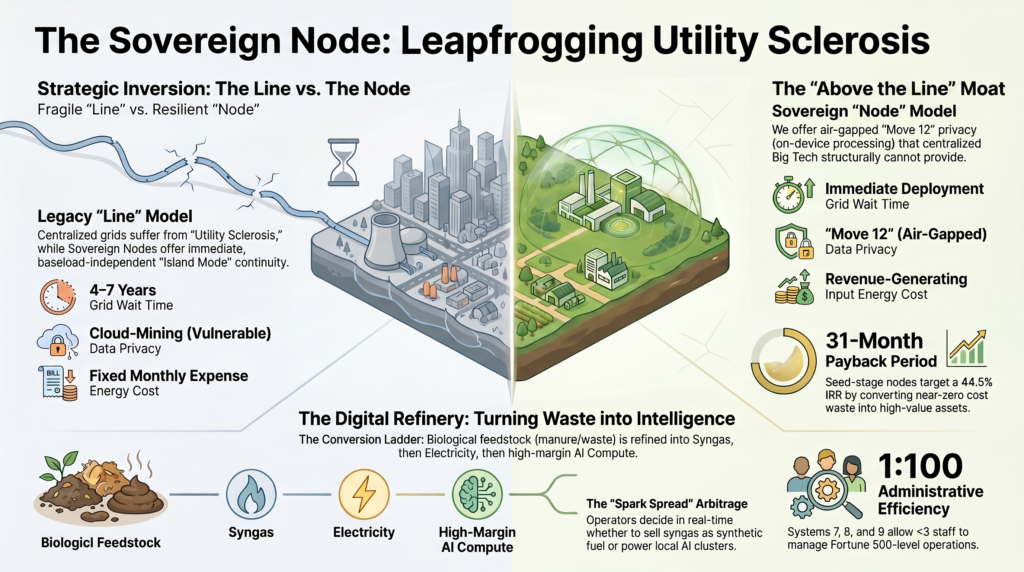
The core of this stagnation is “Utility Sclerosis.” Current interconnection queues for utility-scale expansion range from four to seven years, creating an artificial ceiling on economic development. While urban hubs are bogged down by high taxes and failing legacy pipes, rural communities are positioned to “leapfrog” this stagnation. The transition from the fragile “Line” to the self-contained “Node” is not a mere upgrade; it is an industrial necessity for survival.
video
Table 1: Infrastructure Paradigm Comparison
| Feature | Centralized “Line” Model | Sovereign “Node” Model |
| Systemic Integrity | Sequential Failure (One break kills the chain) | Island Mode (Independent 48-hour survival) |
| Capital Flow | Capital Siphon (95% outflow to urban hubs) | Wealth Retention (Refinery profits stay local) |
| Development Speed | 4–7 Year Grid-Interconnection Wait | Immediate Deployment (Leapfrog baseload) |
| Structure | Vulnerable, Fragile, Dependent | Localized Hub, Sovereign, IP67-Ruggedized |
| Identity/Sovereignty | Government-tied bureaucracy | Sovereign Ledger / Hardware Root of Trust |
This transition represents an industrial leapfrog. By abandoning the “Line,” regional developers can deploy Sovereign Nodes as the necessary technological successor to a failing centralized grid.
2. The Sovereign Node Ecosystem: A Technical Foundation for Autonomy
The Sovereign Node operates as a “Digital Refinery,” a model that integrates energy production with high-density compute to transform local liabilities into high-value assets. This “Refinery Arbitrage” allows a node to function as an independent economic engine, utilizing the Rural Infrastructure Operating System (RIOS) to achieve operational sovereignty.
The Hardware Stack
The physical foundation of this autonomy rests on the RIOS ecosystem:
- Sovereign Sentry: The ruggedized, air-gapped “local brain” that replaces traditional routers and firewalls with local AI compute.
- RIOS-CC-1000 Compute Clusters: IP67-rated server blades designed for high-density local inference where data never exits the node.
- Agra Dot Micro-GTL Units: Plasma gasification systems operating at 1,500°C that convert biological feedstock—manure, tires, hemp, or municipal waste—into baseload syngas and electricity.
Refinery Arbitrage Logic: The Spark Spread
Central to the node’s viability is the “Spark Spread” calculation. Every morning, the operator evaluates the highest-margin output for their generated energy. The node’s economic logic is governed by a precise formula: [(Compute Hourly Rate - Feedstock Acquisition) x RIOS Efficiency] > [Direct Power Sales]
If the local supply chain is fractured, syngas is refined into liquid Synthetic Fuel (ASF™). If there is high demand for secure data processing, energy is directed into RIOS compute clusters to generate high-margin AI-inference tokens.
podcast
Operational Intelligence: The Editor Paradigm
To maintain Fortune 500 efficiency with a headcount of fewer than three full-time equivalents, the node utilizes a specific framework of agentic systems:
- System 7 (The Gears): A proactive Chief of Staff agent that handles drafting, logistics, and administrative triage to move tasks out of the operator’s hands.
- System 8 (The Map): A prioritized navigational interface that filters noise to highlight “Supply-Demand Energy Gaps” and hardware health.
- System 9 (The Road): A Voice-to-Structure tool that converts field observations into permanent, structured Standard Operating Procedures (SOPs), building “Infrastructure as Memory.”
This technical stack is the prerequisite for the legal “Regulatory Hedge” strategy.
3. The Regulatory Hedge: Securing the “Right to Exist” via Resilience Hubs
The “Regulatory Hedge” is a strategic legal maneuver that reclassifies decentralized infrastructure to bypass utility monopoly laws. By framing Sovereign Nodes not as unauthorized public utilities, but as “Local Resilience Hubs,” developers can secure operational sovereignty.
Framing as Critical Infrastructure
We formulate a legal mandate for nodes by labeling them as “Critical Emergency Preparedness Infrastructure.” In this framework, the node provides “Civilization-as-a-Service”—essential energy, medical diagnostics, and voter verification—that remains functional during grid brownouts or internet failures. By providing life-support services that centralized systems structurally cannot guarantee, the node establishes an “Exempt Resilience” protocol that overrides centralized regulatory friction.
The Hardware Root of Trust
The ultimate legal hedge is the Hardware Root of Trust. Sovereignty resides in the physical ownership of the hardware, the soil, and the refinery. Because a node can function in “Island Mode” with zero external network or grid connectivity, it operates “Above the Line.” This allows developers to ignore utility-scale expansion delays by classifying their energy production as a private necessity rather than a challenge to public utility jurisdiction.
SWOT Synthesis Maneuver
This strategy weaponizes “Utility Sclerosis.” While utility lobbyists may push for laws taxing P2P energy trading, the node’s status as a Resilience Hub provides a defensive shield. We leverage the grid’s own failure (the 4-7 year wait) as the market entry vector, presenting the Sovereign Node as the only immediate, scalable source of energy-intensive intelligence available to the community.
4. Community Life-Support Services: The Proof of Essential Functionality
For the Regulatory Hedge to remain legally defensible, the node must provide undeniable, un-commoditizable local value. These “Above the Line” services represent industrial trust that centralized providers are structurally unable to offer.
The Sovereign Field Medic & Vault Warden
Rural distance correlates to mortality. The node addresses this through the Field Medic agent, utilizing Move 12 privacy standards. This allows for urban-grade diagnostic inference (X-rays, labs) to occur locally on the Sovereign Sentry. Because data is air-gapped, it never hits the public cloud, ensuring HIPAA-compliant isolation and “Invisibility”—a moat Big Tech cannot replicate without cannibalizing their data-mining models. Security is further bolstered by the Vault Warden, which uses LiDAR to sense volumetric changes down to 2mm for autonomous site lockdown.
Autonomous Field Sovereignty
The node eliminates the “Permission Gap” created when machinery requires an urban “handshake” to function. The OpenClaw Industrial Foreman manages machinery diagnostics and repair logic locally, bypassing OEM software locks. This ensures that critical harvest events are never stalled by a lack of “permission” from a distant headquarters.
JIT Modular Manufacturing: Prompt to Product
The node serves as a regional fabrication hub through Move 1 (Prompt to Product) logic. By leveraging Zero-Cost Thermal Synergy—using waste heat from the 1,500°C Agra Dot syngas production to power industrial kilns and PCB printers—the node can fabricate specialty components in under four hours. This eliminates dependency on global logistics chains and allows the node to out-compete centralized factories that carry massive electricity overhead.
5. The Economics of Sovereignty: Revenue Streams and Regional Wealth Retention
The “Inversion Business Model” transforms the rural node from a consumer into a “Refinery Node” that exports resilience to urban markets.
Primary Revenue Centers
- Green-Air-Gapped Compute: Selling secure server shares for HIPAA/legal privacy. Given zero-marginal energy costs, projected margins are 40%–65% in years 1-2, rising to 89%-91.8% in years 3-10.
- Synthetic Fuel (ASF™) and P2P Energy Trading: Utilizing Agent-to-Agent (A2A) trading logic, where AI agents negotiate energy swaps instantly, recorded on a local, immutable Sovereign Ledger.
- Community Sovereignty Services: Revenue from JIT fabrication, secure medical vaulting, and Sovereign Elector air-gapped voting verification.
Financial Risk Mitigation
Initial CAPEX (estimated at $1.2M for a full node) is mitigated through the Node-as-a-Service (NaaS) model and 30%–50% federal cash rebates (IRA/USDA). By utilizing “negative cost” waste as feedstock, the node generates “synthetic cash” far more efficiently than traditional commodity farming.
6. Implementation Roadmap: From “Doer” to “Editor”
Implementation requires a cognitive shift. The operator must adhere to the 10% Manual Rule: If you are doing more than 10% of a repeatable task, you have failed to build the road.
The Phase-Based Transition
- Intelligence Transition (The Map): Deploy System 8 first to clear cognitive bandwidth, followed by System 7 to triage administrative “shadow work.”
- Energy Stabilization: Calibrate the Agra Dot baseload power to establish a 24/7 independent energy foundation using local feedstock.
- Trust Deployment (The Moat): Implement Move 12 privacy standards and System 9 SOPs to secure high-margin local contracts.
The Final Requirement: The Civilization Reflex
Graduation into total sovereignty requires the “Civilization Reflex” test: a 48-hour “Island Mode” simulation. The node must provide all pilot services (compute, energy, and fabrication) with zero external connectivity.
Final Call to Action: Centralized systems scale wide but thin; Sovereign Nodes scale deep. Deploy the node, secure the hardware root of trust, and build the “high ground” before the next systemic grid failure. Authorize your own survival.


