
Technology Evolution Roadmap: From Micro-WISP Baselines to Multi-Orbit Resilient Systems
1. The Architectural Shift: Defining the Generation 4 Paradigm
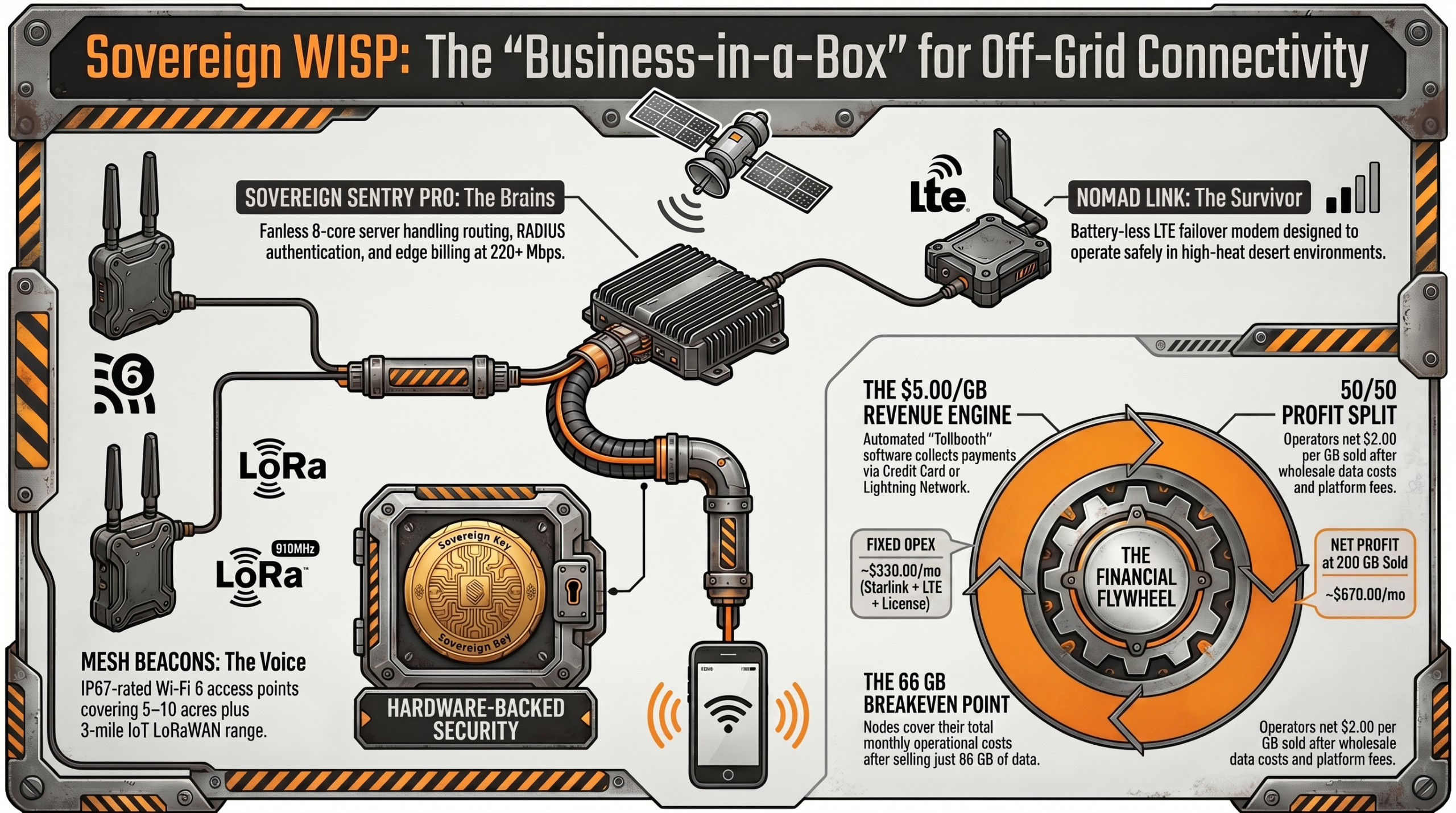
The 2026 Generation 3 (Gen 3) pilot phase successfully established a “Minimum Viable Infrastructure” (MVI) for sovereign communications. Utilizing the Sovereign Sentry Pro (RIOS-SS-PRO) and IP67-rated Mesh Beacons (RIOS-EXT-01), these systems proved that localized micro-WISP kits could generate revenue and provide high-speed access in off-grid environments. However, the strategic objective for the late-2020s is the transition to Generation 4 (Gen 4)—a paradigm shift from provider-locked hardware dependencies to autonomous, provider-agnostic resilience. This evolution is critical to mitigating the inherent architectural debt of single-constellation reliance and terrestrial coverage gaps, moving toward High Availability (HA) systems capable of maintaining connectivity regardless of regional ground station failures or provider-specific outages.
Comparative Technology Matrix: Architectural Evolution
| Technical Vector | Generation 3 (2026 MVI Baseline) | Generation 4 (Projected Late 2020s) |
| Primary Backhaul | Single-orbit (LEO) Starlink Business | Multi-orbit dynamic SD-WAN (Starlink, Kuiper, OneWeb, Lightspeed) |
| Failover Fallback | Terrestrial 4G LTE (Nomad Link RIOS-NL-01) | 3GPP Release 19 5G Non-Terrestrial Network (NTN) |
| Local Wi-Fi Standard | Wi-Fi 6 (802.11ax) | Wi-Fi 7 (802.11be) with Multi-Link Operation (MLO) |
| Local IoT | 915MHz LoRaWAN (Localized 3-mile radius) | Unified 5G NB-IoT NTN (Direct-to-Orbital Payload) |
| Network Access Control | Layer 2 Client Isolation / MAC Captive Portals | Cryptographic Zero-Trust Network Access (ZTNA) |
| Billing / Payments | Centralized Processors (Stripe/PayPal/Crypto) | Layer-2 Decentralized Micropayments (Lightning) |
| Compute / Intelligence | Standard x86 (Intel i3-N305) | Edge AI with Integrated Neural Processing Units (NPUs) |
| Management OS | Virtualized pfSense/Proxmox Stack | Autonomous NPU-Integrated Self-Healing Stack |
This progression marks a fundamental shift from hardware-locked dependencies toward a state of spectral sovereignty and resilient autonomy.
video
2. Backhaul Evolution: From Single-Orbit LEO to Multi-Constellation SD-WAN
Wide-Area Network (WAN) strategy must evolve to eliminate the systemic risk of single-provider lock-in. While current Gen 3 deployments rely heavily on Starlink Business via TriFiWireless, a resilient architecture requires backhaul diversification to ensure uptime in the face of constellation-specific degradation or regulatory shifts.
- Orchestrated Satellite Bonding and OISL: Gen 4 moves beyond single-provider constraints to a provider-agnostic architecture. Using software-defined radios and multi-beam antennas, Gen 4 nodes bond Starlink with emerging constellations like Amazon Project Kuiper, Eutelsat OneWeb, and Telesat Lightspeed. Strategically, this leverages Inter-Satellite Laser Routing (OISL) to bypass terrestrial ground stations. During severe weather or regional infrastructure failure, traffic is routed through the space-based mesh to cloud-integrated gateways located across the continent, ensuring continuity where Gen 3 systems would experience rain-fade.
- 5G Non-Terrestrial Network (NTN) Integration: The current Nomad Link (RIOS-NL-01) provides an essential battery-less LTE bridge, but it remains limited by terrestrial “not-spots.” Gen 4 hardware incorporates 3GPP Release 19 5G NTN transceivers. By aligning with these standards, the system enables direct-to-cell fallback via AST SpaceMobile or Starlink D2C payloads. This eliminates reliance on nearby towers, ensuring emergency routing and transaction processing remain functional globally.
Multi-orbit bonding ensures that the node maintains a persistent uplink, transitioning from simple redundancy to true architectural survivability.
3. Distribution Layer: Advancing from Wi-Fi 6 to Wi-Fi 7 and Unified IoT
To support high-density environments and professional streaming, the distribution layer must scale in throughput while drastically reducing mesh handoff latency.
- 802.11be (Wi-Fi 7) and Spectral Efficiency: The transition from the Wi-Fi 6 Mesh Beacons (RIOS-EXT-01) to Wi-Fi 7 (802.11be) introduces Multi-Link Operation (MLO). This allows simultaneous data transmission across 2.4 GHz, 5 GHz, and 6 GHz bands, effectively eliminating the packet loss common in outdoor mesh environments. Architectural enhancements including 4K-QAM and 320 MHz channels enable real-world throughput exceeding 5.0 Gbps, allowing the node to act as a high-density backhaul for demanding professional applications that overwhelm current Gen 3 baselines.
- IoT Evolution: From Localized to Global Machine-to-Machine (M2M): Gen 3 utilizes 915MHz LoRaWAN gateways for localized sensor telemetry within a 3-mile radius. Gen 4 replaces this localized bridge with unified 5G NB-IoT NTN modules. This shifts the paradigm from human-to-machine localized bridges to a global M2M network where sensors connect directly to orbital payloads, removing the requirement for proximity to a specific ground-based gateway.
This increased wireless density necessitates an evolution in edge intelligence to manage the resulting data volume and optimize spectral resources.
podcast
4. Edge Intelligence: Transitioning to Autonomous RF Optimization
Strategic management of remote infrastructure requires a move from technician-dependent network auditing to closed-loop, self-healing systems driven by Edge AI.
- Satcom OPEX Reduction via NPUs: The Gen 3 compute baseline (Intel i3-N305) is insufficient for the data processing requirements of Gen 4. Future nodes will integrate dedicated Neural Processing Units (NPUs) to facilitate local telemetry filtering and ML-driven data compression. This is a strategic requirement for Satcom OPEX reduction; by processing high-volume video and sensor feeds locally, the node minimizes the transmission of redundant data over expensive satellite links.
- Self-Healing RF Spectrum: Currently, spectrum auditing and interference mitigation require manual intervention using the Sovereign Deck (RIOS-OP-DECK). Gen 4 virtualizes this functionality through Software Defined Radio (SDR) arrays. These arrays autonomously scan the RF environment for rogue signals or interference, automatically shifting broadcast bands or modifying beamforming arrays in real-time to maintain constant throughput without human oversight.
5. Security and Transactional Architecture: Zero-Trust and Financial Autonomy
To protect the economic viability of the node, the architecture must transition from vulnerable web-based captive portals to decentralized cryptographic controls.
- Cryptographic Zero-Trust Network Access (ZTNA): Gen 3 relies on Layer 2 client isolation and pfSense/RADIUS configurations, which remain vulnerable to sophisticated MAC address spoofing and portal bypasses. Gen 4 implements WPA3-Enterprise utilizing ZTNA. Upon payment, a temporary cryptographic token is issued directly to the device’s Secure Enclave. This renders MAC-based exploits physically impossible and secures the network at the device level.
- Decentralized Micropayment Settlement: While Gen 3 utilizes traditional processors (Stripe/PayPal), which introduce merchant fees and regulatory friction, Gen 4 natively integrates Layer-2 decentralized protocols like the Lightning Network. This enables real-time, per-megabyte payments and immediate settlement. This move toward financial autonomy reduces administrative overhead and eliminates the node operator’s reliance on traditional financial intermediaries.
6. Gap Analysis and Implementation Roadmap for Infrastructure Engineers
The most significant “Architectural Debt” facing the ecosystem is the “ISP of Record” gap. Achieving the Gen 4 state requires resolving the legal and technical barriers of reselling bandwidth. Engineers must focus on the following bridging strategies:
- Regulatory Shielding (Addressing the ISP of Record Gap): Individual operators currently carry 100% of the CALEA and DMCA liability. Implementation of a master service agreement where DeReticular acts as the registered ISP of record is the top priority for shielding operators from legal exposure.
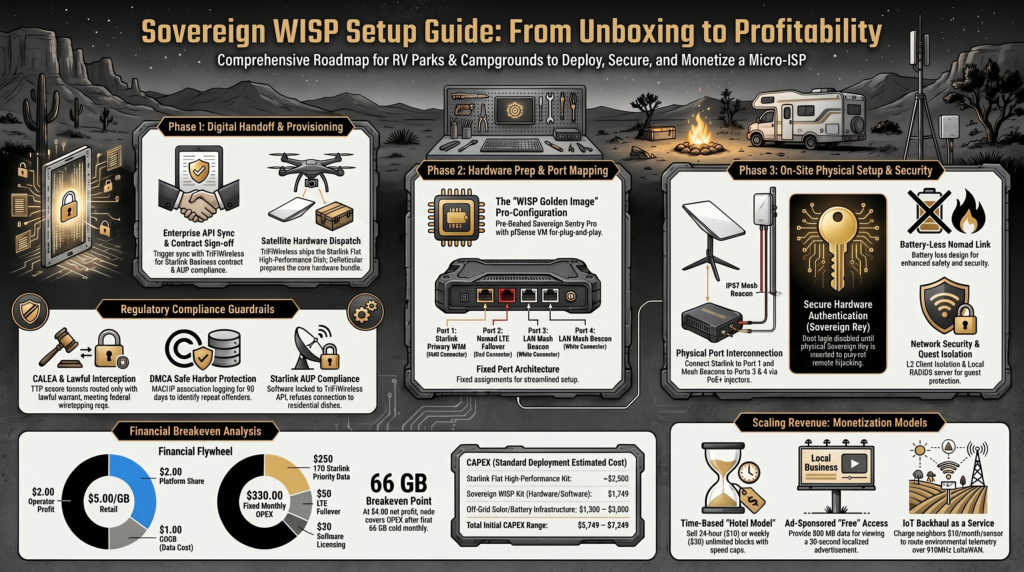
- CAPEX Operationalization: The current upfront CAPEX of $5,749 – $7,249 represents a significant barrier. Transitioning to Hardware-as-a-Service (HaaS) leasing models for Starlink dishes and Sentry nodes allows operators to operationalize this debt through monthly data revenues.
- Prescriptive QoS Prioritization: To prevent bandwidth contention, engineers must implement multi-tier rules within pfSense to prioritize RIOS software updates and critical system telemetry over retail traffic. This ensures node stability during high-congestion retail events.
- Satcom API Bridge Expansion: Software architecture must be expanded to support multi-satcom API bridges for Amazon Kuiper and Eutelsat OneWeb, enabling the orchestrated satellite bonding required for provider-agnostic resilience.
Final Synthesis The transition to Generation 4 represents the transformation of remote infrastructure from hardware-locked pilot kits into autonomous, self-sustaining profit centers. By achieving provider-agnostic resilience and spectral sovereignty, we ensure High Availability connectivity in the most disconnected environments on Earth.


