
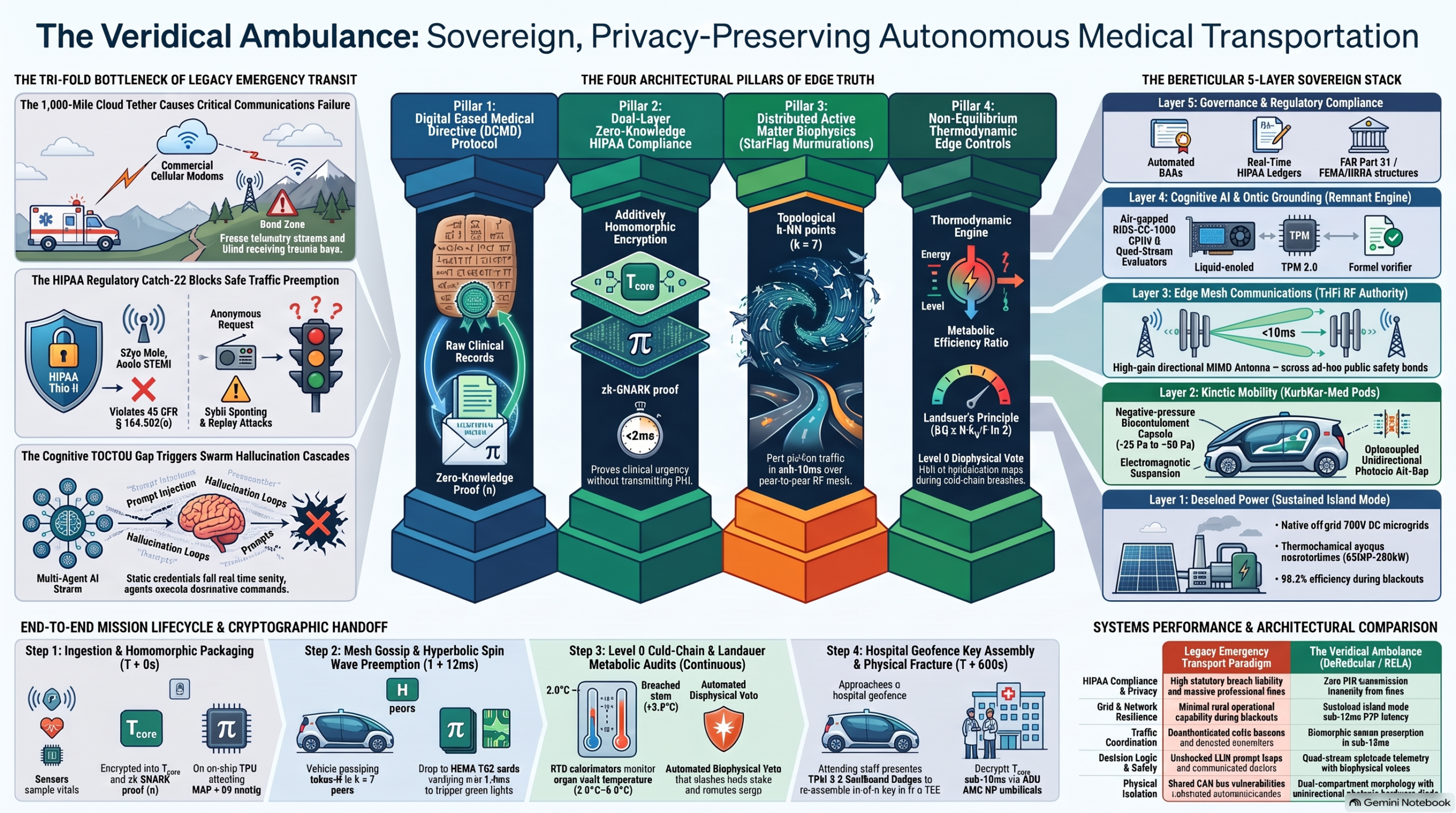
Understanding the Digital Cased Medical Directive: From Ancient Clay Envelopes to Zero-Knowledge Medical Privacy
- The Core Dilemma: The HIPAA Regulatory Catch-22 in Emergency Transit
1.1 The Paradox of Privacy vs. Urgency
Autonomous medical transportation platforms—such as the KurbKar-Med electric vehicle—face a fundamental cyber-physical conflict on modern smart roadways. To navigate urban traffic during a critical emergency, an autonomous ambulance must communicate with municipal intelligent transportation systems (ITS) to cycle traffic signals to green and instruct surrounding civilian vehicles to yield right-of-way. However, broadcasting a patient’s physiological state across open radio frequencies directly violates federal privacy law.
Under federal law, healthcare data is strictly regulated by the Health Insurance Portability and Accountability Act (HIPAA):
- 45 CFR § 164.502(b) (Minimum Necessary Standard): Covered entities and business associates must limit the disclosure of Protected Health Information (PHI) to the absolute minimum necessary to accomplish the intended operational goal.
- 45 CFR § 164.312(e) (Transmission Security): Technical security measures must protect electronic PHI (ePHI) against unauthorized access, eavesdropping, or tampering when traversing public transmission media.
When an emergency vehicle transmits raw clinical telemetry—such as “58-year-old male with acute STEMI (myocardial infarction) and GCS 7″—over open Vehicle-to-Everything (V2X) radio channels to pre-empt a traffic signal, it commits an illegal statutory disclosure. Roadside traffic cabinets, civilian cars, and municipal routing servers are not licensed healthcare providers; under 45 CFR § 164.506(c)(1), the treatment exception permits unrestricted disclosures strictly between healthcare providers, rendering it completely void for traffic infrastructure. Disclosing raw telemetry over open airwaves breaches transmission security and the Minimum Necessary Standard, exposing healthcare operators to severe civil monetary penalties under the HITECH Act enforced by the HHS Office for Civil Rights (OCR).
1.2 The Two Failure Modes: Over-Disclosure vs. The Sybil Trap
Attempts to navigate this challenge using conventional wireless messaging protocols inevitably collapse into one of two dangerous structural failure modes:
- The Over-Disclosure Trap: Broadcasting plaintext or loosely hashed patient telemetry over open public radio networks leaks sensitive medical diagnoses, identities, and location trajectories. Adversaries monitoring open V2X airwaves can easily cross-reference trajectory timestamps with public records to re-identify the patient, breaching HIPAA and triggering mandatory public breach notifications and OCR fines under 45 CFR § 164.402.
- The Sybil & Replay Trap: Stripping all clinical data and sending an unauthenticated “clear the light” beacon allows bad actors equipped with software-defined radios (SDRs) to spoof emergencies, replay recorded preemption signals, or spin up thousands of fake identities (a Sybil attack) to force green phases across the grid, resulting in severe municipal gridlock, crashes, and urban chaos.
The Emergency Transit Catch-22: If an autonomous ambulance broadcasts patient vitals to clear a path, it breaks federal privacy laws. If it strips all clinical context to protect privacy, municipal traffic grids cannot verify the emergency, leaving the system vulnerable to spoofing, gridlock, and physical disruption.
To resolve this modern impasse, systems architects turned to a physical information design pattern invented four millennia ago in ancient Mesopotamia.
- The Ancient Inspiration: Old Babylonian Cased Tablets
2.1 The Archaeology of Privacy: Clay Within Clay
During the Old Babylonian period (ca. 2000–1600 BCE), ancient merchants and magistrates faced a problem remarkably similar to modern data protection: how to verify financial contracts and credit obligations across public trade routes without risking document tampering or exposing private financial terms to unauthorized intermediaries.
Their solution was the physical cased clay tablet:
- The Invariant Inner Core (T_{\text{core}}): The detailed contract, complete debtor/creditor identities, and exact transaction terms were inscribed on a primary clay tablet and baked until immutable.
- The Outer Envelope (T_{\text{env}}): The core tablet was wrapped in a protective outer layer of wet clay. Scribes inscribed only an abstract summary, legal title, or transaction type on this outer shell.
- Cylinder Seals: Before the outer envelope dried, official cylinder seals (\sigma_{\text{debtor}}, \sigma_{\text{creditor}}, \sigma_{\text{magistrate}}) were rolled across its surface, providing unforgeable physical proof of legal validity.
┌────────────────────────────────────────────────────────┐
│ OUTER CLAY ENVELOPE (T_env) │
│ Inscribed with abstract summary & cylinder seals │
│ ┌────────────────────────────────────────────────────┐ │
│ │ INVARIANT INNER CORE (T_core) │ │
│ │ Detailed contract & private facts (Baked clay) │ │
│ └────────────────────────────────────────────────────┘ │
└────────────────────────────────────────────────────────┘
Couriers carried the cased tablet across ancient trade routes, and market observers verified its seal without reading the private contract inside. If a dispute or accusation of fraud arose, a magistrate in open court would “fracture” the outer clay envelope, revealing the untouched inner tablet (T_{\text{core}}) to resolve the case:
\text{Decision}(T_{\text{env}}, T_{\text{core}}) = \begin{cases} \text{Valid}, & \text{if } \operatorname{Strip}(T_{\text{env}}) = T_{\text{core}} \ \text{Fraud Detected}, & \text{if } \operatorname{Strip}(T_{\text{env}}) \neq T_{\text{core}} \end{cases}
2.2 Core Architectural Invariant: Hiding Details While Proving Validity
The fundamental insight of the cased tablet is that operational verification does not require total disclosure. Intermediate actors (couriers, border guards, market observers) only need physical proof that an obligation is valid and untampered with. The underlying private facts remain securely locked inside the protective envelope until reaching their final, authorized destination.
This ancient physical abstraction translates directly into modern cryptographic privacy design.
- The Modern Translation: The Digital Cased Medical Directive (DCMD)
The Digital Cased Medical Directive (DCMD) protocol translates this physical clay architecture into software, using zero-knowledge proofs, homomorphic encryption, and hardware roots-of-trust to achieve absolute HIPAA compliance in autonomous emergency transport.
RAW BIOSENSOR TELEMETRY (MAP = 58 mmHg, EKG, SpO2, Patient ID)
│
▼
┌────────────────────────────────────────────────────────┐
│ LAYER 1: INVARIANT INNER CORE (T_core) │
│ Paillier / Exponential ElGamal Additive Homomorphism │
│ Encrypted under Destination Trauma Public Key (K_pub) │
│ Microjoule 1 kHz continuous updates: C_accum = ∏ C_t │
│ Result: Statistically indistinguishable from noise │
└──────────────────────┬─────────────────────────────────┘
│
▼
┌────────────────────────────────────────────────────────┐
│ HARDWARE ROOT-OF-TRUST (TPM 2.0 Cryptoprocessor) │
│ Generates hardware attestation quote over Level 0 │
│ raw sensor payload (Binds math to physical silicon) │
└──────────────────────┬─────────────────────────────────┘
│
▼
┌────────────────────────────────────────────────────────┐
│ LAYER 2: OUTER ZERO-KNOWLEDGE ENVELOPE (T_env) │
│ zk-SNARK Proof (π) over Arithmetic Circuit C_triage │
│ Hidden Witnesses: Patient Name, SSN, Raw Waveforms │
│ Proven Inputs: MAP < 65 mmHg == TRUE, TPM Signature │
│ Proof Size: ~256 bytes | Verification Time: < 2 ms │
└──────────────────────┬─────────────────────────────────┘
│
▼
┌────────────────────────────────────────────────────────┐
│ BROADCAST TOKEN: H = SHA256(C || π) │
│ Traffic lights & nearby cars verify π in < 2 ms │
│ Lanes clear instantly; ZERO private data disclosed │
└────────────────────────────────────────────────────────┘
3.1 Layer 1: The Invariant Inner Core (T_{\text{core}})
The digital equivalent of the inner clay tablet is an encrypted data payload containing raw patient biometrics (Mean Arterial Pressure, 12-lead EKG, \text{SpO}_2, Social Security Number, and Name).
T_{\text{core}} uses Additively Homomorphic Encryption (such as Paillier or Exponential ElGamal) keyed directly to the public key (K_{\text{pub}}) of the receiving hospital trauma center:
C = \operatorname{Enc}(M, r) = \left( g^r \pmod{n^2}, ; h^r \cdot g^M \pmod{n^2} \right)
where M represents the plaintext biometric message, r is a random blinding scalar ensuring semantic security, g is the generator state, and n is the RSA modulus (n = p \cdot q).
To intermediate routers, nearby vehicles, traffic lights, and network eavesdroppers, this inner core is statistically indistinguishable from random noise, satisfying 45 CFR § 164.312(e).
Crucially, the additive homomorphic property provides a vital operational advantage: it allows onboard sensors and intermediate nodes to perform continuous, low-cost running updates and accumulations of biometric telemetry at native sensor frequencies (1\text{ kHz}) without decrypting the data or generating expensive zero-knowledge proofs for every raw data frame:
C_{\text{accum}} = \prod_{t=1}^K C_t = \operatorname{Enc}\left(\sum_{t=1}^K M_t, ; \sum_{t=1}^K r_t\right)
This mathematical property allows continuous microjoule-level vital sign tracking on edge hardware, reserving zero-knowledge proof generation strictly for discrete clinical state transitions.
3.2 Layer 2: The Outer Zero-Knowledge Envelope (T_{\text{env}})
The digital equivalent of the outer clay shell is a Zero-Knowledge Succinct Non-Interactive Argument of Knowledge (zk-SNARK) generated over an arithmetic circuit (\mathcal{C}_{\text{triage}}) using systems such as Groth16 or PLONK.
A zero-knowledge proof mathematically proves that a statement is true without revealing any of the secret data used to construct it:
- Private Witnesses (Hidden Information): Patient Name, SSN, birthdate, raw vital waveforms, and exact blood pressure values.
- Public Inputs (Proven Facts):
- Clinical Severity Predicate: Proves the patient is in acute hemodynamic shock (\text{MAP} < 65\text{ mmHg} \lor \text{GCS} \le 8) without revealing actual vital values.
- Thrombolytic Tissue Window: Proves the elapsed emergency time is within the critical intervention window (t_{\text{current}} – t_{\text{onset}} \le 180\text{ minutes}).
- Hardware Root-of-Trust Attestation: Proves the biometric data was signed by an authorized, hardware-secured TPM 2.0 sensor cryptoprocessor (\operatorname{VerifySign}_{\text{TPM}}).
Signing sensor payloads via an onboard hardware TPM 2.0 cryptoprocessor binds the zero-knowledge proof directly to authentic physical silicon (Level 0 sensor ground truth). This prevents software-level synthetic data injection, software tampering, or simulated emergency spoofing.
The resulting cryptographic proof is compact (256-byte proof size) and can be verified by roadside microcontrollers in <2 ms verification time.
3.3 Side-by-Side Architectural Mapping
Ancient Mesopotamian Component Modern Cryptographic Equivalent Operational Function in Autonomous Transit
Inner Clay Tablet (T_{\text{core}}) Homomorphic Ciphertext (C) encrypted under hospital public key K_{\text{pub}}. Encapsulates raw clinical vitals and patient identity; unreadable by unauthorized intermediate nodes.
Outer Clay Shell (T_{\text{env}}) zk-SNARK Proof (\pi) compiled over arithmetic circuit \mathcal{C}_{\text{triage}}. Displays public proofs of emergency severity without revealing private patient facts.
Cylinder Seal Impression Hardware TPM 2.0 Silicon Attestation Quote & Digital Signature. Guarantees that data originated from an authentic, tamper-proof onboard medical sensor.
Envelope Fracturing in Court Threshold Decryption by Trauma Team (m-of-n private key share assembly). Unlocks plaintext clinical history inside the secure hospital EHR environment upon arrival.
Having established the theoretical cryptographic mechanics of the Digital Cased Medical Directive, we now turn to its kinetic execution on physical streets.
- Real-World Mechanics: Clearing Traffic Without Leaking Truth
4.1 Chronological Mission Execution Lifecycle
- Ingestion & Encapsulation (T = 0\text{s}): Onboard biosensors detect a severe patient state (\text{MAP} = 58\text{ mmHg}). The vehicle’s local compute node encrypts the raw vitals into T_{\text{core}} using the destination hospital’s public key. Simultaneously, an onboard TPU compiles a Groth16 zk-proof (\pi) confirming \text{MAP} < 65\text{ mmHg} == \text{TRUE}, bound to a hardware TPM 2.0 attestation quote. These are sealed into a DCMD token: H = \text{SHA256}(C \parallel \pi)
- Topological Mesh Gossip: The ambulance broadcasts token H via directional TriFi radio mesh to its k \approx 7 nearest topological civilian peers, eliminating central cloud dependencies.
- Sub-12ms Signal Preemption: Intersection traffic controllers ingest token H and run a cryptographic pairing check on proof \pi. Verification completes in under 2 ms. The controller confirms that an authentic emergency exists, cycling the signal to green without learning the patient’s identity or diagnosis.
- Traffic Clearance via Biophysical Swarm Mechanics: Surrounding civilian vehicles verify the proof and execute evasive maneuvers. Rather than relying on centralized commands, lane clearance propagates through surrounding traffic via hyperbolic spin waves (\omega(k) = c \cdot k). Modeled on starling murmurations (Sturnus vulgaris), interactions occur strictly across k \approx 7 topological nearest neighbors (invariant to traffic density). Coupled with scale-free behavioral correlation (\xi \propto L) and conserved rotational inertia/spin (\mathbf{s}_i), the evasion directive sweeps across the vehicular grid as an acoustic wave at speeds of c \approx 20\text{–}40\text{ m/s}. Traffic parts smoothly without stop-and-go shockwaves, opening a clear corridor for the emergency vehicle.
[ KURBKAR-MED AMBULANCE ] │ │ Broadcasts DCMD Token H = SHA256(C || π) ▼┌──────────────────────────────┐
│ TRIFI RF MESH (k ≈ 7 Peers) │
└──────────────┬───────────────┘
│
┌─────────┴─────────┐
▼ ▼
┌───────────────┐ ┌──────────────────────────────────────────┐
│ TRAFFIC LIGHT │ │ SURROUNDING CIVILIAN VEHICLES │
└───────┬───────┘ └──────────────┬───────────────────────────┘
│ Verifies π │ Verifies π; Initiates Spin Waves
│ in < 2 ms │ (k ≈ 7, c ≈ 20–40 m/s, ξ ∝ L)
▼ ▼
[ CYCLES GREEN ] [ PART TRAFFIC LIKE A STARLING MURMURATION ]
4.2 Hospital Arrival and “Threshold Fracture”
Decryption of T_{\text{core}} does not require manual key assembly by scrubbed surgeons during active resuscitation:
- Geofenced RF Pre-Assembly (1.5 km Out): As the KurbKar-Med ambulance crosses the 1.5 km hospital geofence, its TriFi RF link connects directly to the trauma center edge node.
- Automated Quorum Verification: Attending surgical team members present physical TPM 2.0 Soulbound badges.
- Pre-Computed Session Key: Combining m-of-n threshold private key shares reconstructs and pre-computes the ephemeral session key inside an isolated hospital Trusted Execution Environment (TEE) while the vehicle completes its final approach.
- Instantaneous Core Decryption: The moment the gurney docks at Trauma Airlock Bay 1, T_{\text{core}} is decrypted in <10 ms, instantly populating the trauma bay’s Electronic Health Record (EHR) with real-time hemodynamic history without interrupting clinical workflows.
4.3 Regulatory Reconciliation Matrix
Federal Requirement Traditional Flaw DCMD Resolution
45 CFR § 164.502(b)
(Minimum Necessary Standard) Transmits cleartext clinical diagnoses to non-healthcare entities (traffic lights/civilian cars). Zero PHI Disclosed: Transmits only a 256-byte mathematical proof of emergency severity.
45 CFR § 164.312(e)
(Transmission Security) Sends unencrypted or loosely hashed patient vitals over public airwaves. End-to-End Homomorphic Core: Encrypts clinical data under hospital public keys; payload is noise to eavesdroppers.
45 CFR § 164.402
(Breach Notification Safe Harbor) Intercepted RF broadcasts trigger mandatory public breach reporting and OCR fines. Statutory Immunity: Intercepted packets contain only ciphertext and zero-knowledge proofs, providing absolute breach safe harbor.
Understanding these real-world mechanics reveals broader systems principles that apply across cryptographic epistemology and STEM education.
- Essential Takeaways for the Aspiring Learner
5.1 Distilled Insights: The “So What?”
- Ancient Principles, Modern Problems: Solutions to cutting-edge cyber-physical challenges often draw on historical information architecture. Old Babylonian cased tablets established that operational verification does not require total disclosure—a pattern that directly resolves modern data privacy paradoxes.
- Zero-Knowledge as a Compliance Engine: Zero-knowledge cryptography shifts privacy compliance from an administrative burden into an unyielding mathematical guarantee. By proving predicates (\text{MAP} < 65\text{ mmHg}) rather than exposing raw data, systems satisfy statutory mandates like HIPAA automatically.
- Verifiable Agency at the Edge: Robotic systems do not need to trade privacy for operational efficiency. Combining zero-knowledge proofs with hardware roots-of-trust (TPM 2.0) enables smart infrastructure to verify machine requests instantly without gaining access to private underlying data.
- Island-Mode Sovereignty: Processing proofs at the local edge (onboard TPUs and roadside microcontrollers) allows emergency transport networks to operate reliably during cellular dead zones or infrastructure blackouts, eliminating reliance on centralized cloud servers.
Epistemic Sidebar: The Oracle Separation Protocol A foundational principle in cryptographic epistemology is the separation of ledger immutability from physical truth. Cryptographic consensus (Level 2 Authority) guarantees only that a message was recorded without tampering—it cannot guarantee that the statement is physically true. DCMD bridges this gap by anchoring zero-knowledge proofs directly to physical silicon (TPM 2.0) measuring real-world physiological telemetry (Level 0 Authority).
Epistemic Sidebar: The Via Negativa Principle System safety advances not by endlessly accumulating positive assertions or complex software rules, but by systematically foreclosing invalid parameter space. By mathematically disproving and rejecting falsified states (such as unauthorized signals or unauthenticated data), the protocol narrows system operation strictly to verified, life-saving trajectories.
5.2 Concluding Summary
The Digital Cased Medical Directive demonstrates how combining mathematical techniques with historical information design bridges the gap between strict privacy regulations and real-world emergency response. By replacing cleartext transmissions with zero-knowledge cryptographic envelopes, modern autonomous systems can navigate city streets safely and efficiently—saving lives while mathematically guaranteeing patient privacy.


