Investment Prospectus: Energy Asset Resilience & Risk Intelligence (DEI)
1. The Macro Thesis: Exploiting Linear Fragility
The current era of global infrastructure is defined by “Linear Fragility”—a systemic state of vulnerability where centralized energy grids are no longer reliable anchors for capital. Aging infrastructure, extreme weather, and the inherent instability of intermittent renewables have transformed the national grid from a utility into a liability. DeReticular Energy Intelligence (DEI) executes a strategic pivot from grid dependency to “Island Mode” sovereignty. This is not merely a backup strategy; it is the establishment of a “financial weapon” of self-sufficiency. By transitioning to a “defect-ready” posture, DEI transforms energy from a recurring operational cost into a weaponizable economic asset capable of generating capital in environments where traditional systems fail.
The following table evaluates the bankability and risk profile of the DEI model against legacy infrastructure:
| Category | Centralized Fragility (Legacy) | Sovereign Resilience (DEI Model) |
| Source | Fossil fuels, large-scale hydro | Local waste, hemp, livestock biomass |
| Grid Status | Grid-dependent / Brittle | Island Mode / Defect-ready |
| Environmental Impact | Carbon-heavy | Carbon-negative / Waste-to-energy |
| Reliability | Susceptible to cascading blackouts | Baseload (Always-on / 100% Uptime) |
DEI functions as the “Automated Treasury” of the Octagon network. By utilizing edge-based intelligence to capture unharvested kinetic energy from failing grids, DEI converts volatility into a reliable fiat stream. In this architecture, grid instability is not a risk to be mitigated—it is a commodity to be harvested.
2. The Digital Twin Framework: Comparative Analytics (Texas vs. Uganda)
The core of our risk-pricing intelligence is the “Digital Twin” methodology. By deploying the identical RIOS software stack across disparate “Hard Mode” environments, we create a proprietary dataset that allows for the precise underwriting of infrastructure risk on a global scale.
Our primary comparative nodes provide the data edge required for institutional-grade risk modeling:
- Node 5 (Fort Worth, Texas): The “Urban Energy Lab.” Positioned in the deregulated ERCOT market, this node navigates extreme volatility ($5,000/MWh price caps) and intense heatwaves. It functions as the “University,” utilizing “The Trader” AI agent to master energy management strategies.
- Node 4 (Kaabong, Uganda): The “Green Industrial Engine.” A 7,000-acre Smart Eco-Industrial Park (SEIP) utilizing hemp biomass to produce 10-11 MW of carbon-negative baseload power. It operates in high-humidity equatorial conditions, providing the baseline for industrial reliability.
Through federated learning, the lessons learned in the Texas heat are exported via over-the-air (OTA) updates to optimize the Ugandan industrial engine. This comparative data—balancing North American market complexity against African environmental stressors—forms the empirical foundation for predictive longevity modeling and global risk pricing.
3. Hardware Degradation & Asset Longevity Assessment
For insurers and manufacturers, the financial impact of hardware degradation in high-stress environments is the primary barrier to capital entry in emerging markets. DEI addresses this through rigorous Project Finance logic: by generating high-fidelity degradation data, we enable the raising of specific debt against battery assets without diluting R&D equity.
We specifically analyze the performance of Industrial BESS (Battery Energy Storage Systems) and 10 TPD (Tons Per Day) Agra Micro-Units. Using RIOS “University” data, we implement predictive maintenance protocols that monitor high-frequency cycling and thermal stress. This ensures components are swapped before failure, maintaining 100% operational uptime.
The resulting “Resilience Ratings” provide investors with the “So What?” layer necessary for capital deployment:
- Verified Degradation Curves: Real-world wear data for Tesla Megapacks in extreme climates.
- Operational Readiness: Benchmarked maintenance cycles for 24/7 “Island Mode” operations.
- Bankability Proof: Hard data that transforms speculative emerging-market projects into bankable, de-risked sovereign infrastructure.
4. The Arbitrage Engine: Monetizing Grid-Edge Performance
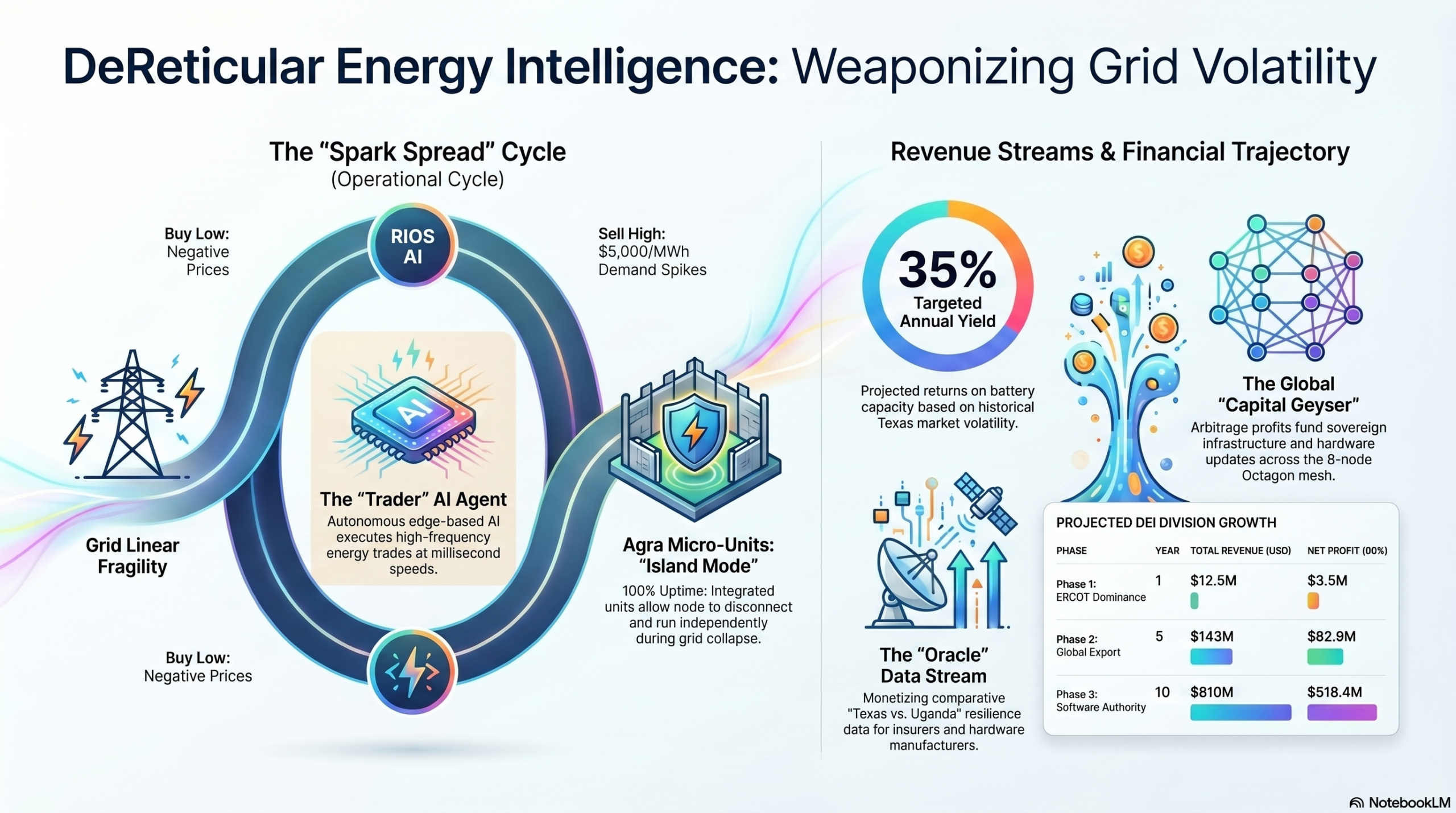
The “Spark Spread Algorithm” is the central nervous system of DEI’s revenue generation. It does not merely trade energy; it autonomously calculates the mathematical differential between the cost of electricity and the value of digital compute. When energy is cheap or negative, the AI directs power inward to “Sovereign Sentry” servers for high-density compute; when the grid spikes, it discharges stored energy for maximum fiat profit. This ensures the asset is never idle.
DEI’s commercial operations are built on three high-margin pillars:
- Autonomous Arbitrage: Exploit millisecond price spikes by buying at negative rates and selling at peak demand.
- Ancillary Services: Stabilize frequency and voltage markets, earning premium fees for maintaining grid “readiness.”
- Energy Longevity Modeling: Monetizing high-margin (90%) data streams by selling “Resilience Ratings” to hardware manufacturers and global reinsurers.
Projected Income Statement (Figures in $000s USD)
| Year | Arbitrage Rev | Grid Services | Data/Software | Total Revenue | EBITDA | Net Profit |
| Year 1 | $10,500 | $1,500 | $500 | $12,500 | $4,375 | $3,500 |
| Year 5 | $110,000 | $18,000 | $15,000 | $143,000 | $78,650 | $62,920 |
| Year 10 | $450,000 | $80,000 | $280,000 | $810,000 | $648,000 | $518,400 |
This “Capital Geyser” funds the broader ecosystem, providing the fiat required for “Soft Power” initiatives and hardware refreshes across the planetary mesh.
5. Strategic Risk Mitigation & Defensive Architecture
DEI utilizes “Regulatory Siloing” as a core defensive strategy. By siloing DEI within the Texas market, we navigate “Hard Mode” regulatory environments without exposing the broader DeReticular conglomerate to energy-sector liability. This structure ensures that if market rules shift, the facility can pivot to 100% internal AI compute or fuel production.
Our architecture is secured by the “Sovereign Stack”:
- Muscle (Agra/Plasma Gasification): 10 TPD units providing baseload power.
- Motion (Kurb Kars): Autonomous logistics ensuring internal supply chain continuity.
- Mind (RIOS Federated Learning): The intelligence layer coordinating autonomous decision-making and edge-based compute.
This stack creates a “defect-ready” system. By bypassing the public cloud and maintaining physical ownership of the infrastructure, DEI neutralizes latency risks and competition from hedge funds who lack the physical “Sovereign Stack.”
6. Conclusion: The Financial Value of Sovereign Resilience
The value of DEI is not found in kilowatt-hours, but in the intelligence required to manage them in a decaying world. For institutional investors, DEI provides the only verifiable record of infrastructure performance under the dual pressures of extreme climate and failing centralized grids. As traditional systems reach their breaking point, this data becomes the most essential tool for pricing global risk.
From the underwriter’s perspective, volatility is the ultimate opportunity. DEI is the system designed to capitalize on the “Death of the Line,” transforming systemic fragility into a high-yield, sovereign treasury.
“The grid is failing everywhere. DEI is the system that learns how to catch the falling pieces and turn them into gold.” — Remnant


